The Culiacán mint
 Culiacán is the capital of the northwestern coastal state of Sinaloa.
The first futile attempt to establish a mint was made when the states of Sonora and Sinaloa were still joined as the state of Occidente, with the capital at El Fuerte. On 29 September 1825 the state government entered into a contract with the Ricardo Extér to set up a mint. Extér was a British merchant who arrived in Mexico after independence and served as a partner in Exter, Graves and Company, a company that had ties to the General Pearl and Coral Association of London. Extér promoted mines in western Mexico and established several contracts for the exploitation of small silver mines that in 1825 brought him income of 153,000 pesos. Extér sought to integrate the mining business with that of coinage.
The contract provided that the contractor was obliged to fit out a building, buy the machinery necessary for the minting and, most importantly, at the end of the contract, the local government was obliged to pay the cost of the building but the machinery would become state property. Thus, at the end of the contract (12 years), it was foreseen that the state would have sufficient conditions to be able to operate the mint on its own account.

The Culiacán mint
After the federal government delegated the operation of mints to the states, the state government began construction of a building to house a mint and the importation of machinery from Europe in 1830, but on 6 December 1834, with the building still incomplete, it invited tenders from private contractors to finish the construction work and then run the mint. On 10 January 1835 it held a meeting with businesses and gave 80 days for people to submit proposalsHistory based on Román Beltrán Martínez, La Casa de Moneda en Culiacán, Documenta Culiacanense, Núm 5, 2003, Culiacán, Sinaloa.
On 3 October 1842 José Delmotte, representing Compañía de Minas de Guadalupe y Calvo proposed establishing a mint in Culiacán and on 4 March 1843 the substitute President, Nicolás Bravo, agreed. Thus the same company was running both the Guadalupe y Calvo and the Culiacán mints. The mint was opened and coinage commenced in April 1846. It was reported that Culiacán had steam powered coining presses as early as 1846 but this is highly unlikely based on the quality or its coinage and the fact that the director of the mint at Guadalupe y Calvo issued a medal in December 1847 commemorating the first use of a steam press for coinage in the Republic. A plausible explanation for this confusion would be that since the machinery was probably purchased in 1846 it was assumed by historians unaware of the facts, that the modern machinery went to the new mint at Culiacán.
The 14-year lease should have run until 1860 but on 14 August 1855 a new lease was granted to Manual García Granados for $5,000 annually for nine years from 30 September 1854, stipulating that Guadalupe y Calvo would remain closed and its work added to Culiacán.
On 5 May 1859, governor Ignacio Pesqueira commissioned the mint to produce 1,066,667 Sonora cuartillas (¼ real) and 1,066,667 Sonora octavos (⅛ real).
Culiacán was the only mint that was never occupied by Maximilian 's forces.
In 1862 the mint passed to Fortunato de la Vega, who obtained an extension for ten years, to end on 30 September 1874. However, on 30 August 1870 the mint reverted to the government. A decree of Benito Juárez on 24 December 1871[text needed] prohibited the leasing of mints then controlled by the government and the extension of any leases then in force. However, notwithstanding the government's decision not to re-lease the mints and the increase in production registered products from 1873 to 1875, on 29 August 1876, the mints of Culiacán, Alamos and Hermosillo were leased again to Robert Symon and Company for a period of three years and six months. This agreement was extended by the various contracts of 20 December 1879[text needed], 1 June 1883[text needed], and 4 February 1888[text needed].
By a decree of 19 December 1892[text needed], the Congreso de la Unión authorised the Executive to make arrangements leading to the termination of the leases of the mints, on the basis of returning to the tenants the sums due to them, for any advances made to the Federal Treasury, and to pay them, by way of compensation, or for the value of the machinery and other reasons, such sums as it deemed equitable. In the event that a satisfactory agreement could not be reached, the Executive, on the basis of the enormous damage caused to the Public Treasury by the lease contracts, and the defects from which they suffer, should, if it deemed it appropriate, attempt sanctions to obtain the rescission of the contracts. Therefore, on 25 January 1896, it was suggested that the three leases of Culiacán, Alamos and Hermosillo be surrendered for a payment of $38,000.46. Sebastián Camacho, representing the lessees, accepted on 27 February 1896.
The mint was then operated by the government until its closure on 31 May 1905.
The amounts minted in the years from 1846 to 1905 are given here.
Mint owners or lessees and their tenures
| from | to | |
| 1846 | 1849 | Compañía Minera de Guadalupe y Calvo |
| 1849 | 1852 | Jecker, Torre and CompanyJecker, Torre y Cia. was a Swiss and Spanish-Mexican finance house valued at $800,000, which had access through Isidoro de la Torre to a fortune of between $2,000,000 to $3,000,000 belonging to his relative Gregorio Mier y Terán. It was reported that Jecker was "an enemy of investing in loans, or in real estate, or in any field that did not produce immediate profits". |
| 1852 | 14 August 1855 | Government of the Republic of Mexico |
| 14 August 1855 | 1862 | Manuel Garcia Granados |
| 1862 | 26 August 1870 | Fortunato de la Vega |
| 26 August 1870 | 29 August 1876 | Government of the Republic of Mexico |
| 29 August 1876 | 30 June 1895 | Robert R. Symon & Company |
| 30 June J895 | 31 May 1905 | Government of the Republic of Mexico |
Assayers and their tenures (as evidence by coinage)
| Initial | Name | Begins on | Ends on |
| CE | Clemente Espinosa de los Monteros | 1846 | 1870 |
| PV | Pablo Viruega | 1860 | 1861 |
| MP | Manuel Onofre Parodi held a succession of positions over four decades. He was an assayer at the Estado de México mint in 1829. He was the sole assayer to appear on the coins of Guadalupe y Calvo from 1844 to 1852, where he was also the local correspondent of El Siglo Diez y Nueve. He was ensayador de cajas in Culuacán in May 1857 when he was one of the officials who refused to swear an oath to the new ConstitutionDiario de Avisos, Año II, Tomo I, 29 May 1857. In May 1861 he was appointed assayer for the Oaxaca mintEl Monitor Republicano, Año XIV, Núm. 3,916, 1 May 1861 but his appointment was revoked before he took up officeEl Siglo Diez y Nueve, Año XXI, Núm. 142, 5 June 1861. He was at Hermosillo in 1866 and was at the Culiacán mint by May 1868 and on its coins from 1873 to 1876. | 1873 | 1875 |
| GP | Celso Gaxiola and Manuel Onofre Parodi | 1876 | |
| CG | Celso Gaxiola | 1876 | 1878 |
| JA | unknown | 1877 | |
| JD | Juan Dominguez | 1878 | 1882 |
| AM | Antonio Moreno | 1882 | 1897 |
The assayers on its decimal coinage were:
| Initial | Name | Begins on | Ends on |
| E | Clemente Espinosa de los Monteros | 1846 | 1870 |
| P | Manuel Onofre Parodi | 1873 | 1876 |
| G | Celso Gaxiola | 1876 | 1878 |
| D | Juan Domínguez | 1878 | 1882 |
| D | 1883 | 1884 | |
| G | 1881 | 1882 | |
| E | 1882 | ||
| AM or M | Antonio Moreno | 1882 | 1899 |
| Q | 1890 | ||
| JQ or Q |
Jesús S. Quiroz When Norberto Dominguez left as Director of the Culiacán mint in July 1903 to become Director General de Correos, Jesús Quiroz replaced him. He was described as honest, industrious, and one whose constancy and commitment have earned him the esteem of all those who have used his good services ( honorado, laborioso, y cuya constancia y empeño le han granjeado la estimación de cuantas personas han utilizado sus buenos servicios)El Tiempo, Año XX, Núm. 5854, 17 April 1903 |
1899 | 1903 |
| FV or V | Francisco Valdez was ensayador by 15 February 1903. | 1903 | |
| MH or H | Merced Hernández | 1904 | |
| Rp or P | 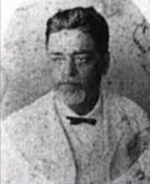
[if correct person, and not his son] Little by little he acquired social and political recognition, both for his medical practice and his teaching practice, as well as for his proximity to regional political power. He was a member of the city council of Culiacán and a deputy in the local Congress in practically all the Legislatures until his death, which increased his authority in the local media. In the educational field, his opinion was influential being a member of the Board of Directors of State Studies since its establishment in 1873, and for many years Secretary and responsible for the commissions of Teaching Methods and Texts, and of Professional Titles of this Board. In [ ] Governor Francisco Cañedo made him secretario general of the government later a member of the junta Patriótica y Científica. Ponce de León was appointed assayer of the mint in May 1904Diario Católico, 10 May 1904. He died of a stroke on 9 November 1913. |
1904 | 1905 |