The Guadalupe y Calvo mint
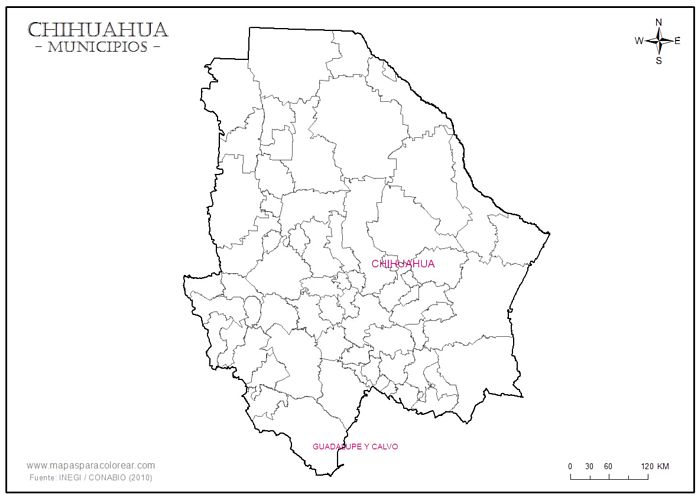
Named in honour of the Virgin of Guadalupe and the governor of the state José Joaquín Calvo, the city of Guadalupe y Calvo is, in the southernmost part of the state of Chihuahua. Located 327 miles south of the capital city, Chihuahua, at an altitude of 7,643 feet, Guadalupe y Calvo was in a remote, but very rich mining area. Its remoteness was one of the principal reasons that local mining interests pressed for the establishment of a mint. The nearest mint was in Chihuahua and transporting bullion there was difficult and dangerous. There were frequent attacks by Apache and Comanche Indians, as well as local bandits.
In 1842 a newspaper reported:
... About eight years ago, … some investigations, made on the two iron-covered slopes, which formed the narrow valley where the stream flows, led to the discovery on the east side of a quartz ridge, which contained grains of gold perfectly perceptible to the naked eye. Shortly after, open-pit tillage began, after the vein had been denounced. In the meantime, the news of this discovery having spread, Messrs. Buchan and Adul, long attached to some English companies, came from Zacatecas; and the result of their voyage was the purchase of a property of 200 varas located to the northwest of the vein and to work this property the company of Guadalupe y Calvo was formed … Gold and silver are concentrated in balls of great wealth. These balls have been found, especially in the work of the English company.El Cosmpolita, Vol. V, Núm. 196, 14 December 1842.
On 3 October 1842 Dictator Antonio López de Sama Anna authorized a ten year lease to the British firm Mackintosh & Company, operating as Compañía Minera Mexicana de Guadalupe y Calvo. The mint opened on 1 June 1844. As specified in the lease, the original matrices were provided by the Mexico City mint.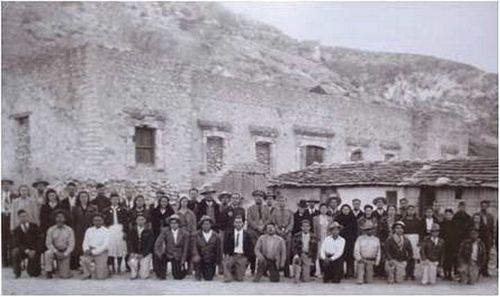
In late 1847 Guadalupe y Calvo became the first mint in the Republic of Mexico to employ steam powered presses for the printing of coins, only eleven years after the introduction of steam press technology at the Philadelphia mint.. This important event is commemorated by a medal bearing the name of the mint director, Tomas Mackintosh.
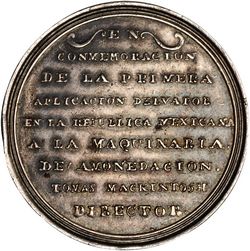
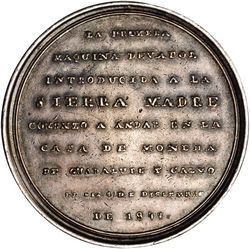
Grove 93a Silver medal (Stack’s Bowers NYINC auction, January 2015, lot 1298)
The obverse of this medal has a nine line inscription that commemorates the first use of steam machinery for producing coins 'EN / CONMEMORACION / DE LA PRIMERA / APLICACION DEL VAPOR / EN LA REPUBLICA MEXICANA / A LA MAQUINARIA / DE AMONEDACION / TOMAS MACKINTOSH / DIRECTOR (In commemoration of the first application of steam in the Mexican Republic to the coinage machinery. Tomas Mackintosh, Director)'. The reverse has a nine line inscription that commemorates the first steam engine brought into the Sierra Madre 'LA PRIMERA / MAQUINA DE VAPOR / INTRODUCIDA A LA / SIERRA MADRE / COMENZO A ANDAR EN LA / CASA DE MONEDA / DE GUADALUPR Y CALVO / EN DIA 1 DE DICIEMBRE / DE 1847 (The first steam engine introduced to the Sierra Madre began to run at the Casa de Moneda de Guadalupe y Calvo. December 1, 1847}'.
In 1849 the lease passed to Jecker Torre y Cia., who, at the same time, also took over the tease for the mint at Culiacán. There were numerous administrative problems at the mint. Finally, coinage operations ceased in April 1852 and the doors were closed on 22 May 1852. Some of the modern equipment purchased for this mint found its way to Chihuahua where it was installed ca. 1860.
As to the closure of the mint, the newspaper El Siglo Diez y Nueve stated that the mint was seized by order of the District Judge of Chihuahua at the request of the General Commissioner of the State because the director of the mint failed to make a payment of 25,000 pesos that the government negotiated to pay troops on the borderEl Siglo Diez y Nueve, Año Décimo, Cuarta Época, Núm. 639, 1 October 1850.
It is said that, between the opening and closing, the mint at Guadalupe y Calvo minted a total of 5,185,827 pesos, of which 2,690,104 pesos was in silver coins and 2,495,723 pesos in gold coins.
| Year | Silver | Gold |
| 1844 | 338,124.00 | 95,004.00 |
| 1845 | 218,298.00 | 688,513.00 |
| 1846 | 250,322.00 | 752,378.00 |
| 1847 | 230,084.00 | 416,350.00 |
| 1848 | 535,543.50 | 185,222.00 |
| 1849 | 491,586.36 | 173,637.00 |
| Total | 2,063,958,06 | 2,311,104.00 |
Mint owners or lessees and their tenures
| from | to | |
| 30 October 1843 | 1849 | Compañía Minera de Guadalupe y Calvo (Mackintosh and Company) |
| 1849 | 22 May 1852 | Jecker, Torre y Cia. |
The Compañía Minera Guadalupe y Calvo a subsidiary of the parent company Manning & Marshall (other authors refer to it as "Mackintosh & Company"The company’s main agent was Ewen Mackintosh, British consul in Mexico ), since the rules stipulated that the mint was managed by a Mexican company. This company, taking advantage of the financial difficulties of the government, obtained several lease contracts, such as Zacatecas in 1842, Culiacán in 1843 and Guadalupe and Calvo in 1844, and came to control 80% of the mintage in Mexico. The mints of Culiacán and of Guadalupe y Calvo maintained various links throughout their operation.
Assayers and their tenures (as evidence by coinage)
| Initial | Name | Began on | Left office on |
| MP | Manuel Onofre Parodi | 1844 | 1852 |