The Durango mint
Located in a once rich mining area, this city is the capital of the state of Durango.
The mint was opened in 1811 by the Spanish Colonial Govemment. By independence, after more than a decade of war, the country was bankrupt and it was urgent to find mechanisms that would help resolve this situation. The mint of Durango continued its work in 1821 and 1822 during Iturbide’s reign, producing 8 reales that were the same as the previous ones with the bust of Ferdinand VII, and ⅛ and ¼ real copper coins with the legend “DE LA PROVINCIA DE NUEVA VIZCAYA”.
The state of Durango officially took over the mint on 22 May 1824 and coins were produced annually until it was closed on 30 June 1895. The second location of the mint was at the intersection of calles 5 de Febrero (formerly de las Carretas) and Miguel de Cervantes Saavedra (formerly del Apartado). This site was located in what was the Palacio del Buen Retiro, so called because it served as a resting place for Archbishop Benito de Orta y Blanco, far from what were then the limits of the city. The third location was at calle Negrete N° 900 Pte. This building was acquired for the federal government in 1881, at a cost of $12,000, by Mariano Herrera, Jefe de Hacienda in the city, and José María Peimbert, interventor of the mint. The deed of sale was formalized on 31 December 1881 before the notary public Jesús Cincuenegui.
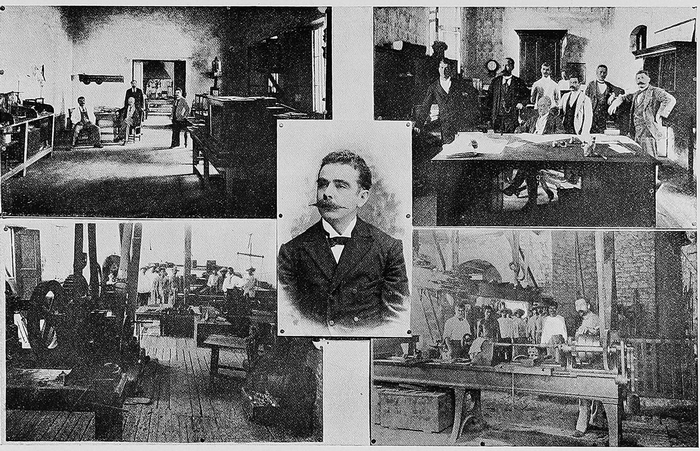
The interior of the mint, with insert of Norberto Domínguez
Durango was one of three mints that produced 8 Reales with the Profile or Hookneck Eagle design. However, there were problems with the quality of production in the beginning.
The early years were difficult for the State of Durango and its mint. There were times when the state did not have a legally organized government. The mint was forced to close from August 1826 until March 1827, causing the governor to complain that the loss of prestige associated with the closing would result in a reduction of the amount of metal brought in for coining. Citing the high cost of operation due to obsolete machinery, the governor recommended a study of the problems. Conditions and economics at the miny improved considerably when a 15 year lease was granted on 24 November 1829 to Manuel Bras-de-Fer and Jose Antonio Pescador.
Under their able management production grew and quality improved dramatically. In 1832 Durango became the second Mexican mint to use hub for the production of dies. When the contract with Bras-de-Fer and Pescador expired on 20 November 1844 the mint was again closed. The State of Durango requested instructions from the Federal Government with regard to the mint. Having had no word from Mexico City, early in 1845 the state legislature accepted a provisional two-year contractEl Registro Oficial, Periódico del Gobierno del Departamento de Durango, Tomo 4o, Sem. 4o. 27 February 1845 that was extendable to seven years with the approval of the Federal Government and the mint was re-opened. Although occupied by the Imperial forces of Maximilian from 4 July 1864 until March 1866, at least some production of Republican 8 Reales continued. Production of 8 Reale was halted in 1870 in favour of the Balance Scale Peso. It resumed in 1873 when that serie was discontinued. From the mid 1860 until the 1880s most of Durango's 8 Reale production was sent to the Orient.
This mint began to produce gold pieces in the year 1832 in values of ½, 1, 2 and 8 escudos. A variety of the 1836 ½ escudo is described here.
The mint also produced copper octavos (from 1824 to 1854) and cuartillas (from 1845 to 1872), with different legends according to the fact that if a Liberal government was established they carried the word "ESTADO" and if they were of the Conservative order they carried the legend "DEPARTAMENTO".
This mint was the fourth most productive in silver minting in the country after those of Mexico City, Guanajuato and Zacatecas.
It closed on 30 June 1895, when the federal government was in a position to settle the debt with the lessees and take possession.
Mint owners or lessees and their tenures
| from | to | |
| 22 May 1824 | November 1829 | Government of the State of Durango |
| 24 November 1829 | 20 November 1844 | Manuel Bras de Fer and José Antonio Pescador |
| 19 February 1845 | 29 November 1847 | Hermann Stahlknecht |
| 29 November 1847 | 30 June 1849 | H. Bernardo Georgy |
| 1 July 1849 | 1857 | Government of the Republic of Mexico |
| 1857 | 16 December 1867 | José Dolores GrimaldoGrimaldo was a local businessman, of Italian origin, Francisco LabordaLaborda was a prominent merchant, of French origin, Hermanos DeliusThe Delius brothers, Alberto, Agustín, German and Julio, were of German origin and had the commercial house that in 1843 operated under the name of Almacenes de Randell y Delius, then changed to Delius Hermanos and Delius Ortigosa, then to Delius e Hildelbrand to resume in 1864 as Delius Hermanos. German Delius and Maximiliano Damm formed a company with Alberto Delius in Hamburg as the partner in charge of the purchase and shipment of goods from Europe., Toribio Bracho, representing Francisco Gurza Gurza was the owner of mining haciendas, the La Concordia hacienda in the state of Coahuila and various other properties, Antonio Arana The Spaniard Arana owned several mines in Durango, had commercial interests in London, Bordeaux and Bilbao and owned the brig "Gabriel" that sailed between Europe and the port of Mazatlan, Sinaloa and Pablo Jáquez Pablo Jaquez was a Mexican who was dedicated to agriculture and various other trades..AHGED, Año de 1857, expediente sobre la entrega de la casa de moneda, núm. 199, Juzgado de Distrito, expediente núm. 68 |
| 16 December 1867 | 31 December 1879 | Government of the Republic of Mexico |
| 31 December 1879 | 30 June 1895 | Cia. Limitada Central de Casas de Moneda de Mexico |
Directors of the mint
| from | to | |
| Manuel Bras de Fer | 1834 | 1835 |
| Manuel Ruiz de León | 1836 | 1842 |
| Manuel Bras de Fer | 1842 | |
| Marcelino Castañeda | 1842 | 1845 |
| Hermann Stahlknecht | 1845 | 1846 |
| Carlos Stahlknecht | 1846 | 1847 |
| Bonifacio Gutiérrez | 1848 | |
| H. Bernard Georgy | 1848 | 1849 |
| Dionisio Guerrero Tavizon | 1850 | 1852 |
| Francisco Elorreaga | 1852 | 1855 |
| Fernando Guerrero Tavizon | 1856 | 1863 |
| Luis de la Torre | 1864 | 1866 |
| Carlos León de la Peña | 1866 | 1872 |
| José María Peimbert | 1872 | 1879 |
| Enrique Amezcua | 1880 | 1893 |
| Norberto Domínguez | 1893 | 1895 |
Assayers and their tenures (as evidence by coinage or documentation)