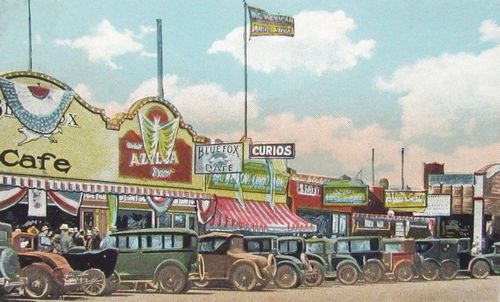
The Aloha Cafe in 1930
The Aloha Café was located on Avenida Revolución. It was first opened e during Prohibition in 1928 by Fernando ‘Frank’ Blanco Cota. He had previously lost The Anchor Cafe in a 1927 fire. Both catered to the US Navy crowd. Cota was born in Ensenada but attended school and lived above the border in San Diego. His place was connected with amateur boxing, promoting bouts between Tijuanans and Americans held in the Aloha Cafe Arena.
The U.S. federal prohibition of alcohol ended in 1933, with California following suit on 8 April. A mere two months later, 150 businesses in Tijuana had closed, including 60% of the bars. As a result. Cota regularly advertised the liquor and dancing of his place to San Diegans, beckoning them to experience the racy Honolulu Trio and their ‘latest hula thrills.’
In November 1938 half a block along Main Street burned down, including the Aloha Cafe. Frank Cota rebuilt and re-opened the bar in the early months of 1939 with neighbour Francesco ‘Frank’ Maggiora{footnote}The Maggiora family came from the Refrancore wine country in Piedmont Italy. Angelo Della Maggiora and Giovanni ‘John’ Maggiora settled in San Diego, and for years operated a bar before the Volstead Act was passed. After the prohibition of alcohol in America, many immigrant families that had for generations been winemakers in Italy migrated south of the border. The Maggioras, Cardinis, Cardinales and Mirabiles were part of a large group of Italian immigrants that settled in Tijuana, profiting from the big Dry Law surge in business.{/footnote}. Together they boasted their establishment was the ‘liveliest nite spot in town,’ open all night.
In the 1940s, The Aloha promoted tequila drinks a-plenty and live entertainment, with floor shows every half-hour by a cast of regular dancers. Many rock bands, including Carlos Santana, played there. It became a disco in the 1970s, a strip club in the 1980s, and closed in 2011, after a fire.
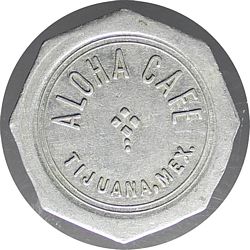
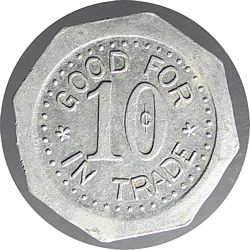
Obverse: ALOHA CAFE / TIJUANA, MEX.
Reverse: GOOD FOR / 10¢ / IN TRADE
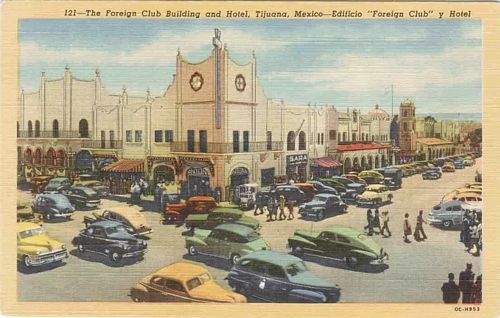
The Foreign Club was Tijuana’s most popular casino and nightclub for many years until eclipsed by the grandeur of Agua Caliente. The compound was located on the corner of calle Tercera and avenida Revolución.
In the early 1900s, progressives were shutting down gambling and aiming for the prohibition of liquor. California’s ‘Red Light Abatement Act of 1913’ pretty much shut down prostitution in San Diego’s Stingaree District. So three American investors, Marvin Allen, Frank Beyer and Carl Withington, formed their ABW Syndicate (Owl Café, Monte Carlo, Tivoli Bar, Foreign Club, Jockey Club) to fully take advantage of Baja California’s licensing of gambling casinos, cabarets, saloons and prostitution. Wirt G Bowman joined the group on Withington’s death, and later invested in building the Agua Caliente casino and resort. A silent partner who afforded them some protections was Colonel Aberlardo Rodriguez, former president of México and later governor of Sonora. After a fire, the resort was completely redesigned and rebuilt by San Diego architect Frank W Stevenson.
 The Foreign Club Cafe de Luxe was the place to dine and dance after a heavy night of gambling — cards, roulette, slots. Full meals were $1 to $1.50. A la carte you could get filet mignon with mushroom sauce for one dollar. Caviar, seventy-five cents. Breakfast served all day – their rhum omelette was a pricey one dollar. As for native Mexican food, they offered homemade chicken tamales, stuffed peppers or turkey enchiladas, two for fifty cents. Local wines were one dollar a bottle. The Foreign Club catered exclusively to affluent Anglo-American customers who had come down to ‘do Tijuana.’ Few Mexicanos were employed there, and blacks were not allowed admittance.
Entertainment, of course, was provided — orchestras, floorshows and dancing. In 1932-33 the pre-eminent dancers to perform at The Foreign Club were Spaniard Eduardo Cansino and daughter Margarita. Their provocative dances Eduardo choreographed got the fourteen year-old noticed by Hollywood types visiting Tijuana. Margarita soon got studio contracts and took her mother’s maiden name — to become Rita Hayworth.
Mexican President Cardenas’ ban on gambling effectively shut down entire resorts like the Foreign Club and Agua Caliente casinos. The Mexican government took possession, converting Agua Caliente into a girls’ school. The Foreign Club burned down in 1935.
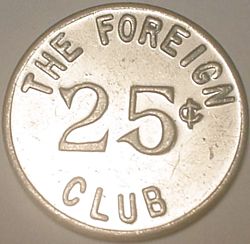
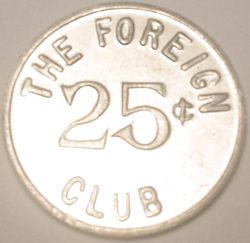
Obverse: THE FOREIGN / 25¢ / CLUB
Reverse: THE FOREIGN / 25¢ / CLUB
Obverse: THE FOREIGN / $1.00 / CLUB
Reverse: THE FOREIGN / $1.00 / CLUB
Obverse: THE / FOREIGN / CLUB
Reverse: GOOD FOR / 15¢ / IN TRADE
23mm. brass
Licores was a chain of liquor stores owned by the brothers Wulfrano and Wilfrido Ruiz.
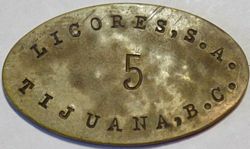
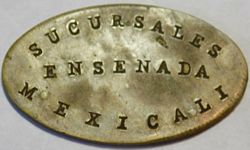
Grove 1700
Observe: LICORES. S. A. / 5 / TIJUANA. B. C.
Reverse: SUCURSALES / ENSENADA / MEXICALI
oval 20 x 35 mm.
This companies produced various series of round tokens. The first has incused denominations.

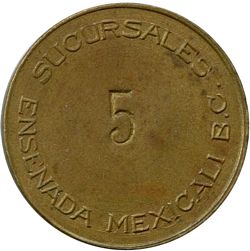
Grove 1701
Observe: LICORES. S. A. / 5 / TIJUANA. B. C.
Reverse: SUCURSALES / 5 / ENSENADA MEXICALI B. C.
24 mm.


Grove 1702
Observe: LICORES. S. A. / 10 / TIJUANA. B. C.
Reverse: SUCURSALES / 10 / ENSENADA MEXICALI B. C.
24 mm.
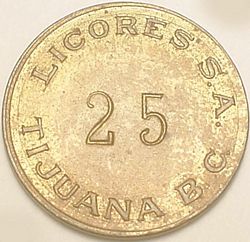
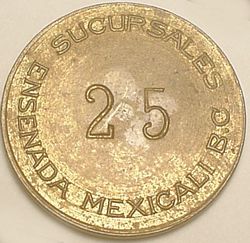
Grove 1704
Observe: LICORES. S. A. / 25 / TIJUANA. B. C.
Reverse: SUCURSALES / 25 / ENSENADA MEXICALI B. C. (incused 10)
22.5 mm.
A second series had raised denominations.
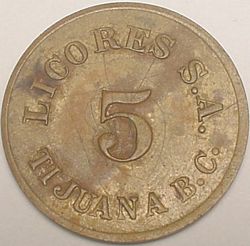
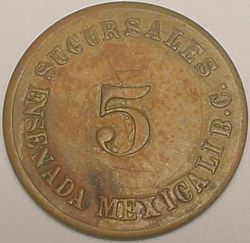
Observe: LICORES. S. A. / 5 / TIJUANA. B. C.
Reverse: SUCURSALES / 5 / ENSENADA MEXICALI B. C.


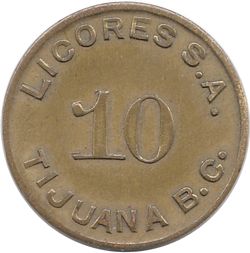
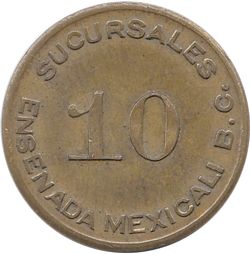
Grove 1703
Observe: LICORES. S. A. / 10 / TIJUANA. B. C.
Reverse: SUCURSALES / 10 / ENSENADA MEXICALI B. C.
22 mm.


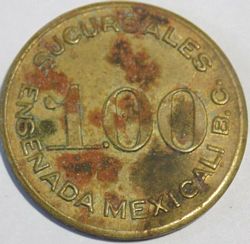
Grove 1706
Observe: LICORES. S. A. / 100 / TIJUANA. B. C.
Reverse: SUCURSALES / 100 / ENSENADA MEXICALI B. C.
22.5 mm.
Another series have a string of dots around the edge.
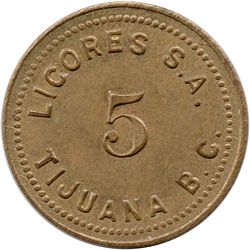
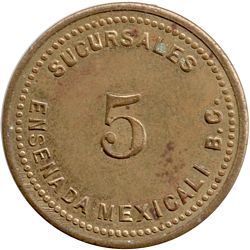
Observe: LICORES. S. A. / 5 / TIJUANA. B. C.
Reverse: SUCURSALES / 5 / ENSENADA MEXICALI B. C.
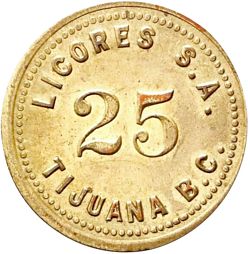
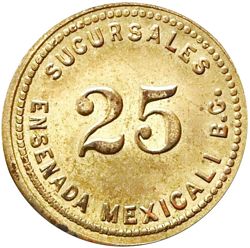
Grove 1705
Observe: LICORES. S. A. / 25 / TIJUANA. B. C.
Reverse: SUCURSALES / 25 / ENSENADA MEXICALI B. C.
23 mm.

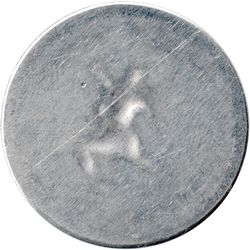
Obverse: SALON VENUS / TIJUANA, MEX.
An Anillo restrike of one side of the original token.
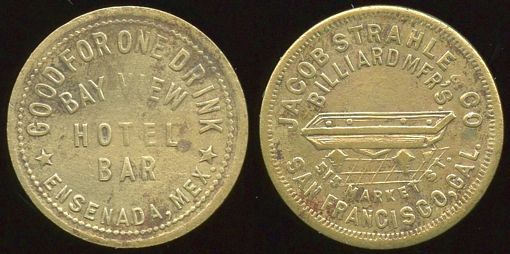
Obverse: GOOD FOR ONE DRINK / BAY VIEW / HOTEL / BAR / ENSENADA, MEX.
Reverse: JACOB STRAHLE & CO / BILLIARD MFR'S / 515 MARKET ST. / SAN FRANCISCO, CAL
24 mm. brass
During the early 1880s there were several billiard table manufacturers in the San Francisco area of California. By the mid 1880s the firm of Jacob Strahle and Company began distributing tokens which advertised its billiard tables on the reverse and had the name of the issuing saloon keeper or merchant on the obverse. Undoubtedly this was done to meet the competition of J. M. Brunswick and Balke Company, which had started issuing its tokens in California during the early 1880s.
The California gold rush brought twenty year old Jacob Strahle to San Francisco in search of a living. Bom on 22 August 1831 in Germany, he arrived in California in 1851 and remained there until his death on 24 November 1909. Little is known about his early life, except that in 1852 he went into business as a billiard table maker in San Francisco. In 1871 Ferdinand de St. Germaine was brought into the firm by Jacob Strahle, who apparently sold the firm or turned it over to St. Germain about three years later. After taking over the firm, St. Germain continued its operation under the Jacob Strahle name until his death in about 1890.
After being located at 533 Market Street for about ten years, the Strahle firm moved to 515 Market Street about 1883, and the tokens show this address. Therefore, they must date from 1883 and thereafter.
All Jacob Strahle tokens were struck in either brass or white metal {footnote}For a history of this company and the tokens that it promoted, see Richard Magnuson, “Jacob Strahle, Billiard Table Manufacturer” in TAMS Journal, vol. 32, Number 1, February 1992{/footnote}. The company produced tokens for three clients in Ensenada, the Bay View Hote, Blundon & Bennett and the Reform Saloon.

Obverse: BLUNDON & / BENNETT
Reverse: GOOD FOR / 12½ / CENTS / IN TRADE
Blundon & Bennett were dealers in general merchandise, with two establishments: one in Ensenada and the second in San Quentin, California.
BLUNDEN & BENNETT, DEALERS IN GENERAL MERCHANDISE.
It is safe to say that there are few more enterprising young business men iu Lower California than Messrs. Blundon & Bennett, wholesale and retail dealers in General Merchandise, Wines, Liquors, Cigars, Tobacco, etc. Mr. J. W. Blundon, the senior member of the firm, and by profession an architect, has had, perhaps, as eventful a career as any man of his years in tbe State. He was born In Washington, D. C, in and was educated at Georgetown College.
Upon attaining his majority he entered the United States Army, from which he was discharged in 1883 with the rank of first sergeant. One of the mott exciting episodes of his military career was the Meeka Indian outbreak. in Colorado, during which time he was wounded. He was then, for a time, in the employ of the Northern Pacific Railroad as engineer, but came that same year (1883) to San Francisco. In that same year, also, he was married to Miss Carrie Shoenman, the first female compositor to enter Ensenada, and the first to set type on the Voice of the Frontier, a weekly paper published at that place.
Mr. Blundon arrived at Ensenada in 1896, in the employ of the International Company, as architect and superintendent of construction of their large hotel and other work, which position he resigned to engage in his present business.
His partner, Mr. L. B. Bennett, is a native of Louisville. Ky., and. by profession, a lawyer. He is a graduate of the State University Law School of Kentucky, and has practiced bis profession in Louisville and several Western towns.
Messrs. Blundon & Bennett now have two well-stocked, prosperous establishments: one in Ensenada, on the corner of First and Rinz streets; and one in San Quentin, on the coiner of Thirteenth and Empressa streets. In conclusion, it is sale to say that few business men in Lower California will commence the New Year with any brighter prospects than Messrs. Blundon & Bennett{footnote}San Francisco Examiner, 1 January 1888{/footnote}.
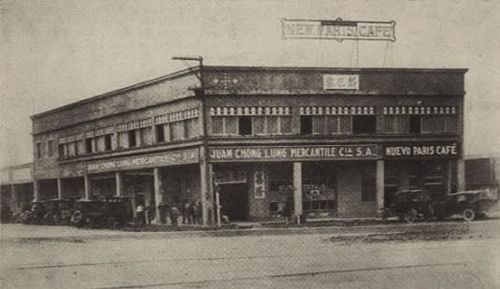
Lew Hing was the first Chinese American industrialist. He came to America in 1871 at the age of 12 to work in his brother’s dry goods store in San Francisco Chinatown and having enjoyed initial success with the Pacific Fruit Packing Company in 1887, he embarked on building a business empire the scope of which was unprecedented for a Chinese. Between 1904 and 1915, he founded four large-scale mainstream industrial and commercial enterprises — the Canton Bank, the Pacific Coast Canning Company, the Chinese Mexican Mercantile Company, and the China Mail Steamship Company. He also built two hotels and a dry goods store in Chinatown. A millionaire by 1913, he had attained fame and fortune, well-respected in the canning industry, and counting among his close friends the mayors of San Francisco and Oakland. Upon his death in 1934, the New York Times {footnote}The New York Times, 9 March 1934{/footnote} published his obituary, calling him “a captain of industry on the West Coast.” Besides his business pursuits, Lew Hing was known for his community and charity work.
In 1913, the Chinese-Mexican Mercantile Company opened a new, five-thousand-dollar store in Mexicali offering wholesale and retail goods, especially foreign goods, including canned goods and food products brought directly from China and the United States. It was located on calle de Teniente Guerrero (today Constitución).{footnote}Calexico Chronicle, 13 July 1913: 3 October 1913{/footnote}. Within five years, the Mercantile became “the firmest and largest establishment in Baja California of its sort doing general mercantile business.” Beyond retail sales, the company ranched some four thousand acres of cotton land and owned the Paris Cafe, where it was possible “for one to be served correctly and enjoy properly cooked Chinese food.” {footnote}La Vanguardia, 18 June 1918{/footnote}.

Obverse: (司 公 務 商 墨 [ ] (si-gung-mouh-seung-mahk-wah (Company Mercantile Mex. Chinese)) / 5 / C.M.M. CO.
Reverse: 美 / 仙 五 (meih sin ngh (U.S. cents five))
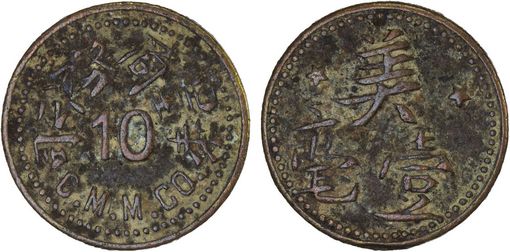
Obverse: (司 公 務 商 墨 [ ] (si-gung-mouh-seung-mahk-wah (Company Mercantile Mex. Chinese)) / 10 / C.M.M. CO.
Reverse: (Chinese characters) meih yat hu (one American dime )
24 mm. brass
Obverse: (司 公 務 商 墨 [ ] (si-gung-mouh-seung-mahk-wah (Company Mercantile Mex. Chinese)) / 25 / C.M.M. CO.
Reverse: (Chinese characters)
30mm. brass
Hussong's founder, Johann Hussong, was born in Forhsam, Germany in 1863. Johann emigrated to the United States in 1888 and changed his name to John. In 1889, the discovery of gold south of the border lured John to Ensenada. John made a living hunting and trading supplies up and down the Baja coast. In June 1891, while on a trading expedition to El Arco, John's carriage flipped over, and his companion, Newt House, fractured his leg. John brought Newt to recuperate at Meiggs' Bar, which back then, was Ensenada's only watering hole. Two days after John and Newt arrived at the bar, Meiggs attacked his wife with an axe. When Meiggs was sent to jail, his wife fled to California. When he got out of jail, Meiggs went in search of his wife, and asked John to mind the bar until he returned. Neither Meiggs nor his wife ever returned. After operating the bar for nearly a year, John purchased and remodeled the building across the street, which was a Southern Lane stage coach stop that bookended the route between Los Angeles and Ensenada. In 1892 he obtained an alcohol license and started operating the John Hussong Bar.
Hussong's is reputedly the place where the Margarita was created in October, 1941 by bartender Carlos Orozco. He concocted a mixture of equal parts tequila, damiana (Cointreau is used now) and lime, served over ice in a salt-rimmed glass for Margarita Henkel, daughter of the German Ambassador to Mexico.
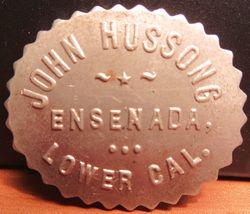
Obverse: JOHN HUSSONG / ENSENADA / LOWER CAL.
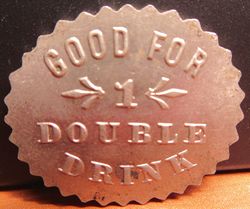
Reverse: GOOD FOR / 1 / DOUBLE / DRINK
Grove 1722
Obverse: MARIANO MA / M / MEXICALI, B. C.
Reverse: GOOD FOR / 50¢ / IN TRADE
30mm. bronze

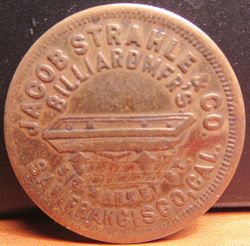
Obverse: GOOD FOR ONE DRINK / A. PERPICH / REFORM / SALOON / ENSENADA, MEX.
Reverse: JACOB STRAHLE & CO / BILLIARD MFR'S / 515 MARKET ST. / SAN FRANCISCO, CAL
24mm. brass
Obverse: SALON ORIENTAL / 1928 / ENSENADA
Reverse: GOOD FOR / 10¢ / IN TRADE
24mm. brass
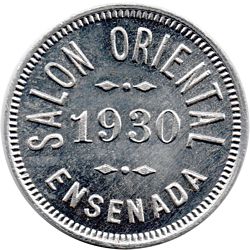
Obverse: SALON ORIENTAL / 1930 / ENSENADA
24mm. aluminum
These are Anillo restrikes so we only have one face.


Venecia 10c
Obverse: VENECIA - CABARET / CS monogram / 1923 / ENSENADA, B. C.
Reverse: BUENA POR DIEZ CENTAVOS around 10¢
<
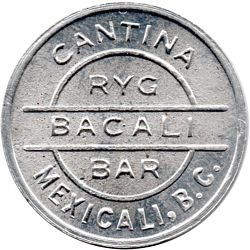

Obverse: CANTINA / RYC / BACALI / BAR
Reverse: MEXICALI, B.C.
An Anillo restrike.
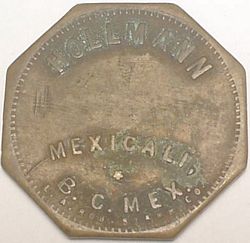
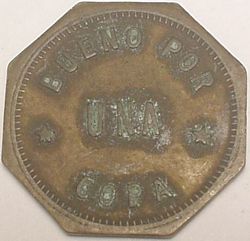
Obverse: HOLLMANN / MEXICALI / B. C. MEX.
Reverse: BUENO POR / UNA / COPA
These were made by L. A. Rubber Stamp Co.
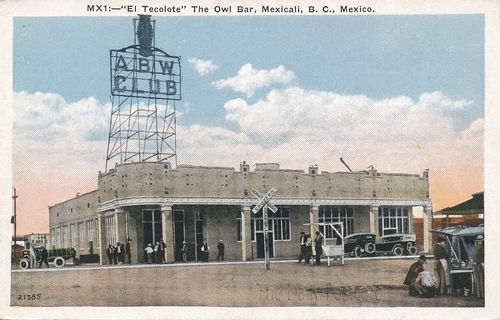
Various establishments catering to vice and other sorts of tourists along the Mexican border offered tokens to their clients. Such tokens were generally made of brass, bronze, aluminum, copper or nickel and were good in trade or merchandise for 5c, 10c, 25c, 50c and one dollar (the dollar was used more often than the peso).
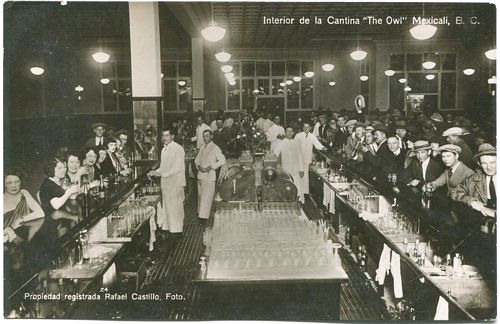
One such establishment was the famous Owl Bar (El Tecolote) in Mexicali, Baja California. Three cabaret owners and operators who were driven out of the Bakersfield, California area by a reform movement went to Mexicali in 1913 and founded the bar. As their names were Marvin Allen, Frank “Booze” Byers, and Carl Withington, they called their company the A.B.W. Corporation.
The Owl Bar featured a casino, dance hall, a brothel, and of course lots of alcohol. At its height, more than sixty girls appeared nightly in the dance hall and among the tables. A gallery, used exclusively for ‘slumming parties’, was rarely empty of tourists from the American side of the border. An advertisement for Mexicali’s nightlife from 1922 stated, “The Owl is of special interest to those who desire to go slumming. A private entrance for private parties is afforded and booths are arranged along the side of the dance floor, which give seclusion to those who merely wish to look in.”
Not surprisingly, many of the most interesting stories relate to the brothel and its 104 rooms. According to Andrew Grant Wood, in his On the Border: Society and Culture between the United States and Mexico{footnote}Andrew Grant Wood (ed.), On the Border: Society and Culture between the United States and Mexico, Rowman & Littlefield, Lanham, MD., 2004{/footnote} the prostitutes represented a variety of ethnicities and races, but the customers were segregated by race. There was a section for white customers and a separate section for non-white customers. It would also appear that once the prostitutes were there, they were not free to leave. The Owl was leveled by an earthquake in 1915 and burnt down a couple of times and a number of U.S. newspapers covered the story of the 1920 fire that sent scantily-clad prostitutes fleeing from the building. The club also burnt down on 30 May 1934{footnote}The San Bernardino County Sun, 31 May 1934{/footnote}.
Although regularly censored, the A.B.W. casinos in Tijuana, Mexicali, Algodones and Tampico avoided permanent closure because of the powerful connections they had forged with the Calles and Obregón administrations. In 1922 an $80,000 donation to the governor of Baja California, General Abelardo Rodríguez, allowed for an extension of The Owl’s gambling permits, under the new name, The A.B.W. Club. However, on 20 July 1935, by orders of the more austere President, General Lazaro Cardenas, the operation was closed completely.
The Owl Bar issued tokens produced by the L.A. Rubber Stamp Company, of Los Angeles, California.
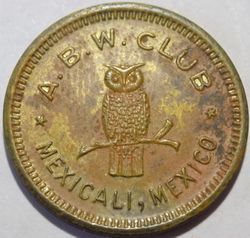
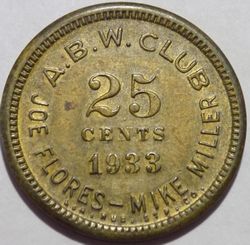
Grove 1265
Obverse: A. B. W. CLUB / MEXICALI, MEXICO
Reverse: A. B. W. CLUB / 25 / CENTS / 1933/ JOE FLORES - MIKE MILLER
24mm. brass
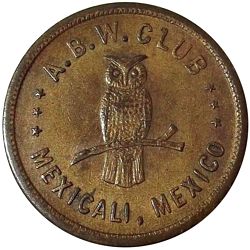
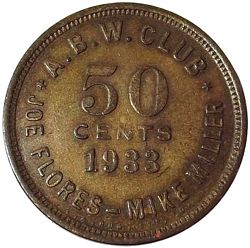
Grove 1266
Obverse: A. B. W. CLUB / MEXICALI, MEXICO
Reverse: A. B. W. CLUB / 50 / CENTS / 1933/ JOE FLORES - MIKE MILLER
30mm. brass

(Stack’s Bowers Auction, 16 May 2023, lot 70687)
Grove 1267
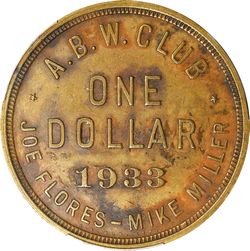
Obverse: A. B. W. CLUB / MEXICALI, MEXICO
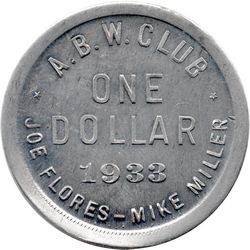
Reverse: A. B. W. CLUB / ONE / DOLLAR / 1933/ JOE FLORES - MIKE MILLER
24mm. brass
In 1967 Anillo Industries, Inc., of Orange, California, bought at auction, 3,492 token dies belonging to the L. A. Rubber Stamp Co., which had gone out of business. Anillo attempted to go into the token striking business and, using the token dies, struck twenty five sets of aluminum manufacturer’s sample tokens. The reverses are blank and are flat since they were designed to be mounted in salesmen’s sample catalogs. It is believed that twenty-two complete sets and three partial sets of these tokens exist, including examples of the A. B. W. Club.



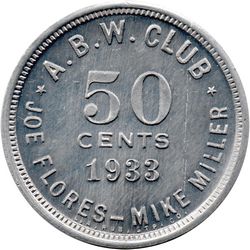
Those who have lost the will to live can note that there are two different die varieties of the 50c restrike. In Die #1 the "5" and "0" are fairly close together. The "T" in "CENTS" is centered under the "0" of "50". "L.A. RUB. STP. CO." is lightly stamped and the "RU" of "RUB." is under the bar between 'FLORES" and "MIKE". In die #2 the "5" and "0" are farther apart than on Die #1. The vertical leg of the "T" in "CENTS" is offset to the left and points up the inner edge of the left part of the "0" in "50". "L.A. RUB. STP. CO." is heavily stamped and the "UB" of "RUB." is under the bar between 'FLORES" and "MIKE". There are other variations in letter spacing between Die #1 & Die #2, but the above are the easiest ones to spot.
Grove 1234
Obverse: CASINO / DE / GUANAJUATO
Reverse: 100
28mm white metal
Grove 1235
Obverse: CASINO / DE / GUANAJUATO
Reverse: 1000
28mm white metal
These were made by L. H. Moise, S. F.
These tokens were issued as a souvenir for the railroad's entrance into San Felipe.
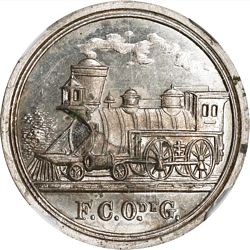
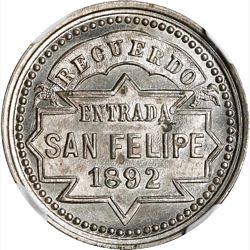
Grove-276A var. (silver). (Stack’s Bowers Auction, 16 May 2023, lot 70684)
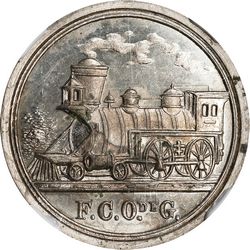

San Felipe Railroad silver (Stack’s Bowers auction, 28 February 2023, lot 72265)
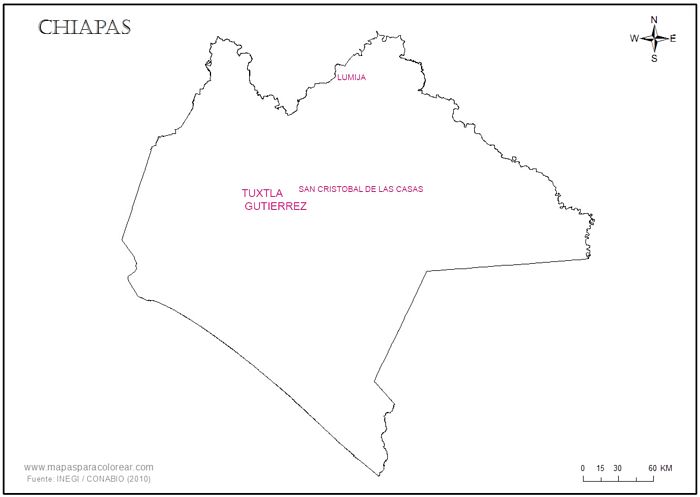
The Mexican Plantation Association, which was incorporated in Delaware in 1897 with a sales office in Chicago, Illinois, had a checkered history. In February 1898 John R. Markley, John B. Wellcome, Lee Mantle, E. W. Graves and D. N. Graves formed an association, and. with Isaiah B. Miller, caused to be executed and delivered to the Chicago Title and Trust company a deed of trust for 6,177 acres of land in Chiapas. At the same time, they entered into an agreement with the trust company that it should hold title to the property and receive and retain the funds of investors until all the proposed shares had been sold. One share for each acre was to be sold for $300 and the payments were to be in monthly instalments of $2.50 for the first four years and $5 a month for the following three years.
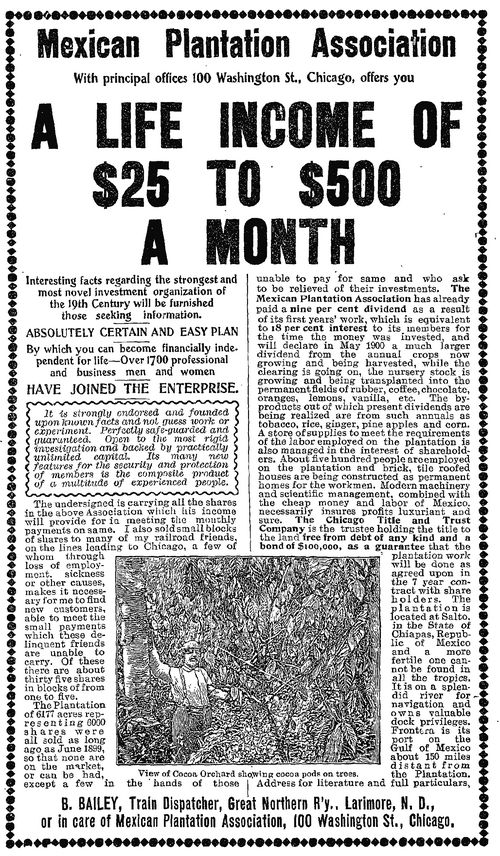
The land was being developed in 1900 and it was expected that within the year about 250 acres in coffee trees, 200 acres in rubber plants, and 5,000 new lemon trees and 10,000 new orange trees would be set out. The plantation also cultivated ginger, vanilla, pineapples and other tropical fruits{footnote}Monthly Bulletin of the American Republics, Vol. IX, Num. 1, 1900{/footnote}. By 1902 it was growing coffee, vanilla, rubber, etc.{footnote}New Order. Volume 72. 1902{footnote}.
However, in February 1909 three Japanese Chicagoan merchants took the company to court. They claimed that they had been defrauded by the promoters, who, with false representations, had induced them to invest $3,500. After purchasing $2,400 worth of shares, they asserted, the promoters sent them "fake" dividends and encouraged them to make further investments. The promoters had claimed that in time the association’s dividends would be greater than any company in the United States except Standard Oil. The promoters were declared to have received upward of $1,000,000 from the sale of shares, but to have have spent less than one-tenth of this in improving the land. A month before the complainants had learned that the land was a jungle; overgrown with weeds and without transportation facilities{footnote}The Inter Ocean, Chicago. Illinois, 26 February 1909{/footnote}.
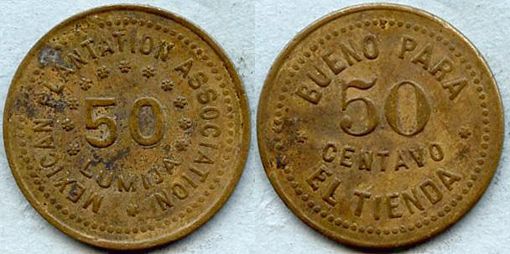
Obverse: MEXICAN PLANTATION ASSOCIATION / 50 / LUMIJA
Reverse: BUENO PARA / 50 / CENTAVO / LA TIENDA
Despite its problems the plantation was still operating in April 1915 when its manager, C. G, Rieb, was fined for using his own paper currency.
José Velasco Coello was a businessman and official in San Cristobal de Las Casas. He is mentioned as a banker (banquero) in June 1894{footnote}El Tiempo, 1 June 1894{/footnote} and ran a clothing store (almacen de ropa) in San Cristobal de Las Casas in 1899. He was a member of the town council in 1892{footnote}El Correo Español, 12 January 1892{/footnote} and presidente municipal in 1897{footnote}La Patria, 19 November 1897{/footnote}.
Grove 2001
Obverse: JOSE VELASCO COELLO / CHIAPAS
Reverse: 12½
32mm. copper-nickel
Grove 1278
Obverse: RECUERDO DEL / MANHATTAN CLUB / SAN LUIS R.C. SON.MEX.
Reverse: blank
25mm. aluminum
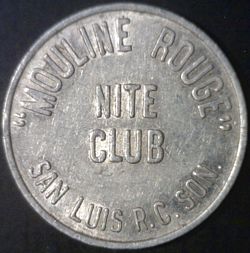
Obverse: MOULINE ROUGE / NITE CLUB / SAN LUIS R.C. SON.
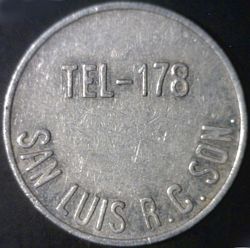
Reverse: TEL - i78 / SAN LUIS R.C. SON.
25mm. aluminum
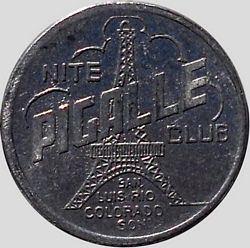
Obverse: NITE / PIGALLE / CLUB / SAN / LUIS RIO / COLORDO / SON
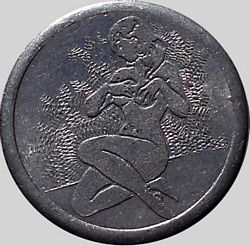
Reverse:
26mm. aluminum
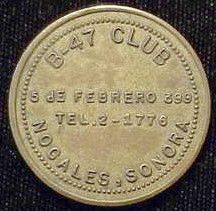

Grove 1269
Obverse: B-47 CLUB / 5 DE FEBRERO 399 / TEL. 2-1766 / NOGALES, SONORA
Reverse: 25 C IN TRADE
29mm bronze
Grove 1270
Obverse: B-47 CLUB / 5 DE FEBRERO 399 / TEL. 2-1766 / NOGALES, SONORA
Reverse: 50 C IN DRINKS
32 mm aluminum

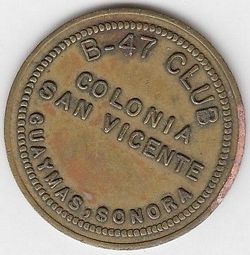
Obverse: B-47 CLUB / PH 2-1716 / 5 / DE FEBRERO / 399 / TEL. 2-1766 / NOGALES, SONORA
Reverse: B-47 CLUB/ COLONIA / SAN VICENTE / GUAYMAS, SONORA

Canal Street in 1969

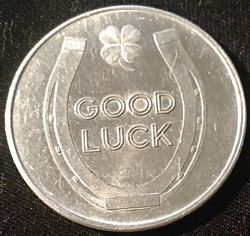
Obverse: CANDILEJAS CLUB / NOGALES, SONORA
Reverse: in horseshoe GOOD LUCK
32 mm aluminum
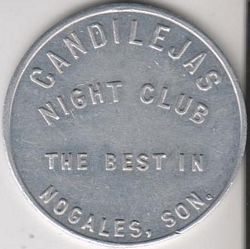
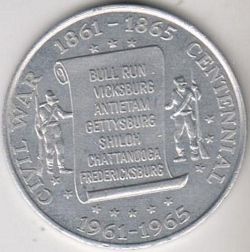
Obverse: CANDILEJAS / NIGHT CLUB / THE BEST IN /NOGALES, SON.
Reverse: 1861-1865 / CIVIL WAR CENTENNIAL / BULL RIN / VICKSBURG / ANTIETAM . GETTYSBURG / SHILOH / CHATTANOGA / FREDERICKSBURG / 1961-1965
35mm. aluminum


Obverse: CANDILEJAS & CONGA / NITE CLUBS / 100 &102 / CANAL ST. / NOGALES, SON. MEX.
Reverse: CANDILEJAS Y CONGA / CABARETS / 100 Y 102 / CALLE CANAL / NOGALES, SON. MEX.
32mm. aluminum

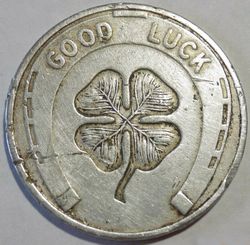
Obverse: CANDILEJAS AND CONGA / NITE CLUBS / 100-102 CANAL ST. / NOGALES, SON. MEX.
Reverse: GOOD LUCK horseshoe and shamrock

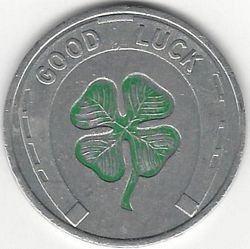
Obverse: CANDILEJAS AND CONGA / NITE CLUBS / 100-102 CANAL ST. / NOGALES, SON. MEX.
Reverse: GOOD LUCK horseshoe and colured shamrock
35mm. aluminum
Grove 1273
Obverse: CONCORDIA CLUB / NOGALES - SONORA. MEXICO
Reverse: GOOD FOR / 12½¢ / IN MERCHANDISE
27 mm brass


Grove 1275
50c
Obverse: LA CONGA / NIGHT CLUB / NOGALES SON, MEX
Reverse: 50 C IN DRINKS
32 mm aluminum
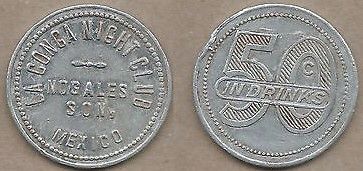
Obverse: LA CONGA NIGHT CLUB / NOGALES / SON, / MEXICO
Reverse: 50 C IN DRINKS
32 mm aluminum

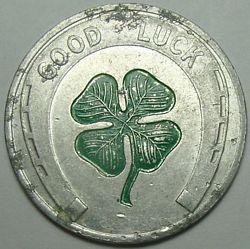
Obverse: CONGA / NITE CLUB / 102 CANAL ST. / NOGALES, SON.
Reverse: GOOD LUCK with horseshoe and shamrock
Grove 1865
Obverse: EXCHANGE SALOON / GOOD FOR / 1 / DRINK
Reverse: J. T. / BRICKWOOD / PROP.
24mm nickel
The Exchange Saloon was located astride the border at Nogales with its doors opening both into the United States and Mexico. It was so named as law officers of both countries met to exchange prisoners without bothering with extradition procedures.
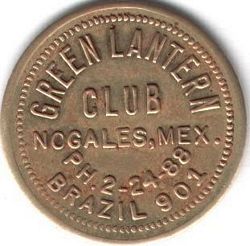
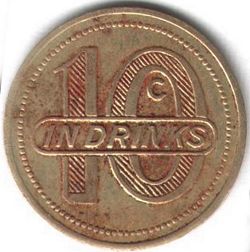
Obverse: GREEN LANTERN / CLUB/ NOGALES, MEX. / PH. 2-24-88 / BRAZIL 901
Reverse: 10c / IN TRADE
26mm. brass
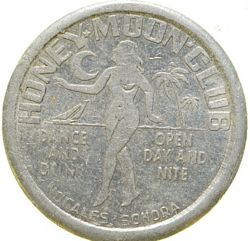

Obverse: HONEY MOON CLUB/ DANCE / AND / DRINK / OPEN / DAY / AND / NITE / NOGALES, SONORA.
Reverse: OPEN DAY AND NITE
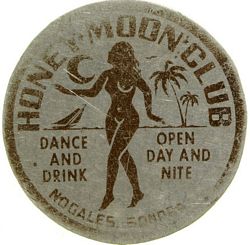
Obverse: HONEY MOON CLUB/ DANCE / AND / DRINK / OPEN / DAY / AND / NITE / NOGALES, SONORA.
Reverse: blank


Obverse: "INDIAN" / NITE / CLUB / CANAL ST - 93 / NOGALES. SON. MEX.
Reverse: CANARET / "IMDIAN" / CALLE CANAL / NO. 93 / NOGALES, SON. MEX.
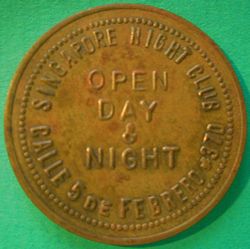
SINGAPORE NIGHT CLUB / OPEN / DAY / & / NIGHT / CALLE 5 DE FEBRERO #370
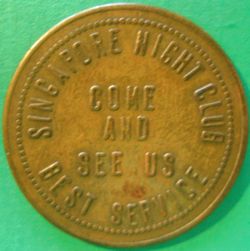
SINGAPORE NIGHT CLUB / COME / AND / SEE US / BEST SERVICE
28mm. brass


Obverse: SINGAPUR / NOGALES / SONORA / CLUB
Reverse: OPEN DAY AND NITE
26mm. aluminum


Grove 1933
Obverse: SONORA RESTAURANT CO. LTD / NOGALES
Reverse: 5
20mm aluminum
Obverse: SONORA RESTAURANT CO. LTD / NOGALES
Reverse: 10
24mm aluminum
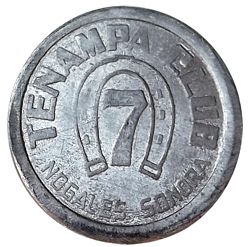

Grove 1286
Obverse: around a horse-shoe and the numeral 7 TENAMPA CLUB / NOGALES SONORA
Reverse: a reclining nude OPEN DAY AND NITE
26mm aluminum
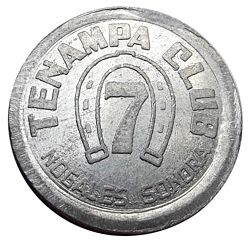
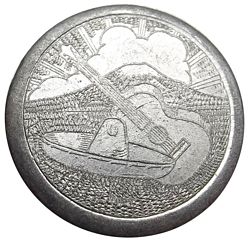
Grove 1287
Obverse: around a horse-shoe and the numeral 7 TENAMPA CLUB / NOGALES SONORA
Reverse: a mountain, guitar and charro hat
26mm aluminum
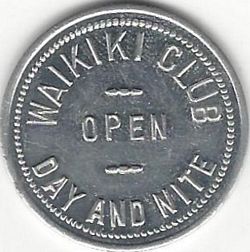

Obverse: WAIKIKI CLUB / OPEN / DAY AND NITE
Reverse: WAIKIKI CLUB / YOUR / PLACE IN / NOGALES


Obverse: BOHEMIA CLUB / TEL. 540 / CANANEA. SON.
Reverse: BUENA POR / UNA / SELECCION
22 mm, brass
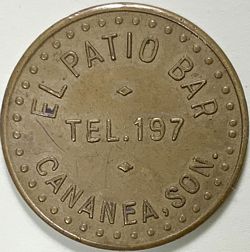
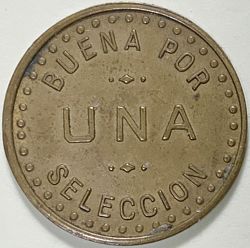
Grove 1150
Obverse: EL PATIO BAR / TEL 187 / CANANEA
Reverse: BUENA POR / UNA /SELECCION
22 mm, brass


5c
Obverse: Copacabana
Reverse: 5
22mm. brass
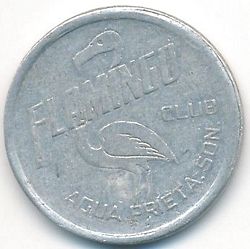
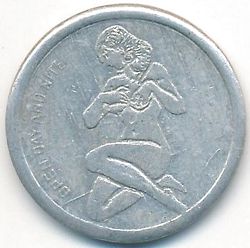
Obverse: FLAMINGO / CLUB / AGUA PRIETA. SON.
Reverse: OPEN DAY AND NIGHT
17mm. brass

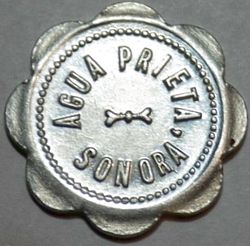
Obverse: FLAMINGO / CLUB
Reverse: AGUA PRIETA, / SONORA


Grove 1276
Obverse: FLAMINGO / CLUB
Reverse: AGUA PRIETA, SONORA Five pointed star
Rulau{footnote}Russell Rulau, Latin American Tokens: An Illustrated, Priced Catalog of the Unofficial Coinage of Latin America--Used in Plantation, Mine, Mill, and Dock--From 1700 to the 20th Century, 2000{/footnote}" says that this was issued during the 1960s and was worth 3 Pesos as the commission the girl earned for inducing a customer to buy her a drink.
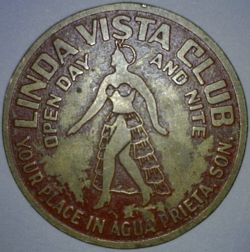
Obverse: LINDA VISTA CLUB / OPEN DAY AND NITE / YOUR PLACE IN AGUA PRIETA, SON.
Reverse: blank

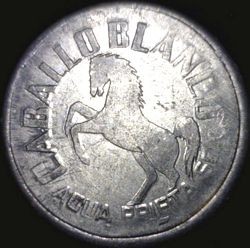
Obverse: WHITE HORSE / AGUA PRIETA, SON.
Reverse: CABALLO BLANCO / AGUA PRIETA, SON.

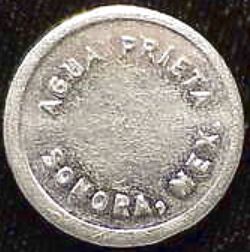
Obverse: QUINTO PATIO / CLUB
Reverse: AGUA PRIETA / SONORA, MEX.
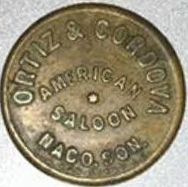

Obverse: ORTIZ & CORDOVA / AMERICAN / SALOON/ NACO, SON.
Reverse: BUENO POR / 5¢ / COPA
21mm. brass


Grove 1154
Obverse: LOS TOCAYOS BAR
Reverse: CABORCA SON
23mm. brass


5c
Obverse: MONTPARTNASE / BAR / CABORCA / SONORA / MEXICO
Reverse: 5¢ IN DRINKS
22mm. brass
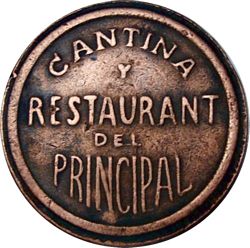
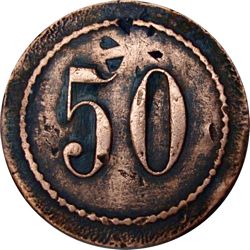
Obverse: CANTINA / Y / RESTAURANT / DEL /PRINCIPAL
Reverse: 50
24mm. copper
This has a counterstamp similiar to the Hacienda de Topahue.
Grove 1310
Obverse: LA COPA DE ORO / VALE / EN / LICORES / HERMOSILLA. SON.
Reverse: 100
28mm brass
Made by L.A. Rubber Stamp Co.
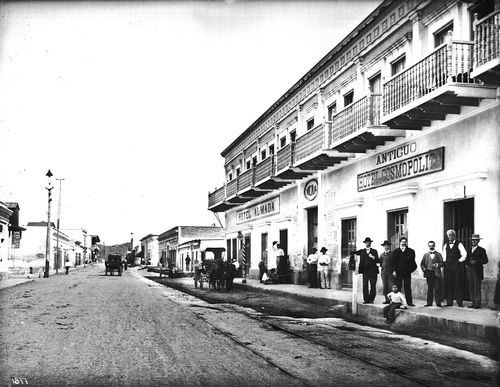
The Hotel Almada, owned by Manuel Almada, located on the seafront, facing the bay, had for 70 years the best reputation in the state, with its restaurant and Gambrinus cantina.


Grove 1667
Obverse: HOTEL ALMADA / CANTINA / GUAYMAS, SON. / MEX.
Reverse: GOOD FOR - ¢25 IN TRADE.
20mm bronze

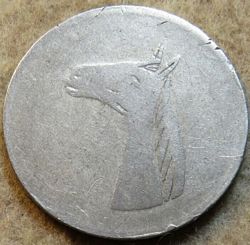
Obverse: CLUB / B-47 / GUAYMAS, SON.
Reverse: horse's head

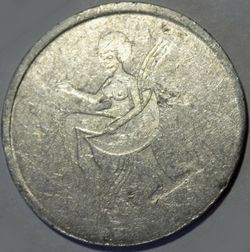
Obverse: CLUB / B-47 / GUAYMAS, SON.
Reverse: woman in glass
This, the only textile plant that existed in the state of Sonora, was founded in 1834 by Manuel Yñigo, Fernando Cubillas and Joaquin Lasteauneau, but by 1855 when the tokens were issued, Ynigo, whose facsimile signature appears on them, had obtained control. The location of the plant was at (San Miguel de) Horcasitas. The plant was dismantled in 1948 and moved to Guadalajara, Jalisco
These tokens were struck in 1855 by the Scovill Manufacturing Company of Waterbury, Connecticut{footnote}The company was founded in 1802 in Waterbury, Connecticut as Abel Porter and Company, as a button and sewing hardware factory. It was an early industrial American innovator, adapting armory manufacturing processes to mass-produce a variety of consumer goods including buttons, medals, coins, and tokens for public transit systems, businesses, and advertising.
With the introduction and spread of daguerreotypy in the United States, the company, now called Scovills and Co., began to manufacture the silver-plated copper sheets used in the process around 1842. They quickly became a key producer of daguerrotype plates and other photographic items.
In 1850 the company was incorporated as the Scovill Manufacturing Company to reflect its expansion into other product lines. The company enjoyed prosperity and tremendous growth through the years. In 1850 they employed 190 people and by 1890, 1,200.
After 1866, the company furnished the United States Mint with the blanks for a number of U.S. coins in various metals - copper, nickel and bronze. Scovill furnished the full set of 23,757 medals for the Columbia Exposition in 1893.{/footnote}.

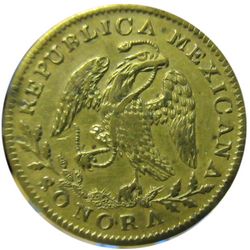
Grove 1717
Obverse: MAQUINARIA DE LOS ANGELES / ¼ and a script signature M. Yñigo
Reverse: Mexican Eagle and REPUBLICA MEXICANA / SONORA
19mm bronze and white metal

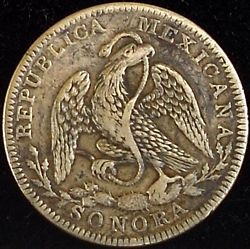
Grove 1718
Obverse: MAQUINARIA / DE LOS ANGELES / 1 R and a script signature M. Yñigo
Reverse: Mexican Eagle and REPUBLICA MEXICANA / SONORA
24mm bronze
Grove 1758
Obverse: BUENO POR UN / DIA DE / TRABAJO / AGUSTIN MONTEVERDE / SONORA. MEX.
Reverse: MARTES
29mm brass
Made by L. A. Rubber Stamp Co.


Obverse: MERCERIA DE LA PAZ / SELDNER / Y VON / BORSTEL / GUAYMAS
Reverse: V. A. ALMADA / MAGDA / JUAN MARCO / HERMOS O / AD MARCOR / ALAMOS
24mm. brass

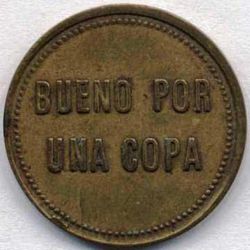
Grove 1763
Obverse: RAYMUNDO MURGA / M / GUAYMAS / SON. MEX.
Reverse: BUENO POR UNA COPA
25mm brass


La Bicicleta 1 tarea
1 tarea (task)
obverse: LA BICICLETA / FABRICA / DE / CIGARROS / GUAYMAS
reverse: VALE UNA TAREA / 1 / A. D. ZUNIGA
25 mm brass or aluminium
La Bicicleta was a cigarette factory, owned by A. D. Zuñiga.

J. Müller & Co. 1c
1c
obverse: J. MÜLLER & Co. / 1¢ / MEXICAN TOKEN
reverse:
23 mm brass

J. Müller & Co. 5c
5c
obverse: J. MÜLLER & Co. / 5¢ / MEXICAN TOKEN
reverse:
27 mm brass
Julio Müller & Cía. were importers and stockists, located at Avenida 8, Guaymas.


José M. Rubio 1 bolado
1 bolado
obverse: JOSE M. RUBIO / GUAYMAS / SONORA MEXICO
reverse: VOLANTIN / SONORA / VALE POR / UN BOLADO
24mm cupronickel


Obverse: TRANSPORTES URBANAS / DE GUAYMAS / RUTAS / LOCALES
Reverse; BUENO / POR UN / PASAJE
24mm aluminum
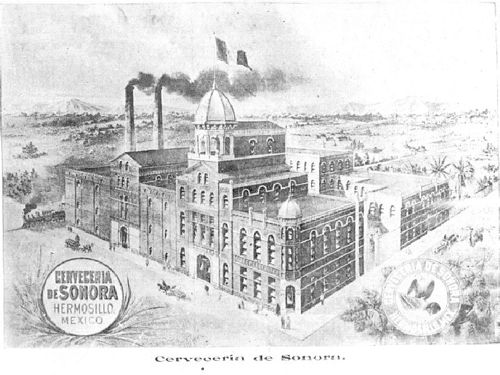
In 1896, three Germans from Bavaria, Geo Grüning, Alberto Hoeffer and Jacobo Schusley, had the idea of founding a brewery in Hermosillo. The first to arrive was Geo Grüning in 1893 and he immediately became involved in the high political and commercial spheres. He married Lolita Monteverde daughter of the presidente municipal, Francisco Monteverde. In 1895 Doctor Alberto Hoeffer, Geo Grüning, Luis E. Torres and Ramón Corral met in the Casino Alemán and deided to investin a brewery and Grüning went to San Francisco, California, to find an architect and mechanical engineer. On 22 September 1897, the notary public Miguel A. López, attested to the foundation of the Cervecería de Sonora, S. A. In 1898 ,Grüning, Hoeffer and Schusley presented themselves to the municipal treasurer, Francisco Monteverde, to process the necessary permits and begin the construction of the building, which was completed in 1904. Grürinig was a director of the brewery from its foundation until approximately 1911, when he handed it over to Hoeffer, whose family would continue to run the brewery years after his death.
The brewery was one of the main industries in the state during the first decades of the twentieth century. However, it ceased to operate when Governor Plutarco Elías Calles, on 8 August 1918. published his decree núm. 1 prohibiting the importation, sale and manufacture of intoxicating drinks, but by 1922 the activities resumed, a fact that began a golden age that lasted until the mid-thirties, closing again in 1935.
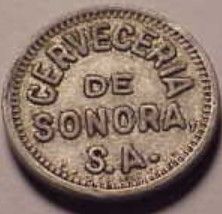

Grove 1245
Obverse: CERVECERIA / DE / SONORA / S.A.
Reverse: UN VASO / DE / CERVEZA
20mm.
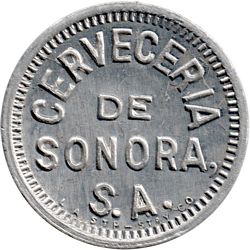
An Anillo restrike
Felipe Salido was an architect and a teacher. He built the City Hall of Alamos, Sonora, and the Federal Palace of Hermosillo. Salido was a principal in the schools in Alamos and Hermosillo; was an officer in the Federal Army; graduated from the Military Academy at Chapultepec in 1884.
Grove 1863
Obverse: FELIPE SALIDO / HERMOSILLO / 25
Reverse: same as obverse
30mm brass
Made by Moises, San Francisco
 Grove 1864
Obverse: FELIPE SALIDO / HERMOSILLO / 50
Reverse: same as obverse
35mm brass
Made by Moises, San Francisco
Grove 2008
Obverse: VOLANTIN / DE / HERMOSILLO / SONORA. MEX.
Reverse: BUENO POR / UN / BOLADO / R. J. CASTRO
30mm bronce
Made by L. H. Moise, San Francisco
A token issued by Gabriel Tona, for the store at Tonichi, county of Ures.
Grove 1966
Obverse: G. TONA
Reverse: 25
23mm aluminum

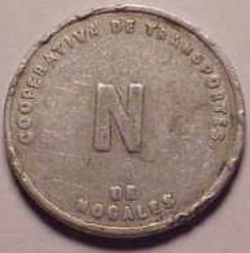
Grove 1978
Obverse: COOPERATIVA DE TRANSPORTES / DE / NOGALES
Reverse; BUENO POR UN PASAJE / N / NOGALES / SONORA
23mm aluminum

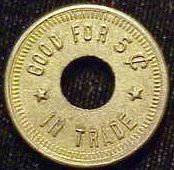
Obverse: F. J. KEOGH / NACO, SONORA, MEXICO
Reverse: GOOD FOR 5¢ / IN TRADE.


Louis Hioki 25c
25c
obverse: LOUIS HIOKI / CANANEA SON. MEX.
reverse: GOOD FOR / 25¢ / IN TRADE
28mm aluminium
obverse:
reverse:
21 mm brass
Bibiano Arevalo was a storekeeper (comerciante) in Cananea. In 1908 he was the owner of the 19 hectares Leonor gold, silver and copper mine in Cananea (footnote}Diario Oficial, Tomo XCIV, Núm. 41, 17 February 1908: La Constitución, Tomo XXXVI, Núm. 25, 13 March 1908{/footnote}.


obverse: CERVECERIA DE SONORA / AGENTE / QUIROZ HERMANOS / LA COLARADA / SON. MEX.
reverse: hand holding beer stein
25 mm aluminium
Quiróz Hermanos were agents for the Cervecería de Sonora.