Reales issues of the Durango mint (counterfeit 8 reales)
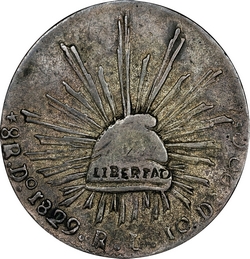
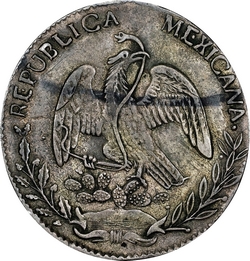
Counterfeit KM-377.4 8r 1829 Do RL (Stack’s Bowers auction, 28 February 2024, lot 73141)
A rather interesting spurious issue that, on account of some fairly extensive wear, appears quite successful at eluding numerous handlers throughout its time in commerce.
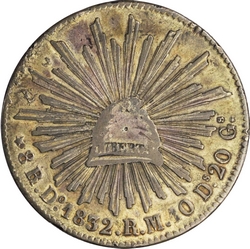
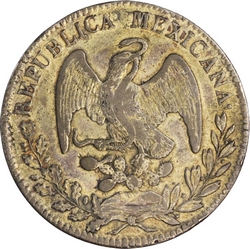
Counterfeit KM-377.4 8r 1832 Do RM (Stack’s Bowers NYINC auction, 21 January 2020, lot 23226)
This spurious example likely circulated a great deal given the moderate, even wear.
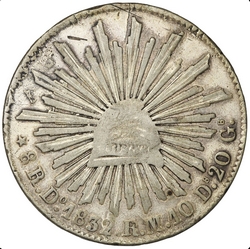
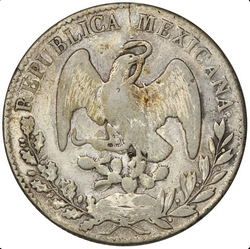

Counterfeit KM-377.4 8r 1832 Do RM (Briggs & Bustos Counterfeit issues II, 10 August 2025, lot 63)
Struck in low-fineness silver, 24.01 grams, 38.7 millimeters in diameter, medal alignment. Well-executed contemporary counterfeit, surprisingly similar to the official issue; matches exactly with No. 365 reported by Leonard Riddell.
 Metal composition: 37.72% Copper, 39.53% Silver, 6.79% Zinc, 3.10% Iridium, 0.82% Lead, 0.79% Germanium, 0.67% Gold, 0.3116% Nickel, 0.28% Iron.
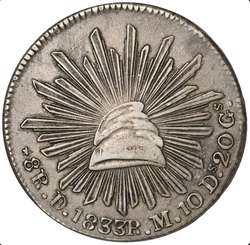
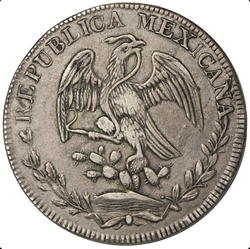

Counterfeit KM-377.4 8r 1833 D RM (Briggs & Bustos Counterfeit issues II, 10 August 2025, lot 64)
Struck in low-fineness silver, 27.55 grams, 38.5 millimeters in diameter, coin alignment. Outstanding quality and remarkable engraving. The cap side design resembles more of a “European style,” with the particularity that the mintmark was engraved with only a “D” instead of “Do”. The obverse shows a slender eagle, more similar to the “Mexican eagle” style. Republican edge cord and coin alignment rotated 10°. Metal composition: 65.55% Silver, 22.24% Copper, 8.92% Zinc, 1.5529% Nickel, 0.93% Tin, 0.7576% Lead, 0.0468% Iron.
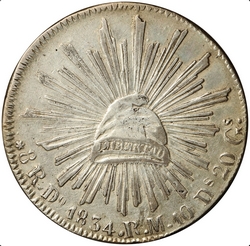
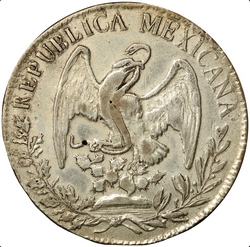
counterfeit KM-377.4 8r 1834 Do RM (Briggs & Bustos Counterfeit issues, 22 February 2025, lot 36)
Struck in silver. Period imitation of the popular European design.
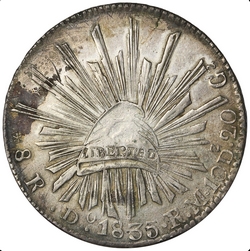
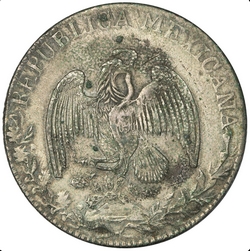

Counterfeit KM-377.4 8r 1835 Do RM (Briggs & Bustos Counterfeit issues II, 10 August 2025, lot 65)
Struck in low-fineness silver, 20.95 grams, 37.3 millimeters in diameter, coin alignment. A design that differs from the “European style” characteristic of the 1832–1842 issues struck at the Durango mint; in contrast, the eagle is slightly smaller and resembles the earlier style also known as the “Mexican eagle.” On the reverse, the cap and rays appear crude, and the legend includes mirrored “s” letters that resemble “z” in “10Ds.20Gs”. Flan slightly reduced in diameter to 37.1 millimeters, well defined Republican edge cord. Metal composition: 42.93% Silver, 34.78% Copper, 14.84% Zinc, 5.96% Nickel, 0.97% Lead, 0.53% Iron
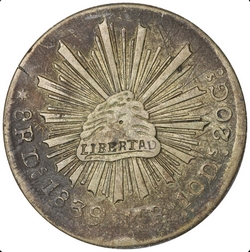
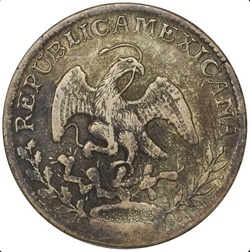

Counterfeit KM-377.4 8r 1839 Ds RM (Briggs & Bustos Counterfeit issues II, 10 August 2025, lot 66)
Struck on bronze flan, 28.12 grams, , 38.2 millimeters in diameter, medal alignment. Contemporary counterfeit with a design completely unrelated to the “European style” circulating at the time. The obverse matches the specimen dated 1832, identified by Riddell under No. 415 (evidently made by the same forger), characterized by a stylized and thin eagle, with no spacing in the legend.
 On the reverse, the cap is surrounded by rays with little variation in size; note the legend with the “Ds” mintmark. Republican design on the edge.