Ferdinand VI Proclamation medals
Ferdinand VI was King of Spain from 9 July 1746 until his death in 1759.
Twenty-five medals have been identified from this reign in the following fourteen locations:
1.- Mexico City
2.- Guanajuato
3.- San Miguel el Grande, Guanajuato
4.- Guadalajara, Jalisco
5.- Valladolid, Michoacán
6.- Puebla
7.- Cholula, Puebla
8.- Tepexi de la Seda, Puebla (not listed so far)
9.- Veracruz
10.- Córdoba, Veracruz
11.- Yucatán
12.- Zacatecas
13.- Fresnillo, Zacatecas
14.- Sombrerete, Zacatecas
Improvement is perceived in the casting technique, particularly in Mexico City, Puebla and Veracruz. For the first time, a sponsor other than a city or town was reflected in the medals. The Consulate of Merchants (Grove F6-5 and F6-6a), the University of Mexico City (Grove F6-8), and the Hispanic College of Guadalajara (Grove F6-17), were the living example of this.
On the other hand, Yucatán issued what is considered the first medal with a denomination, including a numeral "2" engraved at 3:00 on the reverse side, which can be identified in the Frank W. Grove catalog as F6-40.
This reign witnessed the first medal cast in gold, which alludes to Mexico City and unlike the analogous piece in silver, this gold medal was made with special molds, which is evident in the fineness of its details and finishes. The subsequent touch-ups to the cast design with burins and chisels were much more careful, giving an unparalleled elegance.
Mexico City
Guanajuato
San Miguel el Grande, Guanajuato
Guadalajara
Puebla
Cholula, Puebla
Tepexi de la Seda
Valladolid

Proclamation Medal of Mexico City to Ferdinand VI – Col. Alejando M. Bustos
The proclamation of Ferdinand VI in Valladolid is recounted here
Veracruz
In the case of Veracruz there is a letter from the council dated 17 May 1747 giving reports of the ceremonies conducted on 10 April 1747. There are two accounts of the distribution of medals during the proclamation ceremonies. The first is of Jose de Zavaleta, who threw silver medals to the people from his window. The second is of Governor Antonio Salas who threw them to the crowd from a platform. It is unknown which medals were distributed by which individual, but likely the medals in question are Grove-F6-36 and Grove-F6-37.
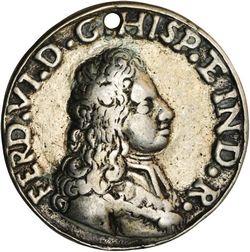
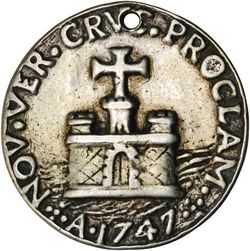
F6-36 Cast and Chased Silver Proclamation Medal (Stack’s Bowers NYINC Auction, January 2015, lot 1010)
This medal has a bust of Ferdinand VI on the obverse and the coat-of-arms pf Veracruz. on the reverse.
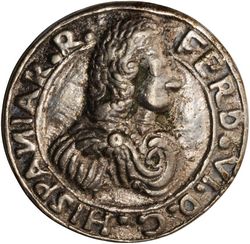
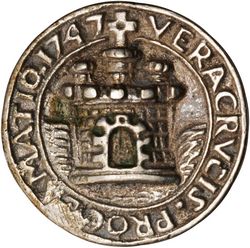
F6-37 Cast Silver Proclamation Medal (Stack’s Bowers NYINC Auction, January 2015, lot 1011)
This medal was modeled directly after the 1724 Veracruz medal of Luis I (Grove-LI-14). Proper alterations were made ensuring the correction of the date and king's name prior to casting. Of slightly less defined details than the 1724 Luis medal, as loss of definition occurs when using a cast medal as the “madre” or “mother coin”.
Córdoba, Veracruz
Yucatán
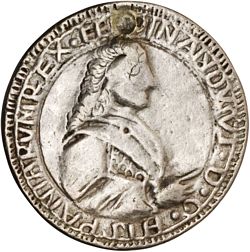
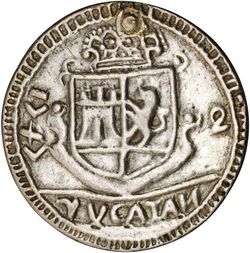
F6-40 Cast Silver Proclamation Medal (Stack’s Bowers NYINC Auction, January 2015, lot 1012)
This medal has the draped bust of Ferdinand VI on the obverse and the crowned arms of Mérida on the reverse.
Zacatecas
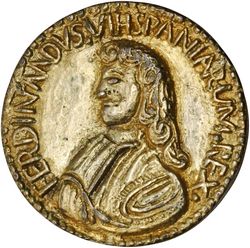
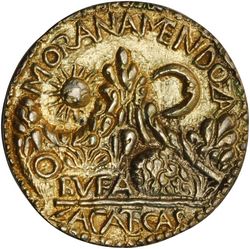
F6-42 Gilt Cast and Chased Silver Proclamation Medal (Stack’s Bowers NYINC Auction, January 2015, lot 1013)
MedinaJosé Toribio Medina, Medallas de Proclamaciones y Juras de los Reyes de España en América, Santiago, Chile, 1917, HerreraAdolfo Herrera, Medallas de Proclamaciones y Juras de los Reyes de España, Madrid, Spain, 1882 and Betts all mention a proclamation medal from Zacatecas for Ferdinand VI; however, this information was taken from an anonymous pamphlet entitled "Proclamaciones". This specimen was once thought to be that medal, however it is not. The medal mentioned in the pamphlet is supposed to be dated "1746", whereas this is undated and the listed diameter is different as well.
Fresnillo, Zacatecas
Sombrerete, Zacatecas