Chopmarks on Mexican Silver: Four Centuries of Trade
by Dan Huntsinger and Taylor Leverage
Western Trade with China
In 1513 Jorge Álvares arrived at Guangzhou, the first European to reach China via sea. This led to direct commercial routes across the Pacific targeting spices, porcelain, and luxury goods, but in return there was a lack of available trade goods of interest to the Chinese. Silver represented one of the few mediums that was readily and reliably accepted, and China’s Single Whip Tax Reform incentivized domestic silver use, which could not be reliably sourced for the entire tax burden.
The introduction of the tornaviaje (return route) in 1565 enabled Pacific trade and the discovery of the single richest source of silver recorded, Potosí’s Cerro Rico in Bolivia, enabled rapid development of international trade. In time, Mexico became a cosmopolitan transit hub, outstripping Potosí to become the most significant silver producer in Spanish America, and by 1803, Mexican mines would produce more than two-thirds of all silver in the Americas.
The Chinese Perspective
The factors that brought a centuries-long wave of silver to China were complex, but were based on the balance between economic necessity and social friction, which together dictated the course of silver’s global utility.
In the late Ming dynasty (1500s) there was shift from tax collection in grain or labor to tax collection in silver (ingots or sycee (a type of gold or silver ingot used as currency in imperial China)). By the Qing dynasty (1600s–1800s) this system was entrenched with the result that every household, farmer, and merchant needed access to silver to meet their obligations, making it the lifeblood of the financial system.
China had few silver mines, with modest output, so foreign silver became crucial to sustain everyday transactions and state revenue. China’s coveted goods (tea, silk, porcelain) along with this thirst for silver created a perfect storm for trade with the West.
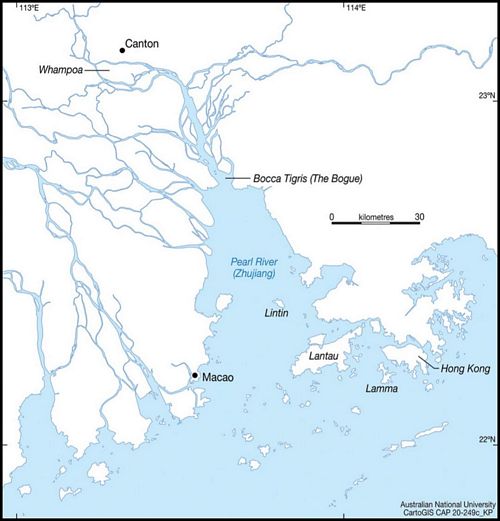
Map of the Pearl River estuary showing the locations of Macao, the Bocca Tigris and Whampoa island
where Western ships anchored and loaded cargoes.
Chinese distrust of the West came from a mix of cultural worldview, political control, and historical experience and the growth of foreign trade and desire by foreign traders for increased access to Chinese ports caused much concern internally. In 1757, the Qianlong Emperor decreed Canton (Guangzhou) be the only legal port for foreign trade. The Canton System exerted strict control and kept foreigners at arm’s length. All Western merchants could only operate in Canton and were confined to a designated area outside the city walls – “Thirteen Factories” (district of warehouses and living quarters). They could not bring their families, build permanent settlements, or practice religion openly, had to leave when the “trading season” ended, and interaction with government officials was strictly prohibited.
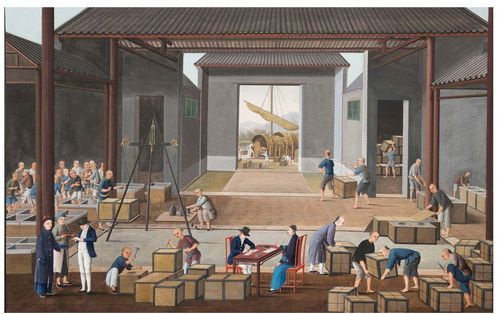
"Tea Production", a Chinese print c. 1820
Certain roles within the Canton System created layers of separation between foreigners and Chinese society. These were
Cohong Merchants (公行): a small (~10-12) guild of licensed Chinese merchant families in Canton, who were the sole intermediary between foreign traders and the Chinese state, and took legal and financial responsibility for foreign traders.
Hoppo (海关监督): an Imperial customs superintendent, appointed directly by the emperor, who wielded immense power, and was often feared and bribed.
Linguists (通事, “Tongshi”): who acted as translators between foreign merchants and Cohong merchants.
Compradors (买办): local Chinese business agents employed by foreign firms, who were the essential intermediaries in daily life, procured supplies (food, fuel, ships) and managed Chinese staff in foreign factories.
The Shroff (or money changer) was a crucial figure in the Canton System trade. Shroffs enabled China’s silver-based economy to transact using foreign coins and their role included testing, verifying and authenticating circulating silver; stamping accepted coins with chopmarks and converting silver into local currency (sycee ingots). The shroff was a guardian of trust, making expert judgements that could make or break a transaction. Shroffs were indispensable middlemen, at the center of every transaction and without them, the Canton System could not have functioned. Foreign trade relied entirely on incoming silver and China’s economy demanded strict assurance of quality.
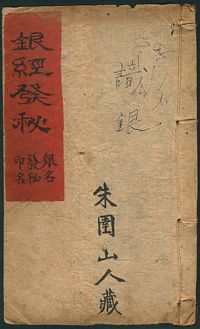
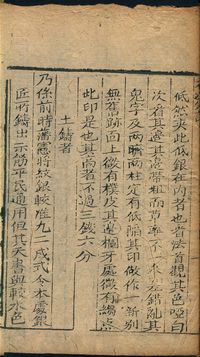
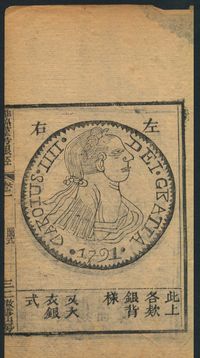
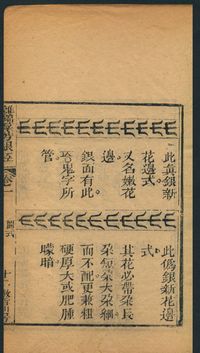
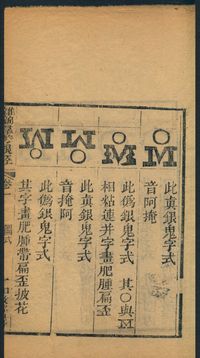
This Shroff Handbook c. 1830-1840 has this passage: “To detect such counterfeits, merchants should first check if the color is matte white. The edges are crudely made; Monster characters, two bellies as well as two candles are lower than genuine; The coin appears to be uncirculated and the surfaces are slightly worn; There are tiny spots on the edges. “Clipped low-content silver” are only made with 3 mace and 6 candareens of silver”.
Chopmarks in Detail
A chopmark was a small mark punched on a silver coin. It was usually Chinese script, sometimes simple geometric shapes, English letters or numbers, occasionally Manchu or ancient script. Examples of chopmarks type are shown below:
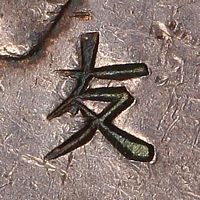
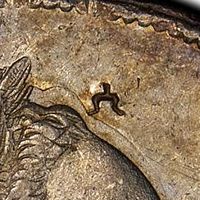
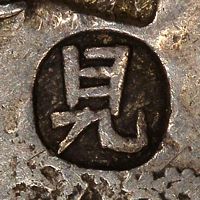
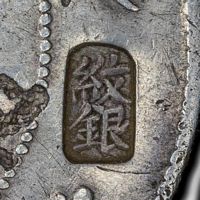
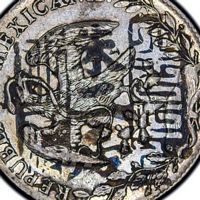
Large Small Incuse Assay / Bank Ink
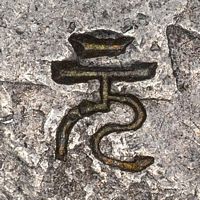

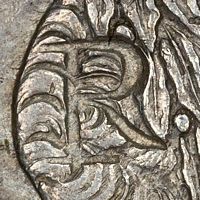
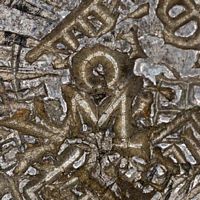
Paper (with ink) Seal Script Symbol English Letter Mexico City Mintmark
The chopmark certifies that a coin had been tested and approved. Each symbol was unique to a shroff (or possibly their employer) and acted similarly to a signature or guarantee: “this coin has been checked – it is good silver.”
Shroffs weighed a coin, sometimes cut a notch or drilled a hole to look for base metal, used various methods to test purity and, if found genuine, stamped a chopmark into the coin’s surface. The coin then re-entered circulation, now more trusted since it carried visible proof of testing. Coins would accumulate multiple chopmarks as they passed through many hands, with each new shroff adding their mark.
Chopmarks were needed because counterfeit silver was continually a problem. Counterfeit Spanish dollars were produced in Southeast Asia, sometimes with incorrect designs and debased silver. European and Latin American counterfeiters struck underweight Spanish dollars to pass them in China, and in China, coins were often clipped (edges shaved for silver) or “sweated” (tumbled in bags so filings rubbed off ).
Mexican Silver Types with Chopmarks
As the single most enduring source of silver for China in coined form, the chopmarked Mexican type set is the most complex and substantial chopmark type collection that can be pursued from a single country, apart from China itself. However, not all types are created equal.
Philip III Cob Eight Reales (1598-1621)
Trade between the Spanish colonies and China commenced c. 1570, and chops reliably appear c.1620. However, silver coins were a frequent target of melting into sycee. Rose considered all cobs to be rare with chopmarks, but hoards began to be documented by 1977, notably in Fukien province.
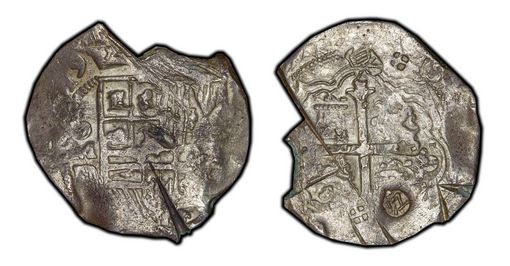
Philip III 8 Reales
Philip IV Cob Eight Reales (1621-1666)
The majority of known cobs can be attributed to this type, likely associated with period hoarding due to an economic slowdown in the 1640s. Four reales are frequently encountered; later half-crown equivalents are much scarcer.
Charles II Cob Eight Reales (1667-1700)
These are comparatively scarce compared to Philip IV, and frequently cut or clipped.
Philip V Cob Eight Reales (1701-1733)
These had a low survival associated with the subsequent introduction of the milled Pillar type. (Louis I issues (1724) are totally unknown with chopmarks.)
Philip V Pillar Eight Reales (1701-1733)
In 1728 Colonial coin production was overhauled and circulation was encouraged by standardized dimensions, with less incentive for sycee melting. Foreign silver emerged as a monetary standard, including in domestic land contracts. We notice the introduction of larger chopmarks, especially in relief.
Klippe issues (1733-1734) and MX mintmark Pillar issues are known but extremely rare.
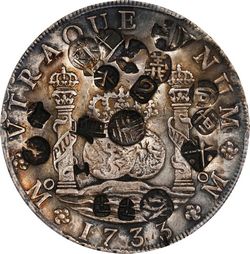
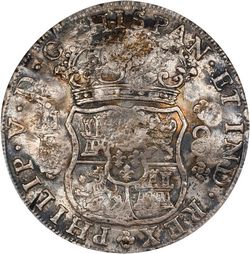
KM-103 8r 1733 Mo MF (Stack’s-Bowers Hong Kong auction, 16 December 2024, lot 44385)
Variety with small crown.
Ferdinand VI Pillar Eight Reales (1747-1760)
These are fairly common with chopmarks.
Charles III Pillar Eight Reales (1760-1771)
These comprise the majority of known Pillar hosts with many examples in a high state of preservation despite chops.
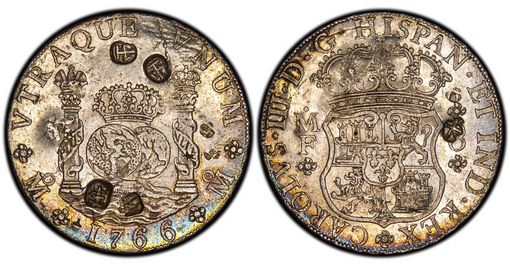
Charles III 1766 M F 8 Reales
Charles III Portrait Eight Reales (1772-1789)
These had a high degree of acceptance in China, including 5-8% over sycee in contemporary circulation, increasing to >30% in the late 19th century. Their popularity kept this type in circulation for up to a century (they are quoted in newspapers post-1900).
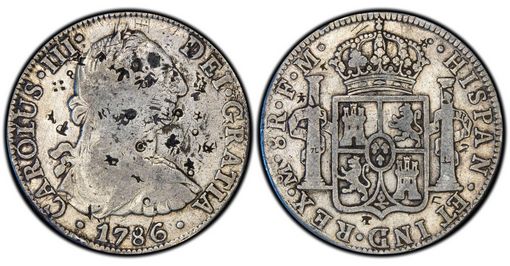
Charles III 1786 F M 8 Reales
In 1785, the total volume of Western trade in Canton doubled in the space of a few years. Mexican silver coins became the de facto international trade standard. There was a shift to smaller chopmarks, and an alleged increase in counterfeit examples.
Charles IV Portrait Eight Reales (1789-1808)
These are highly common on the collecting market.
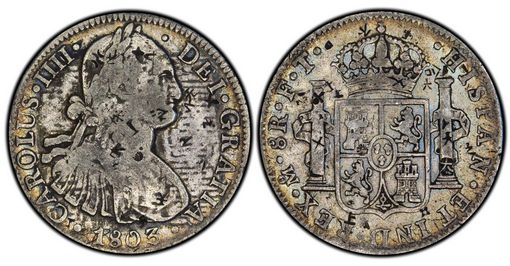
Charles IV 1803 F T 8 Reales
Ferdinand VII Portrait Eight Reales (1808-1822)
Napoleon’s intervention in Spain created colonial unrest, interrupted silver production and export, and created economic depression in China. Also the lesser notoriety of the Ferdinand VII bust style coins generated less acceptance in China.
Iturbide Eight Reales (1822-1823)
Specie exports were limited given the floundering government and the final galleon to complete the journey (the Magallanes) was not permitted to unload its cargo when arriving at Acapulco in 1811, and only left for Manila in 1815. Also, silver intended for the galleon trade was seized. So this is a rare type, with less than 15 examples known.
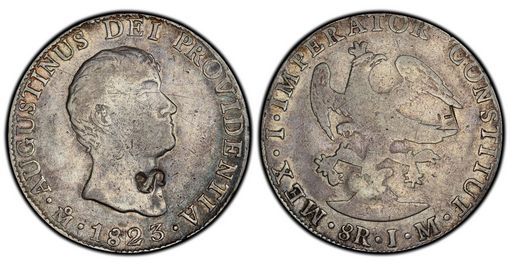
Iturbide 1823 JM 8 Reales
Cap & Rays Eight Reales (1823-1897)
The new Latin American Republic issues were considered less consistent. Hooknecks are near non-existent, with early issues scarce, though imported to the Philippines for counterstamps. In general, pre-1830 examples are rare, and post-1850 examples common. We see large chopmarks on mid-century examples, and small chops on some later pieces.
Of the 14 issuing mints, most are common, some (Oaxaca, Alamos) moderately scarce, Guadalupe y Calvo rare and Estado de México currently unknown. Real de Catorce (1863 only) was heavily exported and is reasonably common.
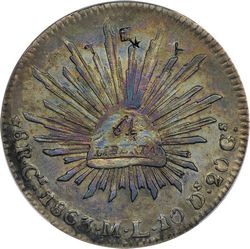
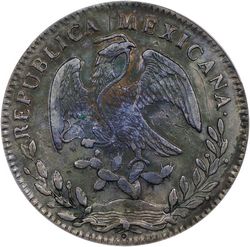
KM-377.1 8r 1863 Ce/Pi ML/MC (Stack’s-Bowers Hong Kong auction, 20 April 2026, lot 49732)
Variety with over mintmark, Ce over Pi, and over assayer, ML over MC. Several small size incuse Chinese chops and punchmarks on both sides including, "九" (Jiu), "丄" (Shang), "º", as well as a few other unidentified chops.
Maximilian Peso (1866-1867)
This was not intended for export, with no indication of fineness, so is rare with less than 20 examples known but realizes high prices relative to its rarity.
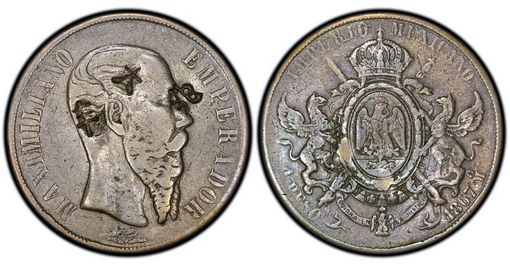
Maximilian 1867 1 Peso
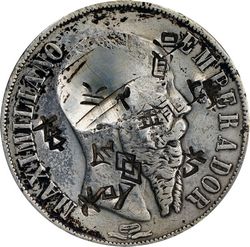
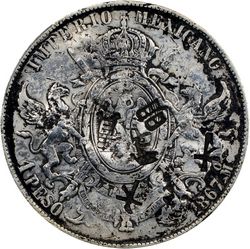
KM-388.1 $1 1867 Mo (Stack’s-Bowers Hong Kong auction, 20 April 2026, lot 49743)
Numerous medium size Chinese and pseudo-Chinese chops and symbols on both sides including, "卞" (Bian), "明" (Ming), "才" (Cai), "合" (He), "天" (Tian), "玄" (meaning unknown), "令" (Ling), "⧉" (Fangsheng, symbolizing unity, harmony and deep bonds) as well as others that are obscured and difficult to identify.
‘Balanza’ Peso (1869-1873)
The radically altered design discouraged easy acceptance abroad and poor feedback abroad coupled with the Panic of 1873 led to a resumption of the Cap & Rays. Once this was thought moderately scarce, but is now effectively common.
Cap & Rays Peso (1898-1909)
The proportion of exported silver in struck coinage form declined rapidly after 1900, from 93% in 1872-73 to 27% in 1902-03. 1898-Mo restrikes were produced at the San Francisco and Mexico City Mints in 1949 for use in China; the last such Mexican type.
‘Caballito’ Peso (1910-1914)
These had very limited export, and are extremely rare with chopmarks.
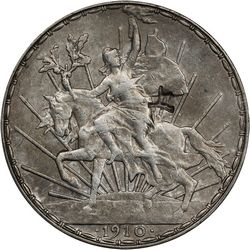
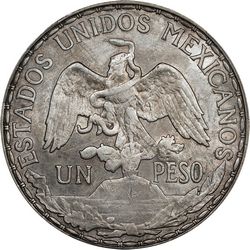
KM-453 $1 1910 Mo (Stack’s-Bowers Hong Kong auction, 21 October 2023, lot 46427)
The Chopmark Collecting Market
Chopmarks have seen a substantial spike in interest over the last five years, but what factors make a chopmarked coin valuable? The four factors affecting chopmark desirability are
Host Rarity/Significance: type collections are the typical avenue for collectors, and the combination of scarcity and historical intrigue contribute to interest.
Preservation: though chopmarks are inherently a form of damage, the rules of the road still apply – wear and cleaning are unattractive, while toning and strong detail are prized.
Stylistic Consistency: compared to struck coins or counterstamps, chopmarks are comparatively easy to fake, so stylistic comparison to known examples is a must, particularly on scarce types.
Provenance: Key names in the chopmark space - F. M. Rose, Hal Walls, etc - or plate matches to vintage auctions give an element of prestige, and confidence in authenticity.
When considering whether a chopmark itself is counterfeit, one should ask
1. Do the chopmarks look right? Too sharp, or strokes individually punched?
2. Was the host coin likely to have circulated in China?
3. Does the presence of chopmarks increase the value of the coin?
4. Can I easily find other coins (in the same auction) with the exact same chopmark(s)?
5. Is the same chopmark repeated over and over on the same coin?
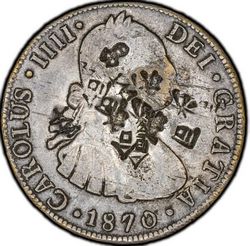
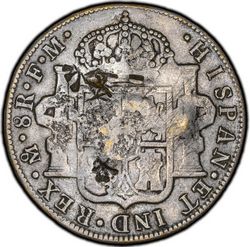
counterfeit Charles IV 8 reales, dated 1870
Finally, books on the topic include Chopmarks by F. M. Rose, 1987 (the first reference dedicated to the subject; largely based on personal experience of the author); Chopmarked Coins - A History, by Colin Gullberg, 2014 (a radical update of type details, including period engravings and chronological type progression) and By Weight, Not By Coyne, by Taylor Leverage, 2023 (an expansion of type range, broken down by nationality; and expanded historical context). Also The Chopmark News, the newsletter of the Chopmark Collectors Club, had been produced since 1990.