Privately countermarked coins
During the first half of the nineteenth century many U. S. businesses counterstamped coins as a form of advertising. Foreign silver and gold coins were legal tender in the United States, under an Act of Congress of 1806, and in fact the two reales coin were more common in circulation in the 1850s than were Liberty Seated quarters of comparable exchange value. So countermarks were applied to foreign coins.
Many of these reales were from Spain or Latin America but some were from Mexico and the following is a list of Mexican coins known with a U. S. counterstampMany of these coins featured in Stack's Bowers auctions, and the information about them is drawn from Gregory Brunk's Merchant and Privately Countermarked Coins: Advertising on the World's Smallest Billboards, World Exonumia Press, 2003.
This practice lasted until 1857 when all foreign coins and private currency were declared illegal.
J. B.
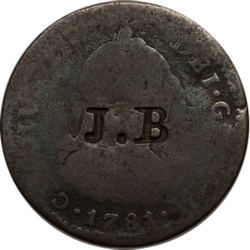
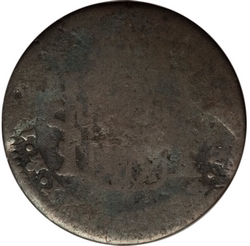
J.B. on 1781 one real (Heritage Auction 231627, 7 July 2016, lot 61381)
J. L. Barnes' Saloon, Bryan. Texas
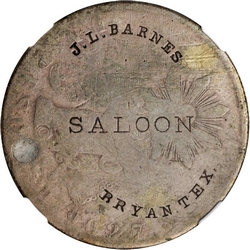
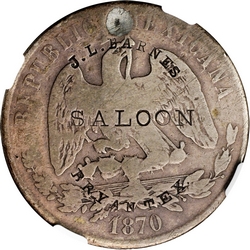
J. L. Barnes on 1870 8 reales (Stack’s Bowers ANA auction, 14 August 2013, lot 21660)
J. L. BARNES / SALOON / BRYAN TEX. on both sides.
J. L. Barnes must have operated his saloon in Bryan in the mid-1870s because the latest known date of coin with his countermark is 1874, he acquired the Capital Hotel in Houston in the late 1870s, and the 1880 Census listed him as an hotel keeper in Houston. The Census also noted that he was then forty-five years old, and had been born in Alabama.
W. & J. Barnes, Rockford, Illinois
W. & J. BARNES / 429 6 AVE on a 1842 centavo
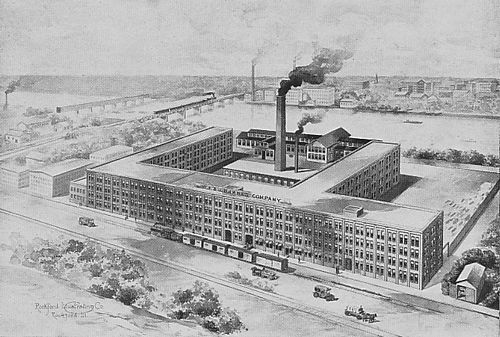
Barnes' Factory, circa 1922
Shortly after the close of the Civil War, young John Barnes was living in central New York state. He decided that opportunities lay farther west and, accordingly, invested his savings in a threshing machine and started working his way westward from farm to farm. When he reached Rockford, John Barnes like the place and settled down. He had previously had experience as a model maker and found employment in that capacity with Emerson Talcott and Company, manufacturers of harvesting machinery.
The tediousness of carving wooden models by hand led Barnes to develop foot-power woodworking equipment. The speeding of production attracted interest in the new machine and Barnes soon realized that his woodworking tools found readier sale than his models. In 1868 he decided to devote full time to these tools and their manufacture.
With the growth of the business, John's two brothers, William Fletcher & Benjamin Franklin, came out from the east to join the new enterprise. Their first plant was housed in a small rented shop conveniently located in the water-power district. Then a move was made to the corner of Wyman and State Streets where the company of W. F. And John Barnes was formed in 1872. Twelve years later the organization moved across the river to a new site and the company was incorporated.
Meanwhile, John's original invention, the foot-powered scroll saw, had found favour in the building industry which employed it for turning out intricate ornaments for cornices, ornate balustrades for stairways, and other rococo decorations. While increasing production of their scroll saw, the Barnes brothers recognized the need in their own shop for other power tools - a circular saw, a foot-power wood lathe, a foot-power former and mortiser. These they proceeded to develop. And here again, machines designed to answer their own requirements were discovered to have a wide application, and so these new tools were added to the gradually expanding Barnes line for sale to other manufacturers, jncluding Henry Ford who ordered a Barnes drill press in 1881 for his experimental shop.
By 1908, the Barnes brothers had consolidated many of their new ideas into a single machine for use in their own shop - a machine which milled, drilled, tapped and faced: this creation was among the very first multiple operation machines for interchangeable parts in the worldRockford Register-Republic, 23 August 1955.
William died in 1930, at the age of 89.
Bender's Star Hotel, Philadelphia, Pennsylvania
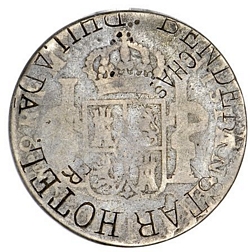
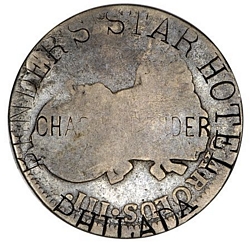
Bender’s Star Hotel on a Carlos III 2 reales (Stack’s Bowers Philadelphia Americana Sale, 30 September 2010, lot 5248)
BENDER'S STAR HOTEL PHILAd around, CHAs W. BENDER at center on both sides.
Charles W. Bender's Eating Saloon was located in the Star Hotel at 71 Dock Street, which premises he owned from 1842 to 1848.
Orra Bennnett and A. Henshaw, Lyons, New York
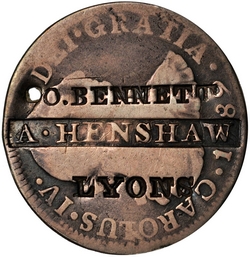
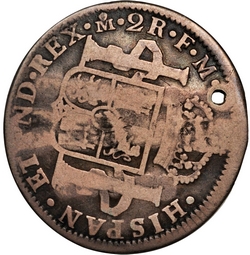
O. Bennett on 1789 2 reales (Stack’s Bowers Philadelphia Americana Sale, 14 September 2011, lot 669)
O. BENNETT / A. HENSHAW / LYONS
A. HENSHAW bar punch plus the punch of O. Bennett from Lyons, NY., above and below the central mark.
Orra Bennett made percussion halflock guns in Lyons, New York. A. Henshaw, who was a gunsmith in the nearby community of Newark. This unique piece is listed as a Hard Times token by RulauRulau, 2001.
Casper M. Berry's Saloon, Philadelphia, Pennsylvania
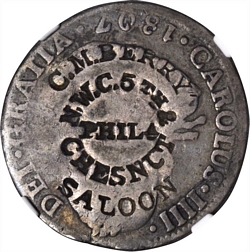
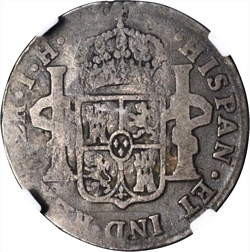
C. M. Berry (Stack’s Bowers ANA auction, 13 August 2019, lot 201)
C.M. BERRY / N.W.C. 5TH & / PHILA / CHESNUT / SALOON on an 1807 Mexico 2 reales.
The Philadelphia directories from 1848 onward noted that Casper (Caspar) M. Berry was an agent, innkeeper or tavern keeper, but his restaurant only was located at 5th and Chestnut Streets from 1859 to 1861. In June of the latter year Berry enlisted in the 26th Pennsylvania Infantry at the age of thirtyeight. He was mustered out in 1862, re-enlisted in the 60th Pennsylvania Infantry in 1863, and had risen to the rank of major by the time of the Battle of Williamsburg in 1862. He was mustered out again in late 1863 after serving with distinction, and the 1864 Philadelphia Directory noted that he was running a hotel at 106 South Sixth Street.
L. L. Bevan's Eating Saloon, Pottsville, Pennsylvania
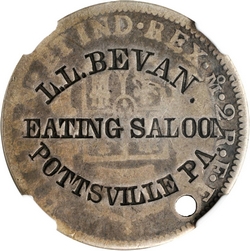
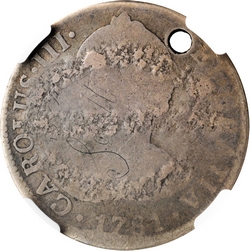
L. L. Bevan (Stack’s Bowers ANA auction, 14 August 2013, lot 21671)
L.L. BEVAN. / EATING SALOON / POTTSVILLE, PA. on an 1781 Mexico City 2 reales.
The right upright of "N" in SALOON is broken, and the "A" of PA is actually an inverted "V." There is also a neat hole at 1 o'clock and a name "? Scott" lightly carved in script into the obverse.
Lewis L. Bevan was also the postmaster of Pottsville in 1857Herbert Bell, History of Northumberland County, 1891.
Blanchard House, Monmouth, Illinois
From 1858 to 1870 Edward Blanchard was the saloon keeper and owner of the Blanchard House.
BLANCHARD HOUSE / MONMOUTH / ILL known on Two Reales.
Lynott Bloodgood, Albany, New York City and Utica, New York
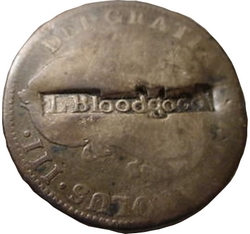
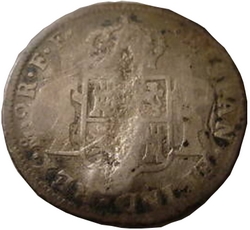
L BLOODGOOD known on two reales.
Lynott Bloodgood began silversmithing in Albany circa 1805, and soon went into partnership with James A. Bloodgood in Utica, where he remained until 1810. He later worked in New York City.
Bolivar, Philadelphia, Pennsylvania
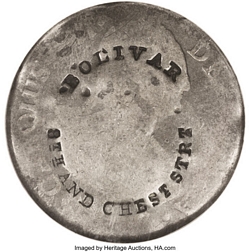
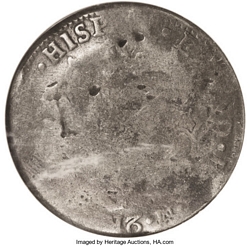
Bolivar on a 1784 two reales (Heritage Auction 416, 16 September 2006, lot 5961)
BOLIVAR / 8TH AND CHEST STRT
William Carels operated the Bolivar House at 203 Chestnut Street from 1827 to at least 1848.
Boston
BOSTON known on 1834 eight reales
Many of these coins were produced from the same stamp, which means that Boston is the name of a person or firm, rather than the city. A possibility is the Boston Type and Stereotype Foundry. It was founded in 1817, and was still in business in 1892.
James Bradley, New York
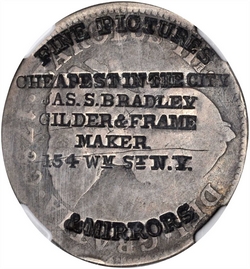
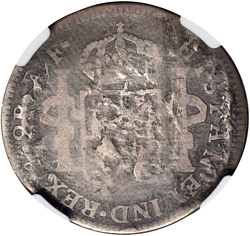
Bradley (Stack’s Bowers Baltimore Auction, 21 March 2018, lot 768)
FINE PICTURES / CHEAPEST IN THE CITY / JAS. S. BRADLEY / GILDER & FRAME / MAKER / 154 WM ST N.Y. / & MIRRORS on a 1780 Mexico City 2 reales. This is the most extensive of the Jas. Bradley countermarks.
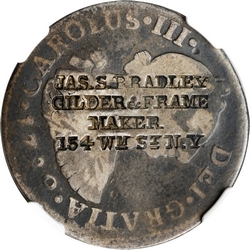
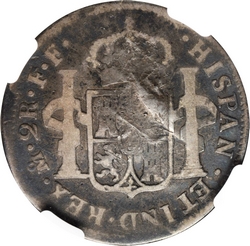
Bradley on a 1789 Mexico City 2 reales (Stack’s Bowers ANA auction, 14 August 2013, lot 21679)
JAS. S. BRADLEY / GILDER & FRAME / MAKER / 154 WM ST N.Y. .
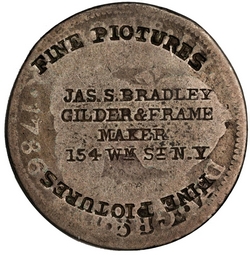
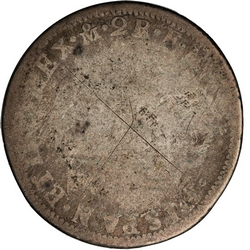
Bradley on a 1786 Mexico City 2 reales (Stack’s Bowers Philadelphia Americana Sale, 14 September 2011, lot 672)
FINE PICTURES / JAS S BRADLEY / GILDER & FRAME / MAKER / 154 WM ST N.Y. / FINE PICTURES.
JAS S. BRADLEY, N. Y. / FINE PICTURES / CHEAPEST IN THE CITY known on 1826 2 reales
In 1855 James S. Bradley's business was listed at 154 William Street, with his residence at 55th and Broadway.
J. K. Bresnin
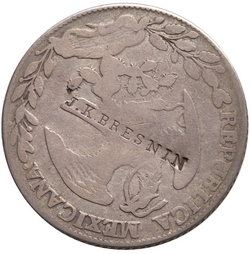
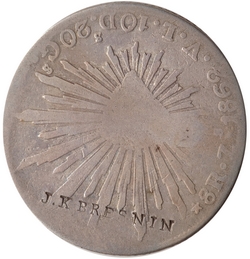
Bresnin on an 1862 8 reales (Heritage Auction 63162, 3 January 2021, lot 44066)
J.K. BRESNIN
Broadway Varieties
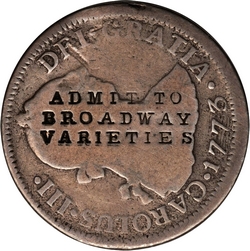
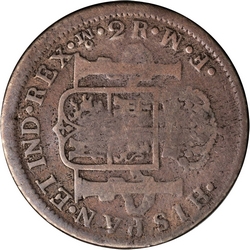
Broadway Varieties on a 1786 Mexico City 2 reales (Stack’s Bowers Philadelphia Americana Sale, 14 September 2011, lot 674)
ADMIT TO / BROADWAY / VARIETIES. An advertisement for Parisian Varieties indicated that it was a burlesque house, and so the Broadway Varieties also may have been a "strip joint."
J. T. Brown, Portland
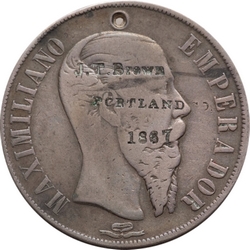
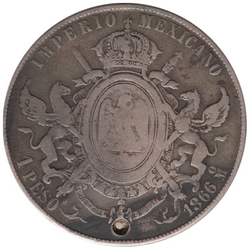
J. T. Brown on an 1866 Maximilian 1 peso (Heritage Auction 63162, 3 January 2021, lot 44072)
J.T. BROWN / PORTLAND CO. / 1867
The Portland Company was a part of the heavy industries in New England, building steam locomotives, railcars, and naval vessels
Bryan
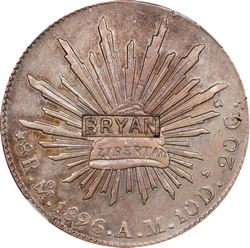
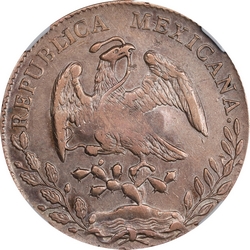
Bryan on a 1896-Mo 8 reales (Stack’s Bowers auction, 11 December 2024, lot 70379)
BRYAN
F. S. Bryant, Kennebunkport, Maine
Bryant was a silversmith active in the early 1860s.
F. S. BRYANT known on 1842 Two Reales
E.C.
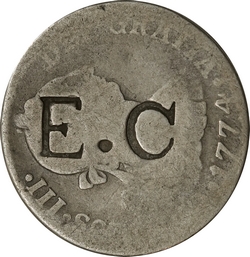
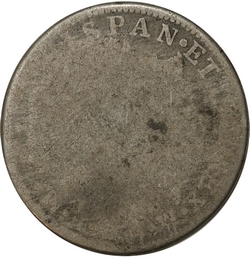
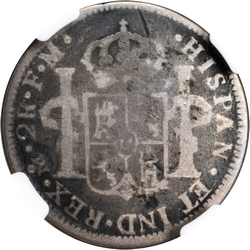
E. C on a 1774 Mo FM 1 Real
C. Cannon, Dubuque, Iowa
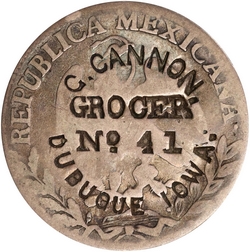
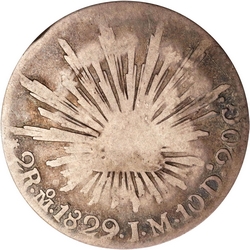
C. Cannon on a 1829 Mexico City 2 reales (Stack’s Bowers auction, 19 September 2024, lot 95645)
C. CANNON. / GROCER / NO. 41 / DUBUQUE IOWA. on the reverse of a 1829 Mexico City 2 reales.
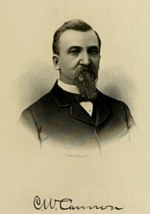 Charles Wesley Cannon was the son of George Cannon, a merchant in Dubuque, Ohio. In 1852 Charles, who was at that time only sixteen years of age, took over his father’s business and the experience gained at that time proved of great value to him in later life. In 1859, a partnership was formed with George B. Smith, and under the firm name of Cannon & Smith their house became one of the most successful in Iowa. City directory advertisements noted that Charles and his younger brother Henry sold groceries at 41 Main Street from 1857 to 1860.
In 1863, soon after the double bereavement of their father and their only sister, Charles and Henry decided to try their fortunes in the far west. They accordingly sold out their business and made a hazardous four months’ journey from Dubuque to Virginia City, Montana, being attacked by Indians and suffering other privations on the way.
In Virginia City they began merchandising under the name of Cannon Brothers. A year later they moved to Helena, Montana, which was then a little mining camp. After having conducted a business for a year Cannon returned to St. Louis. There he formed a partnership with Captain F. H. Kerchiville and Mr. M.S. Mullen, the style of the firm being Kerchiville, Cannon & Company. They chartered three steamboats, loaded with goods and miners' supplies, and sent them to the store in Helena, the boats being unloaded at Fort Benton and brought from there by wagon to Helena. Their venture proved a great success. The business was continued by the firm in Helena until 1869, when Cannon purchased the interests of his partners and continued it successfully until 1880. That year he sold out, retired from merchandising, and gave his attention to real estate, mining and other business interests, which by his capable and sagacious management, grew to enormous proportions. Prosperity continued to attend him and he became a millionaire - the largest taxpayer in Helena, a city noted for its large portions of wealthy citizens. He platted and sold several additions to the capital city of Helena, and was a large owner of real estate in Helena, Butte and Great Falls, besides mining properties in Montana and Idaho, some of which were very rich. He was practically the father of the gas, electric light and street railway systems of Helena, being president of the respective companies. He was also vice-president of the Montana Central Railroad and director in the Montana National Bank for several years. In addition, Cannon and his brother Henry, under the firm name of the Cannon Sheep & Cattle Company, were among the largest wool growers in Montana. Their ranch comprised sixteen thousand acres, required forty-seven miles of fence to enclose it, and was stocked with nearly twenty thousand sheep, besides cattle and horseshe Helena Independent, 7 September 1909. Cannon’s wealth was estimated at $2,500,000 in 1891Dubuque-Times, 13 January 1891.
Cannon lost a fortune in the financial panic of 1893, but the years that followed witnessed a wonderful development in Helena and Montana and Cannon lived to have his faith in Helena vindicated and his dreams of a city beautiful and substantial realizedThe Helena Independent, 7 September 1909.
He died in September 1909.
Milo Chatfield, Bloomington, Illinois
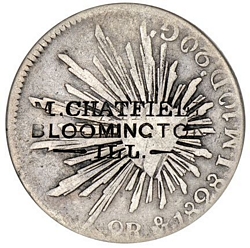
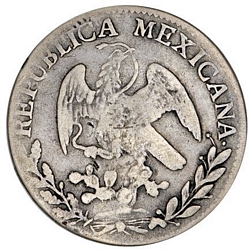
Chatfield on an 1828 Mo JM 2 Reales (Stack’s Bowers Philadelphia Americana Sale, 30 September 2010, lot 5249)
Deeply impressed M. CHATFIELD / BLOOMINGTON / ILL. on three lines diagonally across.
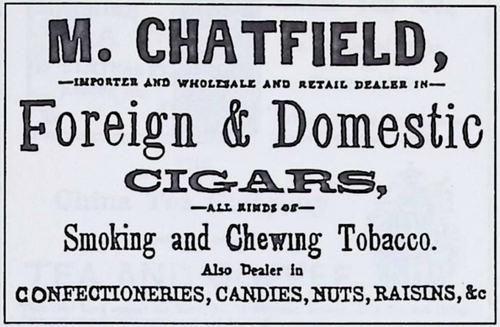
Milo Chatfield was born on 25 December 1819 in Clark County, Ohio. As a Bloomington, Illinois, grocer he advertised in the 1865 directory as "Importer and Wholesale and Retail Dealer in Foreign & Domestic Cigars, all kinds of Smoking and Chewing Tobacco. Also Dealer in Confectioneries, Candies, Nuts, Raisins, &c.". He held a variety of offices, including alderman (in 1858) and street commissioner. In the 1873 city directory his occupation was given as a carpenter, and in 1880 he was listed as mail carrier (he was the first letter-carrier of BloomingtonGratiot County Herald, 15 November 1889).
He died on 11 November 1889 in Bloomington, at the age of 70.
Christy and Woods Minstrels, New York
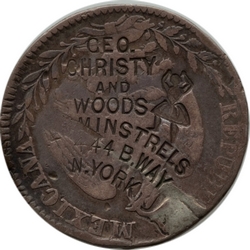
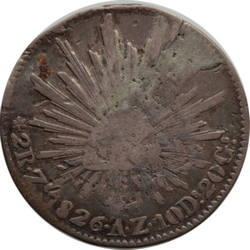
Christy and Woods Minstrels on an 1862 2 reales (Heritage Auction 63162, 3 January 2021, lot 44097)
GEO. / CHRISTY / AND / WOODS/ MINSTRELS / 444 B. WAY / N. YORK / Man dancing left and woman dancing right
This large countermark almost always is weakly struck so that only the male or the female dancer is clear. The stamp also is awkwardly cut. GEO. / CHRISTY / AND / WOODS and the two dancers are symmetrically placed, but the rest of the legend is curved and angled to get all the words on a badly designed stamp.
During its heyday, from the 1840s to the end of World War I minstrelsy was the major exponent of entertainment in America. Many well known persons began in the minstrels-for instance John Wilkes Booth and many stars that later entered vaudeville. Many composers, such as Stephen Foster and Shakespeare Hays, gained popularity with their musical being heard in the minstrels. One history recalls:
The first Negro song ever heard in public was Dixon's "Coal Black Rose," which was followed by others from the same eccentric composer and vocalist. About the same period, Thomas D. Rice, an actor, while on a summer tour with a strolling company in the South, was struck with the novelty of some of the melodies of the plantation Negroes, and selecting one of the liveliest and most grotesque in character, introduced it at the Bowery theatre the following winter. It being regarded as a mere trifle that might, perhaps, amuse an audience for a few moments between the play and the farce, not much was anticipated, either by manager or actor of "Jim Crow"- for it was that famous ditty - but it proved attractive enough in itself alone to fill the Bowery, and Pelly's Theatre in Boston, on alternate weeks, for months succeeding. A more stupid set of doggrel rhymes were never strung together, but there was something in the lively air, combined with the dance and ludicrous attitude of the singer at the conclusion of each verse, that took the popular fancy, and its fame spread far and wide. A Broadway music publisher lost no time in securing the copyright, and issuing in a showy form, with a vignette of "Jim" upon the title-page. Ere many days elapsed it was familiar as household words in every dwelling.
As the Jim Crow performances lost their novelty Negro minstrelsy assumed a new and improved phase in the class of melodies that were for several years so universally popular. In 1843 E. P Christy, the Julian of Ethiopian music, made his first bow to the public as a manager. Procuring a large hall, with galleries, in Broadway, he opened a permanent concert room, and so rapidly did the new order of music grow in public favor, combined with the good taste that pervaded Christy's entertainments, the place was crowded nightly for the two or three following years, by the most respectable classes of our citizens.
The third year, after a most successful tour in the meantime in Europe, he erected an opera house on Broadway, and, with the accessories of scenery, etc., produced, in burlesque, the most popular of the grand operas. In this, as in every other enterprise he may be said, literally, to have "coined money," Rival establishments started into existence, but he always managed to take the lead among them. After acquiring a fortune of nearly a quarter of a million of dollars, he retired several years since from public lifeHistory of White-Negro Minstrelsy, Portsmouth Journal of Literature and Politics, 1 November 1862.
In 1846 Christy's Minstrels was located at 472 Broadway, but then moved.
The performances of Mr. Christy and company will open at the "New Hall of Minstrelsy" No. 585 Broadway, on Monday evening. The hall has been ornamented for the purpose. The quality of the minstrels, however, is the recommendation of the entertainment. These singers have been popular for many yearsNew York Tribune, 21 June 1862.
Christy had an unfortunate death.
The circumstances attending the death, in this city, of the well known E. P. Christy, completes the singular fact that the three originators of one of the most prominent musical novelties of the nineteenth century, Negro minstrelsy, all came within a brief period of each other to a miserable end. George W. Dixon, who composed and sang the first Ethiopian melody ever heard upon the stage, died, in a charity hospital at New Orleans. Thomas D. Rice, better known as, "Jim Crow Rice," who was the first to introduce Negro opera and farce, died in New York, of delirium tremens: and E. P. Christy, who elevated the idea to the highest point of which it was susceptible, that of burlesque or the grand opera, came to his end from injuries received while laboring under a species of Insanity, by throwing himself from an upper window of his dwellingPortsmouth Journal of Literature and Politics, op. cit..
Possibly a comment on the social consequences of blackface.
Christy and Wood's Minstrels was organized in 1853 as the successor to Christy's Minstels. Eventually it was just called Wood's Minstrels.
George Gibbs Clark, Providence, Rhode Island
George Gibbs Clark was born in October 1792, He worked as a silversmith as early as 1813 and was listed in Providence directories until 1868. In 1824 his address was 27 Cheapside, and he noted "Watches cleaned and repaired and jobs in jewelry and silverware executed with neatness and dispatch." From 1826 to 1836, he was a partner of Lorenzo D. Anthony in Clark and Anthony, also at 25 and 27 Cheapgate, which also countermarked coins.
He died on 31 October 1869.
GEO. G. CLARK known on 1821 Two Reales
R. Clark
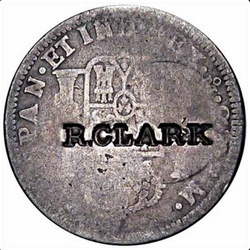
R. Clark on a 1786 Two Reales (Steve Hayden Auction 37, 10 November 2012, lot 572365)
Cooper's Coffee Room, New York, New York
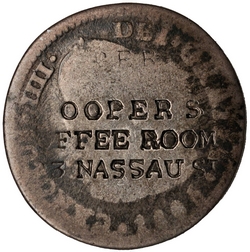
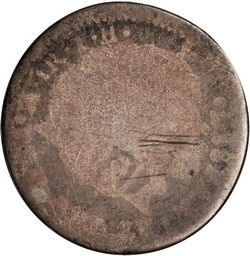
Cooper’s on an 1806(?) Mexico 1 real (Stack’s Bowers Philadelphia Americana sale, 1 September 2011, lot 688)
COOPER'S / COFFEE ROOM / 103 NASSAU ST. known on One and Two Reales
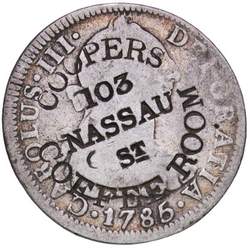
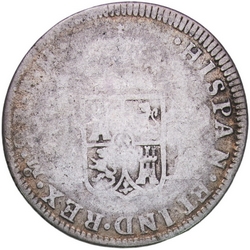
Cooper's on a 1785 Mexico 2 real
COOPER'S / 103 / NASSAU / ST. / COFFEE ROOM known on Two Reales
According to RulauRussell Rulau, , James G. Cooper sold coffee and soda in 1856.
R. D'Angelo, Newark, New Jersey
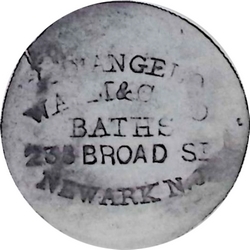
According to the 1854 Newark Directory, D'Angelo was a barber at 238 Broad Street.
R. D'ANGELO / WARM & COLD / BATHS / 238 BROAD ST / NEWARK N. J. known on an 1828 Two Reales
Dr. Darby, Boston, Massachusetts
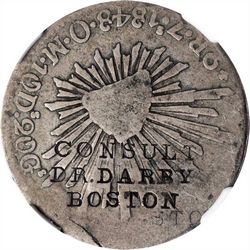
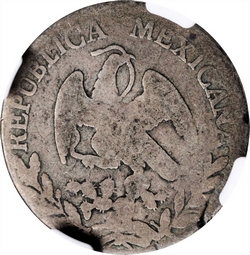
Dr. Darby on an 1848 Zs OM 2 reales (Stack’s Bowers, auction, 24 March 2021, lot 1368)
CONSULT / DR. DARBY / BOSTON
Ralph H. Darby appeared as an apothecary in 1850 at 91 Broad Street in his first Boston directory listing. By 1853 he was listed as a physician at 104 Norfolk Street. The 27 July 1853 Boston Herald noted that "Doctor R.H. Darby has removed his Office and Medical Hall to corner of Fleet and Moon Streets." Beginning in July 1854 he frequently advertised in The Boston Herald that "Dr. Darby can be consulted confidentially on all Complaints at his Office, torner of Fleet and Moon streets, Boston. His mode of treatment (adopted from the London and Paris Hospitals,) is universally successful." He ceased advertising in late 1855, and by 1858 was not listed in any directories.
Many of Darby's countermarks are oddly double struck. Thus, in the coin illustrated, the counterstamp is neatly executed upside down on the upper third of the obverse, with faint traces of an earlier counterstamp discernible as the letters STO below the primary ON in BOSTON
J. T. Davis
J. T. DAVIS known on 1846 Eight Reales
S. Davis
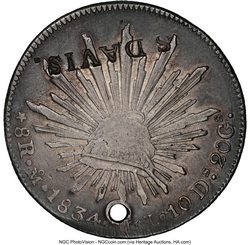
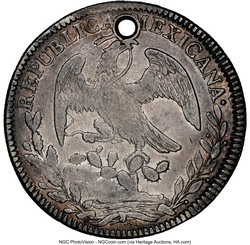
S. Davis on an 1834 Mo 8 Reales (Heritage Auction 61560, 27 October 2025, lot 21184)
S. DAVIS
E. Day, Brooklyn, New York
E. DAY / BROOKLYN known on 1825 Two Reales
William P. Dewitt, Elmira, New York
William P. Dewitt was born in New York state about 1813 and worked as a gunsmith in Elmira, New York, from about 1835 to about 1880. He was known for his walnut stocked target rifles, and his superposed guns with rifle/shotgun stacked barrels. He also made a few side hammer guns, often called "mule ear" guns. . His shop was located at 418 Water Street opposite the Chemung Canal Bank.
W. P. DEWITT known on 1828 One Real
W. P. DEWITT / ELMIRA known on 1828 One Real
Henry Disston, Philadelphia, Pennsylvania
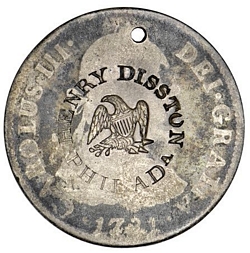
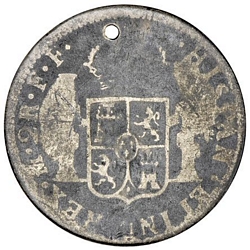
Henry Disston on a 1781 Mo FF 2 Reales (Stack’s Bowers Philadelphia Americana Sale, 30 September 2010, lot 5237)
HENRY DISSTON PHILADa around a federal-style eagle with branch and arrows at center of obverse.
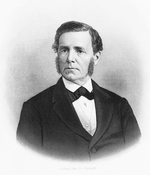 Henry Disston was born on 24 May 1819, in Tewkesbury, England. The family moved to Derby, when he was four for the father's work manufacturing machines that produced lace. His father invented a machine to make a special fine lace and was invited to introduce the machine to a mill in Albany, New York. He arrived in America, as a boy of 14 with his father and 16-year-old sister, Marianna. Three days after arriving in Philadelphia they were orphaned by the sudden death of their father. Henry Disston was taken in as a saw-maker's apprentice at Lindley, Johnson & Whitcraft. He left that company in 1840 and started his own saw-making business.
By 1850, Disston's saws were renowned in the United States, even compared against the English manufactures that were considered superior. By 1859, Disston had 150 people working for him. During the American Civil War, a protective tariff on foreign manufactured goods helped expand Disston's enterprise, and despite a fire that ruined the factory, Disston prospered through the 1860s. During the war, Disston had success when he switched some production from saws to war supplies such as sabers, bayonets and guns.
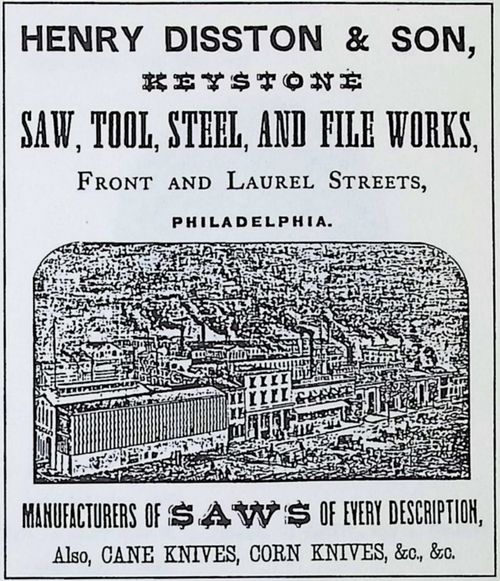
By 1871, Disston's saw mill had outgrown its factory and he moved the business to the outlying neighborhood of Tacony, in what is now Northeast Philadelphia.
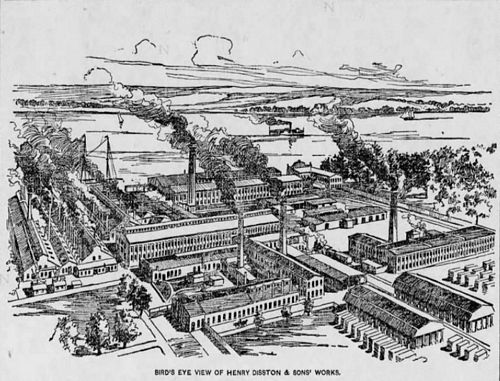
Disston constructed homes for his workers, and designed them in an effort to improve their surroundings from their former dwellings in Philadelphia. The Disston family owned more than 600 homes that were rented to workers and many others were built and sold to workers.
By the late 1870s, Disston's business and social enterprises were succeeding, but his own health was failing. After falling ill in 1877, he suffered a cerebral haemorrhage and died at his home in Philadelphia on 16 March 1878.
Ebling's Columbian Garden, New York
The Bowery in lower Manhattan was the centre for culture -- high as in theatres, low as in gambling dens and ladies of the night. Somewhere in between was the vast Atlantic Garden beer hall at 150 Bowery, memorialized on Civil War tokens and famous for two huge orchestrions or automatic orchestras, the first installed in the 1860s and its successor brought after being a sensation at the World's Columbian Exposition in 1893.
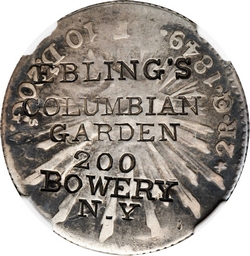
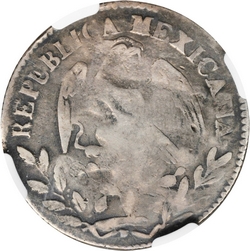
Ebling’s on an 1849 2 reales (Stack’s Bowers ANA auction, 14 August 2013, lot 21714)
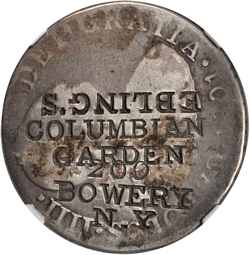
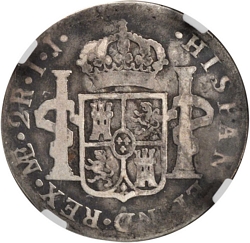
Ebling’s on an 1802 2 reales (Stack’s Bowers Baltimore auction, 26 June 2017. Lot 12236)
This example has the first line of the stamp inverted.
EBLING'S / COLUMBIAN / GARDEN / 200 / BOWERY / N.Y
Joseph E Ebling was born in Pennsylvania in 1818. He was a confectioner according to the New York City Directory of 1839-1840 and the census of 1850. Originally on Houston Street, his confection shop was located at 200 Bowery in the 1840s and 1850s.
Subsequently, Ebling was the commissioner of streets and lamps: in 1856 a jury was unable to come to a verdict in a case that accused him and other municipal officers of "downright villainy, corruption, peculation, robbery and swindling," related to the purchase of street sweeping machinesNew York Herald, 28 January 1856. He was acquitted after a second trial. In 1857 he was entrusted with the responsibility of receiving proposals for lighting street lamps with gas and furnishing and laying the needed supply-pipes for those lamps for blocks above 79th Street in New York CityNew York Evening Express, 6 March 1857.
In June 1857 Ebling was elected commodore of the Harlem Model Yacht ClubNew York Herald, 4 June 1857. The census of 1860 noted that his occupation was "gentleman" and that he owned real estate valued at $15,000 and had a personal worth of $5,000. On 7 July 1861, his son, Eugene W. Ebling, a corporal in Company A of the 11th New York Infantry was shot in the forehead and instantly killed at the Battle of First Bull Run, Virginia.
During the Civil War, Joseph Ebling enlisted at Albany, New York, as a quartermaster on 23 July 1862, was commissioned into the Field and Staff of the 164th New York that same date, and tendered his resignation on 2 October of that year. He last lived in New York City at the foot of East 121st Street and the Harlem River. His death in 1868 was caused by heart disease.
Thomas L. Ennis, Philadelphia, Pennslyvania
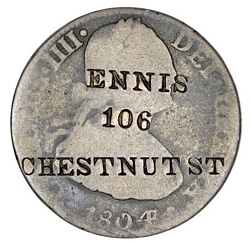
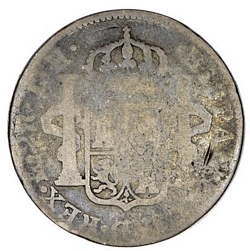
Ennis on an 1804/3 Mo TH 2 Reales (Stack’s Bowers Philadelphia Americana Sale, 30 September 2010, lot 5242)
ENNIS / 106 / CHESTNUT ST on three lines
Thomas Luques Ennis (born c. 1810) was the son of an Irish immigrant Thomas Ennis and Philadelphia Quaker Lydia Cassel. He grew up in Philadelphia where his father was an Inspector of Butter and Lard. It is probably through his mother's Quaker family connections that the son picked up his photography career. Quakers were daguerreotypists in Philadelphia, but more importantly were patrons and frequent customers for portrait daguerreotypes. In the 1850 U.S. Census, Thomas L. Ennis is living in Germantown, Pennsylvania, as a widower with four children ages five to fourteen. Thomas Ennis' occupation was listed in the census as "degarotypist."
As with many photographers of his day, the business address for Thomas Ennis changed frequently. It has been observed that the address of the photographer reflected the importance and in much respect the quality of their product. Ennis did business from 106 Chestnut Street in Philadelphia from 1851 to 1853, then moved his Gallery to Cleveland, Ohio in 1853 with a return to Philadelphia in 1856. Certainly, he had returned to Arch Street in Philadelphia by 1856.By 1860 he has moved with his family to Charlottesville, Virginia according to the 1860 Census. Thomas, his son George, and his nephew Henry C. Brooks all have an occupation of "Ambro Typist." An advertisement appears in a Lynchburg, Virginia newspaper in February 1860 proclaiming the variety of products he has availableLynchburg Daily Virginian, 3 February 1860.
The timing for a new studio in Virginia could have been better. The Civil War began in 1861. It is unknown what happened to Ennis's studio. By March of 1862, he is in Richmond , probably working at C. Rees's Photograph Gallery. In the 1870 U.S. Census, T. L. Ennis is back in Charlottesville without family and is listed as a Hotel Clerk at an establishment owned by Rice G. Bailey. Sometime after 1870, he returned to Philadelphia. Thomas Luques Ennis died on 20 September 1875 in Philadelphia. His occupation on the death certificate is given as "house carpenter"Kelvin Ramsey, The Family Business: Thomas L. Ennis and George O. Ennis.
J. D. Field, New Brunswick, New Jersey
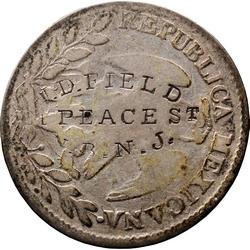
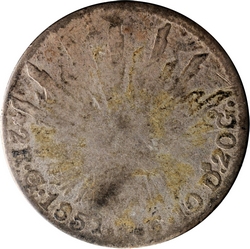
J. D. Field on 1851 Go 2 reales (Stack’s Bowers ANA auction, 14 August 2013, lot 21717)
J. D. FIELD / 21 PEACE ST. / N.B.N.J..
In 1855 J. D. Field & Co. sold ice-creamJohn P. Wall, The Chronicles of New Brunswick, New Jersey, 1667-1931, privately printed, 1931.
Flanagan's Punch, Philadelphia, Pennsylvania
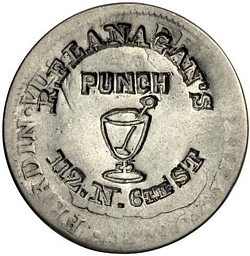
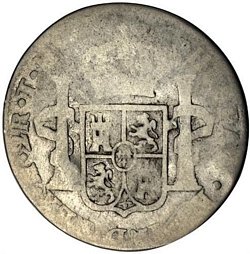
Flanagan’s on an 1809 Mo TH 2 reales (Stack’s Bowers auction, 20 March 2007, lot 2256)
FLANAGAN'S PUNCH / 112 N. 6th STREET around a glass with a stirrer, one of relatively few motifs or icons on coins in this category.
Robert Flanagan ran the Lyon's Hotel from 1835 to 1860. Its original address was 112 North Sixth Street, which was changed to 159 sometime in the 1850s.The bar was known as the Vulcan Hall and Flanagan's Punch seems to have been the drink of the day.
J. Forker
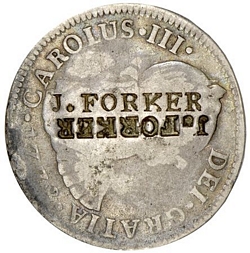
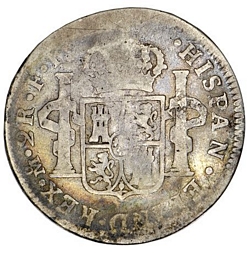
J. Forker on a 1778 Mo FF 2 Reales (Stack’s Bowers Philadelphia Americana Sale, 30 September 2010, lot 5235)
J. FORKER twice vertically
J.F.G
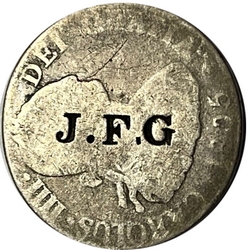
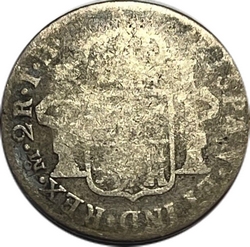
J.F.G on 1805 Two Reales
A similar “J.F.G” stamp appears on percussion fullstock rifles. So this person either was a gunsmith or an arms inspector (Russell Rulau).
J.F.G known on Two Reales
J. G. G.
J. G. G. on a 1805 Mo TH 2 reales
William Gurley, Troy, New York
WM. GURLEY / TROY / NY known on an 1826 Eight Reales. This countermarked coin is quite interesting since it is made from individual letter punches, and has a center hole, suggesting that it once was mounted on some object.
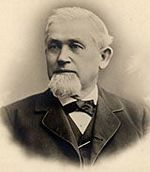 William Gurley was born in Troy, New York, on 16 March 1821. He received the best education afforded by the schools in this vicinity, and choosing the profession of a civil engineer, attended the Rensselaer Polytechnic Institute, from which he graduated in 1839. He worked as a surveyor for a few years and then joined the firm of Oscar Hanks, who was a well-known maker of surveying instruments and church bells in Troy. He worked for Hanks for five years.
In 1845, Gurley established his own scientific instrument manufacturing business in partnership with James Phelp, who had had his own shop since 1838. They called the business Phelps & Gurley. In 1844, William Gurley's brother Lewis Ephraim Gurley joined Phelps' shop as an apprentice and he then attended Union College from 1847 to 1851. Lewis Gurley rejoined the firm in 1851, at which point it was renamed Phelps and Gurleys. In 1852, Phelps sold out his interest and the business was renamed W.& L.E. Gurley, and coins are known counterstamped W. & L. E. GURLEY / TROY, N. Y..
The brothers’ factory operated in departments, each department turning out different components, which were then assembled. This revolutionized the industry which, to that time, operated as small shops making, essentially, individual instruments. Gurley was able to roughly halve the price of their instruments over those of their competition, while maintaining quality.
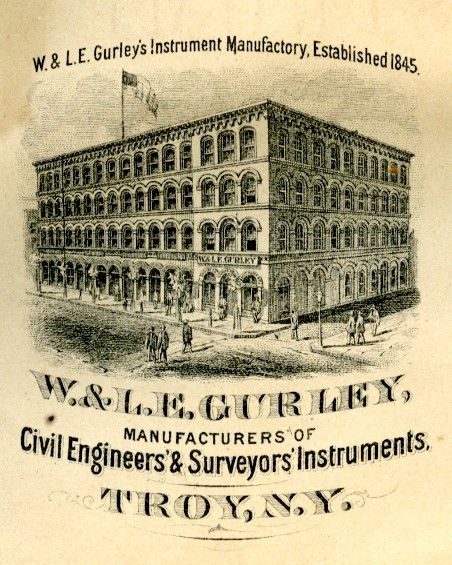
The firm still exists today as Gurley Precision Instruments.
William Gurley was for many years he was connected with the YMCA, and in 1851 was elected its president. He served as alderman from 1860 to 1864, and as fire commissioner he helped to improve fire prevention systems in major cities. He was a member of the New York State Assembly in 1867. In 1868, he was appointed by the Secretary of the Treasury to serve on a commission with Prof. Joseph Henry and other scientific experts to examine the best meter devised for determining the products of distillation, to be subsequently adopted by the department.
Gurley was a long-time trustee of Rensselaer, having been elected to that position in 1855. He was secretary of the institution from 1861 to 1872, vice-president from 1872 to 1887 and acting president from 1886 to 1887.
He died on 11 January 1887, in Troy.
G. W. Hastings, Earleville, New York
G. W. HASTINGS known on a counterfeit 1844 Eight Reales.
G. W. Hastings also issued cardboard chits during the Civil War.
G. W. Hastings died on 29 December 1883The Wellsboro Agitator, 15 January 1884.
Heall
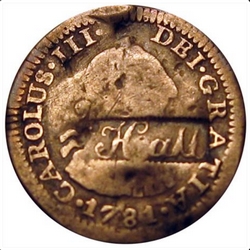
Heall on a 1781 One Real (Steve Hayden Auction 35, 10 October 2011, lot 207415)
Heall in raised script letters in a rectangular saw-toothed depression. The second letter is indistinct and there may also be a leading initial.
Houck's Panacea, Baltimore, Maryland
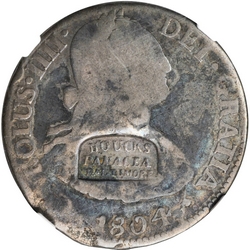
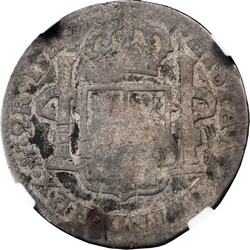
Houck’s Panacea on an 1804 Mexico City 2 reales (Stack’s Bowers ANA auction, 14 August 2013, lot 21748)
HOUCK'S / PANACEA / BALTIMORE
Jacob Houck was born in Frederick, Maryland in 1791. He moved to Baltimore in 1828, and had a dry goods store at 121 West Baltimore Street "opposite the Museum." In 1834 he started selling his panacea, and advertised in the 1835 to 1842 business directories that it was prepared solely from vegetable matter and helped in virtually every illness. Its primary ingredient was Rye Whiskey, along with sugar, gum guaiac, oil of juniper, and oil of lemon per its US patent of 9 May 1833.
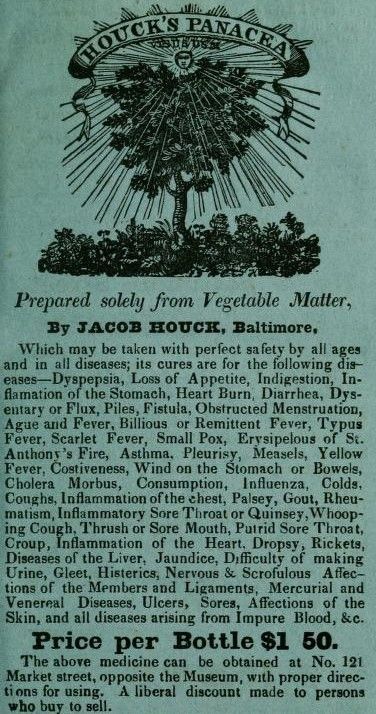 advert (Matchett’s Baltimore Directory, 1835, p. 19)
A bottle cost $1.50, which was three days wages for a farmhand in Maryland at the time, and Houck stated that a liberal discount would be given to those buying for resale. Eventually his shop was located at No 16, the corner of German and Hanover Streets. Jacob Houck died in 1850 and Henry T. Houck became the proprietor of the firmRussell (Rulau, The Standard Catalog of United States Tokens, 1700-1900, 1994.
Apparently Henry T. Houck sold the rights to his panacea since the 1855 Nashville, Tennessee Directory printed an advertisement by A. G. Goodlet, who now sold Houck's Panacea,"popular in both the South and the North." An old bottle indicates that the panacea was then made in Goddletsville, Tennessee, a town largely destroyed by a tornado in 2005.
James & Co, Boston, Massachusetts
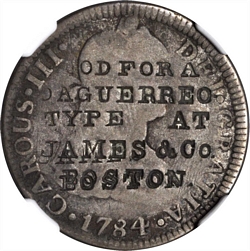
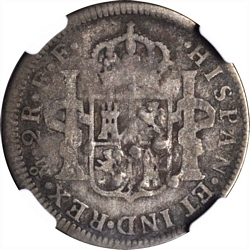 J
J
James & Co. on a 1784 Mexico 2 reales (Stack’s Bowers Baltimore auction, 27 February 2019, lot 270)
[GO]OD FOR A / DAGUERREO / TYPE AT / JAMES & CO. / BOSTON (The JAMES and BOSTON counterstamps are double punched).
David E. James advertised daguerreotypes in Boston from 1856 to 1858. He was listed in the 1857 city directory at 4 Summer Street as D. E. James & Co. His advertising card noted that he published a weekly magazine called The Daguerreotype.
The Patent Double Camera of James & Co., of which they have the exclusive right in the New England States is working wonders in the execution of pictures. Six hundred a day is a moderate day’s work for this establishment, and the accuracy and beauty of finish with which those 25 cent Daguerreotypes are clothed is not exceeded in pictures which at other places cost five dollars. Ladies out shopping should not fail to test the merits of the Double Camera of James & Co., corner of Winter and Washington streets. They will find Mr. Foss, the clerk of the house, affable and obliging, and always ready to exhibit specimens, whether the object is to obtain a picture or not. Pictures on glass are also taken in a superior manner and at low rates, and Daguerreotypes of every style and priceThe Boston Herald, 5 June 1856.
A Lady entered the daguerreotype house of James & Co., corner of Winter and Washington streets, yesterday, and inquired of the clerk, Mr. Foss, if she could have a picture taken and finished up in half an hour, as she had just that time before leaving for the cars. Mr. Foss replied that there would be no difficulty in accomplishing that, and in ten minutes delivered her two perfect likenesses of herself, executed at one sitting by their patent Double Camera, from which to select the one that suited her. She was so well pleased with them that she took them both, and departed with an air of astonishment at the expeditious and perfect manner in which they have been produced. James & Co.’s is the place to get good pictures taken, cheap and expeditiouslyThe Boston Herald, 13 June 1856.
R. & J. D. Johnson, Middletown, Connecticut
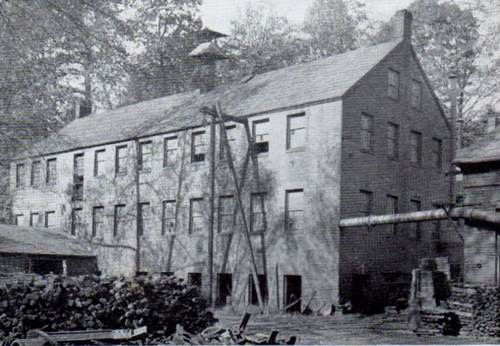
R. and J. D. Johnson Gun Shop, Mill Hollow
John R. & J. D. Johnson were gunsmiths in Middletown, Connecticut, Around 1815 they built a factory on Lower Pameacha for the manufacture of rifles for the government. They employed from 25 to 30 workers and made from 1,000 to 1,200 rifles a year. They did a successful business until 1825 when the government contracts were discontinued.
This coin is countermarked from the stamp they used on the 3,000 model 1817 flintlock rifles that they supplied to the government from 1824 to 1827 Flayderman, Norman. Flayderman’s Guide to Antique American Firearms, 1990. p. 438.
US / Eagle / R. & J. D. JOHNSON on a 1784 Mo One Real
Jones' Exchange Hotel, Philadelphia, Pennsylvania
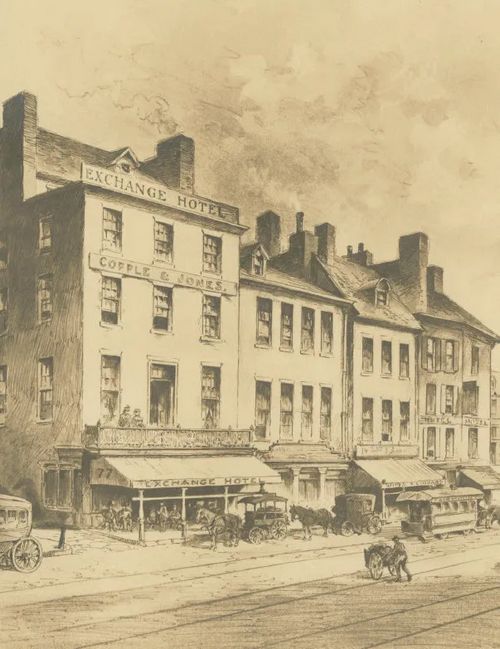
The Exchange Hotel in the 1840s
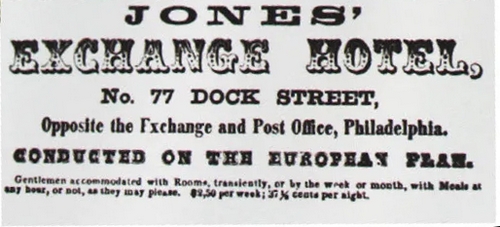
advert in the 1853-1854 W. W. Reilly & Co.'s Ohio State Businesss Directory
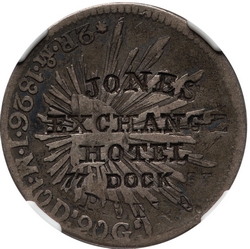
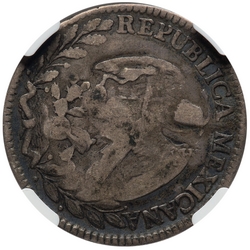
Jones' Exchange Hotel on an 1825 Two Reales (Heritage Auction 60515, 16 February 2026, lot 52118)
JONES / EXCHANGE / HOTEL / 77 DOCK ST. / PHILA .
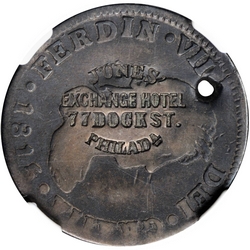
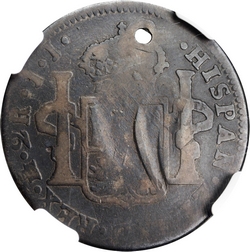
Jones on an 1815 Mexico City 2 reales (Stack’s Bowers ANA auction 14 August 2013, lot 21756)
JONES' / EXCHANGE / HOTEL / 77 DOCK ST. / PHILADA . (This is the slightly different variety of Jones' Exchange Hotel counterstamp with a smaller imprint and longer abbreviation of Philadelphia).
Richard B. Jones Jr. was born around 1822 in Pennsylvania, the son of a Montgomery County judge. After completing his education, he went to work for Charles W. Bender, a man well known to collectors of 19th-century merchant tokens as the owner of the Star Hotel at 71 Dock Street in Philadelphia.
On 19 September 1844, the New York Daily Herald reported “I understand that a new hotel is to be opened on Saturday next in Dock Street opposite the Exchange, upon the "Lovejoy" plan, by Bender's faithful and much liked assistant, young Richard B. Jones, who takes as his partner in business, Daniel Coppell [sic], also well known and exceedingly popular with our community. The house is to be called the "Exchange Hotel and Eating Saloon." I may remark that the establishment, particularly in the vicinity in which it is to be located, will be a desideratum and a great public accommodation-I bespeak for it on the part of the travelling community particularly, a liberal share of patronage”. The hotel was so called because of its proximity to the Merchants' Exchange, which was also on Dock Street.
In an advertisement for their four-story "Exchange Hotel and Eating Saloon" in the New York Daily Herald of 16 November 1844 the owners stated that they had refitted it with a well stocked bar and were serving “dinners, suppers and breakfasts at the shortest notice”. The rooms were "airy and well ventilated," and there was a large stable for horses. Their location was described as being "in the immediate vicinity of the principal banks, railroad and steamboat landings, and opposite the Philadelphia Exchange."
Copple and Jones remained in business together until early 1850, at which time they dissolved their partnership. Copple opened Copple's Hotel, at Carter's Alley and Exchange Place. He remained in business until his death in November 1857. On 2 December 1857, the entire contents of his hotel were sold at auction, along with "the good will of his well-known and popular establishment."
As for Jones, he remained at the 77 Dock Street establishment, which he renamed Jones Exchange Hotel. Shortly after that he assumed the title of colonel, which most likely was self-conferred. Business was good, and many dignitaries patronized his hotel. Jones also catered various events, and in December 1851, he prepared a banquet for 550 people in celebration of Hungary's Governor Louis Kossuth's visit to Philadelphia. Henry David Thoreau was another famous patron of the establishment: The journal of Henry David Thoreau, 1837-1861 states that on 20 November 1854, he “Put up at Jones's Exchange Hotel, 77 Dock Street; lodgings thirty-seven and a half cents per night, meals separate”.
By 1857 Jones had taken an associate or partner by the name of Thompson, and the 1858 directory included an advertisement for Jones & Thompson, Exchange Hotel, on Dock Street. Jones was only able to enjoy his new business for a few months. As it was reported in the 1 February 1858 Daily Evening Express of Lancaster, Pennsylvania, and several other newspapers,
Col. Richard B. Jones, well known as the keeper of the Exchange Hotel (Dock-st) Philadelphia for many years, and latterly as proprietor of a splendid Restaurant and Confectionery in Arch-st., met with his death in a violent and shocking manner on Saturday.
Jones lost his balance while leaning out of a third story window to latch a shutter at his new establishment and fell to the ground, fracturing his skull on a stone step. He died almost immediately.
Jones, who was only 35 years of age, was survived by his wife and two young children David Schenkman "Philadelphia's lncuse Lettering Tokens Of The 1850s" in The Numismatist, .
Dauphin C. Kendall, Boston, Massachusetts
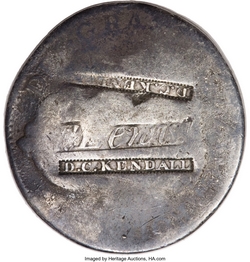
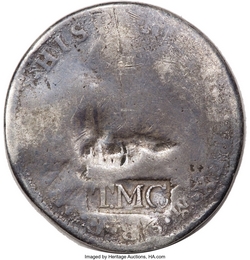
D. C. Kendall on1776 2 reales (Heritage Auction 462, February 2008, lot 81287)
This host coin has three different counterstamps. The first and most important is the name D. C. Kendall within a toothed border, and it has been counterstamped twice. This jeweler appears on a list of silversmiths and related craftsmen in the 1855 Boston, Massachusetts, directory. His full name is Dauphin C. Kendall, who operated out of 1 India Wharf. The second counterstamp appears to be T. Lewis and is under the Kendall counterstamp. We believe this was the first stamp on the coin. The third stamp is on the reverse, TMC in block letters with a toothed border.
T. Knight, New South Wales, Australia
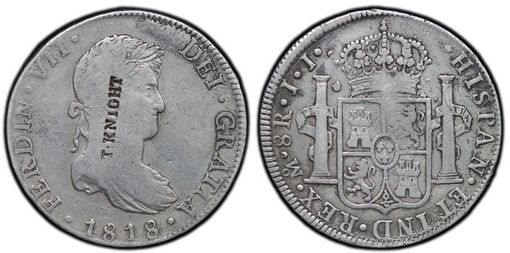
T. Knight on a 1818 Mo JJ 8 reales (Heritage Auction 61560, 14 February 2008, lot 21107)
This coin is stamped with the elusive and sought-after "T. Knight" countermark, traditionally found on the "Holey Dollars",
According to Gregory G. Brunk's Merchant and Privately Countermarked Coins and a number of other sources, this counterstamp is believed to have represented a gentleman that was a prominent bullion dealer based in the penal colony of New South Wales. While very little is known about the mysterious T. Knight, their importance to the colony should not be understated based on the counterstamp showing up on other issues of the era.
Knight's Mineral Water Saloon, Baltimore, Maryland
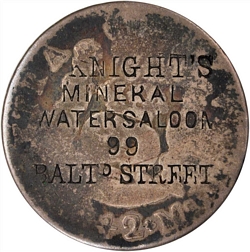
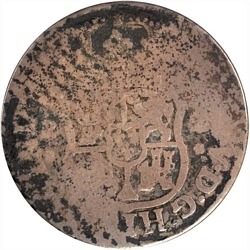
Knight’s on a 1742 Mexico City 2 reales (Stack’s Bowers Baltimore auction, 26 June 2017, lot 12151)
A. KNIGHT'S / MINERAL / WATER SALOON / 99 / BALTO STREET.
Albert Knight came to Baltimore in 1854. He first sold mineral water on the corner of Eagle and Hamilton Streets, and then at 99 Baltimore Street until 1860, when he went to Cuba. He returned to the US during the Civil War and sold mineral water for the Army Quartermasters Department. Knight died in New Bern, North Carolina in 1863.
F. D. Kohler & Co., San Francisco, California
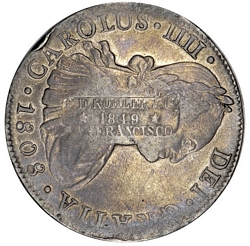
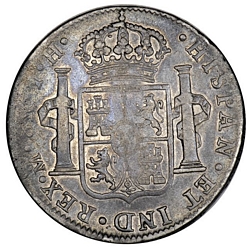
Kohler (Stack’s Bowers Philadelphia Americana Sale, 30 September 2010, lot 5250)
F.D. KOHLER & Co / 1849 flanked by stars / SAN FRANCISCO in rectangular lozenge vertically across the King's portrait.
F. D. Kohler was a private assayer during the early stages of the Gold Rush. In 1850 he was appointed California's state assayer, and sold his business to Baldwin & Company.
However, Brunk notes: "While these countermarked coins may have been made from a genuine stamp intended for marking ingots, they appear to have been struck during the 1950s and 1960s. It even is possible that they are still being made."
Kunkel's Opera Troupe, Baltimore, Maryland
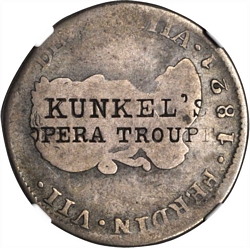
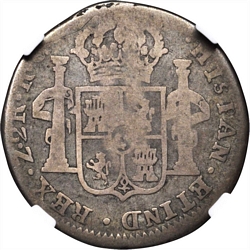
Kunkel’s Opera Troupe on an 1821 2 reales (Stack’s Bowers Baltimore Auction, 27 February 2019, lot 269)
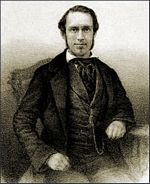 KUNKEL'S / OPERA TROUPE known on 1823 and 1833 Two Reales
George Kunkel was born in Greencastle, Pennsylvania in 1821. He managed theatres during the 1850s in Richmond and Washington and at one time John Wilkes Booth was part of his company at the Jenny Lind Theatre in Richmond, before he left for a better job at Ford’s Theatre in Washington. Kunkel moved to Baltimore, Maryland in 1855, where he managed the Old Front Street and Holliday Street Theatres and specialized in minstrel shows.
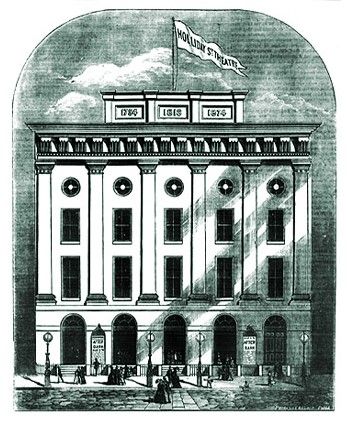
Holliday Street Theatre
A typical minstrel show consisted of comedic skits, accompanied by dancing, music, and variety acts, all performed by white entertainers who wore black makeup, and depicted minorities as buffoonish, superstitious, feeble-minded, and clumsy. By the late 1840s, minstrel shows had become quite popular in America, with many shows having adapted once artful operas into cheap boorish parodies. Given the adaptation of the opera genre, these companies of actors and their managers became known as ‘Opera Troupes’ and by the late 1850s, Kunkel’s company had become known as ‘Kunkel’s Opera Troupe.’
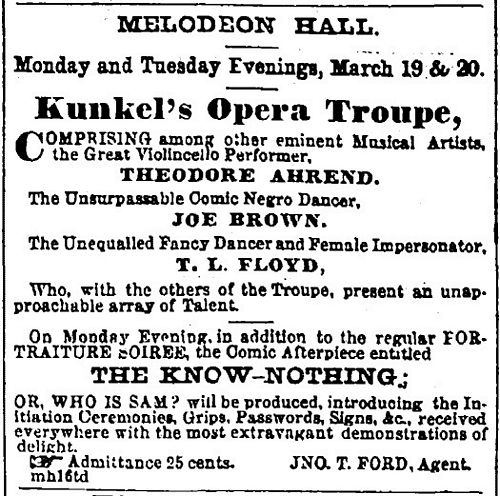
A listing from The Cleveland Leader, 17 March 1855
Kunkel died in 1855information from Aaron Packard, George Kunkel’s Opera Troupe Tokens of Baltimore.
G. A. Lawrence, Ithaca, Michigan
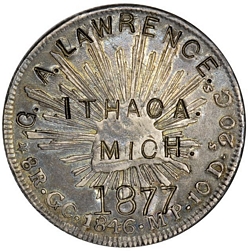
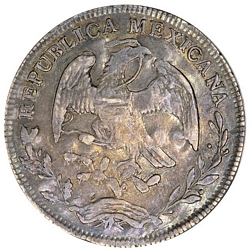
G. A. Lawrence on an 1846 GC MP 8 Reales (Stack’s Bowers Philadelphia Americana Sale, 30 September 2010, lot 5253)
G.A. LAWRENCE arches above ITHACA. / MICH. / 1877 counterstamped on three horizontal lines.
W. Levis, Philadelphia, Pennsylvania
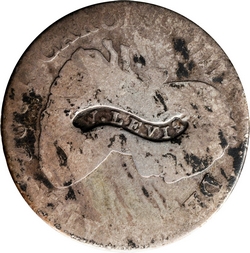
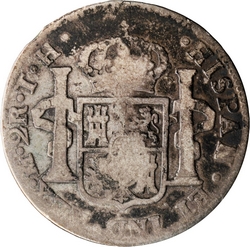
W. Levis on an 1807 Mexico City 2 reales (Stack’s Bowers ANA auction, 14 August 2013, lot 21778)
W. LEVIS
William Levis spelled his name as both "Levis" and "Lewis." He seems to have been born in 1785 and died in 1842 or 1849. Unfortunately, the accounts provided in reference works differ, and it has proven difficult to trace the details of his life. While it is clear from his stamps that Levis was a
silversmith, a person of this name is mentioned only infrequently in Philadelphia directories and usually with a different job, such as currier or an oil and leather merchant. That suggests William Levis worked near Philadelphia, rather than in the city itself. RulauRussell Rulau, op. cit. suggests he may have lived west of Philadelphia in Chester County, and that Levis also had a son of the same name. That, in turn, might explain why some countermarks are "LEVIS" and others are "LEWIS".
W. W. Long's Change Hotel, Philadelphia, Pennsylvania
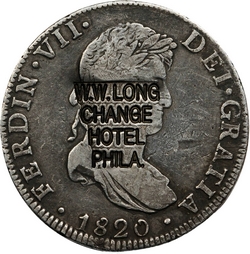
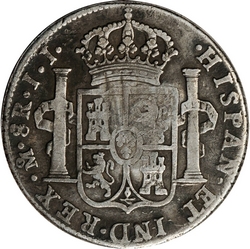
W. W. Long on an 1820 Mo 8 reales (Stack’s Bowers Philadelphia Americana sale, 14 September 2011, lot 749)
W.W. LONG / CHANGE / HOTEL / PHILA..
Also known as MUSEUM HOTEL / W. W. LONG / 376 SO 3D ST. PHILA. on a 2 reales. W. W. Long's Museum Hotel was listed in Philadelphia directories at this address from 1854 to 1857, when 3rd Street was renumbered. Long struck some of the most elaborate merchant tokens of the nineteenth century. On them he advertised "Pistol & Rifle Galleries, Bagatelle & Shuffle Boards, Liquors, Oysters, Segars, &c Refectory & Museum Hotel, Billiards & Bowling."
R. Lundy, New York, New York
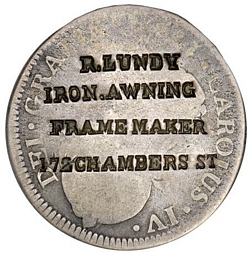
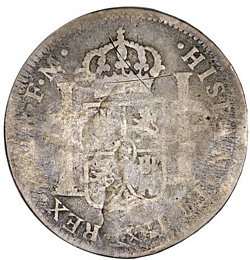
R. Lundy on 1790 Mo FM 2 Reales (Stack’s Bowers Philadelphia Americana Sale, 30 September 2010, lot 5239)
R. LUNDY / IRON. AWNING / FRAME MAKER / 172 CHAMBERS ST on four lines
Robert Lundy was listed in the 1850 Census as a blacksmith in Ossining, New York). By 1859 he was located New York City, and the 1859 New York State Directory and Commercial Almanac placed him at 177 Chambers Street.
Magee
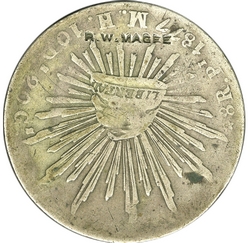
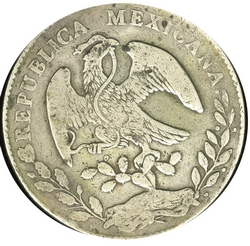
Magee on (Heritage Auction 462, 14 February 2008, lot 81285)
J. H. M'C
J. H. M'C known on a 1734 Two Reales
Meschutt's Metropolitan Coffee Room, New York
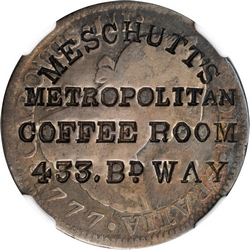
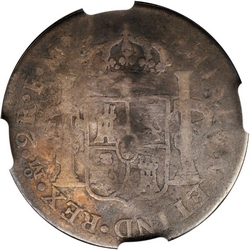
Meschutt’s on an 1777 Mexico City 2 reales (Stack’s Bowers ANA auction, 14 August 2013. Lot 21791)
MESCHUTT'S / METROPOLITAN / COFFEE ROOM / 433. BDWAY.
Frederick Meschutt ran a restaurant or "eating house" at 559 Broadway in New York City in the 1860s.
L. Millers, New York
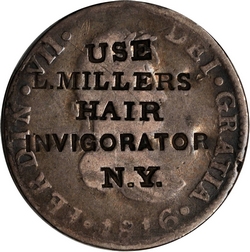
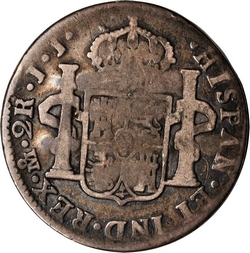
L. Millers on an 1816 Mexico City 2 reales (Stack’s Bowers Philadelphia Americana sale, 14 September 2011, lot 758)
USE / L. MILLERS / HAIR / INVIGORATOR / N.Y. on an 1816 Mexico City 2 reales.
Louise Miller began work as a hairdresser at 295 Bowery Street. By 1867 he was selling his own hair dye and hair invigoration concoction that purported to "restore gray hair, prevent baldness, remove scurvy and dandruff, and beautify the hair" at 25 cents and 50 cents a bottle.
There are several varieties of counterstamp from L. Miller because each part is a separate punch..
The Model Artist's, New York
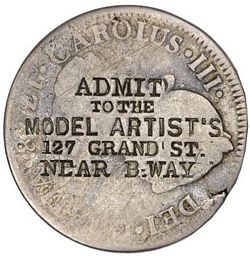
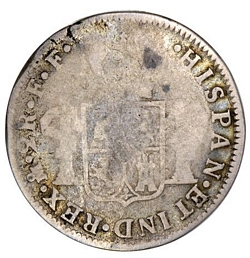
Model Artist’s on an 1790 Mexico City 2 reales (Stack’s Bowers Philadelphia Americana Sale, 30 September 2010, lot 5234)
ADMIT / TO THE / MODEL ARTIST'S / 127 GRAND ST. / NEAR B.WAY
(The following information lifted from Aaron Packard, The “Model Artist’s” Theatre and Its Token)
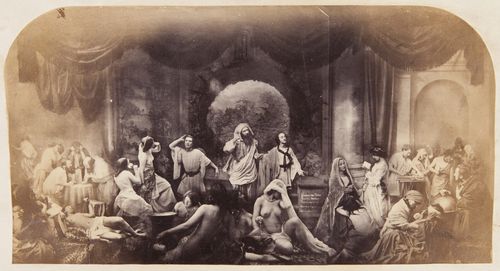
An example of Tableaux Vivants Theatre – ‘Two Ways of Life,’ Oscar Gustave Rejlander, c.1857
An Englishman born in Paris in 1819, George Lea emigrated to the United States at the age of 19. Initially trained as a pharmacist in Bristol England, Lea came to America penniless but found employment at a New York City drug store on Crosby Street. Not long afterward Lea became the store’s owner and went on and opened up additional stores at Grand and Mulberry Streets, Allen and Spring Streets, and two more on Broadway.
In 1856 Lea made his entry into show business. A performance at the Chinese Assembly Rooms initially flopped, bu rather than giving up on the speculative venture, Lea contacted the New York Herald and took out a full-page advertisement for the show, a first for the United State. His determination paid off - demand for the show skyrocketed and he was thus able to earn a profit.
Starting in the 1850s several entertainment ventures opened in New York which made tableaux vivants their primary bill. Tableaux vivants, the forerunner of burlesque, featured actors, mostly women, posing nude or semi-nude under the guise of replicating master artworks. Situated at 127 Franklin Street one block from Broadway, The Franklin Museum was one such venue. Opened by George Lea and occupying the upstairs spaces of the building, the main attraction that Lea put on stage were ‘Model Artists’, basically nudie shows claiming an air of legitimacy by having “artists” re-enact semi-nude scenes found in classical paintings.
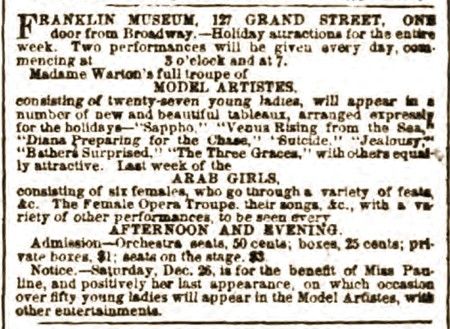
Lea’s ads were prominently placed and repeatedly located throughout the dailies.
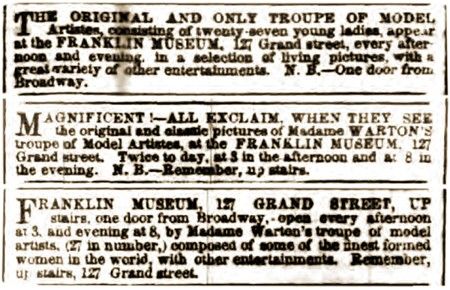
The New York Herald, 1 September 1856
Despite being a roaring success, the era of Model Artists and Tableaux Vivants being a fixture in New York’s theatre scene did not last long. The genre was popular from about 1854 through 1860. As New York’s mainstream shows matured and grew ever more complex, tableaux and semi-dressed scenes found themselves incorporated into mainstream theatrical performances, where and when such glimpses were dramatically legitimate and apropos. For those customers who simply wished to continue seeing scantily clothed women, the rise of concert saloons satisfied the need.
By the early 1860s Lea had moved on. After having accumulated a sizable profit from the Franklin Museum venture, he branched out, expanded his reach, and pursued more legitimate theatrical enterprises. By 1862 he was managing places of drama in New York, Baltimore, Washington, and Detroit.
By the end of the Civil War, Lea found himself a very wealthy theatrical manager. However, having invested his earnings in speculative stocks, he ultimately lost his entire fortune.
In 1867 Lea relocated upstate to Port Jervis, New Tork and once again returned to his roots and opened a drug store. Ever the speculator, soon thereafter he also took-up managing area theatres and hotels, including developing Pennsylvania’s Shohola Glen resort.
George Lea died in 1902 ‘A Born Speculator Dead,’ The New York Times, 21 August 1902.
M. Morse
M. MORSE known on an 1843 Eight Reales
D. Munson
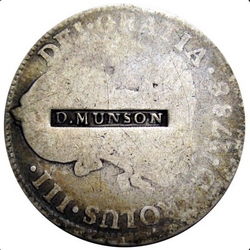
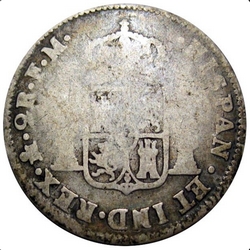
Munson on a 1788 Mo FM 2 Reales (Steve Hayden Auction 47, 22 November 2019, lot 443)
Neligans Worm Candy
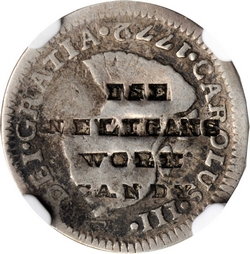
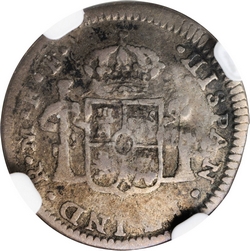
Neligans on an 1772 ½ real (Stack’s Bowers ANA auction, 14 August 2013, lot 21960)
USE / NELIGANS / WORM / CANDY
This was a medicine used to expel parasitic worms from the intestines. It supposedly forced the worms out of the body, often by stunning or paralyzing them. Such products were popular in the mid 1800s.
J. N. Newton
J. N. NEWTON known on an 1825 Two Reales
Dr. William Pierce, Boston, Massachusetts
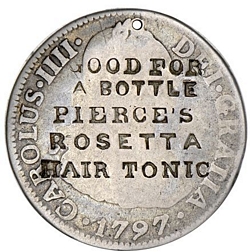
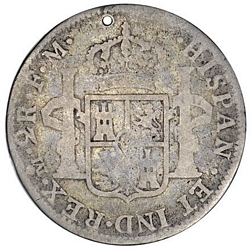
Pierce’s on a 1797 Mo FM 2 Reales (Stack’s Bowers Philadelphia Americana Sale, 30 September 2010, lot 5240)
GOOD FOR / A BOTTLE / PIERCE'S / ROSETTA / HAIR TONIC on five lines horizontally .
Dr. William Pierce of Boston manufactured Pierce's Hair Tonic, a compound that would "preserve the hair, prevents its falling off, and cure baldness".
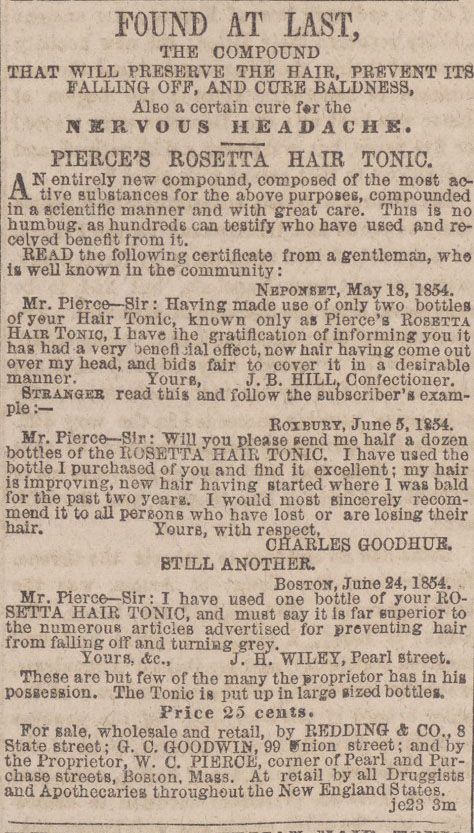
advert in the Boston Pilot, vol. 18, no. 31, 4 August 1855
Adverts in 1854 and 1855 contained such glowing endorsements as "Having made use of only two bottle of your Hair Tonic, known only as Pierce's ROSETTE HAIR TONIC, I have the gratification of informing you it has had a very beneficial effect, new hair having come out over my head, and bids fair to cover it in a desirable manner" and "I have used one bottle of your ROSETTA HAIR TONIC, and I must say it is far superior to the numerous articles advertised for preventing hair from falling off and turning gray." The price of a bottle was 25¢ and Pierce advertised "For sale, wholesale and retail, by REDDING & CO., 8 State Street; G. C. GOODWIN, 99 Union Street, and by the Proprietor, corner of Pearl and Purchase streets, Boston, Mass.. At retail by all Druggists and Apothecaries throughout the New England states."
J. L. Polhemus, Sacramento, California
J. L. POLHEMUS / Mortar and Pestle / DRUGGIST / 190 J. ST. COR 7TH / SACRAMENTO CAL. known on an 1849 Two Reales
James Lozier Polhemus was born in New York City in 1825, and raised in Paterson, New Jersey, where his father was a shoe maker. Polhemus was an early pioneer who took the Orpheus from New York and arrived in California in 1849. There he established a pharmacy across from the Magnolia Saloon in August 1850, and moved to 190 J. Street in December, where he remained until his death in 1866.
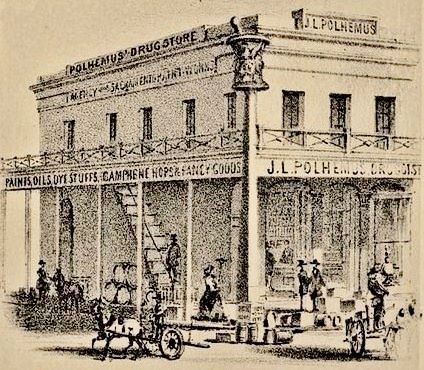
Polhemus' store, circa 1857
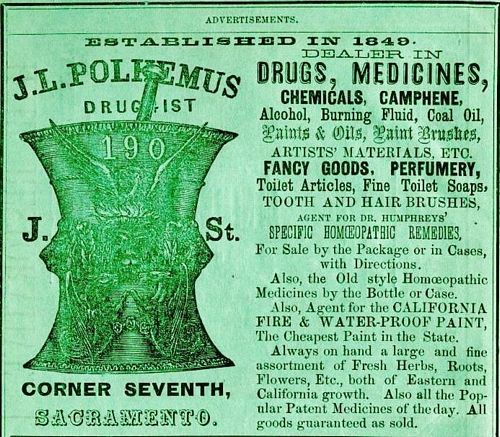 an advert from an 1863 directory
According to the Sacramento Income List of 1865 Polhemus made $900 in that year. He was the "Oldest established legitimate druggist in the city, open all night, selling on a cash basis, and at cost to indigents"Reynolds, John. 1964. “J. L. Polhemus Counterstamped Store Cards of Sacramento, California,” in TAMS Journal 4: pp. 103-107. Polhemus stamped all the coins that passed through his till, including gold pieces.
W. S. Ridley
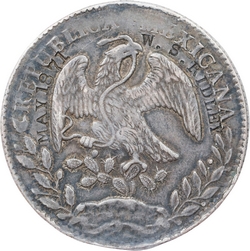
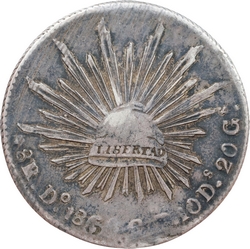
W. S. Ridley on a 186- 8 Reales (Stack’s Bowers auction, 11 December 2024, lot 70386)
MAY 1871 W.S. RIDLEY .
Apparently, this souvenir countermarked coin commemorate some important event in the lives of a Ridley family member.
John H. Rochestens, Rochester, New York
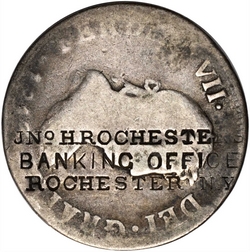
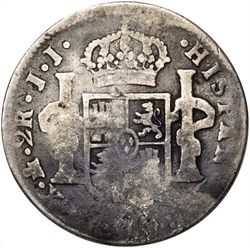
Rochestens on an 1813 Mexico City 2 reales (Stack’s Bowers Baltimore Auction, 21 March 2018, lot 792)
JNO. H. ROCHESTENS / BANKING OFFICE / ROCHESTER N.Y.
Sachem Oyster Saloon, New York
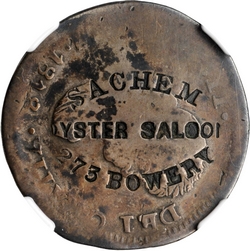
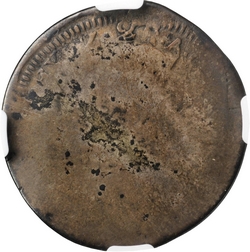
Sachem Oyster Saloon on an 1818 Zacatecas 2 reales (Stack’s Bowers ANA auction, 14 August 2013, lot 21866)
SACHEM / OYSTER SALOON / 273 BOWERY.
In the Native-American tribes of the Algonquians the sachem was the elected leader or chief of a single tribe or a collection of allied tribes.
In early New York City a district leader or boss in the political machine known as Tammany Hall were known as sachems. Tammany Hall wielded enormous influence over not only city politics but at the state and national level for well over a century.
Old New York City directories list no establishment named the Sachem Oyster Saloon so its very existence has come into question. However, searching the address 273 Bowery, a saloon operated by a man named Leopold Loeber was located there in 1856 and another (the same?) by one Albert Jordan in 1858. The actual name of the establishment is not recorded but it seems at least possible that this was the Sachem Oyster Saloon. It may be that it was a gathering place for members of Tammany Hall.
H. Schoonmaker, New York
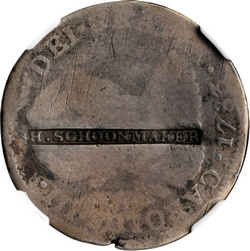
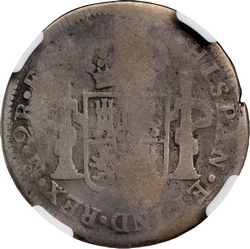
Schoonmaker on a 1783 Mexico City 2 reales (Stack’s Bowers ANA auction, 14 August 2013. Lot 21870)
H. SCHOONMAKER.
William H. Schoonmaker operated a military cutlery and fancy hardware store at 181 Broadway in New York City.
S. Schmidt's Liquid Hair Dye, Baltimore, Maryland
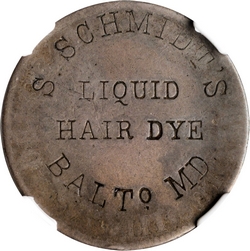
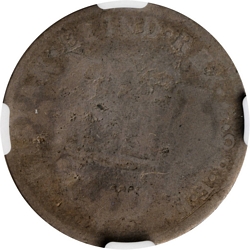
Schmidt’s on a Mexico City 2 reales (Stack’s Bowers ANA auction, 14 August 2013, lot 21670)
S. SCHMIDT'S / LIQUID / HAIR DYE / BALTO MD.
W. Scott, Louisville. Kentucky
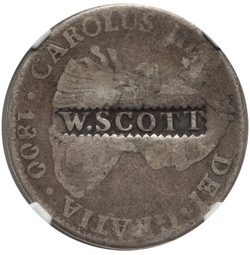
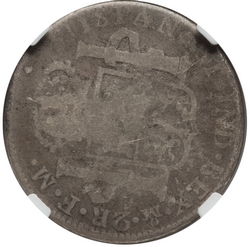
W. Scott on an 1800 Two Reales (Heritage Auction 1227, 6 December 2015, lot 8581)
William D. Scott, a silversmith, was listed in the 1841 directory as a watchmaker in partnership with R. E. Smith. In the early 1840s he was involved in the jewelry and silversmithing firm of Scott and Kitts. In 1844 he formed W. D. Scott and Company, which was located at 489 Main Street.
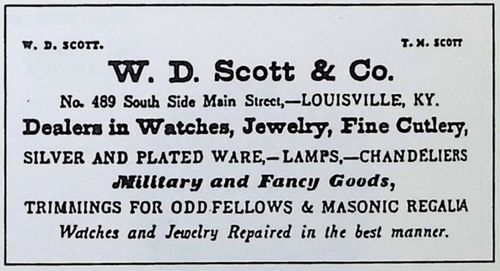
He is not listed in the 1852 city directory, and probably died in 1851.
Smith's Hotel, New Brunswick, New Jersey
SMITH'S HOTEL / N. BRUNSWICK. N.J known on 1828 Two Reales
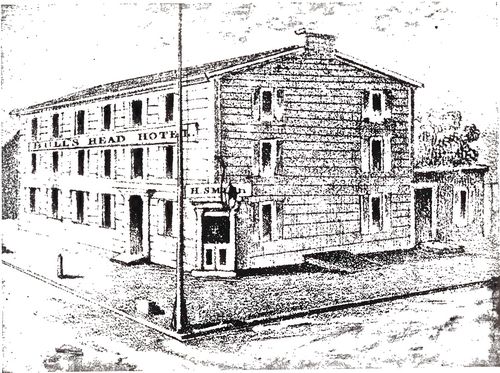
Bull's Head Hotel
In 1855 it was reported that the Bull’s Head Hotel, on the corner of Hiram Street, had been temporarily changed to “Smith's Hotel,” kept by John Williams, who was “for a number of years principal assistant at Stelle’s Hotel,” and competed with Silas Hall of the City HotelJohn P. Wall, The Chronicles of New Brunswick, New Jersey, 1667-1931, privately printed, 1931.
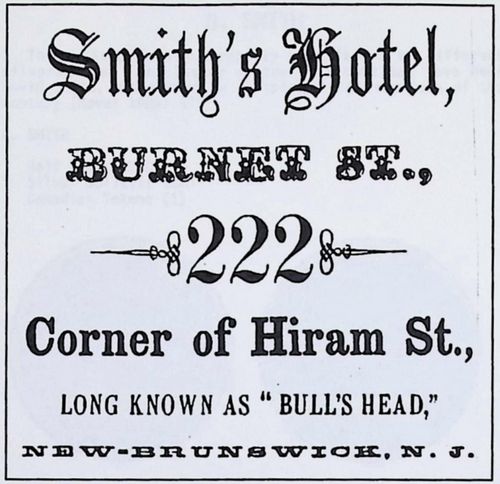
The hotel was demolished in 1876 for the widening of Hiram Street.
Spayd & Bell, Philadelphia, Pennsylvania
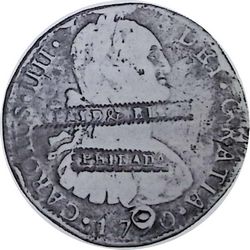
Spayd & Bell on a counterfeit 1870 Eight Reales
SPAYD & BELL / PHILADA in serrated rectangles
During the 1830s John Spayd and John Bell made wooden planes.
Sterling
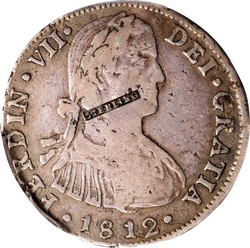
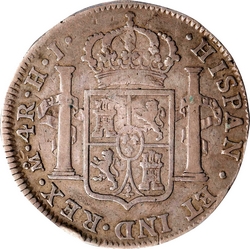
Sterling on 1812 Mo HJ. 4 reales (Stack’s Bowers auction, 14 November 2022, lot 71730)
STERLING.
It is unknown where, when, or by whom this countermark was struck, and even the obvious presumption that its purpose was to mark objects of sterling silver purity (0.925) is complicated by the fact that this 4 Reales piece is composed of 0.903 silver.
Stickler, New York
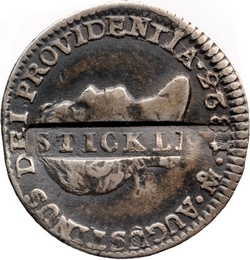
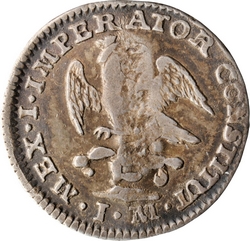
Stickler on an 1823 Mexico City ½ real (Stack’s Bowers ANA auction, 14 August 2013, lot 21885)
STICKLER.
John Stickler was listed as a silversmith at 29 Liberty St., New York City in 1821 and at 104 Broadway in 1822. He was also in a partnership with William Gale as Gale & Stickler in those same years. Both he and Gale were apprenticed under John & Peter Targee at the 29 Liberty St. address. While Gale is listed in subsequent directories still at 104 Broadway, it is unknown where Stickler was after 1822 or if he was even alive, as he is not listed. This is the same stamp found on his silverware.
Stiles
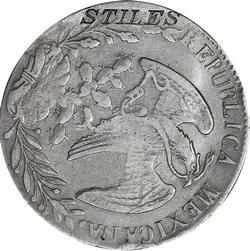
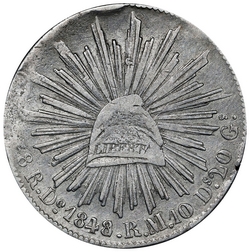
Stiles on the reverse of a 1848 Do 8 reales (Stack’s Bowers auction, 6 December 2023, lot 76401)
STILES.
Stoddard's, Philadelphia, Pennslyvania
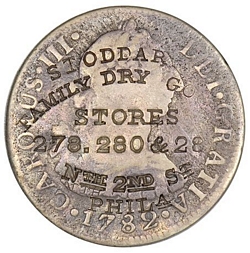
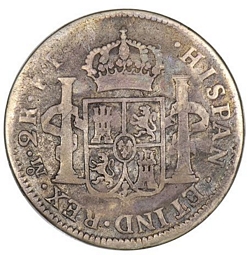
Stoddard’s on 1782 Mo FF 2 Reales (Stack’s Bowers Philadelphia Americana Sale, 30 September 2010, lot 5238)
STODDARD'S / FAMILY DRY GOODS / STORES / 278-280 & 282 / Nth 2nd St / PHILA on six lines horizontally
The 1844 Philadelphia Business Directory listed Curwin Stoddard at the address listed on the counterstamp. By the time the 1865 directory arrived, the firm had become Stoddard and Brother.
Stoltz's Segar Store, Philadelphia, Pennsylvania
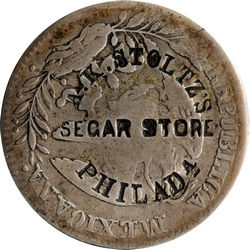
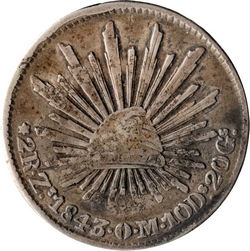
Stoltz’s on an 1843 2 reales (Stack’s Bowers ANA auction 14 August 2013, lot 21889)
A. K. STOLTZ'S / SEGAR STORE / PHILADA .
Adam Stoltz was listed at Noble above New Market in 1849. From 1854 to 1860 he was located at 307 North Third Street.
Stone & Ball, Syracuse, New York
Seymour H. Stone and Calvin S. Ball sold silverware and jewelry, repaired clocks and watches, and held a contract with the Syracuse school board to keep its clocks in working order. They were partners from 1853 to 1869, and in 1856 their shop was located at 1 East Genesee Street. After the partnership ended, Ball ran the firm by himself until 1903, when it was sold to Stetson and Crouse. A reporter from the Syracuse Herald interviewed Ball in the late 1890s, and the paper published an article on Stone & Ball's countermarked coins on 27 June 1897. The article confirms that the coins were stamped in 1853 and 1854, but some errors had crept into Ball's recounting after forty-five years of time had passed. Rather than all the firm's countermarks being on quarters, less than half of them are known on this denomination.
QUARTERS RETURN HOW COINS SENT FROM SYRACUSE HAVE TRAVELED. NOW COME BACK LIKE THE CAT SOME HAVE KNOCKED ABOUT NEARLY FORTY-FIVE YEARS. One of the Oldest Business Men of the City Tells How He and His Partner Adopted a Novel Advertising Scheme. There are many novel schemes for advertising, but few efforts are rewarded by direct results that can be traced through nearly half a century. In 1853 two young men, Calvin S. Ball and S. H. Stone, began business as jewelers in the old savings bank building. They succeeded the firm of Norton & Hotchkiss. During the first year of their partnership the young merchants conceived the original idea of perpetuating their name by stamping it upon the coin of the realm. Accordingly every quarter that came into their possession was stamped with the inscription: STONE & BALL, SYRACUSE, N.Y. This coin with its inscribed substitute for "In God We Trust" was then replaced in the cash drawer and paid out again to customers. None but 25-cent pieces were stamped and the work was all done during the first two years of the partnership; but for forty-four years these quarters have been heard from in many unique and unexpected ways. Immediately upon the breaking out of the war most of them disappeared and it is the opinion of Mr. Ball that they were hidden away down South; and not until about 1880 did they begin to make their reappearance. He now has about $10 worth of stamped quarters that have been returned to him by both acquaintances and strangers from all parts of the country. A great many letters are also received, all of which he answers and supplies whatever information is asked. "We used to send money," said he, "in return for the quarters, but so many swindlers got into it that we had to stop. | have reason to think that one fellow wrote us four different times requesting us to send money in exchange for his quarter. Each time he used a different name and the letter was sent from a different place. We sent the money several times, but never got the quarter. Often | meet people in the Street who hand me one of our old coins. It is easy for people to find us, as | believe that | am the only merchant, excepting perhaps S.I. Ormsbee, who is still carrying on the book and paper business, who has continued in the same business in this city during the forty-four years without change."
STONE & BALL (Incuse) known on 1821 One Real
STONE & BALL / SYRACUSE / N. Y. known on 1816 Two Reales
This type was made using a first type incuse "STONE & BALL" stamp, while the city name was made from a separate incuse stamp. This means the spacing between "STONE & BALL and SYRACUSE / N. Y." differs among specimens. The incuse counterstamp often appears to be weakly struck on the right, making the last two letters of Ball's name difficult to read. This is because the last "L" of "BALL" in the stamp quickly broke, while the next to last "L" broke sometime later.
Andrew J. Sweet, Dryen, New York
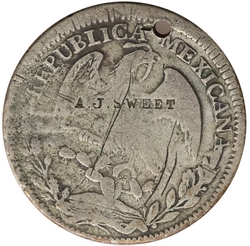
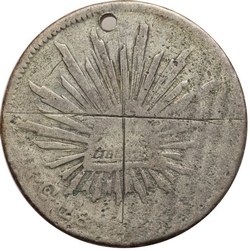
Sweet on an 18-- 8 reales (Heritage Auction 63162, 3 January 2021, lot 44372)
A.J. SWEET
The 1860 Census listed Andrew J. Sweet as a thirty year old blacksmith in Dryden, New York.
N. Talbot & Co. Shaw's Flat, California
Shaw's Flat was a mining town situated in Tuolumme County, California, located two miles from Sonora won the road from Sonora to Columbia. Talbot moved there from Maine and was listed as a blacksmith there in the 1857 California State Business Directory.
N. TALBOT & CO. / SHAW'S FLAT known on an 1848 Eight Reales.
William H. Tallmadge, Poughkeepsie, New York
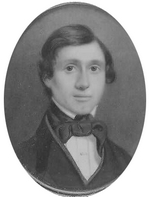 William Henry Tallmadge was born in Poughkeepsie, New York on 27 June 1813. The 1859 Poughkeepsie Directory listed him as selling hardware, etc. at 260 Main Street.
He died on 2 June 1888, in Poughkeepsie, at the age of 74Poughkeepsie Journal, 3 June 1888.
W. H. TALLMADGE known on a 1822 Two Reales
G. W. Taylor
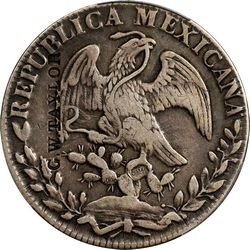
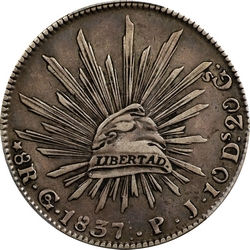
G. W. Taylor on 1837 Go PJ 8 reales (Stack’s Bowers auction, 16 May 2023, lot 40481)
G. W. TAYLOR
James M. Taylor, Brooklyn and New York City, New York
Taylor's stamps are the most often seen merchant countermarks on silver coins. According to the 1854 Brooklyn Directory, his address was 47 Fulton Street. In 1855 his New York office was located at 169 Chatham Street and his residence was at 107 East 89th Street, but the directories only noted that he was a "broker" in their residential listing. Apparently Taylor was a currency dealer as a few broken bank notes exist with his ink stamp "J. M. Taylor / Broker / 169 / Chatham Square / N. e The latest coin with one of his stamps is dated 1856. So it seems he was out of business by 1857, and likely was bankrupted by the Panic of 1857. While Taylor did not appear in directories after 1856, he was listed in the 1860 Census.
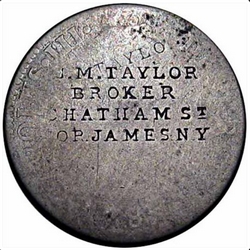
J. M. Taylor on a 1787 Two Reales (Steve Hayden Auction 37, 10 November 2012, lot 573599)
J. M. TAYLOR / BROKER / CHATHAM ST. / COR. JAMES. N. Y.
Texas 4 Bits
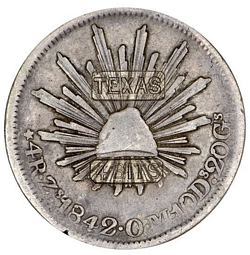
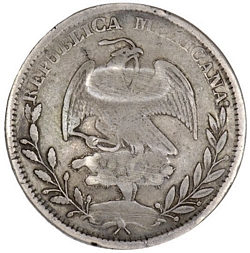
Texas 4 Bits on 1842 Zs OM 4 Reales (Stack’s Bowers Philadelphia Americana Sale, 30 September 2010, lot 5251)
TEXAS in rectangle above cap design of host coin, 4 BITS in rectangle below cap.
Brunk lists this and similar style pieces as Fantasies. He notes: "These are of a radically different style than countermarks of the 1840s. Such fantasy punches are very sharp, having been made from hardened steel stamps that produce razor-like thin letters."
Caleb C. Tracy, New York
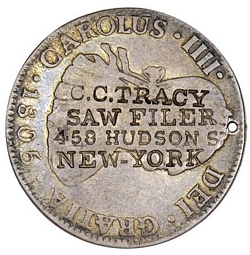
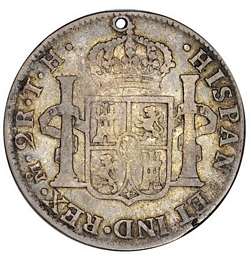
C. C. Tracy on an 1805 Mo TH 2 Reales (Stack’s Bowers Philadelphia Americana Sale, 30 September 2010, lot 5244)
C.C. TRACY / SAW FILER / 458 HUDSON ST / NEW-YORK vertically across obverse portrait.
A saw filer by trade, Caleb C. Tracy was located on Hammersley Street in New York City in 1847. By 1848 he had relocated to 458 Hudson Street, the address on the coin illustrated.
F. E. Voigd
F. E. VOIGD known on an 1842 1/8 Real
GW
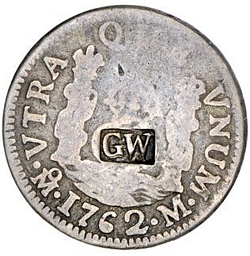
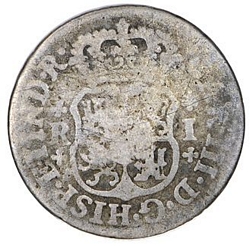
GW on an 1807 one real (Heritage Auction 427, 27 September 2007, lot 81577)
Wagner
WAGNER known on a 1811 Half Real and 1816 Two Reales
Walcott Brothers, Boston, Massachusetts
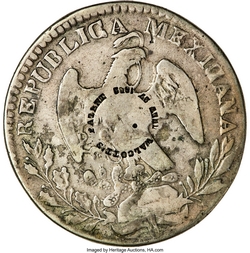
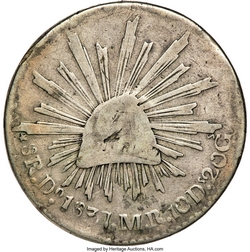
Walcott’s Patent on a 1837 8 reales (Heritage Auction 1551, 15 December 2011, lot 4068)
WALCOTT'S PATENT JULY 27, 1852 in tiny letters and numbers.
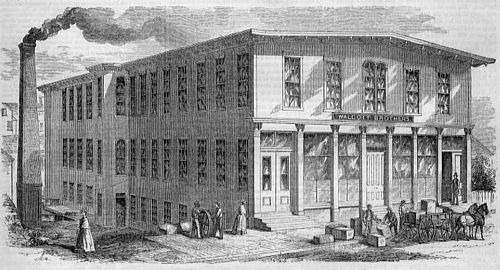
Exterior View of Walcott Brothers' Manufactory, Pawtucket, an engraving published 22 September 1855 in Ballou's Pictorial Drawing-Room Companion, Boston, Massachusetts
Walcott Brothers patented and made a scissors-like Graduated Button-Hole Cutter with the identical patent information seen on this coin.
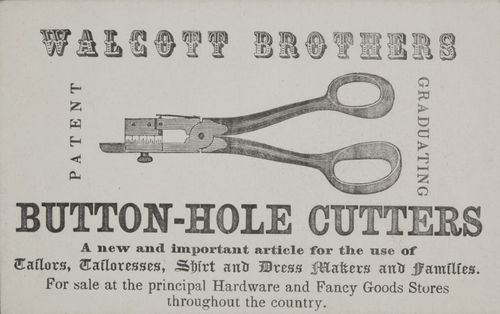
Examples of the rare tool are still in use today.
Alphonso B. Walker, Iowa City, Iowa
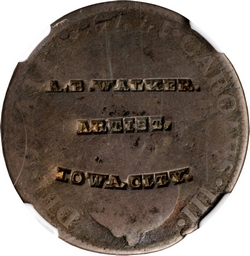
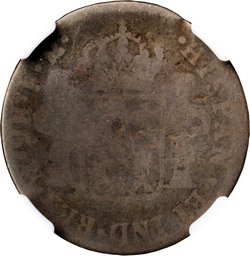
A. B. Walker on a 1774 Mo 2 reales (Stack’s Bowers ANA auction, 14 August 2013, lot 21904)
Iowa--Iowa City. A. B. WALKER. / ARTIST. / IOWA CITY.
Alphonso B. Walker was a photographer in Iowa City from 1858 to 1862. He subsequently moved in 1871 and became the steward of the Iowa Deaf and Dumb Institute in Council BluffsSteven Schooley, Steven. 1989. “A. B. Walker and His Counterstamped Coins,” in Gobrecht Journal 15 (March 1989), pp. 31-32..
Waltons Bitters, Cincinnati, Ohio
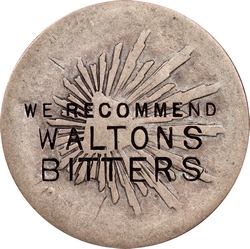
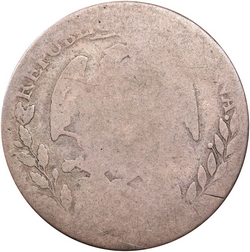
Waltons Bitters on an undated Cap and Rays 4 reales (Stack’s Bowers auction, 19 September 2024, lot 95750)
WE RECOMMEND / WALTONS BITTERS
Walton's Bitters was a patent medicine and alcoholic tonic produced by Samuel W. Walton & Co. in Cincinnati, Ohio, during the late 1860s and early 1870s. Like many bitters of the era, it was heavily alcoholic and marketed as a cure-all tonic (claiming to treat ailments like cholera), allowing makers to bypass heavy alcohol taxes.
The recipe was to take 20 ounces orange peel, 14 ounces Virginia snakeroot, 8 ounces yellow cinchona bark, 6 ounces coriander seed, 5 ounces aniseed, 5 ounces gentian root, and 2 ounces wormwood herb; add to 31 gallons of 100% proof spirits, 8½ gallons of water, and 2 gallons of simple syrup; macerate for seven days and then filterT. M. Griffiths, Non-secret formulas, St. Louis, 1897.
E. E. Wambold, Savannah, Georgia
E. E. WAMBOLD known on a 1833 Two Reales
E. E. Wambold was a gunsmith and sporting goods merchant in Savannah, Georgia, In the 1898 city directory he is listed, with Miss C. Wohanka, at 215 Congress Street and in the 1904 directory at 309 Congress Street.
F. Weed
F. WEED known on a 1829 Eight Reales
G. W. Welsh, Hanover, Pennsylvania
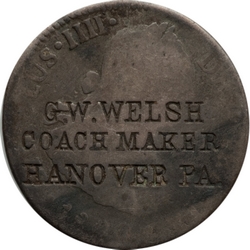
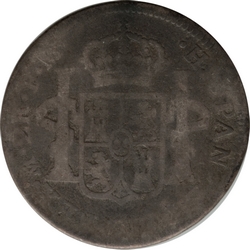
G. W. Welsh on Mo FM two reales (Heritage Auction 63162, 3 January 2021, lot 44395)
Hanover, Pennsylvania was a hub of the coach making business, with 25 coachmakers who employed some 2,000 people in the carriage building trade.
Hermann Wettstein, Harvard, Illinois
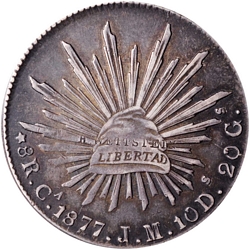
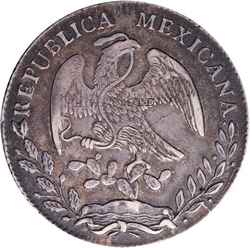
Wettstein on an 1877 Ca JM 8 reales (Stack’s Bowers auction, 1 September 2021, lot 70696)
H. WETTSTEIN
Hermann Wettstein from Harvard, Illinois, is listed in the 1880 Illinois State Gazetteer as a dealer in watches, clocks and jewelry. He was also an inventor of note with many patents in his name, as well as a traveling author and speaker promoting his philosophical theories.
Whitbeck's Circus
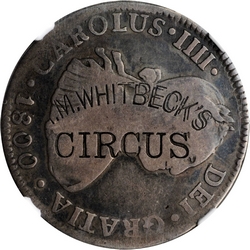
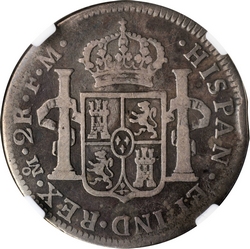
Whitbeck’s Circus on an 1800 Mo FM two reales (Stack’s Bowers ANA auction, 14 August 2013, lot 21908)
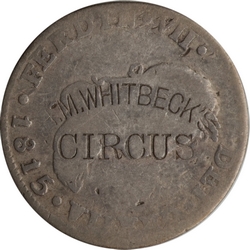
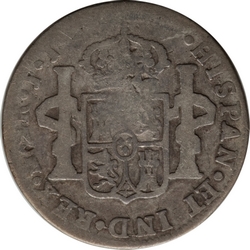
Whitbeck’s Circus on an 1815 two reales (Heritage Auction 63162, 3 January 2021, lot 44398)
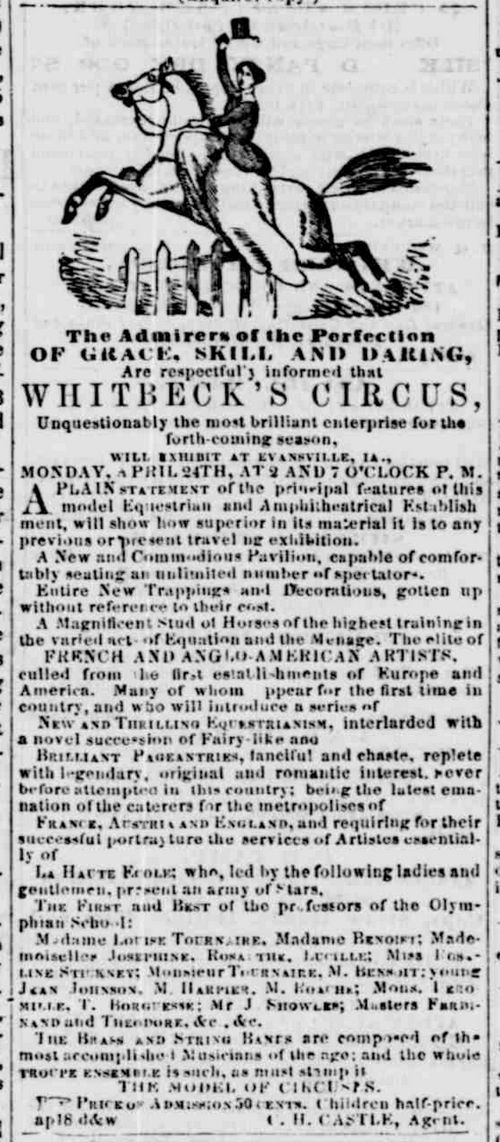
advert in Evansville Daily Journal, Vol. 6, No. 303, 18 April 1854
Henry Mortimer Whitbeck and his partners Charles H. Castle and Washington Kidwell started their "Original One-Horse Show" circus in 1854. The advertisement above claims that it had “a New and Commodious Pavilion, capable of comfortably seating an unlimited number of spectators2 and “a Magnificent Stud of Horses of the highest training in the varied acts of Equation and the Menage” ridden by “the elite of FRENCH AND ANGLO-AMERICAN ARTISTs culled from the first establishments of Europe and America”.
The circus briefly traveled the Ohio River and its tributaries on a steamboat that summer, but was bankrupt by the time it reached Pittsburgh in October. That fact dates these pieces to the middle of 1854. Seemingly unphased Whitbeck continued in the circus business and died in September 1871 as a passenger on a circus train when another train collided with his.
C. Whitcom
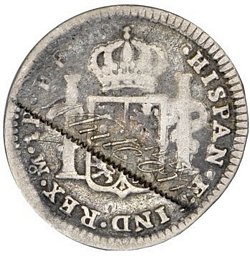
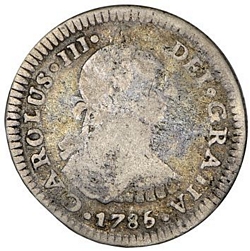
C. Whitcom on a 1785 Mo FF 1 Real (Stack’s Bowers Philadelphia Americana Sale, 30 September 2010, lot 5233)
C.WHITCOM 1827 in fancy Spencerian script within crenulated cartouche diagonally across coin .
Wood's Minstels, New York
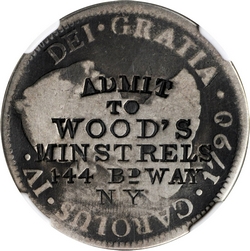
Wood’s Minstrels on a 1790 Mexico City 2 reales (Stack’s Bowers ANA auction 14 August 2013, lot 21922)
ADMIT / TO / WOOD'S / MINSTRELS / 444 BDWAY / NY.
Wood's Minstrels was the successor of Christy and Woods Minstrels - which also countermarked coins. Wood's original Minstrel Hall was located at 446 and 448 Broadway, and is known from a contemporary notice to have performed Poor Uncle Tom in 1852. The troupe advertised in both the August 1853 New York Times and New York Herald.
Wood’s Minstrels and Ethiopian Delineators,
444 Broadway above Howard Street.
Open every evening,
H. Wood, Manager and Proprietor.
The entertainment of Wood’s Minstrels embrace all elements of Ethiopian minstrelsy, the company being composed of the oldest and most experienced performers. They are the originators of their own peculiar style consisting of overtures, quick steps, choruses, quartettes, glees, duets, songs, ballads, extravaganzas, burlesque, lectures, thrilling tragedy and eccentric comedy, comprising together a melange of the most talented and pleasing soirees, all their pieces being composed expressly for them and which they defy the world to equal, Door open at 6 1/2 o’clock, to commence at 8 o’clock. Tickets 25 cents.
The Minstrel Hall burned down in 1854. The show reopened in 1857 on the site of the old Lyceum of Natural History. In 1866 Wood's Minstrels remodeled the Jewish Synagogue at 514 Broadway and turned it into a theaterWerner G. Mayer, "Woods Minstrels and Other Tokens of New York City," in TAMS Journal 1975, p 155.
GW
GW on 1762 M 1 Real (Stack’s Bowers Philadelphia Americana Sale, 30 September 2010, lot 5232)
GW in small rectangular cartouche.
Wyoming Armory, Cheyenne, Wyoming
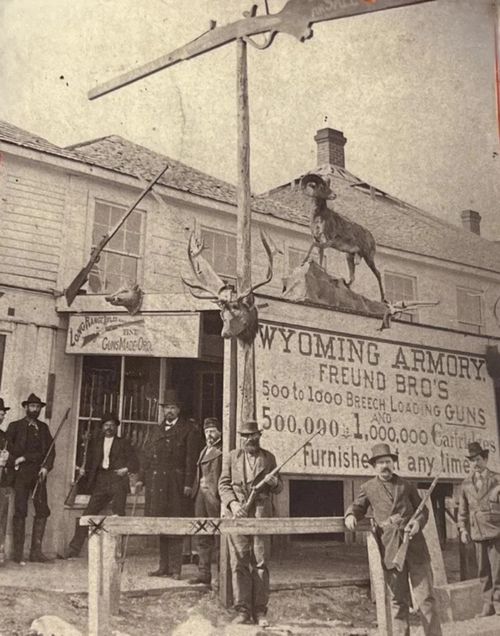
Wyoming Armory c. 1872
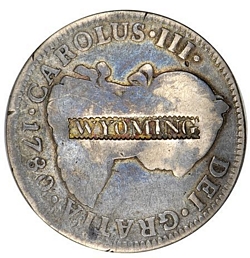
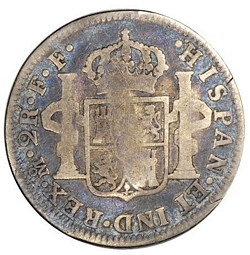
Wyoming (Stack’s Bowers Philadelphia Americana Sale, 30 September 2010, lot 5236)
WYOMING on 1780 Mo FF 2 Reales.
This counterstamp for the Wyoming Armory in Cheyenne, Wyoming, originated with Frank W. Freund, a gunsmith who held a number of patents. From 1865 to 1867 he worked in Nebraska City, Nebraska, then briefly in Julesburg and Denver, Colorado. From 1867 to 1885 he was in Cheyenne, Wyoming, ending his career in New Jersey. From 1867 to 1880 he partnered with his brother, George, and their trademark was "Wyoming Armory." Both that trademark or simply WYOMING appears on the lock plates of the firearms they produced.
Dr. William Young, Philadelphia, Pennsylvania
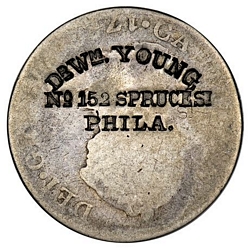
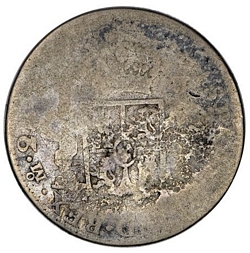
Wm. Young (Stack’s Bowers Philadelphia Americana Sale, 30 September 2010, lot 5241)
Dr. Wm. YOUNG arches above No 152 SPRUCE St / PHILA. on two lines below, all inverted on 2 reales
Dr. William Young of Philadelphia, Pennsylvania operated an "Infirmary for Diseases of the Skin" at 33 South Fourth Street in 1838. From 1841 to 1857 he was located at 152 North Spruce, moving to 416 on the same street soon thereafter. During his merchant days he advertised variously as a physician, chemist, and oculist. His son, William Young, Jr. joined his practice in 1859.
Federal eagle
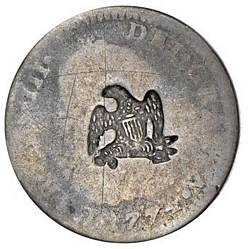
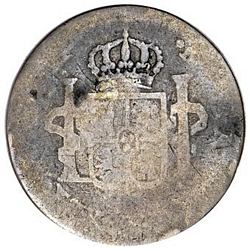
Federal eagle on 1774 Mo FM 1 real (Stack’s Bowers Philadelphia Americana Sale, 30 September 2010, lot 5264)
Boldly impressed and intricately designed federal-style eagle at center, perhaps the mark of a gunsmith though no information is found in the Brunk reference.
Three busts
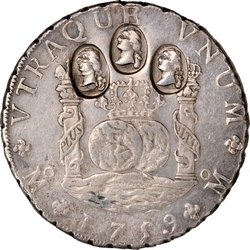
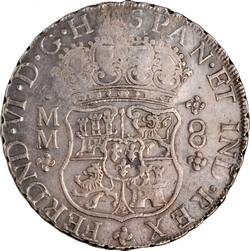
Three busts on a 1759 Mexico City 8 reales (Stack’s Bowers ANA auction 14 August 2013, lot 21938)
The counterstamps have a more "modern" look to them, and might be of early-to-mid 20th century manufacture.