Gold Coinage of Charles III
by A. F. Pradeau
The gold coinage of this monarch consists of three main types:
First type. Coins of 1760 and 1761—The obverse presents a young thin face, long pointed nose, neck uncovered, and bust armored and mantled; the legend in large letters CAROLVS . I l l . D . G . HISPAN . ETIND . REX . 1760. The reverse is similar in every respect to the fourth type of Ferdinand VI. There are two varieties of the obverse; on one, the Golden Fleece is suspended from a ribbon and hangs just below the neck; on the other, the Fleece is suspended from a chain and separates the REX from the date. On the reverse the collar of theOrder of the Golden Fleece appears only on the onzas.
Second type. Coins of 1762 to 1771. The obverse: the bust is larger and heavily draped. The neck is covered. The toison d'or hangs on the breast. The nose is pointed and appears more pronounced because of a receding forehead. The peruke shows individual curls. The lettering of the inscription is smaller and the name is spelled CAROLUS. The upper portion of the head projects into the margin and separates the legend into right and left parts. The reverse presents four main variations:
1. The shape of the coat of arms is different. The arrangement of the component parts is changed, and the arms of Castile and Leon appear in the center.
2. The crown is placed higher.
3. The mint mark is on the left of the Fleece and the assayers' initials are to the right of it.
4. The legend reads: IN.UTROQ.FELIX.AUSPICE.DEO. (With God's guidance [one is] happy in each [place].)
While apparently the old dies continued in use until at least 1783, about 1763 some of the smaller gold coins began having the collar of the Order of the Golden Fleece surrounding the coat of arms, and when this occurred, the full coat of arms appeared.
By secret order issued 18 March 1771, the fineness of the gold coinage was reduced from twenty-two to twenty-one karats, equivalent to .875 fine.
Third type. During 1772 the type was again changed. The obverse shows the portrait of the king, more mature, receding forehead, and prominent rounded nose. The legend around the margin reads: CAROL . I l l . D . G . HISP . ET . IND . R . and the date.. The reverse differs from the previous type in three particulars:
1. The shape of the coat of arms.
2. The value of the coin (8, 4, 2 or 1) in Arabic numerals is placed to the left of the shield; the capital letter S is on the right.
3. The mint mark is indicated by tiny letters, about a third smaller than the rest of the inscription. At times the mint mark and assayers' initials face inwardly.
One escudo
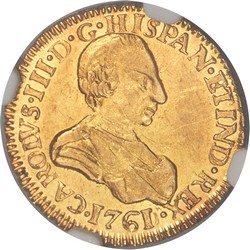
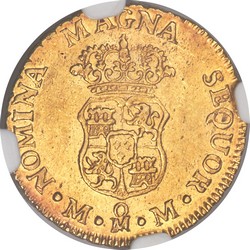
KM-116 1E 1761/0 Mo MM (Heritage auction 3041, August 2015, lot 31140)
| Date | Asssayer | Comment |
| 1760 | MM | |
| 1761/0 | MM | |
| 1761 | MM |
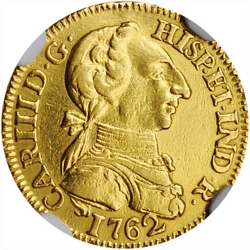
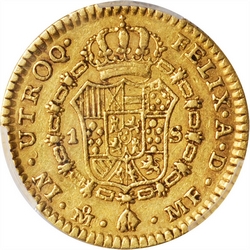
KM-117 1E 1762 Mo MM (Stack’s Bowers ANA auction, 24 August 2021, lot 45304)
| Date | Asssayer | Comment |
| 1762 | MM | |
| 1762 | MF | |
| 1763 | MM | |
| 1763 | ||
| 1764 | ||
| 1764 | ||
| 1765 | ||
| 1765 | ||
| 1766 | ||
| 1767 | ||
| 1768 | ||
| 1769 | ||
| 1770 | ||
| 1771 |
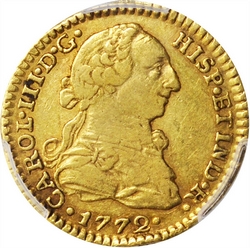
KM-118.1 1E 1772 Mo MF (Stack’s Bowers auction, 13 October 2021, lot 71424)
| Date | Asssayer | Comment |
| 1772 | FM | |
| 1773 | FM |
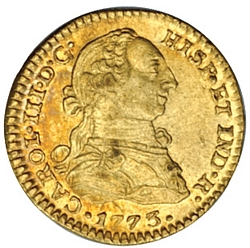
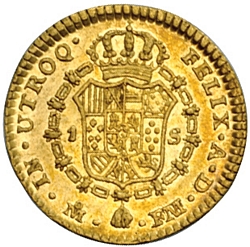
KM-118.2 1E 1773 Mo FM ((Louis E. Eliasberg, Sr. Collection, 15 April 2005, lot 3166)
This type, the third showing the bust of Charles III, was struck 1773-88 This type comes in two varieties; "inverted mintmark" and "upright mintmark". The inverted mintmark variety prevailed 1773-1788; the upright mintmark appeared 1772-73 and 1788 only. This marks the second date of the fineness being lowered from .901 to .875 gold
| Date | Asssayer | Comment |
| 1773 | FM | |
| 1774 | FM | |
| 1775 | FM | |
| 1776 | FM | |
| 1777 | FM | |
| 1778 | FF | |
| 1779 | FF | |
| 1780 | FF | |
| 1781 | FF | |
| 1782 | FF | |
| 1783/2 | FF | |
| 1783 | FF | |
| 1784 | FF | |
| 1784 | FM | |
| 1785 | FM |
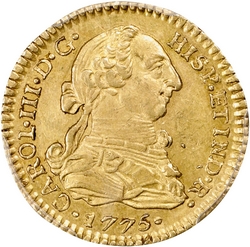
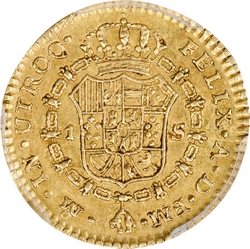
KM-118.2 1E 1775 Mo FM (Stack’s Bowers auction, 26 August 2025, lot 41315)
KM-118.2a 1E 1786 Mo FM (Heritage auction 3041, August 2015, lot 31166)
| Date | Asssayer | Comment |
| 1786 | FM | |
| 1787 | FM | |
| 1788 | FM |
Two escudos
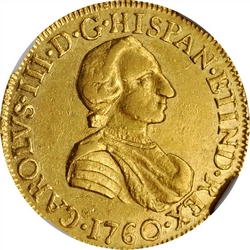
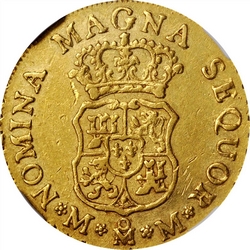
KM-128 2E 1760 Mo MM
| Date | Asssayer | Comment |
| 1760 | MM | |
| 1761 | MM |


KM-129 2E 1769 Mo MF (Stack’s Bowers auction, 16 January 2021, lot 22219)
| Date | Asssayer | Comment |
| 1762 | MF | |
| 1763 | MF | |
| 1765 | MF | |
| 1766 | MF | |
| 1767 | MF | |
| 1768 | MF | |
| 1769 | MF | |
| 1770 | MF | |
| 1771 | MF |


KM-130.1 2E 1772 Mo FM (Stack’s Bowers auction, 16 January 2021, lot 22224)
Inverted Assayers' letters and Mint Mark
| Date | Asssayer | Comment |
| 1772 | FM | |
| 1773 | FM |


KM-130.2 2E 1775 Mo FM (Stack’s Bowers Baltimore auction, November 2015, lot 39363)
| Date | Asssayer | Comment |
| 1773 | FM | |
| 1774 | FM | |
| 1775 | FM | |
| 1776 | FM | |
| 1777 | FM | |
| 1778 | FF | |
| 1779 | FF | |
| 1780 | FF | |
| 1781 | FF | |
| 1782 | FF | |
| 1783 | FF | |
| 1783/2 | FF | illustrated below |
| 1784 | FF | |
| 1784 | FM | |
| 1785 | FM |


KM-130.2 2E 1783/2 Mo FF (Stack’s Bowers auction, 24 February 2026, lot 76478)


KM-130.2a 2E 1785 Mo FM (Ponterio Baltimore auction, winter 2014, lot 587)
| Date | Asssayer | Comment |
| 1786 | FM | |
| 1787 | FM | |
| 1788 | FM |
Four escudos


KM-140 4E 1760 Mo MM (Stack’s Bowers NYINC auction, 15 January 2022, lot 2087)
| Date | Asssayer | Comment |
| 1760 | MM | |
| 1761 | MM |


KM-141 4E 1768 Mo MF (Stack’s Bowers auction, 16 January 2021, lot 22218)
| Date | Asssayer | Comment |
| 1762 | MF | |
| 1763 | MF | |
| 1764 | MF | |
| 1765 | MF | |
| 1767 | MF | |
| 1768 | MF | |
| 1769 | MF | |
| 1770 | MF | |
| 1771 | MF |
KM-142.1


KM-142.2 4E 1772 Mo FM (Stack’s Bowers NYINC auction, 15 January 2022, lot 2089)
| Date | Asssayer | Comment |
| 1772 | FM | |
| 1773 | FM |
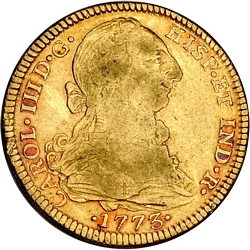
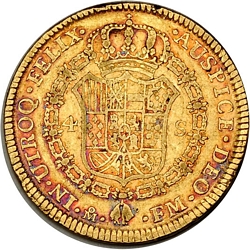
KM-142.2 4E 1773 Mo FM (Ponterio NYINC Auction , 7 January 2011, lot 117)
| Date | Asssayer | Comment |
| 1773 | FM | |
| 1774 | FM | |
| 1775 | FM | |
| 1776 | FM | |
| 1777 | FM | |
| 1778 | FF | |
| 1779 | FF | |
| 1780 | FF | |
| 1781 | FF | |
| 1782 | FF | |
| 1783 | FF | |
| 1784 | FF | |
| 1784/3 | FM | illustrated below |
| 1784 | FM | |
| 1785 | FM |


KM-142.2 4E 1780 Mo FF (Stack’s Bowers auction, 16 January 2021, lot 22223)

KM-142.2 4E 1784/3 Mo FM (Stack’s Bowers auction, 17 May 2024, lot 34216)
KM-142.2a 4E 1786 Mo FM/FF (Stack’s Bowers auction, 17 October 2018, lot 72564)
Good strike with clear over-assayer.
| Date | Asssayer | Comment |
| 1786 | FM | |
| 1787 | FM | |
| 1788 | FM | |
| 1789 | FM |
Counterfeit


counterfeit KM-142.2 4E 1784 Mo FF (Stack’s Bowers auction, 31 October 2023, lot 70072)
A crude counterfeit issue that may have been made for use in jewelry. Weight: 12.90gm.
Eight escudos


KM-153 8E 1760 Mo MM (Stack’s Bowers auction, 22 October 2025, lot 72417)
The first year of Charles III coinage, designed with the order around Charles III's neck extending below his bust.
| Date | Asssayer | Comment |
| 1760 | MM | |
| 1761 | MM |
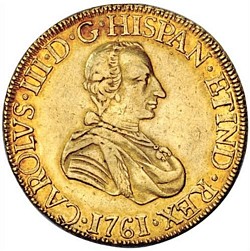
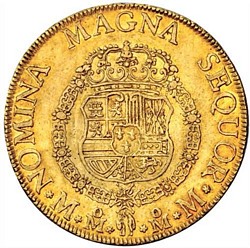
KM-154 8E 1761 Mo MM (Louis E. Eliasberg, Sr. Collection, 15 April 2005, lot 3144)


KM-153 8E 1761 Mo MM (Stack’s Bowers auction, 16 January 2021, lot 22213)
| Date | Asssayer | Comment |
| 1761 | MM |
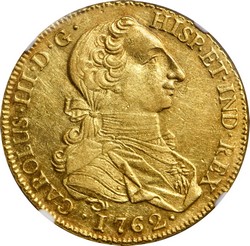
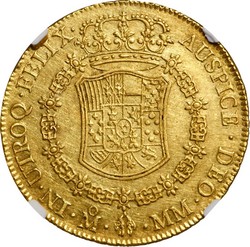
KM-155 8E 1762 Mo MM
| Date | Asssayer | Comment |
| 1762 | MM | |
| 1762 | MF | |
| 1763 | MM | |
| 1763 | MF | |
| 1764 | MF | |
| 1764 | MM | |
| 1765 | MF | |
| 1765 | MM | |
| 1766 | MF | |
| 1767 | MF | |
| 1768 | MF | |
| 1769 | MF | |
| 1770 | MF | |
| 1771 | MF |
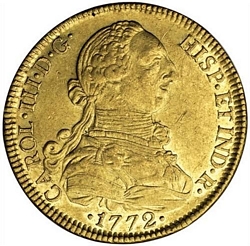
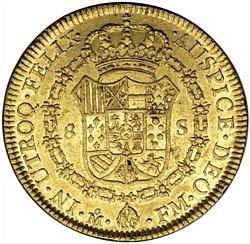
KM-156.1 8E 1772 Mo FM (Stack’s Bowers auction, 18 April 2007, lot 5746)
| Date | Asssayer | Comment |
| 1772 | FM | |
| 1772 | MF | |
| 1773 | FM |
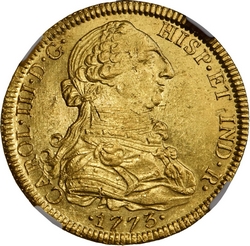
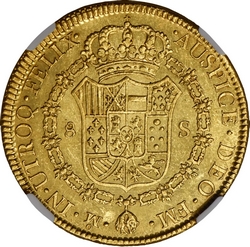
KM-156.2 8E 1773 Mo FM (Stack’s Bowers auction, 16 January 2021, lot 21066)
The rarer of the two sub-types, having the inverted mintmark. Exceptional quality for this scarcer transitional issue, which began the practice of placing the mintmark to point towards the rim rather than into the central designs.
| Date | Asssayer | Comment |
| 1773 | FM | |
| 1774 | FM | |
| 1775 | FM | |
| 1776 | FM | |
| 1777 | FM | |
| 1778 | FF | |
| 1779 | FF | |
| 1780 | FF | |
| 1781 | FF | |
| 1782 | FF | |
| 1783 | FF | |
| 1784 | FF | |
| 1784 | FM | |
| 1785 | FM |


KM-156.2a 8E 1787 Mo FM (Stack’s Bowers NYINC auction, 13 January 2024, lot 53129)
| Date | Asssayer | Comment |
| 1786 | FM | |
| 1787 | FM | |
| 1788 | FM |