Estado de Jalisco, 5-centavo Pattern (and comments on 1-peso and 10-centavos)
by David Hughes
The common 24-25mm Jalisco 5-centavo, GB-241, is noted in a clashed die state where the rays from the liberty cap appear around the numeral 5, making a Radiant-5. This is not a variety but a collectable curiosity, as noted by Amaya.
A single 5-centavo pattern is known, suggesting that the final design was worked out on the multiple 2-centavo patterns. It is larger diameter (26mm) than the common 5-centavo. The liberty cap legend is a mix of various sizes, similar to the X-short ray 2-centavos, somewhat like this: REPUBLICA MEXICANA, centered vertically. This suggests a common origin in time and space with the X-short rays 2-centavo pattern. The liberty cap is shaped differently than the final design, and the tips of the rays are rounded instead of pointed.
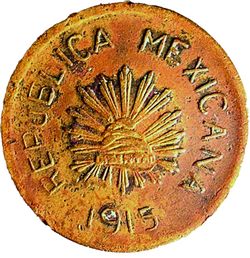
The pattern Jalisco 5-centavo, GB-242, 26mm diameter, 1.5mm thick, brass. Coin is dished, from using thin metal in the planchet. Note the recut letters in EDO. This piece is ex-Karam, ex-Flores, and is the GB, Bailey/Flores and Amaya plate coin.
The 1915 reeded edge 1-peso was closely modeled after the 1915 Chihuahua Army of the North peso. It appears a late issue, completed as a copper pattern strike in front of the advancing Constitutionalist forces, the silver for a proposed coinage, if any, likely removed or lost during the Army of the North’s retreat from Guadalajara. Three examples have been reported (Flores, 2004), one of these appearing at the 2023 USMexNA Convention. I lost my chance of examining this piece at the Convention before it returned to Mexico: alas, he who hesitates is lost. Reeding on this coin suggests it is contemporary with the very late produced reeded edge 1-centavo: perhaps reeded edges were intended to be introduced on all the coins, but never finalized before the coinage ended. See photographs in the September 2004 Journal, or the GB/Amaya catalogues.
If I was to guess, I would say the 19mm dies on 20mm planchet 2¢ X-short ray and 26mm 5¢ patterns were the first prepared, based on the uneven lettering. The overall design of the series was worked out on the subsequent second short-ray and third (19mm dies on 21-22mm planchet) 2¢ patterns. Finally, 19mm 1¢, 21mm 2¢ and 24mm 5¢ dies of the final design were prepared and used. A 1¢ die was (in error?) prepared on a 21mm diameter 2¢ die blank (the Crooked-1) and a mint sport was struck using it and the regular 19mm 1¢ liberty cap die. Finally, late in the series, the 1¢ reeded edge and the 1-peso reeded edge pattern were produced. Conjectures, of course, but it is interesting how writing about a subject tends to focus your thinking, and it makes a sort of logical sense.
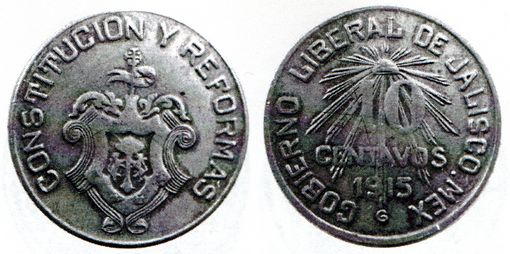
Gobierno Liberal de Jalisco 10c (GB-243, A-JL-15)
(photo courtesy of Carlos Abel Amaya)
The Jalisco 1915 10-centavo is a rare and interesting piece. It appears to be an earlier strike, prior to the occupation of Guadalajara by the forces of Villa (Ejercito del Norte) or Carranza (who did not appear to issue any Revolutionary coins). The legend CONSTITUCION Y REFORMAS (Constitution and Reforms) appears on no other Revolutionary coin. It was the slogan that Carranza, in his decree no. 20, of 14 February 1914, established should be used to sign off all dispositions and correspondence, so predates Villa’s split with Carranza, and the arrival of the Villa’s Army of the North in Guadalajara, along with the purported Villa railroad car mobile mint. This piece is likely one of the very few Conventionalist coins issued by a powerless government set up by the various Revolutionary factions at the 1914 Aguascalientes Convention, subsequently ignored in the vicious internecine fighting of 1915, eventually withering away in Cuernavaca exile with the Conventionalist President abandoning the eff ort and, rather amazingly, avoiding being shot.