Reales issues of the Guanajuato mint (8 reales)


KM-377.8 8r 1870 Go YF (Stack’s Bowers auction, 7 August 2012, lot 40688)
Diameter 39 mm. 27.070 g, 0.90277 silver
| Date | Asssayer | Recorded Mintage |
Comment |
| 1825 | JJ | G (no o) in the mintmark. This proves that the die sinking of the mintmark was a two strp process, first the G and then the o. The rarity of this coin suggests that the error was discovered esrly and corrected | |
| 1825 | JJ | ||
| 1826 | JJ | there were two die styles this year. The die style of 1825-1826 has full J's | |
| 1826 | JJ | die style of 1826-1828. straight J's | |
| 1826 | MJ | ||
| 1827 | MJ | ||
| 1827 | MR | ||
| 1828/7 | MR | ||
| 1828 | MR | ||
| 1828 | MJ | die style of 1826-1828. full J | |
| 1828 | MJ | die style of 1828-1829. This die style featurea a lower relief, but better detailed cap and a larger eagle with sharply defined feathers. full J | |
| 1828 | MJ | die style of 1828-1829. straight J | |
| 1829 | MJ | die style of 1828-1829. | |
| 1829 | MJ | die style of 1828-1829. 1/0 in 10Ds | |
| 1829 | MJ | mule. cap of 1828-1829 and eagle of 1829-1830 | |
| 1829 | MJ | die style of 1829-1830. distinctive tall cap, eagle appears shorter with a thicker neck | |
| 1830 | MJ | die style of 1829-1830. straight J, period in assayer | |
| 1830 | MJ | die style of 1830-1843. For the first time were produced almost entirely from a hub. The hub lacked only the last digit of the date (183) and the assayer. This die style was artistically speaking far superior to anything being produced in Mexico at the time. three periods after the date. full J, no period in assayer |
|
| 1831 | MJ | full J, three periods after date | |
| 1831 | MJ | straight J, two stars and one period after date | |
| 1831 | MJ | straight J, three periods after date | |
| 1832 | MJ | ||
| 1832 | MJ | 1 over inverted 1 in date | |
| 1833 | MJ | straight J, three periods after date | |
| 1833 | MJ | straight J, one period after date | |
| 1833 | MJ | full J, three periods after date | |
| 1833 | JM | ||
| 1834 | PJ | ||
| 1835 | PJ | star on cap | |
| 1835 | PJ | no star on cap | |
| 1836 | PJ | ||
| 1837 | PJ | ||
| 1838 | PJ | ||
| 1839/8 | PJ | ||
| 1839 | PJ P/J | ||
| 1839 | PJ | ||
| 1840/30 | PJ | ||
| 1840 | PJ | ||
| 1841/31 | PJ | ||
| 1841 | PJ | ||
| 1842/1 | PJ | ||
| 1842 | PJ | ||
| 1842 | PM/J | ||
| 1842 | PM | ||
| 1843 | PM | die style of 1830-1843. medal axis | |
| 1843 | PM | die style of 1830-1843. coin axis | |
| 1843 | PM | new die style with lower relief die style of 1843-1848. coin axis |
|
| 1844 | PM | ||
| 1845 | PM | ||
| 1846/5 | PM | ||
| 1846 | PM | ||
| 1847 | PM | ||
| 1848/7 | PM | ||
| 1848 | PM | ||
| 1848 | PF | This date begins the die style of 1848-1853. The cap is similar to the one used since 1843 but the eagle is entirely redesigned in lower relief | |
| 1849 | PF | ||
| 1849 | PF | F over inverted F | |
| 1850 | PF | ||
| 1851/0 | PF | ||
| 1851 | PF | ||
| 1852/1 | PF | ||
| 1852 | PF | ||
| 1853/2 | PF | ||
| 1853 | PF | ||
| 1854 | PF | New dies appear and continue through 1870. smaller cap and eagle that are well designed but engraved in lowere relief. | |
| 1855 | PF | ||
| 1856/5 | PF | ||
| 1856 | PF | ||
| 1857/5 | PF | ||
| 1857/6 | PF | ||
| 1857 | PF | ||
| 1858/7 | PF | ||
| 1858 | PF | ||
| 1859/7 | PF | ||
| 1859/8 | PF | ||
| 1859 | PF | ||
| 1860/59 | PF | ||
| 1860 6/5 | PF | From 1860 through the early part of 1868 the 6 in the date is always punched over a 5. Because a 6 fits so completely over a 5, very careful punching looks almost like a normal date. | |
| 1860 | PF | ||
| 1861/0 6/5 | PF | ||
| 1861 6/5 | PF | ||
| 1861 | PF | ||
| 1862/1 6/5 | YE/PF | ||
| 1862 6/5 | YE/PF | ||
| 1862 | YE | ||
| 1862/1 6/5 | YF | ||
| 1862 | YF | ||
| 1863 6/5 | YF | ||
| 1863 | YF | ||
| 1867 6/5 | YF | ||
| 1868 6/5 | YF | ||
| 1868 | YF | ||
| 1870 | YF | ||
| 1870 7/6 | FR | ||
| 1870 | FR/YF | ||
| 1870 | FR | ||
| 1873 | FR | new dies were introduced when the Balance Scale peso was discontinued. The o of the mintmark was removed from the inside of the G and placed superscript after the G. This die style was used from 1873 through 1886 | |
| 1874/3 | FR | ||
| 1874 | FR | ||
| 1875/3 | FR | ||
| 1875 | FR | ||
| 1875/6 | FR | ||
| 1876/5 | FR | ||
| 1876 | FR | ||
| 1877 | FR | 2,477,000 | |
| 1878/7 | FR | 2,273,000 | |
| 1878 | FR | ||
| 1878/7 | SM | ||
| 1878 | SM/FR | ||
| 1878 | SM | ||
| 1879/7 | SM/FR | ||
| 1879/8 | SM | ||
| 1879 | SM | ||
| 1880 | SB/M | ||
| 1880 second 8/7 |
SB/SM | ||
| 1880 | SB | ||
| 1881/0 | SB | 3,974,000 | |
| 1881 second 8/7 |
SB | ||
| 1881 | SB | ||
| 1882 | SB | 2,015,000 | |
| 1883 | BR B/S | 2,100,000 | |
| 1883 | BR | ||
| 1884/3 | BR | ||
| 1884 second 8/7 |
BR | ||
| 1884 | BR | ||
| 1884 second 8/7 |
RR | all known examplesa are overdates | |
| 1885 8/7 | RR | 2,363,000 | |
| 1885 | RR | ||
| 1886/ second 8/7 |
RR | 4,127,000 | all known specimens are overdates |
| 1887 | RR | 4,205.000 | This year is the beginning of the standardisation of dies in Guanajuato which continues until 1897 |
| 1888/7 | RR | 3,985,000 | |
| 1888 | RR | ||
| 1889 | RR | 3,646,000 | |
| 1890 | RR | 3,615,000 | |
| 1891/0 | RS | 3,197,000 | |
| 1891 | RS | ||
| 1892/0 | RS/JS | 3,672,000 | Go/Ga Guadalajara die being reused in Guanajuato |
| 1892 | RS | ||
| 1893 | RS | 3,854,000 | Go/Ga |
| 1893 | RS | ||
| 1894 | RS | 4,127,000 | |
| 1895/1 | RS | 3,768,000 | |
| 1895 | RS | ||
| 1896/1 | RS/ML | 5,229,000 |
Go/As |
| 1896/5 | RS | ||
| 1896 | RS/JS | Go/Ga There is no trace of an overdate but Guadalajara closed in June 1895 | |
| 1896 | RS | ||
| 1897/2 | RS | 4,344,000 | |
| 1897 | RS/JS | Go/Ga | |
| 1897 | RS | illustrated below |
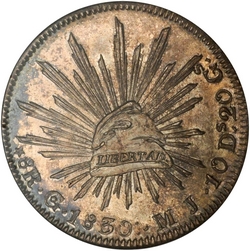
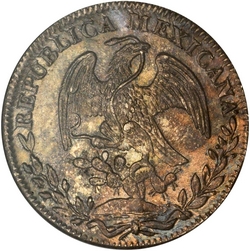
KM-377.8 8r 1830 Go MJ (Ponterio Chicago ANA auction, 13 August 2011, lot 20547)
Full "J", die style of 1830-43.
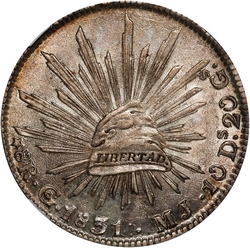
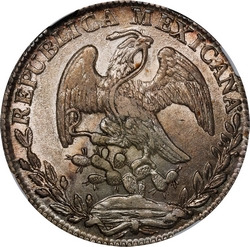
KM-377.8 8r 1831 Go MJ (Stack’s Bowers auction, 31 October 2023, lot 70433)
Three periods after date / Full "J" variety.


KM-377.8 8r 1831 Go MJ
three stars after date


KM-377.8 8r 1852/1 Go PF (Briggs & Bustos auction, 31 August 2025, lot 288)
Another rare variety from this series, the “1852/1” overdate, with remnants of the previous digit visible beneath the “2.”

KM-377.8 8r 1874/3 Go FR (Briggs & Bustos auction, 31 August 2025, lot 289)


KM-377.8 8r 1876/5 Go FR (Briggs & Bustos auction, 31 August 2025, lot 291)
 A rare overdate, not easy to identify since the 6 was punched directly over the 5, leaving only traces of the earlier digit at the lower centre of the 6.


KM-377.8 8r 1879/8 Go SM/FR (Briggs & Bustos auction, 31 August 2025, lot 292)
 A combination overdate and over-assayer variety not described by Dunigan & Parker, presumably very rare considering only three examples certified by NGC, none by PCGS.
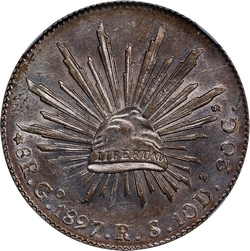
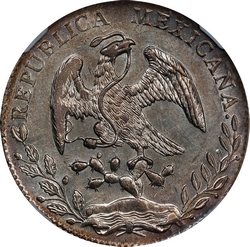
KM-377.8 8r 1897/2 Go RS (Stack’s Bowers auction, 31 October 2023, lot 70558)