The Bank of England Countermarked Dollars, 1797-1804
by H. E. Manville
(originally published in British Numismatic Journal, vol. 70, 2000)
IN 1797 and 1804 the extraordinary expedient of countermarking foreign coins was authorized by the Treasury. Nearly three million dollar-size coins, supplied by the Bank of England and almost entirely Spanish eight-reales pieces, were stamped at the Royal Mint on Tower Hill and issued by the Bank.
The economic crisis that brought on the issue of countermarked coins had been building for many years and was triggered by a run on the gold reserves of the Bank in late February 1797. Within a ten-day period, cash payments by the Bank were suspended, an immediate resumption of the striking of silver and copper coins was urged in the House of Commons. countermarked dollars were announced at one price and then issued at another, £1 and £2 notes were authorized and issued by the Bank (the previous lowest denomination had been £5), and an issue of copper pennies and twopences was discussed.
The historical background leading to the issue of the Bank of England countermarked dollar tokens is well known. ln 1796 Great Britain was at war with Republican France and her allies; Ireland was in turmoil; and the survival of an unsubjugated England depended upon her navy and a continuance of trade. A French fleet had attempted an invasion of lreland in December J796 but had not landed. A French diversionary attack on the coast of Wales in February 1797 did come ashore but the French force was captured by the local militia without firing a shot. Nevertheless, the danger of a French invasion, either of Ireland or England, remained a reality and, in fact, a small French force did land in County Mayo in August l798 but was soon defeated.
Added to these external threats was the dependence upon local agriculture (the 1799 harvest was particularly poor) and exports to feed her population. Imported grain had to be paid for in specie and the enormous costs of subsidies to support Continental action against the French (£23¼ million between 1800 and 1801 alone) drained gold reserves. By early in 1797 the money crisis had become acute.
Invasion threats had caused extraordinary demands for cash by the Bank of England's customers - so much so that £90,000 was withdrawn on Thursday, 23 February and £130,000 the next day - leaving only £626,923 in cash and gold on hand. On Saturday, 25 February, the French invasion on the Welsh coast, although immediately suppressed, forecast even greater cash demands in the following week. On Sunday, the Privy Council met and issued an order to the Bank to cease making cash payments until Parliament could decide a further course of action. On Monday, the 27th, the crowds which gathered to exchange paper for gold were told of the Order in Council and sent away.E.M. Kelly, Spanish Dollars and Silver Tokens: An account of the issues of the Bank of England 1797—1816, London, 1976, pp. 14-17
Countermarked dollars, 1797
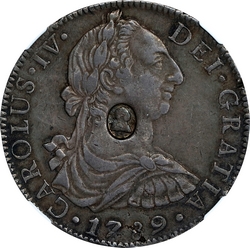
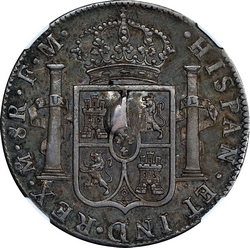
KM-633 Great Britain bust on 8r 1789 Mo FM (Stack’s Bowers NYINC Auction, 13 January 2024, lot 53262)
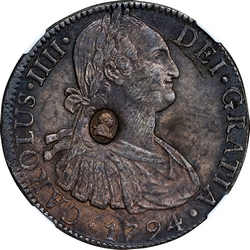
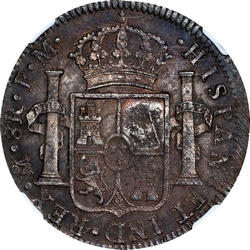
KM-634 Great Britain bust on 8r 1794 Mo FM (Stack’s Bowers NYINC Auction, 13 January 2024, lot 53266)
In February 1797 the Bank's silver reserves were in foreign dollars, amounting to some £241,000. The original source of most of these dollars was Spanish American mints: 'at the end of the eigh-teenth century sixty per cent of the world's ou1put of silver coins came from La Valenciana mine in Mexico.’Kelly, op. cit., p.19 A second source was the purchase of Spanish dollars from Hamburg, Portugal, the West Indies and other marts, and a third was from captured Spanish coins that the Bank could purchase. The taking of Spanish prize ships could only be exploited after October 1796 when Spain, a former ally against France, declared war on England.
On Friday, 3 March 1797 a Treasury Warrant was sent to the Tower Mint instructing the officers to countennark Spanish Dollars supplied by the Bank of England with a puncheon of the king's head:
After Our Hearty Commendation. These are to authorize and direct you to prepare the necessary means of Stamping the Mark of the King's Head used at Goldsmiths Hall for distinguishing the Platc of this Kingdom on such Silver Spanish Dollars as shall be sent to your office from the Bank of England. For which this shall be your warrant.
Whitehall. Treasury Chamber the 3rd day of March 1797.
W.Pitt
J. Smyth
S. Douglas
To the Warden, Master & Worker & Comptroller & the rest of The Officers of His Majesty's Mint. Spanish Dollars to be stamped with the Kings Head.
What exactly was the 'puncheon with the king's head'? In December 1784 a duty of 6d. per ounce on silver plate had been imposed. This was immediately reflected during the obligatory hallmarking by adding a new mark with the king's head to signify that the duty had been paid. For the first two years a left-facing bust of George III within a small octagonal was applied. In 1786 this duty-mark was changed to a right-facing bust in a small oval. Five sizes of oval puncheons were employed on different sizes of plate and the largest was selected to mark the dollars.
Records at Goldsmiths' Hall, show that by 29 May 1795 Fendall Rushforth, the Deputy Touch Warden, had received from Mint engraver John Pingo over 300 punches of various types and sizes, including five sizes of duty marks with the king's head in an oval. On 30 May 1796 an additional 231 punches had been received from Pingo. and between 6 January and 10 May 1797 a further 46 punches. From 5 July l 797 the plate duty was increased and new duty marks with a nick in the oval's rim were employed. On 28 May 1798 the nicked oval punches were defaced and the following day 186 unnicked punches in four sizes were 'Receiv' d of Mr Pingo.
Marking dollars to give a fixed value was not an entirely novel idea. Although 1797 was several years before the heyday of countermarking in Scotland in the first quarter of the nineteenth century, the early 1790s had seen two English companies countermark dollars to pay their workers - the Cark Cotton Works in Lancashire and the Revolution Mill at East Relford in Nottinghamshire.
Quantities marked and issued, 1797
Dming the eighteenth century enormous quantities of Spanish dollars of eight reales were available as a commodity on the London market, the price fluctuating with availability, demand and the course of wars. These circulated freely, not only in Great Britain but throughout much of the world. Market prices in London were always quoted by the ounce and over a year tended to fluctuate in a fairly narrow band. In 1795 the low had been 4s. 11½d. in April and May, the high 5s. 4½d. from August to December, bullion prices that translate to 4s. 3¼d. to 4s. 7¾d. per dollar. In 1796 the price varied from 5s. 4½d. (4s. 3¼d.) in the first quarter of the year to March, to 5s. 2d..(4s. 5½d.) in September.(footnote} An Account Of the Market Prices of ….. Spanish Dollars, or Pillar Pieces of Eight …. from the 3d of January 1746, to the 1st of March 1811 inclusive. Extracted from Castaing's and Lloyd's Lists, First Quotation every Month ... Ordered, by the House of Commons, to be printed, 4 March 1811./footnote}
As soon as the Mint received dollars from the Bank and had a supply of the oval punches they worked with astonishing rapidity, and the London Times on Monday, 6 March, could announce:
Bank of England, March 6, 1797.
In order to accommodate the public with a f'urther supply of coin for small payments, a quantity of dollars, which have been Supplied by the Bank. and stamped at the Mint are now ready to be issued at the Bank at the Price of Four Shillings and Sixpence per Dollar: and a further quantity is preparing.
No sooner had this announcement been published than the Bank realized that although they may have obtained their dollars at a lower rate, the market value on 3 March was 5s. 5d. per ounce Troy, which translates to 4s. 7¾d. per coin, and at that rate dollars issued at 4s. 6d. would soon find the melting pot. A further notice in The Times, on Thursday, 9 March, announced a new valuation:
Bank of England. Monday. March 9, 1797.
In Consequence of its appearing to be the general Opinion that the Dollars will be more conveniently circulated at the Rate of 4s. 9d. per Dollar. than at that of 4s. 6d. which had been proposed. Notice is hereby given, That Dollars are now ready to be delivered accordingly at the Rate of Four Shillings and Ninepence per Dollar.This announcement was somewhat disingenuous: four-and-nine was not a more convenient sum than four-and-six and the sole reason appears to have been the current market price of the dollars
The market price of Spanish dollars, as quoted in the Sessional Papers of the House of Commons, had been 5s. 3d. per ounce on 2 December 1796; no price was noted on 3 January 1797; and then 5s. 2½d. on 3 February; 5s. 5d. on 3 March; 5s. 5½d. on 4 April and 2 May; 5s. 3d. on 2 June; 5s. on 4 July; 5s. ld. on I August; 5s. on I September; and was not quoted in October through December 1797.
The market price of individual dollars, averaging about 416 gr, was 4s. 5¾d. in early February 1797 but had risen to 4s. 7¾d. by 3 March, the very day that the Treasury issued the wanant to the Mint authorizing the counternarking of the dollars. Because the bullion price of dollars fluctuated, as with any other commodity, the Bank obviously would have been shaving it very closely to issue dollars at 4s. 6d. when the market price was 4s. 5¾d., and when the price rose by a penny three-farthings above 4s. 6d. in early March they were forced to revalue the marked dollars upwards to avoid instant melting by the public.
From June 1797, when the price of dollars on the London bullion market fell to 4s. 6d., the application of a false punch on a genuine dollar would have yielded a profit of about a 5%, and during the summer a further drop in the market price would have increased the profit to between 8% and 9.5%. The many false countermarks on genuine coins known today testify that extensive counterfeiting went merrily on for months. Although the quality of many of the false marks is rather poor, some are quite good, and with such a small stamp it is no wonder that the Bank clerks, to say nothing of the general public, had difficulty trying to separate the wheat from the chaff.
Kelly records that, to everyone's surprise, the Bank's representative at the Mint reported that forged dollars had been found among the coins sent over in mid-July. They had been countermarked and he was sure that some had passed into circulation.Kelly, op/ cit. p. 2915 This report raises several questions. If the Mint detected counterfeit dollars on receipt, why did they stamp them? If the frauds were discovered only after the dollars had been punched. why did they not separate them and inform the Bank? When, in the autumn of 1797, the Mint petitioned the Treasury for payment, they specified an end date for their countermarking of 31 May. Add to this problem the many false marks on counterfeit dollars, and it is no wonder that the Bank felt forced to recall their tokens after little more than half a year.
The first recall notice, dated 28 September 1797 and printed in the London Gazette, announced that dollars would be redeemed until 31 October. At first, only coins with official marks were to be accepted. The difficulty, however, in deciding which oval marks were genuine and which were not was so acute that the Bank capitulated
A notice in The Times, dated 10 October, announced that all genuine dollars would be accepted at 4s. 9d., whether the mark was official or not, from 'all persons who appear to have taken them in the fair way of currency or business. This indulgence will be continued until Saturday, the 21st inst., unless it should become necessary to withdraw it by the attempts of evil-minded and dishonest persons to impose on the bank. In the event, only some £1,076 17s. 6d. worth of genuine dollars with false marks was redeemed.
On 23 November l 797 the Mint Office informed the Lords Commissioners of the Treasury that between 5 March and 31 May in that year they had received from the Bank of England 2,323,295 Spanish dollars, weighing 167,916 pounds troy, 'which were stamped and returned to the Bank of England, in equal weight', The Mint suggested that 'for defraying the charge and expense attending the stamping, forging [the steel] and engraving punches and compensating the officers of the Mint for extraordinary attendance in giving the required dispatch to the business, in the receiving, weighing, delivering, and keeping accounts of the said dollars, and in regard to the charge and risk attending this service; there be allowed one penny upon the pound weight (on which the Master of the Mint declines any claim to himself) and on the above mentioned weight of 167,916 Pounds will amount to £699-13-3,' Payment of this sum was approved by the Treasury over a year later on 4 February 1799,
The Mint figure of 2,323,295 dollars weighing 167,916 pounds troy, delivered March-May 1797, yields an average of slightly more than 416 grains per coin (416.30363 gr). This figure is about two grains higher than the average of randomly-chosen countermarked Spanish dollars weighed recently, but some of the heavier dollars may have been culled for melting over the years and it is possible that other coins may have lost a grain or two through normal handling wear during the past two centuries.
The Mint account of the numbers of Spanish dollars stamped and their weight does not quite agree with the Bank's figures, as given the following year. In reply to questions of the Lords of the Committee of the Privy Council to the Governor and Company of the Bank of England, relative to the countennarked Spanish Dollars, about March 1798, the Bank reported that '1,934,033 ounces [161,169 pounds 5 ounces] of dollars were stamped at the Mint consisting of 2,232,788 pieces amounting at 4s. 9d. each to £530,287 3s. 0d.' By this account, the average weight of a dollar was 415,78 gr.
Counterfeits
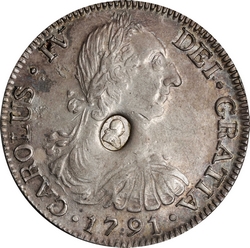
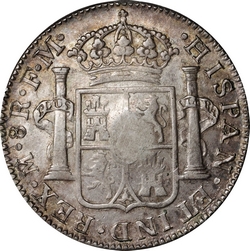
counterfeit KM-627 Great Britain bust on 8r 1791 Mo FM (Stack’s Bowers NYINC Auction, 20 January 2022, lot 8645)
counterfeit bust of George III within oval indent on a Sheffield plate die struck counterfeit 8 Reales. Both host coin and countermark are of crude manufacture, but very well preserved and very attractive.
Stack’s Bowers writes: This prolific issue saw many imitations of the official hallmarks; in fact it is known that numerous counterfeiting operations were in production of such issues. This series is much more complex than many would believe with many variations such as genuine countermarks applied to forged hosts, forged countermarks applied to genuine hosts and counterfeit countermarks applied to the counterfeit hosts.
Expounding upon this further some of the counterfeiting organizations, presumably those of Birmingham, were really sophisticated often utilizing multiple dies and die parings. By comparison the present example dated "1791" shares the exact same reverse die as the contemporary counterfeit Dollar dated "1777" contained in lot # 24694 (part of), but a different obverse.
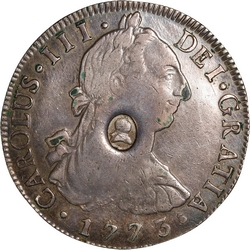
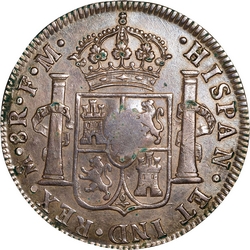
counterfeit KM-627 Great Britain bust on 8r 1773 Mo FM (Stack’s Bowers NYINC Auction, 16 January 2024, lot 56742)
Imitating Bank of England type I oval countermark; counterfeit bust of George III within oval indent on a struck silvered bronze counterfeit 1773-Mo FM Mexico 8 Reales.
Countermarked half-dollars, 1799
On 21 September 1799, the Treasury issued a warrant instructing the Officers of the Royal Mint to countermark Spanish Dollars with the Mark of the King's Head:
After Our hearty Commendations. These are to authorize and direct you to prepare the necessary means for Stamping the Mark of the Kings Head used at Goldsmiths Hall for distinguishing the Plate of this Kingdom on such Silver Spanish Dollars as shall be sent to your office from the Bank of England. for which this shall be your warrant. Whitehall. Treasury Chambers the 21st Day of September 1799-
W. Pitt.
S. Douglas.
Charles Small Pybus.
To the Warden. Master and Worker & Companyerror. Should be Comptroller and the rest of the Officers of His Majesty's Mint
Spanish Dollars to be stamped with the King's Head,
Subsequently on 6 November 1799 the Mint sent a request to the Treasury for payment for countermarking Spanish Dollars in September of that year:
To the Right Honorable the Lords Commissioners of His Majeslys Treasury.
May it please your Lordships.
In obedience to your Lordship's warrant dated 21st Seper. last directing us to receive Silver Spanish Dollars from the Bank of England to be marked with the stamp therein directed.
We beg to acquaint your Lordships that in pursuance thereof we received 945,460 Dollars weighing 34. 166 pounds weight which were stamped accordingly and returned to the Bank in equal weight.
That for defraying the expense incurred in the execution of this Service and in consideration of the Risque to which it was necessarily exposed together with some compensation to the Oflicers for extraordinary attendance it is humbly proposed that your Lordships may be pleased to grant an allowance or one penny in the pound weight. being the same as your Lordships were pleased to allow in a similar Service in the year 1797. which at that rate will amount to One Hundred forty two pounds seven shillings and twopence. and that your Lordships may be pleased to authorize Lord Hawkesbury to pay the said Sum of £ 142-7-2 out of monies received by him for the Service or this Office to be divided in Sutch proportions among the parties intituled thereto as the Principal Officers may think just and proper. and that the Auditor be directed lo allow the same, in the Master’s Account under proper voucher.
All which is nevertheless humbly submitted to your Lordships Wisdom.
We are
May it please your Lordships &c. &c.
Ed Lucas Depty Wardn
James Morrison Depty Mastr
John Wyett Depty Comptr
Mint Office
6th Nov. 1799
Payment of this amount was approved on 17 April 1800.
Although only dollars were sanctioned in the Treasury warrant, and dollars were stated in the request for payment, 945.460 coins weighing 34,166 pounds Troy averages about 208.15 grains-half of the weight established for dollars of eight reales - and it is therefore obvious that the entire 1799 marking was on half-dollars of four reales. It also suggests that the Bank no longer kept a stock of the 1797 countermarked dollars which could be re-issued and, in fact, by 30 June 1799 the Bank had converted to bullion its entire holdings of 2,194,091½ countermarked dollars, weighing 1,895,696 ounces and valued at £521,100. Whatever the reason, the newly-counter-marked half-dollars were never officially issued in Great Britain.
The great majority of dollars with genuine-type counterrnarks from the 1797 issue are on host coins from Spanish-American mints, principally Mexico City. Host dollars from Spanish main-land mints are decidedly rare. In contrast, the majority of the half-dollars supplied by the Bank evidently were from the Madrid mint and a few from Seville because these are the coins with gen-uine-type oval countennarks commonly encountered today. Apparently, the Bank had obtained 410 sacks of four reales coins, weighing very close to 1,000 ounces each, that had come directly from Spain, or through a middleman supplier. Oval marks on half-dollars other than from Madrid and Seville should be viewed with suspicion: false oval marks are known on Spanish-American half-dollars and even those with genuine-type marks tend to be on unusual host coins that might appeal to collectors.
The problem of why four reales coins were officially struck remains a mystery. It is fairly certain that the cause for the contemplated reissue of the stamped dollars in 1799 was a military expedition to Holland, but it seems likely that in the chaotic state of the exchange rates at the end of 1799 it was considered inexpedient to issue them and they were eventually melted down when the dollars were in short supply in 1811.
However, Stack’s Bowers writes: Some sources suggest that only Dollars and 1/2 Dollars for the oval and octagonal countermarks were issued, while others state that during the countermarking action the record of account was done in bags of 1,000 ounces troy. According the E.M. Kelly, author of Spanish Dollars and Silver Tokens, states that of the sixty entries for Current Cash Account, totals for the day, twenty eight listed 1/2 Dollars and 1/4 Dollars. Other minor denominations bearing these marks are known such as 1 and 1/2 Reales, both of which are excessively rare. The 1/4 Dollar while significantly more difficult to obtain when compared to the Dollar and 1/2 Dollar, does appear from time to time. Since 2011 we have documented only two other examples to have come to market, with the present survivor being a known third.
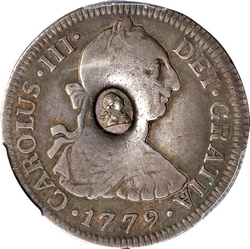
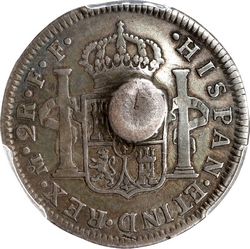
KM-unlisted Great Britain bust on 2r 1779 Mo FF (Stack’s Bowers NYINC Auction, 13 January 2023, lot 21391)
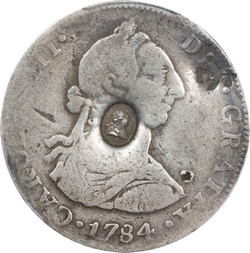
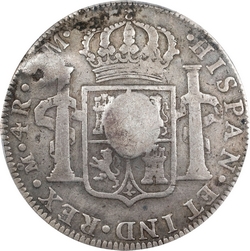
KM-B622 Great Britain bust on 4r 1784 Mo FM (Stack’s Bowers auction, 20 April 2026, lot 49645)
A single medium size Chinese chop on the obverse, "荃" (Quan), with two unidentified punchmarks.
Countermarked dollars, 1804
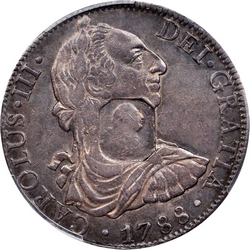
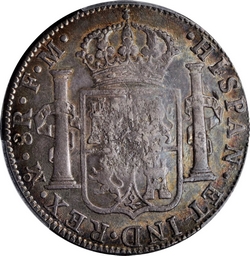
KM-655 Great Britain bust on 8r 1788 Mo MF (Stack’s Bowers Auction, 16 January 2021, lot 22335)
The countermark was somewhat unevenly applied from a worn punch with good definition of the shaped border.
KM-656 Great Britain bust on 8r 1789 Mo FM (Stack’s Bowers Auction, 12 August 2024, lot 40167)
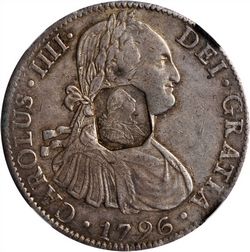
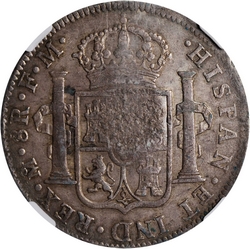
KM-656 Great Britain bust on 8r 1796 Mo FM (Stack’s Bowers Auction, 13 October 2021, lot 71027)
The need for silver coins, always a problem as long as the Government would not allow either an increase in the official coinage of 5s. 2d. per ounce or the striking of silver coins at a rate of 65 or 66 shillings to the pound instead of 62 (which price and weight had been in effect since I601). again became acute in 1803. In May of that year, Napoleon had shattered the fragile Treaty of Amiens, signed in March 1802, and the renewal of war brought on the usual rising prices and hoarding of what silver coin remained in circulation. Banks were paying £101 to obtain £60 worth of silver coin.
In December, a deputation of city bankers urged the Directors of the Bank of England to provide some relief to the shortage of silver coins. Their petition was reflected in a press report on Christmas Day:
It is to be regretted that the Bank does not issue some portion of the dollars it is stated to possess. in order to relieve the inconvenience now so generally experienced from the want of silver coinage; they might, as formerly, be issued at a price above their intrinsic value. by which means they would remain in circulation, but should even a loss attend their delivery, a circumstance in no way probable, the public have a right to a slight participation in the enormous profits which result to the Bank from the restriction of its paymentsThe Observer, Sunday, 25 December 1803 .
The Government acted with commendable alacrity to the request and on 2 January l 804, the Treasury issued a warrant instructing the officers of the Mint again to countermark Spanish dollars:
After our hearty Commendations: These are to authorize and direct you to prepare the necessary means of stamping in an octagon form the head now used for impressing the Silver penny, omitting the inscription. on such silver Spanish Dollars. as shall be sent to your Office from the Bank of England: for which this shall he your warrant.
Whitehall. Treasury Chamber. the 2nd day of January. 1804.
Henry Addlington
William Brodrick
Nat Bond.
To the Warden. Master & Worker and Comptroller, and the rest of the Officers of His Majestys Mint.
Although the supply of available Spanish dollars was no longer as plentiful as it had been in 1797. both the Bank in delivering dollars and the Mint in stamping them acted quickly and within ten days the press could report that the newly countermarked dollars were available:
'DOLLARS - The Directors of the Bank have intimated to the Bankers and Merchants, that they may be accommodated with any quantity of Dollars (stamped with the Kings head) at 5s. each, and that they will be received again in payment by them, for a time, at that rate. Due notice will be given of the period of their circulation ... They have rated them at 5s. which is full threepence halfpenny above their real value according to the price of bullion. that they may not be melted down. and the only danger of loss that the Bank can run is. that this profit of 3½d. may tempt the vigilant active race of manufacturers who overlook no occasion of benefit. to affix a stamp to Dollars not issued by the Bank - so that they may have to redeem more than they give out. They will of course guard against counterfeits.
Every Banking-house in town yesterday moming received £1.000 worth of dollars from the Bank in exchange for Bank paper.The Morning Herald, Friday, 13 January, 18.
By 9 February more than 400,000 countermarked dollars had been returned from the Mint and transferred to the Bank's Current Cash Account: 'by the 21st February the number of dollars in the Bank was reduced to 39,000 although there was a balance of unissued stamped dollars amounting to 284,000 out of the total of 412,140 returned from the Mint.' According to Mint figures, the total number of countermarked dollars amounted to 415,080. Eventually, 266,000 octagonally-stamped dollars were issued to the public.Kelly, op. cit. pp. 50-51.
The press prediction that the new stamp would soon be counterfeited was accurate and a majority of the dollars with octagonal countermark seen today have been stamped with a false puncheon. The large head adapted from the Maundy penny design of 1792, 1795 and 1800 was difficult to copy accurately and evidently the Bank's clerks were able to recognize and reject the counterfeits for redemption at issue price - thrusting them back onto the public from where many of the survivors have found their way into numismatic circles.
Nevertheless, the situation remained acute, as reported in The Sun, Wednesday, 18 April 1804:
Many Dollars are in circulation with a forged stamp. by which the Public is likely to be defrauded of nearly threepence in each Dollar. as the Bank will not pay or take in those with counterfeit stamps. The Directors are so well satisfied of the extent of this mischief that they do not now issue any more of the stamped Dollars, but have contracted with Mr. Bolton [sic], of Soho. to strike a large quantity with a beautiful impression of the King's head. which we understand cannot be counterfeited without great difficulty; they will be issued in short time.
Boulton had prepared dollar patterns as early as 1798, and by May 1804 the Bank had accepted his offer, an announcement appearing in the London Gazette, Saturday, 12 May 1804:
Bank of England, May 12, 1804.
The Court of Directors of the Governor and Company of the Bank of England, with the Approbation of His Majesty's Most Honorable Privy Council, having caused Dollars to be stamped at Mr. Boulton's Manufactory. with His Majesty's Head and an Inscription 'Georgius III, Dei Gratia Rex' on the Obverse. and Britannia, with the words 'Five Shillings Dollar Bank of England, 1804' on the Reverse, which they propose to issue instead of the Dollars which have been lately stamped at His Majesty's Mint at the Tower, the latter of which it is expedient to withdraw from Circulation. hereby give Notice. that those Dollars which have been stamped at the Tower since the 1st Day of January last. and which are now in Circulation, will not be current, nor be received at the Bank at the Rate of 5s. each, after the 2nd Day of June next; and that after the 20th Instant until the said 2nd Day of June inclusive, they may be exchanged for Dollars with the new Stamp, or for Bank Notes, after the Rate of 5s. for each Dollar. Attendance will be given at the Bank for this Purpose on Monday the 21st Instant, and the following Days (Sunday and Fast Day excepted), until Saturday the 2nd Day of June inclusive. But to avoid Confusion from a Crowd of Persons applying at the same Time, the Court finds it necessary to give Notice. that smaller sums than Eight Dollars cannot be exchanged at the Bank.
Robert Bell. Secretary.
With Boulton 's overstamped dollars in production, it was expedient rapidly to withdraw the Bank's newly-marked dollars, and the circulating period of the octagonals was even shorter than that of the ovals in 1797: 11 January to 2 June 1804.44 Thus the experiment of circulating Spanish dollars in l797 and 1804 (with, perhaps, the intention of an issue in 1799) came to a rather ignominious end, superceded by technology then unavailable in London. The firm of Boulton & Watt overstamped dollars from 1804 to 1811 (all dated 1804, however), but the use of countermarks on dollars did not die. We have seen that a few manufacturing firms had countermarked dollars before 1797, and until the mid to late 1820s scores of private tradesmen and banks, particularly in Scotland, continued the practice.
Counterfeits
Counterfeit KM-655 Great Britain bust on 8r 1788 Mo MF (Stack’s Bowers Auction, 2 November 2023, lot 73765)
An interesting counterfeit counterstamp, seemingly contemporary, which we have observed applied to both genuine and counterfeit host coins in the past. In the present instance, the stamp has been applied to a genuine 1801-Mo FM 8 Reales. A test cut appears on the rim above the D in DEI, presumably an effort by a suspicious owner to authenticate the piece.
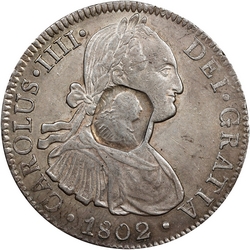
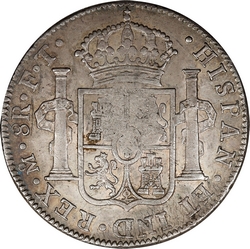
counterfeit KM-656 Great Britain bust on 8r 1802 Mo FT (Stack’s Bowers Auction, 1 March 2023, lot 3406)
Crude imitation of a Bank of England Type II applied to the obverse of a 1802-Mo FT Mexico 8 Reales
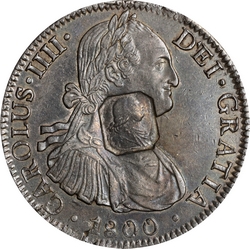
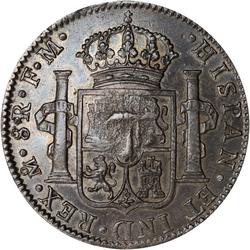
Counterfeit KM-656 Great Britain bust on 8r 1800 Mo FM (Stack’s Bowers NYINC Auction, 20 January 2022, lot 8647)
Imitating Bank of England type II octagonal countermark applied to the obverse of a 1800-Mo FM Mexico bust 8 Reales of Charles IIII (IV).
As with the official oval hallmark issued several years prior to the octagonal issuance, a plethora of counterfeits are known. A few of these contemporary counterfeits are quite similar to the official issue, but to the trained eye can be spotted rather quickly. However, some are the exact opposite and in fact are crude, goofy looking and easy to spot. This series is indeed much more complex than many numismatists give it credit for with a fair number of extremely rare host coins and denominations. A neat and interesting issue perfect for collectors of British or cut & countermarked coinage looking to expand their knowledge and appreciation of this series.