Countermarked coins used in England
In the late eighteenth and early nineteeth centuries there was a chronic shortage of British coins, the principal reason being that the market price for silver was higher than the Royal Mint was authorised to pay.
Britain needed more silver coin and the answer to this problem lay in the vast number of foreign coins, mostly eight reales, which captured in war or acquired through peaceful commerce, filled the vaults of the Bank of England and were available as a regular commocity on the bullion market. In 1797 Spanish dollars were stamped, by authority of the Bank of England, with the oval punch containing the bust of George III which was used to mark silverware.
A number of private companies also countermarked dollars with their own marks which recycled the foreign coins as British tokens. Harrington Manville's Tokens of the Industrial Revolution Foreign Silver Coins Countermarked for use in Great Britain, c. 1787-1828, gives an historical account of the cities, towns and hamlets which became the places for issuing such countermarked coins, following that with detailed comments on the issuers, and a catalogue of recorded examples.
When the great silver shortage ended, almost all of the countermarked coins were exchanged for official coin, and melted.
Cark Cotton Mill, Cartmel, Lancashire
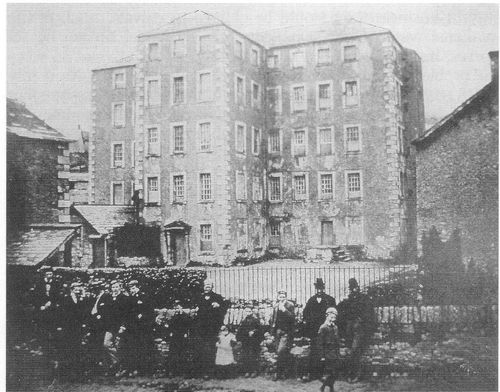
Cark Cotton MiIl, built for James Stockdale & Co. 1782, destroyed by fire 1935. Photo c. 1880
Cark lies about six miles south of Lake Windermere in the Lake District, fifteen miles from Lancaster and 260 miles to the northwest of London.
In 1784 James Stockdale acquired the OId Cark forge together with watercourses and other land on which to build a cotton spinning works. On 9 May 1785, James Stockdale and four other men signed articles of partnership in the business of 'buying, spinning, manufacturing and selling of cotton.' The mill, together with 'divers dwellinghouses, warehouses and other necessary works' were by then in place and production probably began very close to the date the partnership agreement was signed.
Thackery, Stockdale and Company, under which Cark Cotton Works operated, was an alliance of capital (four merchants) and practical experience provided by a cabinetmaker. The merchants were James Stockdale, Joseph Thackery and Joseph Ryder both from Manchester and Thomas Satterthwaite of Lancaster.
James Stockdale, who lived from 1724 to 1806, was a thoroughgoing man of business, and despite his advancing years, was willing to add cotton spinning to his wide range of activities. These included lands in the North American colonies at Suffolk in Virginia, which lands he Iost during the War of American Independence, a West Indian plantation, shipping, shipbuilding, mining, the operation of blast furnaces and iron forges and an investment (with John Wilkinson) in Perier Brothers' Works for supplying Paris with waterTransactions of the Cumberland and Westmorland Antiquarian & Archaeological Society, Vol. LXIV 1964. Article XXIV. The Stockdale family etc. by W.H. Chaloner M.A. Ph.D.pp. 352-358.. Joseph Thackery and Joseph Ryder were both well-known cotton merchants from Manchester.
Thomas Satterthwaite. on his father's death. moved with his family from Leeds to Lancaster, a port then growing rich through the buying and selling of African slaves and its trade with the Caribbean. He became a West Indian merchant, so he and Stockdale were ideally placed for supplying Cark Cotton Works with cotton.
The fifth partner with the practical experience was Edward Hardy from Mossley near Ashton-under-Lyne. He was an engineer at Cark until his death in 1796, and he was given the 'sole and entire direction and management' of the machinery.
The partners put in £3,600 to buy the site and build the mill, Iater described as a large cotton mill, a number of cottages, workshops, engine houses, tails and other races, and no fewer than nine bridges, destroying entirely the rural appearance of the village.'
Throughout the early years the partners spent much time and money on the mill's power supply, contracting with Boulton and Watt in January 1786 for a 'fire engine' to divert water from the tail race into a 'snoring hole' from which it would be pumped back into the dam, so giving a continuous supply of water to the wheel that drove the machinery. One letter dated 18 July 1786 from James Stockdale’s son, Fletcher, to James Watt quotes some very interesting statistics, 'we have not less than upwards of 400 people unemployed and not one fourth of their time at work, which we are obliged to keep constantly in pay and whose wages does not amount to less than £70 or £80 per week.' This is one of the few references to the numbers employed in an early spinning mill, and a quick calculation shows that the average weekly wage of the largely juvenile labour force to be about four shillings.
The Cark Cotton Works was one of the larger mills in Lancashire at this time with up to 3,400 spindles, so the new engine was very necessary.
Stockdale's involvement with both Wilkinson and Boulton & Watt gives rise to speculation about the source of the Cark Cotton Works countermarked dollars. Wilkinson was receiving copper tokens made by Thomas Williams at Anglesey from die engraved by John Gregory Hancock by March 1787, and a specimen was received by Boulton in August 1787. Later Wilkinson had some silver tokens made, and it is speculated that these would have been made by either John Westwood or Thomas Williams. Eventually however Matthew Boulton became involved in the manufacture of Wilkinson's copper tokens from about 1789 or 1790David Vice, The Tokens of John Wilkinson, Format March 1990.
It is therefore quite possible that James Stockdale saw these Wilkinson tokens, and experiencing problems with wage payment too, looked into a similar solution. However, it is also possible, as Cark Cotton Works were supplied with one of the early models of a Boulton & Watt fire engine in late 1786 and early 1787, that Boulton, being aware of problems with obtaining coinage to pay wages, decided to produce some countermarked coins for his friend as an experiment and advertisement.
Cark Cotton Mill was eventually sold on the 9 May 1814. After remaining empty for many years, the building was used for corn milling by the Hall family, until fire destroyed it on 9 May 1935information from Eric C. Hodge, "Cark Cotton Works", in Spink Numismatic Circular, April 2001, Volume CIX, No. 2.
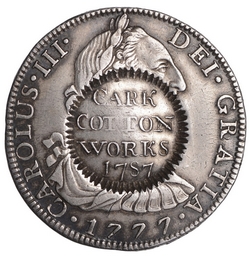
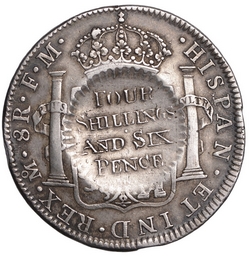
KM-; Manville101 4/6 on 8r 1777 Mo FM (Noonans auction of Eric Hodge Collection, 29 September 2026, lot 6089)
This FOUR SHILLINGS AND SIX PENCE countermark is known on 1764 Mo MF, 1772 Mo FM, 1776 Mo FM, 1778 Mo FM, 1780 Mo FF and 1785 Mo FM. The date of the host coins helps to confirm an early issue for a period probably extending only up to the mid to late 1790s. The 1767 date on the countermark presumably refer to when the countermarked tokens were first issued
Cromford, Derbyshire
Richard Arkwright was one of the pioneers of the Industrial Revolution, making huge improvements in methods of spinning cotton. He opened a horse-powered spinning mill in Nottingham in 1775 and a few years later a larger water-powered mill at Cromford, utilising the waters of the river Derwent. His son, also Richard, took over the running of Cromford and other mills in 1792 and his concern for the health and welfare of his workers resulted in numerous innovations, including the provision of circulating coinage. Because the dates of the host coins extend many years beyond Sir Richard’s death, the issue of token may be counted among the innovations undertaken by the younger Richard Arkwright.
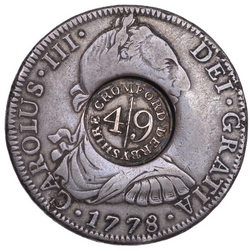
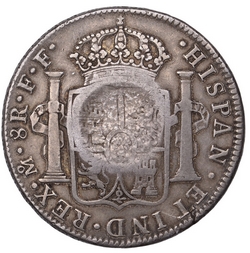
KM-C643; Manville 104 4/9 on 8r 1778 Mo FF (Noonans auction of Eric Hodge Collection, 29 September 2026, lot 6093)
The 4/9 countermark is known on 1773 Mo FM, 1774 Mo FM, 1777 Mo FF, 1778 Mo FF, 1781 Mo FM, 1781 Mo FF, 1791 Mo FM, 1793 Mo FM, 1796 Mo FM, 1797 Mo FM, 1798 Mo FM, 1799 Mo FM, 1800 Mo FM, 1801 Mo FM, 1801 Mo FF, 1802 Mo FT, 1803 Mo FT, 1804 Mo FT, 1806 Mo FT, and 1810 Mo HJ.
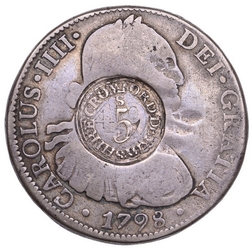
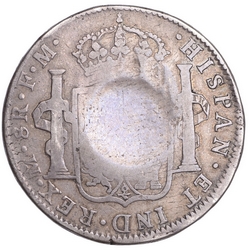
KM-C643; Manville 102 5/ (over 4/9) on 8r 1798 Mo FM (Noonans auction of Eric Hodge Collection, 29 September 2026, lot 6091)
The Five Shillings (5s) is known on 1781 Mo FF, 1789 Mo FM, 1793 Mo FM (5s over 4/9), 1795 Mo FM, 1797 Mo FM, 1798 Mo FM (5s over 4/9), 1801 Mo FM (5s over 4/9), 1803 Mo FT.
A contemporary counterfeit is known, struck from a punch imitating the larger 9 of the denomination but with cruder and uneven lettering.
Four coins are recorded reading A & Co CROMFORD in a small circle around 5/0 within a lined circle but this countermark is without serious question a twentieth-century concoction.
Donald & Co., Birmingham, Warwickshire
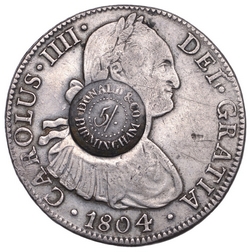
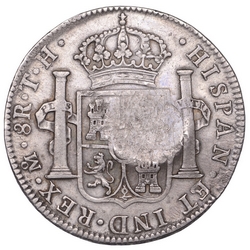
KM-C645; Manville 100 5/ on 8r 1804 Mo TH (Noonans auction of Eric Hodge Collection, 29 September 2026, lot 6088)
These coins were probably issued by one William Donald, a hosier and clothing and hat manufacturer, listed in the Birmingham trade directories at various addresses between c. 1793 and 1815.
This countermark is known on 1803 Mo FT and 1804 Mo TH. That the dates of the host coins are closely bunched suggests a circulation period of about 1805 to 1810, after which the price of Spanish dollars on the bullion market remained generally above five shillings until after the battle of Waterloo in 1815.
Percy Main Colliery, North Shields, Northumberland
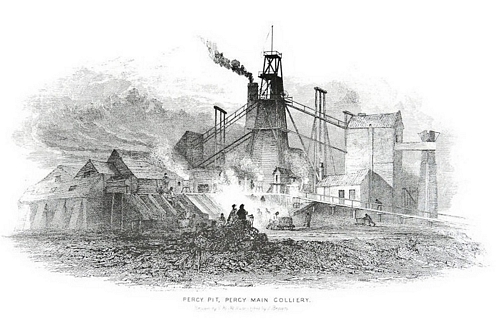
Pery Main Colliery, from an early 19th century print by Thomas Hair
The Percy Main Colliery, owned by the Duke of Northumberland, was located about five miles east of Newcastle upon Tyne and four miles west of Tynemouth. Sinking of the first shaft began in 1796 and at one time it was the deepest coal mine in the country, but water problems were endemic and finally caused the mine to be abandoned in 1851.
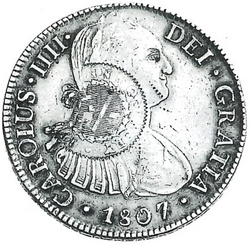
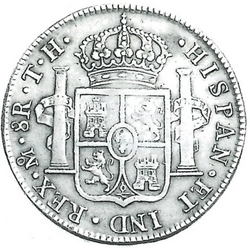
Manville-106 5/- on 8r 1807 Mo TH
PERCY MAIN COLLIERY in a small toothed circle around 5/- is known on 1789 Mo FM, 1790 Mo FM, 1807 Mo TH (weakly punched)
WhetmoreS. A. H. Whetmore, “Notes on Some Issuers of Countermarked Spanish Dollars” in British Numismatic Journal, 28 (1955-7), pp. 620-48 suggests that the acute shortage of metallic currency on Tyneside in 1811 and 1812 (during which time a silver one-shilling token was issued by the nearby Berwick Main Colliery) may have occasioned the issue, but these dates are either too early or too late for a five-shilling token, because of the bullion price of silver at that time. A period from 1808 or 1809 to 1810 seems more likely.
Revolution Mill, East Retford, Nottinghamshire
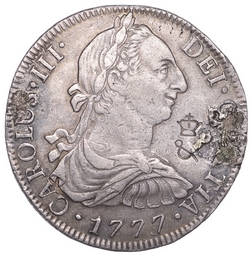
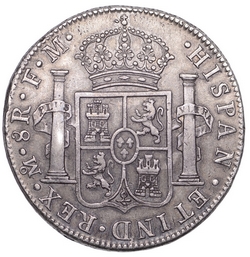
KM ; Manville 105 crowned ampersand on 8r 1777 Mo FM (Noonans auction of Eric Hodge Collection, 29 September 2026, lot 6098)
Revolution Mill was built by Major John Cartwright, the radical reformer and brother of Rev E Cartwright, the inventor. The mill was on the north side of Spital Hill, Retford, and was completed in 1788 at a cost of £25,000. Its business was "breaking, combing, preparing, spinning, seizing, dressing and winding wool", and it was powered by a Boulton and Watt steam engine of 30 hp, one of the first and largest in the East Midlands. The mill was soon employing 600 people, but it failed and was sold in 1798. The mill was in disuse by the turn of the 19th century and after the building was sold in 1805, Cartwright moved to London.
A drawing dated February 1787 in the Boulton and Watt collection suggests that the mill was 123ft long by 29ft wide and of four storeys.
The lack of an issuer’s name and a denomination place this countermark early in the countermarking period, before marks began to show more details. In fact the mark might never have been connected with the Revolution Mill had it not been for a notation by Sarah Sophia Banks in her acquisitions notebook that she had received one in 1794 - “Spanish dollar stamped for circulation at the Revolution Mill in East Retford Notts (1794)”.Manville. op. cit., p.210.
The genuine countermarks are thin and lightly punched in front of the Spanish king’s bust. These are known on 1778 Mo FF, 1785 Mo FM, 1791 Mo FM, 1792 Mo FM.
The false punch is thicker and heavily stamped on the bust, and is known on 1792 Mo FM. It may have been contemporary but appears modern.
Yelloley’s Pottery, Ouseburn, Northumberland
Robert Yelloley’s Ouseburn Pottery, located near Newcastle, was built between about 1780 and 1790. The pottery produced white, printed and brown ware until it was closed in about 1854.
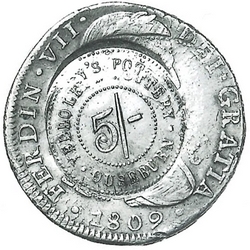
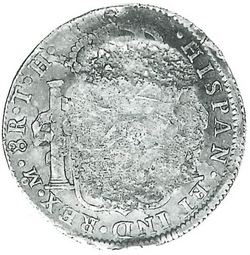
Manville-X107 5/- on 8r 1809 Mo TH
However, the countermark, YELLOLEY’S POTTERY OUSEBURN around 5/-, known on a 1809 Mo TH, is a modern (1920s) concoction.
Other coins listed by Manville, but not located, include
HCT Company
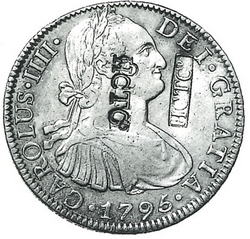
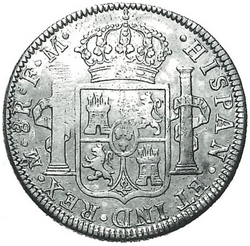
Manville-114 on 8r 1795 Mo FM
This is known stamped three times by two different punches on a single dollar. It is most doubtful that the piece was a circulating token, and it was probably a test or trial piece of a maker’s mark.
J. D.
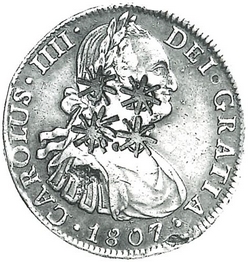
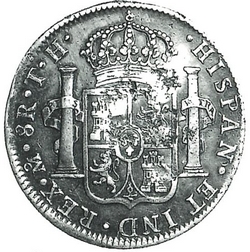
Manville-115 5/6 on 8r 1807 Mo (cancelled)
S.D.
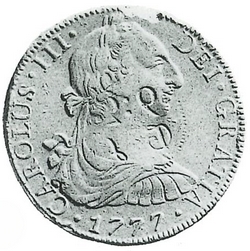
Manville-116 on 8r 1777 Mo FF or FM
The letters 5s 6d in script and the valuation are retrograde – evidently engraved on a puncheon by an inexperienced hand who did not realise that they would be reversed after punching.
L. B.
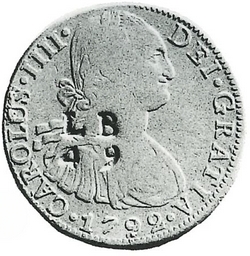
Manville-118 4/9 on 8r 1792
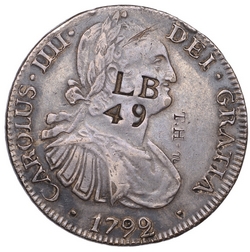
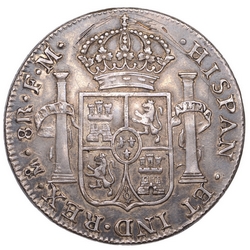
KM- ; Manville-118 on a counterfeit 8r 1792 Mo FM (Noonans auction of Eric Hodge Collection, 29 September 2026, lot 6101)
This counterfeit coin, from an unknown location, is countermarked L B 49, with an additional countermark T H N to the right.
5/
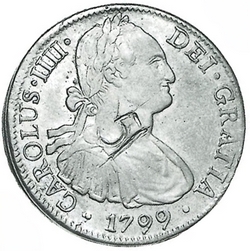
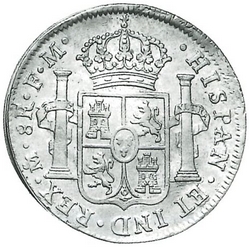
Manville-117 5/ on 8r 1799 Mo FM
4.9
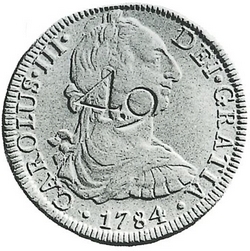
Manville-119b 4.9 on 8r Mo 1784