US Contemporary RevMex Medals
by David Hughes
The Mexican Revolution did not remain in Mexico, but involved or spilled over into the United States on several occasions. In 1914, the US Navy blockaded arms shipments to Victoriano Huerta, per the order of President Woodrow Wilson. On 21 April 1914, the Navy landed Marines at the port city of Veracruz. This action was brought on by Navy (over)reactions coupled with poor communications, and the arms shipment they were trying to block simply used another port to offload the cargo. This occupation, with the US Army replacing the Marines, lasted until 23 November 1914, and was a complete diplomatic disaster. After the Villista incursion and shoot up/burn down of Columbus, New Mexico on 9 March 1916, an Army Punitive Expedition under General John Pershing entered Mexico and chased Pancho Villa from 14 March 1916 to 7 February 1917, never catching him, thereby giving Mexico another folk hero. The Columbus incursion and later incidents at Glen Springs and Boquillas, in the Big Bend of Texas, on 5-6 May 1916, resulted in public and political outcry, prompting mobilization of the National Guard on 18 June 1916 to secure the border (some consider this a field exercise for the then-current European war that eventually involved the United States).
All of these actions were commemorated on medals sold in the Post Exchange (PX), struck by Schwaab S. & S. [Stamp and Seal] Co, of Milwaukee, WI. The 36mm Schwaab medals are gilded bronze, but the gilding is very thin or poorly applied: if the following items were circulated as pocket pieces the gilding came off. This discussion focuses on the Schwaab medals: these are the most commonly encountered pieces, and form a nice set.
BATTLE OF VERA CRUZ/APRIL 21st, 1914
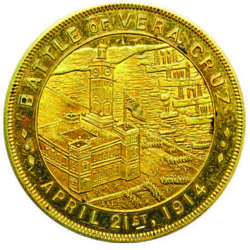
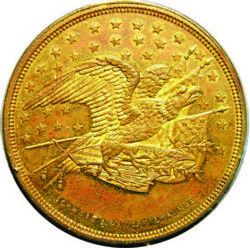
This is the only medal of this series with the maker’s name on it, but die matching shows the later medals were all produced by Schwaab. The building shown on the medal, built in 1902, still exists and is now known as the Venustiano Carranza Lighthouse.
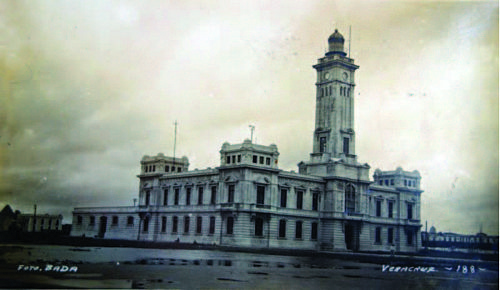 The actual building is symmetrical with the lighthouse tower in the center, but the die-sinker eliminated this wing of the building due to laziness or poor information. The medal depicts a busy scene, consisting of a naval bombardment, landing boats propelled by oars (motorized launches were actually used), marching US Marines, disorganized Mexican opposition (?) in the lower center, and
an American flag hoisted on the lighthouse building (according to a US Marine photo gallery website, the first US flag was not raised in Veracruz until 27 April). The reverse eagle is an early version in the Schwaab series, not seen on later medals, with seven stars under the eagle wing and two stars under the lower flagstaff ornament (7/2).
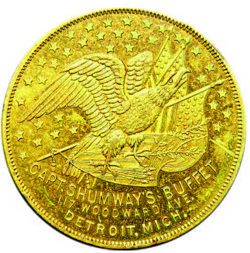
An interesting variety of the Veracruz medal advertises CAPT. SHUMWAY’S BUFFET/117 WOODWARD AVE/DETROIT, MICH on the reverse, using the above obverse. The eagle has been revised to provide room for lettering and is the pattern for future eagles in the series, although it retains all three flagstaff bases (subsequent issues only have one
flagstaff base showing), with seven stars under the eagle wing and four stars under the lower flagstaff ornament (7/4). The Veracruz medal may be scarcer than the subsequent medals: the Captain Shumway variety is definitely scarce.
SERVED IN MEXICO WITH THE AMERICAN/PUNITIVE EXPEDITION IN PURSUIT OF VILLA/1916.
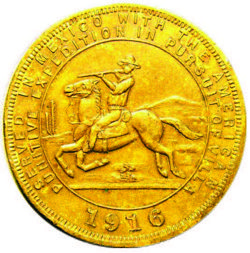
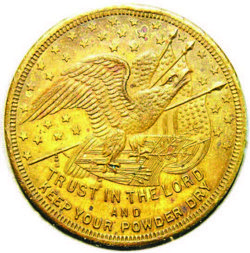
The obverse pictures a Cavalry soldier firing from a galloping horse, having dropped the reins, and yes, that is how the soldier and horse trained to do it. This reverse die was also used on the following CALLED TO THE COLORS and the large letter IN MEMORY OF MY ARMY LIFE medals. Note the seven stars under the eagle wing and the five stars under the lower flagstaff ornament (7/5). Because of the subject matter, this is the most popular of the Schwaab medals and priced accordingly.
POST EXCHANGE/U.S. TROOPS/ HACHITA, N.MEX.
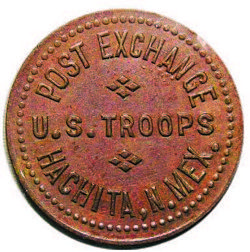
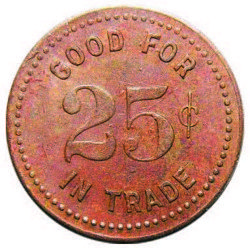
Camp Shannon, Hachita, NM, was one of three jump-off points for the insertion of the Punitive Expedition in 1916. It served as a US Calvary post until 1922. At least three Hachita PX tokens were issued, Good For 5¢, 10¢ (with a scalloped rim) and 25¢ In Trade.
The following medals commemorate the National Guard and Army service on the Mexican border. Their instructions were to not cross into Mexico, but unofficial crossings occurred.
CALLED TO THE COLORS JUNE 18, 1916/FOR SERVICE ON THE MEXICAN BORDER.
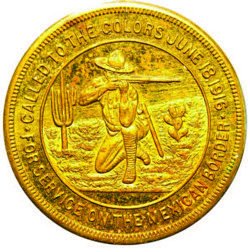
This medal commemorates the National Guard mobilization. The kneeling Army Infantry soldier was a popular Schwaab design, used on two Schwaab medals and multiple Schwaab souvenir decorations, badges, and watch fobs of the time. The galloping Cavalry soldier and the kneeling Infantry soldier were also used by other makers of souvenir badges. The reverse die is the same (7/5) die used for the PURSUIT OF VILLA medal, above.
EL PASO/JULY 6/1916.
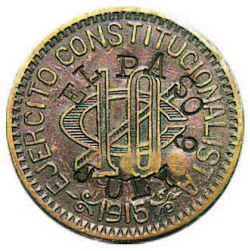
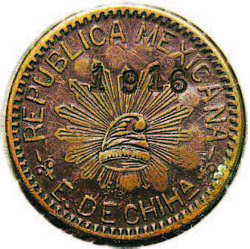
This interesting counterstamped Chihuahua 1915 10-centavo piece notes the first arriving National Guard units in El Paso, Texas on 6 July 1916, as confirmed by an El Paso newspaper of the time, and appears to be a souvenir of that event. I am sure the weather was lovely.
IN MEMORY OF MY ARMY LIFE/ON THE MEXICAN BORDER
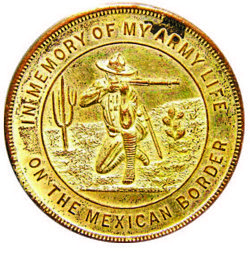
This is the large letter variety. Note the copper rim, where the gilding has been worn off by pocket wear, making this an AU. This is probably the most common Schwaab medal, and uses the same design as the CALLED TO THE COLORS medal. The reverse die is the same (7/5) die as the two above medals.
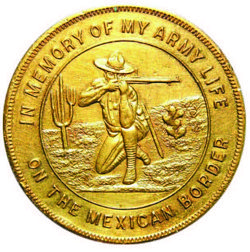
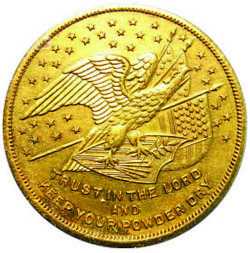
A second variety of the IN MEMORY OF MY ARMY LIFE/ON THE MEXICAN BORDER exists, with smaller lettering on two new dies. On the reverse die, note the eight stars under the eagle wing and the five stars under the lower flagstaff ornament (8/5). Some of the details have been simplified on the reverse die (there are no decorative flag cords, and the single olive branch does not extend beyond the shield). This second variety may be scarce, not previously reported that I know of, appearing to be a second issue, struck late in the Border Service operations.
This new reverse (8/5) die was used on subsequent (i.e., not RevMex) Schwaab medals. The kneeling Infantry soldier, without cactus, was used on SERVED WITH THE AMERICAN ARMY IN FRANCE/1918, NATIONAL GUARD ENCAMPMENT/ 1920, and NATIONAL GUARD ENCAMPMENT/1921 medals, paired with the (8/5) star reverse. The older (7/5) star reverse, though in a later die state with loss of eagle detail due to die polishing and a die crack through two of the stars in the upper field, was used on a SERVICE WITH AMERICAN ARMY/IN THE WORLDS WAR, 1917. No photographs, alas, as these issues are out of my collecting interests.
This discussion does not, of course, take into account the various national (Army, Navy, Marine, National Guard) service medals, National Guard state service medals (16 states issued decorations), local (municipal) service medals, and souvenir decorations (my favorite is a “1916//Award Of Merit/Mexico”, officially signifying nothing, that could be purchased at the PX and mailed home to the kids).