Grove 666
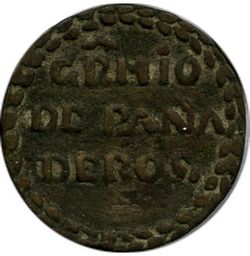
obverse: within a border of laurel leaves GRMIO / DE PANA / DEROS
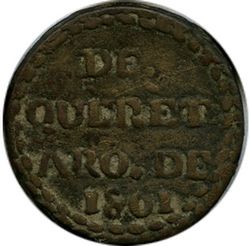
reverse: within a border of laurel leaves DE QUERET / ARO . DE / 1801
29 mm. cast bronze
Grove 667
obverse: within a border of laurel leaves GRMIO / DE PANA / DEROS
reverse: within a border of laurel leaves DE / QUERE / TARO MA / YO DE / 1806
29 mm. cast bronze


Grove 500 Basilio Lopes y nieto
Grove 500
Obverse: BASILIO / LOPES Y / NIETO
Reverse: QUERE / TARO MA / YO DE / 1806
32mm. Bronze
In 1896 it was reported that such was the scarcity of small currency (one, five and ten centavo coins) in Guaymas that businesses had begun to make use of tokens in their retail operations{footnote}Moneda. Es tal en Guaymas, puerto de Sonora, la escasez de moneda menuda (décimos, quintos y centavos), que el comercio ha empezado á hacer uso de fichas en sus operaciones al por menor. (El Siglo Diez y Nueve, Tomo 110, Núm. 17558, 10 July 1896){/footmote}.
During the Colonial period, coinage began to form part of the historical contribution of the Municipality of Zamora At first, coins were issued by private individuals; as local trade increased and, per haps because of excessive private issues, it was necessary for the Municipal Government to issue coins with an official guarantee in order to insure their general acceptance.
The· mint established in the Municipality probably had adequate installations and machinery and, consequently, they could manufacture their own coin blanks because they did not use federal coins or those of·other Municipalities. Due to this, they also engraved a variety of dies of which some are of high quality. More evidence of their excellent system of elaboration is that coins were normally milled; nevertheless, there was an exception in 1858 where we find crude and imperfect designs. Perhaps, this is due to the fact that they continued using the same dies in subsequent years or they were counterfeits of the period.
Regarding varieties, a study shows some information about them. On first observing these coins, we are able to determine that pure copper and copper alloys were used. Coins bearing the same date and struck from the same dies exist in different metals.
An important aspect of these coins is the countermarks which were placed on them subsequent to their original mintage; they can be classified into two types: Official and Private. Official counterstamps were ordered by the authorities for legal circulation in the Municipality. Private counterstamps identify a person, a business or hacienda and were exclusive in usage.
Counterstamps known as official are: the name of the Municipality of Zamora and one bearing the value 1/8. They were used for the following reasons: (1) to guarantee the validity of the pieces and to differentiate them from counterfeits: (2) for identification and new use when a coin was worn and illegible. On making a comparative study, we find four varieties of the Zamora counterstamp
Die variety legend 1/8 at right. (image courtesy Claudio Verrey)
and two of 1/8
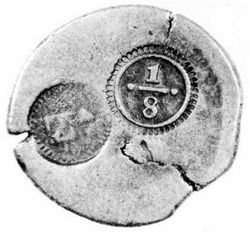
Outer surface edge des ign has semi-circles and dots. (image courtesy Claudio Verrey)
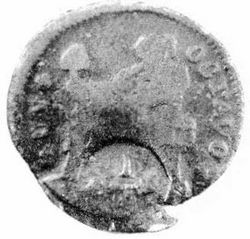
No outer surface edge design. Leaves in the center. (image courtesy Claudio Verrey)
Comparing them with the dates, we can see what dates have been counterstamped, but there are some dates which I have not seen with a counterstamp.
In regard to private counterstamps, these could have been made by urban businesses that, because of a lack of coinage, counterstamped their own Municipal coins or those of other municipalities and, because of their lack of validity, used them as coin blanks.
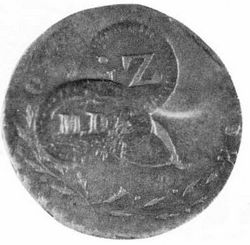
Oval counterstamp of letter M.D.A., decoration and outer surface edge design of lines. (image courtesy Claudio Verrey)
I found some very well struck maln varieties bearing two initials:’ F.S’ or ‘A.L’ which perhaps stand for the name of the engraver or some public official.
The following is a list of the pieces found with their different dates and varieties:
| Date | Without counterstamp |
Za | 1/8 | Without initials | F.S. | A.L. |
| 1842 | X | X | ||||
| 1843 | X | X | X | |||
| 1845 | X | X | X | |||
| 1846 | X | X | X | |||
| 1848 | X | X | ||||
| 1853 | X | X | ||||
| 1854 | X | X | ||||
| 1855 | X | |||||
| 1857 | X | X | X | |||
| 1858 | X | X | X |
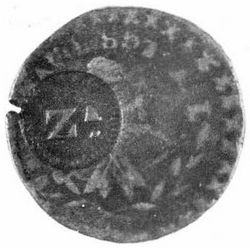
Counterstamp of the most common 'type of which the outer surface edge design is comprised of 45 lines.
(image courtesy Claudio Verrey)
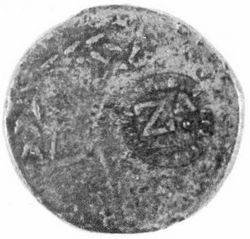
Large letters, outer surface edge design has 30 lines. (image courtesy Claudio Verrey)
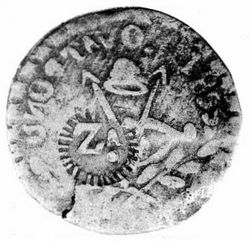
Counterstamp is a little smaller. Lines are thicker. (image courtesy Claudio Verrey)
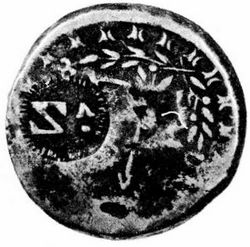
Inverted counterstamp error. (image courtesy Claudio Verrey)
[image needed]
Private countermark of letters S. A in a circle. Outer edge surface design of lines.
Die variety legend 1/8 (at right). (image courtesy Claudio Verrey)
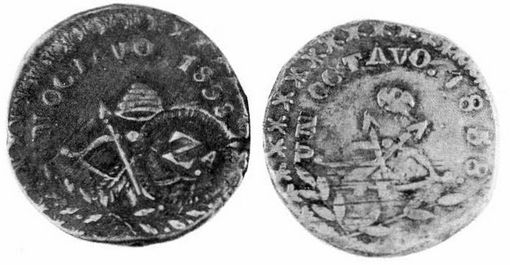
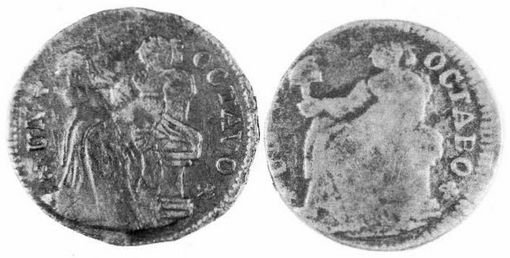
Remarkable die varieties of the obverse (at left), a cap over the arch (right), an eagle (image courtesy Claudio Verrey)
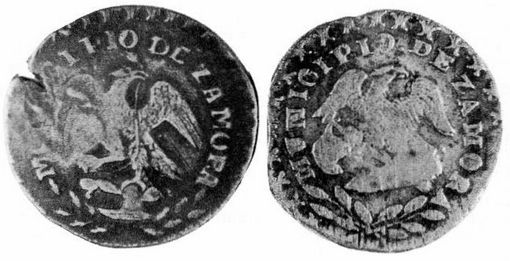
Reverse, eagle on cactus (left), eagle on quiver holding a flag (right) . (image courtesy Claudio Verrey)
During the War for Independence, three prosperous businessmen and merchants of the Villa de Santiago del Saltillo, asked the local Cabildo for permission to mint their own copper coins.
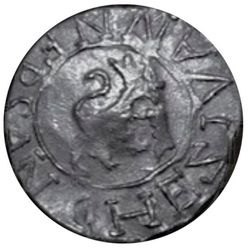
Juan Nepomuceno Sánchez ¼r
On 14 May 1812 the local council of Villa del Saltillo authorized the merchant Juan Nepomuceno Sánchez[text needed] to manufacture 500 pesos in cuartillas, i.e. 16,000 coins, backed by a deposit of $500. It was requested that the applicant's surname be included on the coin, as well as a password represented by a lowercase letter "ese" crossed by a capital Z. José Miguel Lobo Guerrero, the President of the council, stressed that Nepomuceno Sánchez would be responsible for the damages resulting from the trade and public use of the money.
All the cuartillas were delivered around 19 May 1812.
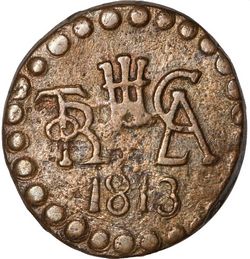
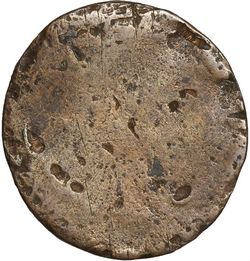
Toribio de Alcalá ¼r 1813 (Briggs & Bustos auction IX, 13 September 2024, lot 270)
By 1813, another merchant, Toribio de Alcalá, asked for permission[text needed] to manufacture 500 pesos in copper cuartillas, which were known among the inhabitants of the Villa de Santiago del Saltillo and the town of San Esteban de la Nueva Tlaxcala as "Toribio".
These had a peculiar design with a castle between the monograms 'TOR'and 'ALC'.
By 14 September 1813, according to a decree issued by the city council[text needed], the coins had resulted in a great benefit to local commerce and, especially, managed to help the poor people.
Torivio de Alcalá, at least, is known to have made 5,000 additional coins illegally.
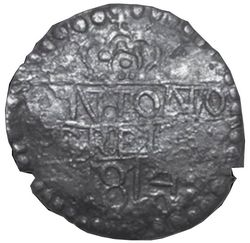
José Antonio Pereyra
José Antonio Pereyra also asked the government to manufacture 500 pesos in copper cuartillas. The request was granted by the mayor, Juan González,[text needed] who stated that the coins were valid for 1814 and 1815. The coins were known as "Pereira".
Each of these three businessmen managed to prevent the counterfeiting of their coins. In the case of Nepomuceno, he "wounded" the coin by marking it at the height of the "H" of Sánchez(?). Toribio replaced a circle with a star(?), a strategy that did not really work for him, because they counterfeited such a large amount of coins, that he ended up in bankruptcy.
In February 1806, when Viceroy Iturrigaray authorized the issue of tlacos in San Luis Potosí, he mentions the following reasons that led the government to endorse the issue of low-denomination coinage: Constant counterfeiting of the copper coinage issued by individuals; their necessity in small currency trading; and an abundance of currency issued by various landowners and localities. There is an urgent need to centralize and unify issues that, due to their different qualities, are easy to falsify.
A short time later, on 18 June 1807, Viceroy Iturrigaray issued a decree (bando)[text needed] authorizing the issuance of copper coins in San Luis Potosí.
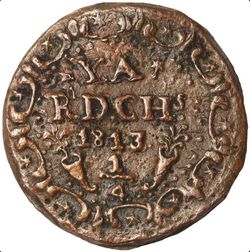
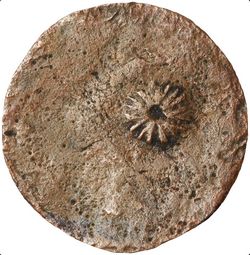
Charcas ¼r 1813 (Briggs & Bustos auction XIII, 12 September 2025, lot 190)
First necessity issue struck during the War of Independence in the locality of Charcas. Well-executed and attractive design featuring the initials “YA/RID.CHs,” interpreted as Ylustre Ayuntamiento Real de Charcas. The centre displays the date 1813, with the denomination ¼ beneath.
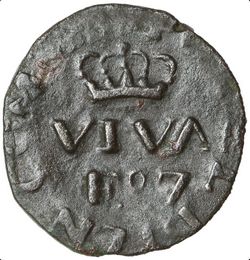
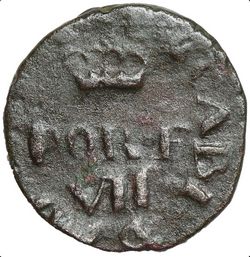
Matehuala ⅛r (Briggs & Bustos auction IX, 13 September 2024, lot 267)
Municipal Coin corresponding to the royalist side during the War of Independence, issued by the Cabildo of Matehuala, probably contemporary to the “Publico de Matehuala” of 1816 LINK, given certain similarities in design, central legends in obedience to Ferdinand VII; on obverse “POR. F/VII”, reverse ”VIVA/FO 7, note the change from Roman to Arabic numbering, as for the value it is believed to correspond to an Octavo de Real.