Reales issues of the Culiacán mint
Silver
Quarter real


KM-368.1 ¼r Culiacán 1855 CLR (Stack’s Bowers Baltimore Auction, 28 March 2011, lot 8082)
Diameter 12 mm. 0.845 g, 0.90277 silver
| Date | Engraver | Recorded Mintage |
Comment |
| 1855 | LR |
Half real


KM-370.2 ½ r 1861 C PV (Stack’s Bowers Kirk Menczer Collection, 23 June 2026, lot 72069)
Diameter 16 mm. 1.690 g, 0.90277 silver
For a consideration of the rarity of Culuacán ½ real see here.
| Date | Asssayer | Recorded Mintage |
Comment |
| 1846 | CE | ||
| 1848/7 | CE | ||
| 1849/8 | CE | ||
| 1849 | CE | ||
| 1852 | CE | ||
| 1853 | CE | unconfirmed | |
| 1853/1 | CE | ||
| 1854 | CE | ||
| 1856 | CE | ||
| 1857/6 | CE | ||
| 1857 | CE | ||
| 1858 | CE | 1R for ½R | |
| 1860 | PV | 1R for ½R | |
| 1861 | PV | 1R for ½R (for discussion, see here) | |
| 1863 | CE | 1R for ½R (illustrated below) | |
| 1867 | CE | ||
| 1869 | CE | 1R for ½R |


KM-370.2 ½ r 1863 C CE (Stack’s Bowers Kirk Menczer Collection, 23 June 2026, lot 72070)
"1R" Error. Rare date and denomination error. Unlike the earlier 1858, a clean "1" punch was used on the denomination, making this a one year type.
One real


KM-372.1 1r 1848 C CE (Stack’s Bowers auction, 12 September 2023, lot 73354)
Diameter 20 mm. 3.380 g, 0.90277 silver
| Date | Asssayer | Recorded Mintage |
Comment |
| 1846 | CE | ||
| 1848 | CE | ||
| 1850 | CE | ||
| 1851/0 | CE | ||
| 1851 | CE | ||
| 1852/1 | CE | ||
| 1853/2 | CE | ||
| 1854 | CE | ||
| 1856 | CE | large 6 | |
| 1857/4 | CE | ||
| 1857 | CE | ||
| 1857/6 | CE | ||
| 1858 | CE | ||
| 1859 | CE | ||
| 1860 | PV | ||
| 1863 | CE | ||
| 1869 | CE |
Two reales


KM 374.3 2r 1861 C PV (Stack’s Bowers Baltimore auction, 28 March 2011, lot 8250)
Diameter 27 mm. 6.670 g, 0.90277 silver
| Date | Asssayer | Recorded Mintage |
Comment |
| 1846 | CE | ||
| 1847 | CE | ||
| 1848 | CE | ||
| 1850 | CE | ||
| 1851/0 | CE | ||
| 1852/1 | CE | ||
| 1853/2 | CE | ||
| 1854 | CE | ||
| 18454/3 | CE | ||
| 1856 | CE | ||
| 1857/4 | CE | ||
| 1857/6 | CE | ||
| 1860 | PV | ||
| 1861 | PV | ||
| 1869 | CE |
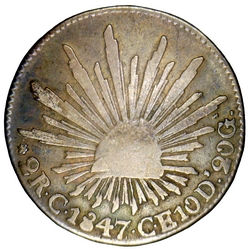
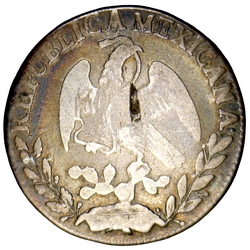
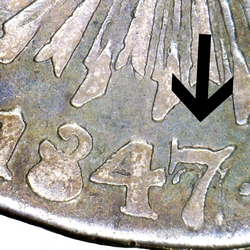
KM-374.3 2r 1847 C CE – repunched “7”
Just like varieties with repunched letters, repunched digits are also a very common attribute seen on Republic coinage. In fact, repunched digits in the date are arguably the most common variety attribute found in the Mexico Republic series of coins. Not only will you find overdates (i.e. 1848/7), but repunched digits (i.e. 1847/7). In this example, there is a very clear repunch of the “7” digit in the date. If you look closely at the digit, it appears that there may be a normal “7” digit punched over a smaller “7” punch or something else altogether.
Four reales


KM 375.1 4r 1857 C CE (Stack’s Bowers Baltimore auction, 28 March 2011, lot 8325)
Diameter 32 mm. 13.540 g, 0.90277 silver
| Date | Asssayer | Recorded Mintage |
Comment |
| 1846 | CE | ||
| 1850 | CE | ||
| 1852 | CE | ||
| 1857 | CE | 4-6 known | |
| 1858/7 | CE | ||
| 1860 | PV |
Eight reales
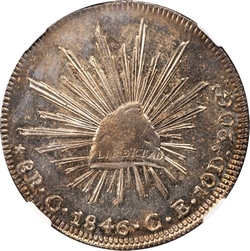
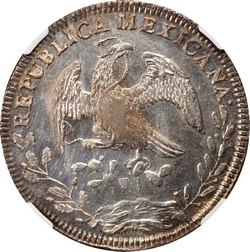
KM-377.3 8r 1846 C CE (Stack’s Bowers NYINC auction, 12 January 2019, lot 41208)
Dot after G variety.
Diameter 39 mm. 27.070 g, 0.90277 silver
The 8 Reales series was interrupted in 1870 and not resumed until 1873, during which time the mint issued Balance Scale Pesos. Culiacán was one of only four mints that produced 8 Reales until the series ended in 1897.
| Date | Asssayer | Recorded Mintage |
Comment |
| 1846 | CE | No dot after G in finemess | |
| 1846 | CE | Dot after G in fineness | |
| 1847 | CE | ||
| 1849 | CE | G/E | |
| 1849 | CE | ||
| 1850 | CE | ||
| 1851 | CE | ||
| 1852/1 | CE | ||
| 1852 | CE | ||
| 1853/0 | CE | ||
| 1853 | CE | Thick rays | |
| 1853 | CE | MEXIGANA (illustrated below) | |
| 1854 | CE | ||
| 1854 | CE | larger eagle and Liberty cap | |
| 1854/3 | CE | illustrated below | |
| 1855/4 | CE | ||
| 1855 | CE | ||
| 1856 | CE | ||
| 1857 | CE | ||
| 1858 | CE | ||
| 1859 | CE | ||
| 1860/9 | PV/CE | ||
| 1860 | PV | ||
| 1860 | CE | ||
| 1861/0 | CE | ||
| 1861 | PV/CE | ||
| 1861 | CE | ||
| 1862 | CE | ||
| 1863/2 | CF | ||
| 1863 | CE | ||
| 1864 | CE | ||
| 1865 | CE | ||
| 1866 | CE | ||
| 1867 | CE | ||
| 1868/7 | CE | ||
| 1868 | CE | ||
| 1869 | CE | ||
| 1870 | CE | ||
| 1873 | MP | ||
| 1874 | MP | C mintmark | |
| 1874 | MP | Cn mintmark | |
| 1875 | MP | ||
| 1876 | CG | ||
| 1876 | GP | ||
| 1877 | CG | 339,000 | |
| 1877 | CG | Gn mintmark error | |
| 1877 | JA | ||
| 1878 | CG | 483,000 | |
| 1878 | JD | ||
| 1878 | JD | D over retrograde D | |
| 1879 | JD | ||
| 1879 | JD | Straight 9 | |
| 1879 | JD | Round 9 | |
| 1880/70 | JD | ||
| 1880 | JD | ||
| 1881/0 | JD | 1,032,000 | New die style |
| 1881 | JD | C mintmark | |
| 1881 | JD | Cn mintmark | |
| 1882 | JD | 397,000 | C mintmark |
| 1882 | AM | ||
| 1883 | AM | 333,000 | |
| 1884 | AM | Cn mintmark | |
| 1884 | AM | C mintmark | |
| 1885/6 | AM | 227,000 | |
| 1885 | AM | C mintmark | |
| 1885 | AM | Cn mintmark | |
| 1885 | AM | Gn mintmark error (illustrated below) | |
| 1886 | AM | 571,000 | |
| 1887 | AM | 732.000 | |
| 1888 | AM | 768.000 | |
| 1889 | AM | 1,075,000 | |
| 1890 | AM | 874,000 | |
| 1891 | AM | 777,000 | |
| 1892 | AM | 681,000 | |
| 1893 | AM | 1,144,000 | |
| 1894 | AM | 2,118,000 | |
| 1895 | AM | 1,834,000 | |
| 1896 | AM | 2,134,000 | |
| 1897 | AM | 1,580,000 |


KM 377.3 8r 1853 C CE (Stack’s Bowers auction, 24 June 2021, lot 72283)
"MEXIGANA" legend error.
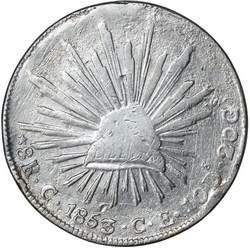
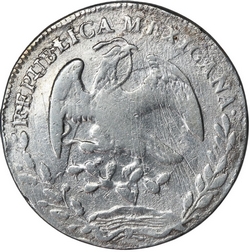
KM-377.3 8r 1853/0 C CE (Briggs & Bustos auction, 31 August 2025, lot 269)
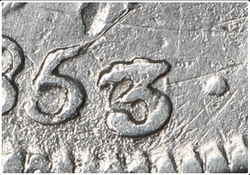 Design variety known as “Mexican cap” to distinguish it from the same-year issue with the Sonora cap. Variety with a clear overdate visible in the final digit of the date (1853/0), not described by Dunigan & Parker. In fact, this corresponds to an obverse die distinct from all others located, based on the positioning of the rays, confirming this variety.


KM 377.3 8r 1854/3 C CE (Stack’s Bowers Baltimore auction, 16 May 2023, lot 70360)
Variety with Sonora Cap & Eagle
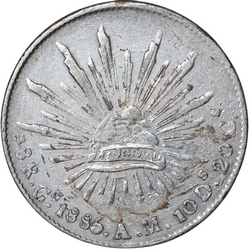
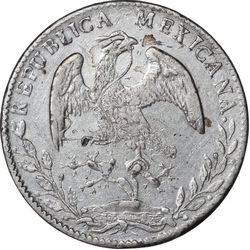
KM-377.3 8r 1885 Gn AM (Briggs & Bustos auction, 31 August 2025, lot 276)
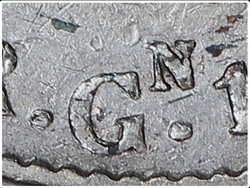 Variety with the mintmark engraved as “Gn” instead of “Cn.” Both dies were likely engraved locally, as their design has a more “crude” appearance compared to the standard for this date.