Counterfeit Portrait Eight Reales
by Robert “swamperbob” Gurney
The portrait style Spanish-American eight reales was one of the most well-known, and extensively circulated silver trade coins that the world has ever seen. Produced in Spain’s New World colonies from 1772 to 1825, the coin made Spain a major player on the world financial stage in the eighteenth and early nineteenth centuries. This was due in large measure to the fact this coin accounted for about sixty percent of the annual silver production worldwide. The portrait eight reales of Mexico City were the primary trade coin desired by the Chinese after 1785 and generated premiums in the range of 16-26% over the period from 1830 to 1930.
The popularity and general acceptance of this particular coin made it the object of forgers who operated in all areas of the globe. It was a coin not merely counterfeited in the countries of origin, but in all of the places where it was accepted as currency in day-to-day transactions. It was produced in small back-room operations and in large factories. It was produced at times in utter secrecy, yet at other times it was more or less an “open secret.” It was produced as both worthless base metal copies and as “perfect” imitations containing the correct amount of silver. It has been made to circulate as currency, as well as to specifically deceive collectors.
This article identifies different types of counterfeits, including a class of full weight silver replicas of the portrait eight reales series, and attempts to answer when and why these were made.
My interest in these counterfeits began as a teen when I met and spoke to one of the forgers who actually made these coins for a living in Massachusetts in the 1920s. Over the years I have acquired documentary proof that these coins were in fact made but until the advent of accurate XRF (X-ray Fluorescence) testing I did not have a scientific way of identifying any of them. The image is of the first portrait that I got from the self-confessed counterfeiter.
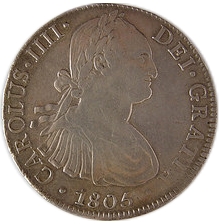
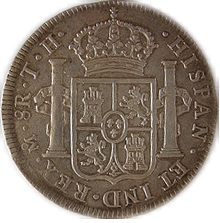
counterfeit KM-109 8r 1805 Mo TH
The coin has been proven to have too little gold as a contaminant (to have been made in 1805) by two different XRF laboratories and this coin is the basis for my belief that full weight silver counterfeits were produced for the China trade as late as 1930.
Milestones in the History of Silver Refining
All of the silver ore mined in central Mexico and used in the period around 1800 contains gold as a contaminant. This is a well-known fact. Virtually all Mexican silver has gold as a contaminant. Another less well known fact is that the Valenciana mine which produced 60% of the silver coined at Mexico City was highly contaminated with gold. Recent test borings tested with XRF indicate 2-3%.
Refining ore to extract metal was an industrial practice that began with the patio process. This process relied on the fact that gold, silver and copper (copper is also a contaminant) will amalgamate with mercury. The resulting amalgam is heated to drive off the mercury leaving the metal behind. This is a mix of gold, silver and copper. Metals like iron and platinum also found as contaminants do not amalgamate with mercury. The mixture is refined by cuppelation which extracts the copper. This leaves a silver gold solution. Silver and gold are mutually soluble so in liquid form they form an actual solution that cannot be mechanically separated. In other words in a liquid state gold even though it is denser will not drop to the bottom. The final step referred to as parting separated the gold from the silver with acid. Silver reacts with nitric acid while gold will not. This method of parting gold is ancient but does not remove all of the gold from the silver.
When gold and silver traded at a ratio of just 16 to 1, the removal of as much silver from the gold was critical and results with nitric acid parting could produce 99.0% fine gold. Silver also could not be refined past 99.0% but because parting of gold was costly there was a point beyond which it was viewed as uneconomical to bother extracting the gold at all. This was particularly the case when the contamination was on the order of 0.2% or less.
The history of gold and silver parting is the key factor to be considered when reviewing silver coins.
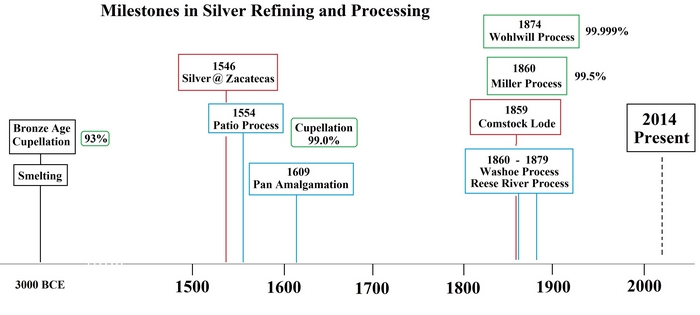 The above chart gives a timeline for the methods of refining silver used from antiquity onwards with the dates of key discoveries (refinements of the process), along with the levels of purity achieved. It shows that the Spanish-American refining methods were different than the methods developed after the Comstock Lode was discovered in the United States. In rapid succession a series of technological innovations like the injection of chlorine gas into the liquid solution of silver and gold led to better and better parting rates. Gold purity rose from 99.5% at best to 99.99% fine within the space of about ten years, 1870-1880.
Counterfeit Coin Varieties and their Period of Manufacture
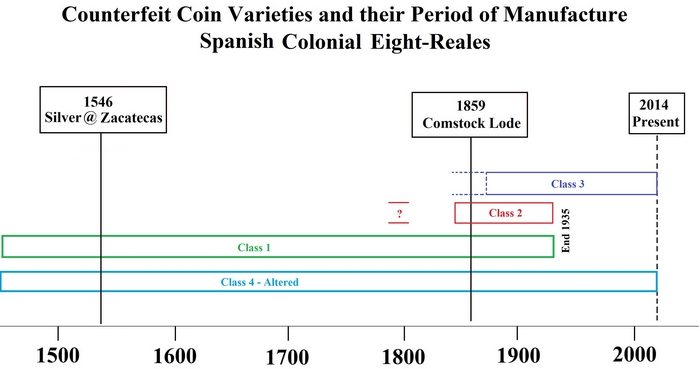
Some people, including the American Numismatic Society, believe all types of counterfeits can be classified into just ‘Contemporary’ and ‘Modern (or Numismatic)’. However, for the eight reales I prefer four classes for clarity based on the reasons that the coins were made, as well as the alloys used. For each class I have indicated a period of time when they were made. Note that many overlap.
| Class 1 | Contemporary Circulating Counterfeits (base metal below 800 fine) | made from the inception of eight reales until 1935 |
| Class 2 | Contemporary Circulating Silver Counterfeits (assay over 800) | made from 1830 until 1935 (with a possible early episode ca.1800) |
| Class 3 | Numismatic Forgeries- made to deceive collectors | made from the start of collecting ca. 1850 until the present |
| Class 4 | Other - includes altered coins used in circulation and those altered for collectors among other types like buttons, replicas, souvenirs etc | made from the inception of the eight reales until today |
This is summarized in the diagram below.
In my book (Counterfeit Portrait Eight-Reales: The Un-real Reales by Robert Gurney, Gordon Nichols and John Lorenzo, 2014) we expand on the thirty-nine varieties of Class 1 counterfeits noted by Dr. John L. Riddell as existing in circulation in New Orleans in 1845 (A Monograph of the Silver Dollar, Good and Bad, Cincinnati, 1845)available in the USMexNA online library and swell that number to some 589 varieties. We also cover the numismatic fakes that plague the industry.
However, the focus of this article is the existence of Class 2 counterfeits - full weight silver replicas made in the UK and US to support the financial needs of the China trade between 1830 and 1930.
I believe that millions of these counterfeits were made after the originals made in Mexico between 1772 and 1811 were worn to a point where they no longer commanded a premium from the Chinese merchants.
This trade began with UK merchants and lasted until the Opium Wars made it possible for the British to sell opium in China and thereby reduce the balance of trade between the UK and China. The same remedy was not available to US merchants. The US government failed to get permission to officially make replicas but US companies (acting, I believe, with the tacit support of the government) did start making US versions at least by 1873. The large silver discoveries in Nevada and the silver surplus made the Chinese the world’s largest consumer of silver and the US obliged in part with these counterfeit portrait eight reales.
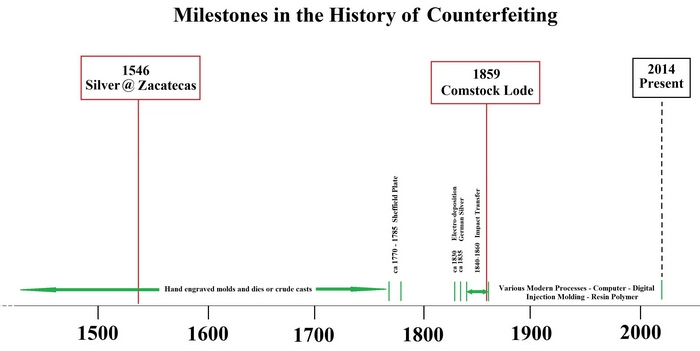
The above chart covers the major historic points in counterfeiting and illustrates why 1830 is a great date, actually a watershed, to divide older technologies from the more modern methods. Until 1770 counterfeiters had only two viable methods of creating a coin - engraving their own dies or making a cast copy. In 1770 Sheffield plate technology was developed in the UK which resulted in massive numbers of counterfeits being produced from 1796 to 1820. These were all silver coated base metal -all early Class 1.
In about 1830 electro-deposition and electro-typing were developed allowing accurate molds to be created. This was followed in 1835 by German Silver production which allowed planchets to be created at a minimal cost with no silver being used (This fact alone – little or no actual value – contributes to the survival of counterfeits made from German Silver or electroplated copper).
In the period 1840-1860 impact transfer and other methods developed in rapid succession – a process that appears to be ongoing and accelerating as I write this. These are all “modern” industrialized techniques, none of which were available to “colonial era” forgers. So 1830 is a great dividing point between true Spanish Colonial forgeries and later forgeries which should all be considered republican efforts.
The key to identifying some of the later date Class 2 coins is the assay. In 1772-1811 Mexico City refined silver with the patio process. The refined ingots were purified at the mint by cuppelation and parting with nitric acid which produced silver about 99% fine. About 1860 the US developed processes that produced a better parting of gold and silver reaching 99.5% purity. This rose to 99.999% in 1874. This is when pure silver as we know it today was first available.
Therefore an accurate XRF test (a non-destructive form of forensic scientific analysis of the metallic elements contained in an object using“secondary” fluorescent emissions produced with bombardment with gamma or x-rays) will determine if a coin was made with silver refined before 1811 or after 1874. This will identify and eliminate most US-produced counterfeits but unfortunately not the earlier UK versions made between 1835 and 1874.
Fortunately the early silver counterfeits may not be very plentiful at all if the statements of early Chinese economists are correct. I have read that before 1840 roughly 85% or more of the silver coin that entered China was melted into saycee ingots. This makes sense since silver was illegal to export from China until after the first Opium War and in any event China had a balance of trade surplus with the west. Based on this and the reduced need for the British to make silver counterfeits after 1840 (the first Opium War), the majority of silver counterfeits that survived in China to return in the past few decades were likely those made at the latest point in time - the US counterfeits.
I appreciate that it may be difficult to imagine that full weight silver coins existed that were not made in the date and place indicated. These coins were sometimes struck as were the originals on screw presses with open sides. Blanks were edged before striking. Great pains were taken to duplicate the dies and in some cases dies were hubbed. For the entire time period that eight reales have been collected these Class 2 silver counterfeits have laid unidentified in collections and banks worldwide. I am not advocating the removal of these coins from collections nor am I in any position to state that these coins are worth less than originals because relative scarcity at this point is unknown.
I simply believe that we need to identify these coins for what they really are - historic relics of an age where silver content was more important than actual origin and where merchants took advantage of a unique situation to make an added profit at the expense of the Chinese.
The coin on the cover is a Sheffield plate counterfeit confirmed by both XRF tests and specific gravity. It has under 60% of the appropriate silver content and has a clear ribbon seam in the dentils