Counterfeit 8 Reales
Contemporary counterfeit coins, i.e. those struck in the same time frame as the genuine issue, used less silver so that the counterfeiter gained by the difference in precious metal (Unofficial restrikes were produced after the genuine issue, were mostly faithful to design as well as silver content, and intended for bullion trade. Modern forgeries are meant to deceive collectors.)
Dr. John Leonard Riddell, during his appointment as melter and refiner of the New Orleans Mint, catalogued a wide variety of counterfeit 8 reales in A Monograph of the Silver Dollar: Good and Bad, published in 1845available in the USMexNA obline library. At the time, 90% of silver dollars circulation in the US were Mexican or the earlier Spanish American issues and he reported that roughly 1% of these were counterfeits. These can be identified by careful examination of the design details as well as measurement of weight and specific gravity. One of the better known examples of large scale 8 reales counterfeiting was produced in Birmingham, England. The technique of bonding thin silver plating to copper was developed in Sheffield in the mid 1700s and was thereafter adopted to the task of counterfeiting at Birmingham. The initial issue was a tactic in the war with Spain to discredit Spanish bullion.
Modern technology can assist with authentication. One technique that can be employed is X-ray fluorescence (XRF), a non-destructive surface analysis that can determine the makeup of alloys. Until the invention of the MacArthur-Forrest cyanide leaching process in 1887, significant trace elements, unique to the geology of the mine site, were present in all silver alloys. Thus, the trace amounts of gold and platinum from the mines of Mexico are a diagnostic signature for silver alloys of that place and time. Likewise, modern contaminants should never be present in the genuine alloy.
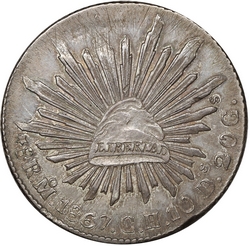
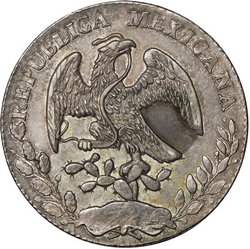
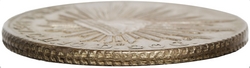
counterfeit KM-377.10 1r 1867 Mo CH (Briggs & Bustos Counterfeit issues auction, 10 August 2025, lot 75)
Struck in slightly underweight silver. 27.05 grams, 37.6 millimeters in diameter, coin alignment. Exceptionally well executed and engraved—virtually indistinguishable from a genuine piece at first glance without knowing its metallic composition, which is: 87.44% Silver, 11.02% Copper, 1.03% Tin, 0.2644% Lead, 0.1461% Zinc, and 0.1031% Gold. Only upon close examination can subtle differences be noticed in elements such as the mintmark, the cap, the rock from which the cactus emerges, and the edge, all of which feature slightly simplified designs.
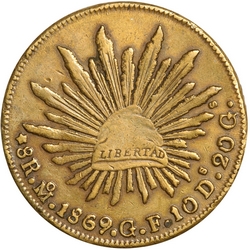
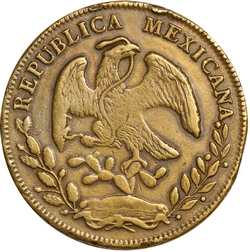

counterfeit KM-377.10 1r 1869 Mo GF (Briggs & Bustos Counterfeit issues auction, 10 August 2025, lot 76)
Struck on a brass or bronze planchet. 25.26 grams, 40 mm in diameter, coin alignment. Assayer initials not recorded for this date. The design contours show a coarse, dented appearance. Overall wear, edge knocks, and a thick republican edge cord.
The following have unrealistic mint or assayer marks.
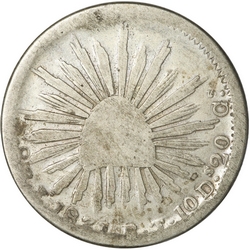
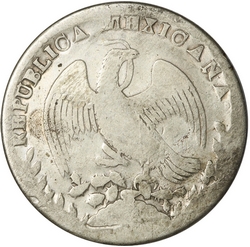
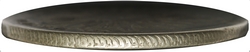
counterfeit KM-unlisted 1r 1831 X RT (Briggs & Bustos Counterfeit issues auction, 10 August 2025, lot 82)
Struck on a flan of mixed alloy, 24.74 grams, 38.9 millimeters in diameter, medal alignment. Unusual design and engraving, which matches the same obverse die as the specimen dated 1835 illustrated by John Leonard Riddell, listed under No. 424.
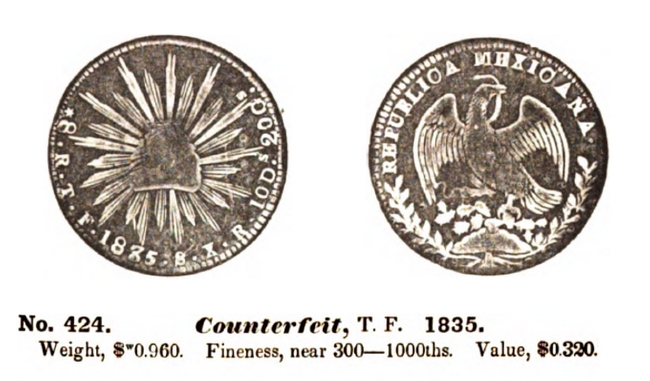 On the reverse, the initial “X” replaces the mintmark, and the letters “R.T.” appear in place of the assayer’s initials. Crude Republican edge cord. Metal composition: 57.08% Copper, 30.06% Zinc, 11.27% Nickel, 0.59% Iridium, 0.517% Lead, 0.3207% Cobalt, and 0.1646% Iron.
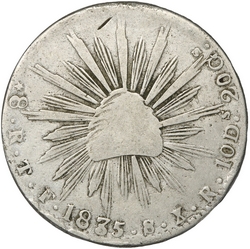
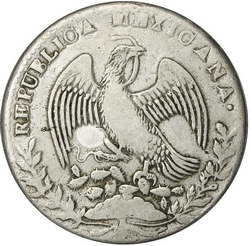

counterfeit KM-unlisted 1r 1835 TF SXR (Briggs & Bustos Counterfeit issues auction, 10 August 2025, lot 83)
Interesting counterfeit struck on a flan of alloy commonly known as alpaca, 27.12 grams, 39 millimeters in diameter, medal alignment. Peculiar design featuring an eagle with unusually large wings; on the opposite side, the cap shows folds at the top. As for the legend, it displays the initials T.F. in the mintmark position and S.X.R. in place of the assayer’s initials. Republican edge cord is extremely weak. Same dies as the specimen offered in Briggs and Bustos auction, 22 February 2025, lot 40, although that piece was struck on what appeared to be a brass flan. Metal composition: 62.54% Copper, 19.10% Nickel, 17.17% Zinc, 0.622% Cobalt, 0.3461% Lead, and 0.2149% Iron.
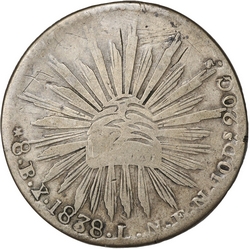
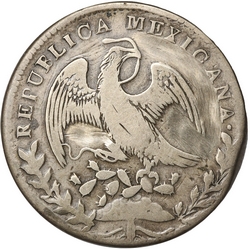
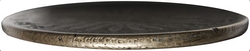
counterfeit KM-unlisted 1r 1838 X LNEN (Briggs & Bustos Counterfeit issues auction, 10 August 2025, lot 84)
One of the most extravagant specimens in terms of design, clearly originating from the same counterfeiting workshop as the two preceding examples. Weight: 24.36 grams, 39.3 millimeters in diameter, medal alignment On the obverse, the eagle displays a marked asymmetry in wing size, giving it a highly curious appearance. On the reverse, the cap features numerous folds at the top, surrounded by thick, long rays that intrude into the legend. The mintmark position bears the initial “X,” and the assayer’s initials appear as “L.N.E.N.” Republican edge cord is crude in appearance. Metal composition: 76.40% Copper, 9.65% Nickel, 8.42% Zinc, 4.43% Iridium, 0.559% Cobalt, 0.3319% Iron, and 0.1981% Lead.