Mexican Coins used in Costa Rica
by Manuel B. Chacón Hidalgo
With the arrival of the Spaniards and the process of conquest and colonization a new spatial planning, political, economic, cultural and social order was established in Costa Rica: also, a monetary system made of coins in gold, silver and, to a lesser extent, copper was imposed. Costa Rica had no mining of precious metals or mint, so the few coins that circulated entered through trade with other colonies in the Spanish Empire with products such as food supplies, pigs, biscuits, feed, leather, cacao, tobacco and livestock as well as payment received for civil and ecclesiastic officials. Given the shortage of coins in this period, barter was also practiced for transactions and, from 1709 and until the late eighteenth century, cacao seeds were officially used as coins.
Costa Rica used coins minted in other parts of America, such as Lima, Potosí, Guatemala and Mexico, among other places – and Spain as well.
With the proclamation of independence in 1821, one of the first concerns the leaders of the emerging state of Costa Rica had was to organize its monetary system and create the conditions needed for producing its own currency. This was not possible until 1825, so that, at the beginning, Costa Rica continued to use the system and coins inherited from the colony and other recently independent colonies, counterstamping them to legalize their use. Costa Rica counterstamped coins at different times over one hundred years, largely due to a shortage of its own coinage.
The first Costa Rican counterstamp came into use in 1822. A few months after independence, in July, the Supreme Governing Board authorized the importation of “strong” round pesos as provisional currency from Panama. These coins were called “American Insurgents”.
To verify that it contained the required amount of silver and to guarantee its quality, the coin had to be assayed, and if it was found to be of legal proof an imperial crown was engraved on it as a counterstamp, to legalize its circulation. This work was carried out by silversmiths dedicated to producing items of silver.
One of the main provisions to corroborate the weight and legality of Insurgent coins was to compare or contrast them with Spanish coins from Mexico and Guatemala. To distinguish those of good and low legal weight, they were authorized with two types of counterstamps each.
The 8 Reales coins that complied with the weight would only be marked with the Imperial Crown counterstamp and, in the case that the analysis determined that its intrinsic value was of 6 and 7 Reales because of its low weight, it would be counterstamped with the Imperial Crown and the corresponding number (6 or 7).
An 1825 document sheds light on the type of coin to which (in 1822) the counterstamp was placed. In view of the circulation of coins of different origins in Costa Rica, José María Peralta noted in that document that the so-called provisional coins were still in circulation, which consisted of American coins of diverse provenances.
With respect to the identification of so-called provisional or Insurgent coins, Carlos Jara Moreno conducted a study finding an 8 Reales coin from Zacatecas with the counterstamp of the Imperial Crown. Only this example is known until today, which must be considered the first coin of Costa Rica.
In Costa Rica, these coins were circulating until 1833 when the mint of Costa Rica amortized and restruck them. Some of these restruck coins show marks in the place where the Crown counterstamp was located, and others have remnants of the base coin engraving, some of them also identified as Zacatecas.
In 1824 Costa Rica joined the Central American Federal Republic, consisting also of Guatemala, Honduras, El Salvador and Nicaragua, which set out the characteristics required of Central American coins. That same year the first Costa Rican mint was founded; provisionally located in Alajuela, it was known as the Ingenio San José de los Horcones. It was there that Costa Rica began, starting in 1825, to mint its own coins in gold. This mint operated for a short time only, closing down in 1825 due to a lack of machinery and trained personnel, and because of the poor quality of coins it was producing.
In 1828 the Costa Rican mint was created, located in San José: it managed to stay in operation until 1949. In spite of this, from 1825 to 1889 the mint could not supply all the coinage needed to handle the growing number of transactions of goods and services.
Different government administrations thus found themselves forced to legalize the circulation of colonial and foreign coins from various independent American states for use in commercial transactions, together with the country’s own currency. A problem with many of these coins was their quality was quite poor, basically due to their gold or silver content, or because they had been counterfeited. As a result of this situation orders were issued at different times for various types of foreign coins to be counterstamped before circulating. These counterstamps consisted of engravings of stars, trees, volcanoes, lions and women’s busts, among other designs – some of which represented the country’s coat of arms at the time the coins were counterstamped.
Starting in the decade of the 1840s, circulating coins were too few in number for the economy’s needs. This shortage was due to the mint’s limited production capacity, as well as to the scarcity of metal used for coinage. Additionally, there was increased demand for metal, a demand that resulted from the rise in the industry of coffee beans, which were raised and processed for sale as a cash crop.
In 1841, the second counterstamping took place during the second administration of Chief of State Braulio Carrillo (1838-1842), who laid down provisions for the new symbols and legends to be used on coins, namely, to have a shield engraved on the obverse in the shape of a sixpointed star, symbolizing the existence of a free and sovereign state no longer linked to the Federal Republic.
In November 1841, due to the shortage of currency and the circulation of low-grade coinage, the Carrillo administration ordered legalization, by means of a star-shaped counterstamp, of all foreign silver coins in circulation with values of ½, 1, 2, 4 and 8 reales. This was the first time the new national coat of arms had been minted on coins to guarantee their quality and identify them as belonging to the Costa Rican state. In addition, a cone-shaped perforation was made in them to extract a portion of metal to be kept by the government in payment for their legalization.
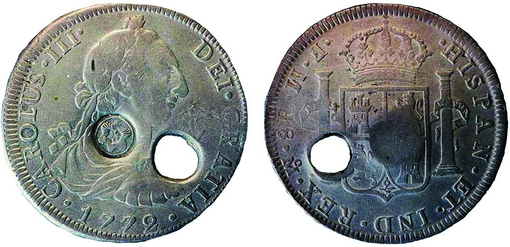
8 reales, Carlos III, 1772, México, with 1841 counterstamp
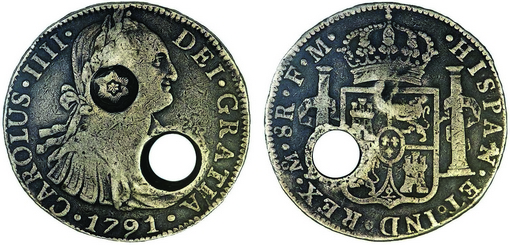
8 reales, Carlos IV, 1791, México, with 1841 counterstamp
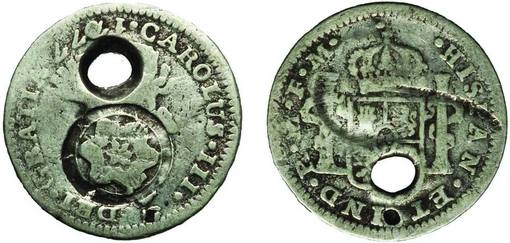
½ real, Calos III, 1771, México, with 1841 counterstamp
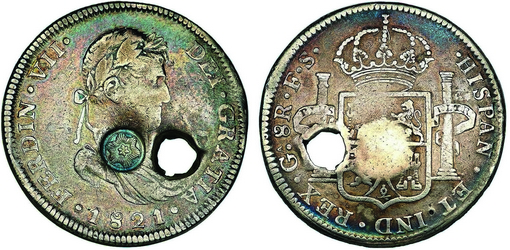
½ real, Carlos III, 1771, México, with 1841 counterstamp
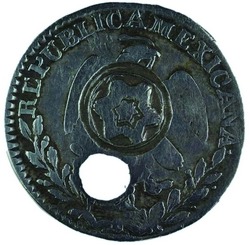
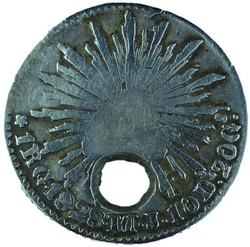
1 real, 1828, Guanajuato, with 1841 counterstamp
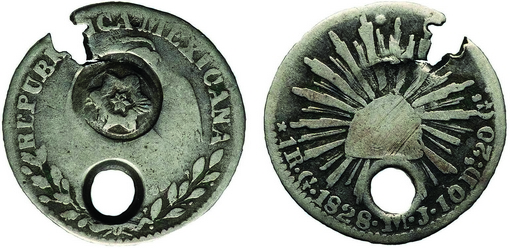
1 real, 1828, Guanajuato, with 1841 counterstamp
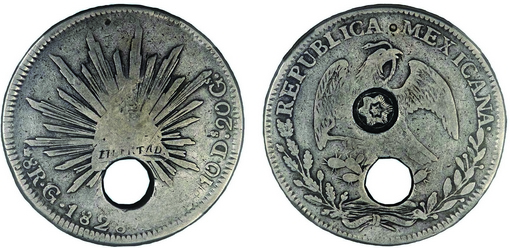
8 reales. 1828, Guanajuato with 1841 counterstamp
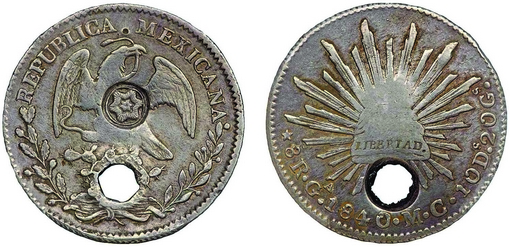
8 reales, Guadalajara with 1841 counterstamp
In 1842, Francisco Morazán overthrew Braulio Carrillo to reestablish the Central American Federation, and as a result the design and coinage of the Federation period came back into use. Although Francisco Morazán was overthrown in turn in 1842, succeeding administrations up to 1848 kept the Federation’s design and currency in the hopes that it would once again return to life.
Nevertheless, although coins from 1828 to 1837 were in circulation and new ones were issued with engravings from that period, the money supply was insufficient. For this reason, in 1845 and 1846 the circulation of coins from other nations was once again legalized by means of counterstamps.
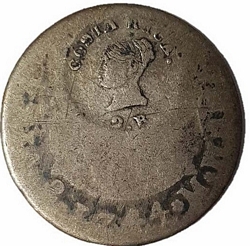
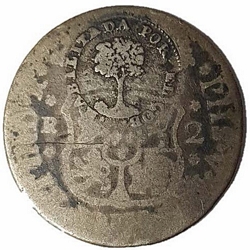
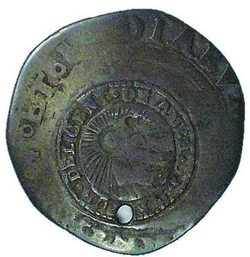
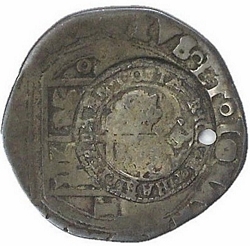
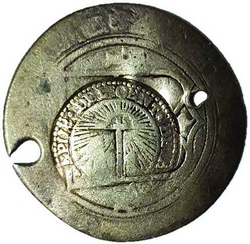
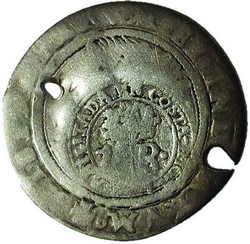
2 reales, Phulip V, 1744, México, with 1845 counterstamp
The 1845 counterstamp was stamped on Spanish 2 real coins, called pesetas; on the obverse was the torso of a woman with the inscriptions “Costa Rica” and “2 R;” on the reverse was a circle with a tree in the center and the inscription “Habilitada por el Gob” (Authorized by the Government).
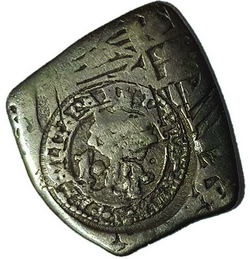
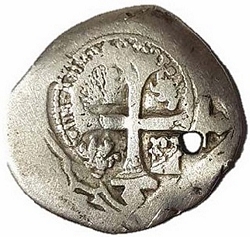
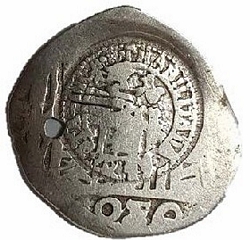
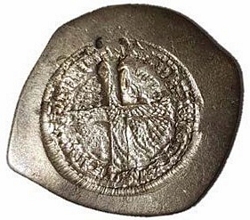
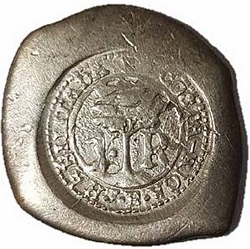
The 1846 counterstamp was applied to macuquina (cob) coinage. On the obverse was a circular counterstamp of three volcanoes, with an inscription reading “Repúb. del Cent. de Amér. 1846;” the reverse had an engraving of a tree and the inscription “Habilitada en Costa Rica JB” (Authorized in Costa Rica JB).
On 31 August 1848, during the administration of José María Castro Madriz, Costa Rica was proclaimed a sovereign, independent republic, and the country began establishing diplomatic relations with different European nations and the United States. With this measure, any possibility of Costa Rica returning to the folds of the Central American Federal Republic disappeared.
As part of the new set of symbols adopted for the Republic of Costa Rica, President José María Castro Madriz decreed the creation of a flag and coat of arms, which was engraved on coins in 1850.
In 1849 and 1850, however, gold and silver coins were minted with Federation symbols, due to the necessity of providing the economy with currency for transactions while dies were ordered for producing coins with the new engravings.
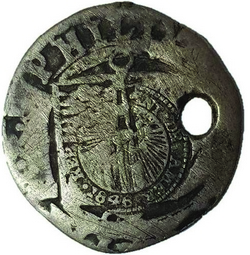
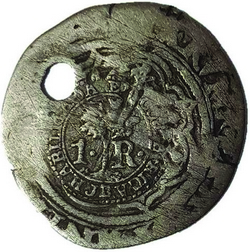
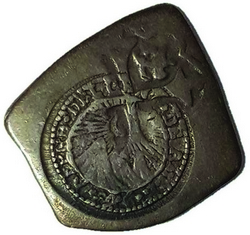
The 2 real, 1 real and ½ real silver coins issued in 1849, as well as those issued in earlier years for the last two denominations, were counterstamped that same year with the figure of a walking lion enclosed in a 5-millimeter diameter circle and the legend “Habilitada por el Gobierno.” The 1842 ½ real coins with the star-shaped shield were also counterstamped.
Later, in 1850, English one shilling coins, equivalent to 2 reales, and six-pence coins, equivalent to 1 real, were counterstamped with the image of a 6-millimeter walking lion.
In 1857 this counterstamp was also applied to gold ½ escudo and 1 escudo Central American Federation-type coins.
There are also some unauthorized coins that were counterstamped by error and they are very rare.
There are some counterfeits too, which consist of applying the legitimate counterstamp on other coins not authorized by the government. These counterfeits were made by a jeweler in the 1950s who got a punch of the walking lion. Most of the base coins used were United States coins in denominations of 50 cents and others of Costa Rica in denominations of 1 real (1847, 1849, 1850). It is possible that this counterstamp has been placed on Mexican coins of the colonial period too.
However, there is a difference in the application of the counterstamp, because the legitimate was applied with machine and the false with a hammer. The false is characterized by not being so clear. In addition, the punch used had a fault in the part corresponding to the lion’s tail so that in the falsly countermarked coins there is missing a small part of the lion´s tail.
In the 1980s a famous collector from Costa Rica bought the punch from the jeweler to prevent further counterfeiting.