In 1825 the legislature of the State of Mexico decided to establish a mint in their state, based on the higher population than other Mexican states where mints existed and on the Ley de Clasificación de Rentas (Revenue Classification Law) of 16 November 1824. To this end, after much discussion, the following decree was issued on 1 July 1825:
The Constituent Congress of the State of Mexico, in order to provide benefits to individuals in the minting of their metals, has decreed as follows:
Article 1. The State will establish on its account a mint with its corresponding refining office.
Article 2. This establishment will function as a concession to an individual or a company.
Article 3. Buying funds will be established by the State and for now in Pachuca, Temascaltepec Zimapán and Taxco.
Article 4. The governor will propose to the Congress the amount for the buying fund in each of these mines.
Article 5. Silver and gold metals acquired through these funds shall be coined in the mint of the state.
Article 6. The employer shall specify a fixed term, within which the coined metals shall be delivered to their owners.
Article 7. The employer shall be accountable for all the faults noticed in the weight and fineness of the coinage and for the compliance to the obligations indicated in the bases of the present contract.
Article 8. The governor of the state shall ask for bids from entrepreneurs under the aforementioned terms and after hearing the opinion of the Board will proceed to formalize the corresponding contract considering the most advantageous offers and requiring the necessary warranties.
Article 9. The formalized contract will be forwarded to the Congress for its approval.
Which is hereby communicated to the governor of the state who will ensure its compliance, printing, publication and circulation.
The reasons expressed by the Congress of the State of Mexico to install a mint in Tlalpam were threefold: that the surrounding mines - among the richest of the Republic - justified it, that this would save the miners mining transportation costs, and lastly that establishing the mint would open a new industry of some benefit to the Treasury. Public officials were so sure that interested bidders would be plentiful for the projected mint, that a sum of $95,000 was authorized in advance – on 12 September - for the purchase of metals to comply with Articles 3 and 4 of the aforementioned decree: $40,000 were to be employed in the region of Taxco, $20,000 in Temascaltepec, $20,000 in Pachuca , and $15,000 in Zimapán .
A beautiful essay for pieces of eight, believed, based on its style, to be from engraver José Guerrero, who had also prepared the dies for the famous medal in honor of General Guadalupe Victoria, was also prepared: it bears the Mexico Mo mintmark and the JM initials corresponding to the assayers José García Anzaldo and Manuel Ruíz de Tejada.
The miners of the region did not share the political enthusiasm to establish a mint in Tlalpam and refused to support the project. Moreover, the Mexico City mint, only 16 km away, inspired them with greater confidence than a new company apparently managed by venal and ambitious politicians. As a result, the government did not receive a single bid to lease the mint. This failure did not discourage the members of the government who managed to bring about modifications in the decree of 19 July 1825, enabling the Government of the State of Mexico to install and operate its own mint and assay office. Not deterred by the obstacles arising - including the inexperience of the staff that were appointed and the costs involved - Acts deemed necessary for the mint were approved in quick succession.
Melchor Múzquiz - governor of the state and later President of the Republic - proposed an old house in ruins for the mint’s location which he valued at $17,500. He then appointed a board to buy on credit all the necessary coining equipment from the Mexico City mint. Juan Nepomuceno Sanabria drew up plans for the building of the mint but the reconstruction of the old house sold by Melchor Múzquiz was commissioned instead to Manuel Rionda. The budget presented by Rionda to the legislature for the repairs and remodeling of the building amounted to $11,625. It was approved by the Chamber and works began on 9 July 1827. By mid-October, $18,183.17 had already been spent but the advances were slow and more funds were required to complete the works. Another budget was hastily proposed for a total of $52,675 and immediately passed by the legislators. This requested increase in the budget raised suspicions against the contractor and an expert, Teodoro Latropinier, was appointed by the Governor to inspect the works. His report not only approved the works done but also made a warm eulogy of all the works that had been completed. Nevertheless, the costs continued to rise and had reached $106,776 before the building was even able to accommodate the mint.
At first, when Múzquiz’s offer was made public, high praise was given for his magnanimity and munificence, but as the cost of the work kept augmenting, the general feeling turned against him and in the end he was vilified by most who believed the operation had left him a handsome profit.
Shortly after starting the reconstruction works, the Governor appointed the employees of the projected mint and each began to receive his salary even though the facility was not yet functioning. The legislature became aware of this anomaly and on 8 January 1828 requested the suspension of these payments, and a detailed and updated daily report of expenses with a final budget of the funds that were needed for the completion of the work.
On 28 February 1828 the Chamber approved the expenses related to the projected mint, but revoked the appointments that had been given to the employees. It is doubtful whether the Governor took this censorship into account since on the 20th of that same month, he informed the legislature that orders had been delivered to the employees appointed to the mint to ensure their observation of the federal regulations for establishments of that nature.
When dies were requested to start the minting operations, it was agreed that they could not bear the “Mo” mintmark since that belonged by right to the mint of Mexico City. The abbreviations “Eo Mo” which corresponded to the name Estado de México would thus be used for the coins that would be minted at Tlalpam.
The Provisional Government Junta had, on 11 June 1822, established a tax of 2% on minted silver and gold which was systematically used on payment of a contracted debt of a forced loan. This tax was still collected in 1828 under the designation of “Extraction rights” and the state legislature on 24 May 1828 decreed that the coinage circulating within the state without the paperwork proving the payment of the aforementioned right was not only subject to the immediate payment of said right but also to a 3% penalty. The resulting profits would then be split equally between the denouncers, the apprehenders and the municipality.
Numerous documents related to the establishment of a mint in Tlalpam can be found when studying the decrees of the Constituent Congress of the state of México. Between 1827 and 1831 many resolutions were passed on this matter by the legislature, some related to the designation of the employees, others to the accounting of the mint, etc. There is also evidence that by 5 September 1828 the legislators were agreed that installing the mint had been a huge mistake and that prudence seemed to suggest its immediate closure. On 29 May 1829 a serious dissension occurred between the mint’s employees and the state governor threatened to sack the ones responsible. At this point, the legislature intervened and instructed the mint not to make changes in the personnel without its authorization.
The staff of the mint included:
| Director | Manuel Rionda (until February 1829) |
| Colonel José María Abarca (from February 1829 until 13 June 1830) | |
| José Vicente Luna (in 1830) | |
| Treasurer | Colonel José Vicente Villada (from 10 March to 15 October 1829) |
| Colonel José María Chavero (until 1830) | |
| José Vicente Luna ( appointed interim manager in 1830) | |
| Manuel Navarrete (a provisional appointment in 1830) | |
| Assayers | Luis Velázquez de la Cadena, main assayer |
| Francisco Parodi, second main assayer | |
| Luis Parodi, first alternate assayer | |
| Manuel Onofre Parodi, second alternate assayer | |
| Engravers | Manuel Arao |
| Miguel Ramirez |
The “LF” initials that appear on the coins of this mint are for the second assayer, Francisco Lelo de Larrea.
In a communication addressed to the state governor on 29 January 1829, Rionda lamented that his duties as director of the mint had become a heavy burden for him. It is not known whether this gentleman was removed from office or resigned voluntarily but considering the later events, it is very likely that he resigned and that, fearful of the fate that awaited him as a result of the failure of the mint, he sought safety before the storm broke out. In any case, the fact is that he left Tlalpam and soon afterwards was appointed as director of the mint of Mexico City.
On 22 May 1829 the legislature was asked to authorize the expenditure of $5,711.15 to be invested in making some repairs needed at the mint, including $711.15 that would be spent on works requiring immediate attention with the remaining $5,000 to finish what had not yet been completed. A series of events ensued, culminating on 2 June with an indictment filed against former director Rionda. On 16 June the Secretary of State publicly guaranteed Rionda’s integrity but could not stop the wave of indignation that had arisen. On 14 July four prominent jurists asked for Rionda to be prosecuted for embezzlement and fraud against the public finances. The defendant was officially notified and testified in one of the courts in Mexico City. The process continued later in Tlalpam in absentia of the defendant and on 25 August 1830 he was finally convicted and sentenced to banishment from the territory of the state and the confiscation of his urban properties. It is likely that the charges against Rionda led to his eviction from the direction of the Mexico City mint at the end of 1829 when Ildefonso Maniau took over. Rionda later sought to vindicate himself and published a 47-page booklet entitled Rara aplicacion de la ley en la sentencia de D. Manuel Rionda.
The second treasurer of the mint of Tlalpam was Colonel José Vicente Villada whose provisional appointment was extended on 10 March 1829. He resigned on 15 October 1829 and Governor Joaquín Lebrija granted him a bonus of $1,000 in recognition of his services. Nevertheless, it was soon established that Villada’s accounts were not in proper order: when requested to reimburse the missing funds, he responded that he was not able to do so and the government immediately confiscated his properties in the state of México and sold them to cover the embezzled amount.
Based on some official documentation, including the minutes of the legislature from its session of 18 September 1830, it appears that the mint had a good number of assayers, who were left unemployed and almost helpless after the mint had closed. Pressed by need and encouraged by the paternalistic attitude of the authorities, they asked to continue receiving their salaries until employed again. The legislature was sympathetic towards the request and would have approved it had there been funds available in the State Treasury. In consequence, the Congress agreed to give preference to these assayers whenever a position of similar category opened at any of the government’s dependencies. Sadly, the names of these assayers have been lost to history.
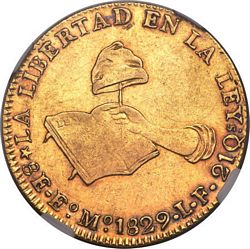
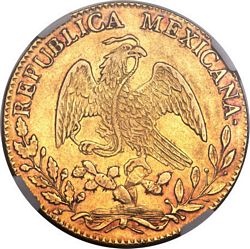
KM 383.4 8 Escudos 1829 (Heritage Long Beach auction, September 2014, lot 31253)
The minting operations in Tlalpam started on 23 February 1828 but that mint was short lived. On 29 May 1830 a decree of the state legislature ordered the closure of the mint: the last coins would be struck on 9 June of that year and operations stopped four days later. The employees of the mint sent a formal protest to Governor Melchor Muzquiz through Director Joaquín Lebrija expressing their consternation at the ruin that awaited their families. A special mention was made of the fact that many of them had quit better positions at the Federation to serve the State. On 3 June Lebrija requested Muzquiz to suspend the closure and stated that the employees of the mint had agreed to accept only a partial proportional payment of their salaries if the mint’s funds had become insufficient. This rather magnanimous attitude out of imperious need was not considered and on 8 June a new, more threatening, letter was sent to the governor. An excerpt of this letter follows:
We consider the Constituent Congress to have no authority to issue providences other than those absolutely necessary for the celebration of elections and the reunion of the new Constitutional Congress; any other legislative act that it exerts can only be considered as an attack against the sovereignty of the State. The citizen, on another hand, is obliged to obey only the law and it must be understood that obeying the dispositions that the Constituent Congress has issued outside its faculties would only mean yielding to brute force. Your Honor has the obligation to protect our political rights and particular interests guaranteed by law, and thus we exhort him to pay us the corresponding owed warranties…
Muzquiz evidently refused to acquiesce to this petition since on that same date the following note was sent:
All the petitions guided by moderation and the respect to the authority from the employees of this mint have been ignored… (and now they) must speak as free citizens… In consequence …they protest … and comply by force and not the law … which had conceded them the warranties of their employments.
The following were the amounts minted at the Tlalpam mint:
| Period | Gold | Silver | Totals |
| February to June 1828 | - | 227,955.00 | 227,955.00 |
| July 1828 to June 1829 | 95,976.00 | 514,990.88 | 610,966.88 |
| July 1829 to June 1830 | 107,568.00 | 216,171.00 | 323,739.00 |
| Total | 203,544.00 | 959,116.88 | 1,162,660.88 |
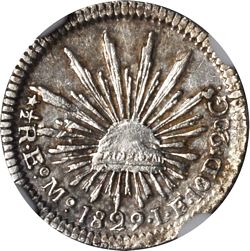
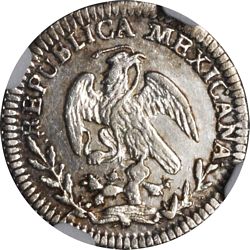
KM 370.4 ½r 1829 Eo Mo LF (Stack's Bowers Baltimore auction, March 2011, lot 8132)
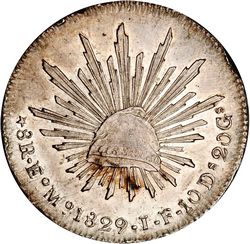
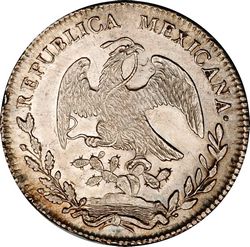
KM-377.5 8r 1829 Eo Mo LF (Stack's Bowers Baltimore auction, November 2010, lot 6276)
Only the following partial mintage figures detailed by denomination have been found, but they are of the utmost importance since they detail some of the denominations that were struck. From 23 February 1828 to 15 October 1828: $346,874.75, divided as follows:
| 20,482 | pieces of | 1 Real | 2,560.25 |
| 4,922 | pieces of | 2 Reales | 1,230.50 |
| 340,660 | pieces of | 8 Reales | 340,660.00 |
| 606 | pieces of | 2 Escudos | 2,424.00 |
From 16 October 1829 to June 1830: 156,301.00, divided as follows:
| 153,005 | pieces of | 8 Reales | 153,005.00 |
| 206 | pieces of | 8 Escudos | 3,296.00 |
The government of the State of México tried to lease the mint and its rights but to no avail and on 29 May 1830 decreed its closure. Finally, the legislature decreed on 3 October 1831 to return the equipment to the Mexico City mint and to sell the building. According to historian Father Mariano Cuevas{footnote}Historia de la Nación Mexicana, México, 1953, Vol. II{/footnote}, Lorenzo de Zavala confiscated the equipment and never returned it.
The mint was never able to produce sufficient profits to cover its operational costs: net losses amounted to $9,491.63 on its first year of operations, then $14,966.42 on its second year, and $18,539.95 in its third and last year. After the building was sold and the equipment returned to the Mexico City mint, the total net loss was of $149,774.93.
After the state of México was dismembered, its capital was transferred to Toluca. On 7 December 1847 Governor Francisco M. de Olaguibel signed a decree authorizing the reopening of the mint. However, since Toluca was only 73 km away from Mexico City and thus within the limits exclusively reserved to the mint of that city, the project was dismissed after the director of the Mexico City mint, Alejandro Bellange, protested. No further attempts to reopen the mint were made although it is somewhat ironical that one was made at all, considering the blatant failure of the mint of Tlalpam.
KM 370.4 ½r 1829 EoMo LF (Stack's Bowers Baltimore auction, March 2011, lot 8132)
Diameter 16 mm., 1.69 g., 0.90277 silver.
For a consideration of the rarity of this single year Estado de Mêxico ½ real see here.
| Date | Asssayer | Recorded Mintage |
Comment |
| 1829 | LF |
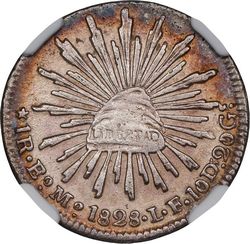
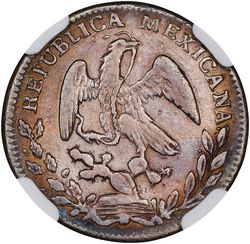
KM-372.3 1r 1828 EoMo LF (Stack’s-Bowers auction of Kirk Menczer Collection, 23 June 2026, lot 72304)
Diameter 20 mm., 3.38 g., 0.90277 silver.
| Date | Asssayer | Recorded Mintage |
Comment |
| 1829 | LF |
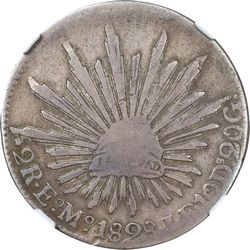
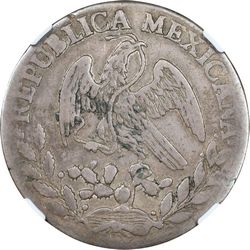
KM-374.5 2r 1828 EoMo LF (Stack’s-Bowers auction of Kirk Menczer Collection, 24 June 2026, lot 73037)
Diameter 22 mm., 6.76 g., 0.90277 silver.
| Date | Asssayer | Recorded Mintage |
Comment |
| 1829 | LF |
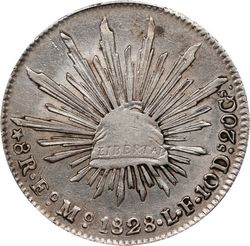
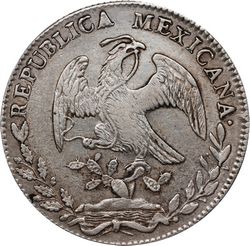
KM-377.5 8r 1828 EoMo LF (Stack’s-Bowers auction 16 January 2026, lot 41099)
Diameter 39 mm., 22.07 g., 0.90277 silver. The 8 reales was produced in 1828, 1829 and the first half of 1830.
| Date | Asssayer | Recorded Mintage |
Comment |
| 1828 | LF | ||
| 1829 | LF | illustrated below | |
| 1830 | LF | illustrated below | |
| 1830/20 | LF | illustrated below |
KM-377.5 8r 1829 EoMo LF (Stack's Bowers Baltimore auction, November 2010, lot 6276)
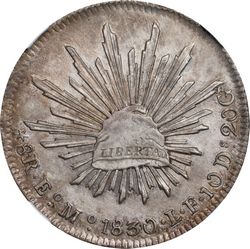
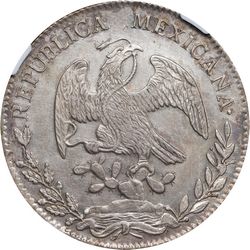
KM-377.5 8r 1830 EoMo LF (Stack’s-Bowers auction, 26 August 2025, lot 41399)
As the mint only operated until July of 1830, the coins struck with the 1830 date are most elusive within this already challenging series. An overdate 1830 over 1820 is known.
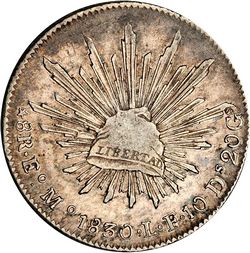
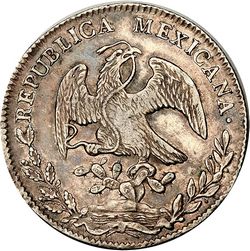
KM-377.5 8r 1830/20 EoMo LF (Stack’s-Bowers Baltimore auction, 4 November 2010, lot 6277)
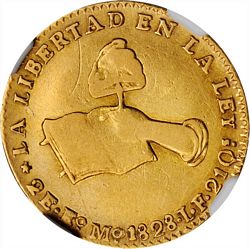
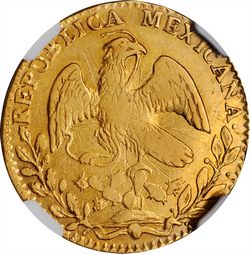
KM-380.2 2E 1828 EoMo LF (Stack’s-Bowers auction, 6 August 2020, lot 21476)
Diameter 23 mm., 6.77 g., 0.8750 gold
| Date | Asssayer | Recorded Mintage |
Comment |
| 1828 | LF |
KM 383.4 8E 1829 EoMo LF (lot 31253, Heritage Long Beach auction, September 2014)
Diameter 37 mm., 27.07 g., 0.8750 gold. The 8 escudos coin was minted in 1828 and 1829.
| Date | Asssayer | Recorded Mintage |
Comment |
| 1828 | LF | ||
| 1829 | LF |
In 1957, Alberto Pradeau published his great book Historia Numismática de México de 1823 a 1950, volume I{footnote} Alberto Francisco Pradeau. Historia Numismática de México de 1823 a 1950. Tomo I. Edición Patrocinada por la Sociedad Numismática de México. 1957{/footnote}, and on page 503 wrote the following information related to the assayers of the Tlalpan mint.
ENSAYADORES: Luis Velázquez de la Cadena, ensayador propietario; Franscisco Parodi, segundo ensayador propietario; Luis Parodi, primer suplente; Manuel Onofre Parodi, segundo suplente,
GRABADORES: Manuel Araos.
Miguel Ramírez.
Also, on the same page, Pradeau concludes the following regarding the L.F. assayers of the E°M° mint: Las inciales L.F. que aparecen en la moneda acuñada en esta ceca, corresponden a los nombres de pila de D. Luis Velazquez de la cadena y de D. Francisco Parodi Pagani (The initials L.F. that appear on the coins minted at this mint (E°M°) correspond to the first names of Luis Velázquez de la Cadena and Francisco Parodi Pagani.)
And finally, on page 507, the list of assayers (ensayadores) of the E°M° mint changes:
ENSAYADORES: D. Luis Velázquez de la Cadena,
D. Francisco Pagani, (sic)
D. Luis Varela,
D. Francisco Lelo de Larrea,
D. Manuel Onofre Parodi,
D. Antonio de la Portilla.
As the reader can see, Alberto Pradeau listed seven different assayers for the State of Mexico mint: Luis Velázquez de la Cadena, Francisco Parodi (and later writes it as Francisco Pagani, concluding that it was Francisco Parodi Pagani), Luis Parodi, Manuel Onofre Parodi, Luis Valera, Francisco Lelo de Larrea and finally Antonio de la Portilla.
Since then, all authors who published numismatic books and articles (both from Mexico and the USA) related to the coinage of the E°M° mint (1828-1830) continued to repeat Francisco Parodi Pagani{footnote} The only Francisco Pagani I could locate was born in Mexico City on 14 October 1792, and was the son of the Italian Luis Pagani Zanona and María Antonia Rodríguez Zenteno from Mexico City.{/footnote} as the second assayer of this mint, which is totally wrong.
While looking for genealogical information about the only assayer who appears on all the coins minted by the Guadalupe y Calvo (G.C.) mint in the state of Chihuahua, Manuel Parodi (M.P.){footnote}Manuel Onofre Parodi Ortiz (Zimapán, Hidalgo, ca. 1810-1811 – Culiacán, Sinaloa, 11 February 1875) was an assayer at the mints of the State of Mexico (1828-1830), Guadalupe y Calvo (1843-1851), Culiacán (1854), Hermosillo (1866), and again in Culiacán (1871-1874). In the Mexican newspaper El Monitor Republicano No. 3,916, dated 1 May 1871, there is a note from the State Secretariat and the Office of Finance and Public Credit appointing him assayer at the Oaxaca State Mint, a position he never actually held, demonstrating the significant disorganization within the Mexico’s mints. He is one of the very few assayers who worked in four different mints in the Mexican Republic.{/footnote} I located, by pure serendipity, the marriage certificate of Francisco Lelo de Larrea where it is specified that he was an assayer at the Tlalpan mint.
In the Mexico City newspaper El Sol of 25 December 1827 a list appears of the managers and employees working at that time at the State of Mexico Mint.

Luis Velázquez de la Cadena appears as First Assayer, Francisco Lelo de Larrea as Supernumerary Assayer{footnote}A supernumerary employee is used to fill temporary vacancies or to carry out activities of a purely transitory nature.{/footnote}, and Francisco Pagani as First Treasury Officer. This notice appeared exactly four months and two days before operations began at the State of Mexico Mint.
Marriage certificate of Francisco Lelo de la Larre{footnote}Francisco Lelo de Larrea was baptized in the Church of Santo Domingo in what is now the municipality of Santo Domingo Tehuantepec, Oaxaca, on 22 September 1804, with the name Francisco de Paula María de Jesús Josef Agustín Ygnacio Joaquín Mariano Judas Tadeo Lelo de Larrea Terán. Francisco Lelo de Larrea died in Mexico City on 4 March 1871{/footnote} with María Dolores de Rosas, celebrated in Tlalpan on 11 September 1829, where Luis Velázquez de la Cadena and Manuel Parodi both appear as witnesses. Both the groom and the two witnesses indicate that they were assayers at the Tlalpan Mint.

En la Ciudad de Tlalpam a once de Setiembre de mil ochocientos veinte y nueve ante mí el Lic. Don Francisco Patiño cura propio de esta Parroquia compareció Don Francisco Lelo, Ensayador de la Casa de Moneda de esta capital, á fin de contraer matrimonio con Doña María Dolores de Rosas y estando precente le recibí […] (In the City of Tlalpan, on the eleventh of September, one thousand eight hundred and twenty-nine, before me, Licentiate Don Francisco Patiño, priest of this Parish, appeared Don Francisco Lelo, Assayer of the Mint of this capital, in order to contract marriage with Doña María Dolores de Rosas, and being present, I received him […])

First witness for the couple getting married. […] In the same act: before me, the undersigned priest, the couple getting married presented as their witness a man whom I know, who stated his name was Don Luis Velásquez de la Cadena, Assayer of this Mint, a native of […]

Second witness for the couple getting married. […] En el mismo día: ambos contrayentes precentaron por su testigo a un hombre á quién fé conosco que expresó llamarse Don Manuel Onofre Parodi Ensayador de esta Casa de Moneda […] ([…] On the same day: the couple getting married presented as their witness a man whom I know, who stated his name was Don Manuel Onofre Parodi, Assayer of this Mint […])

Signature of the second Assayer of State of Mexico Mint (Francisco Lelo de Larrea)
Again, in the Mexico City newspaper El Sol of 11 June 1830, a note dated 9 June 1830 was published by employees of the Tlalpan mint (when its closure had already been authorized), listing the assayers Luis Velázquez de la Cadena, Francisco Lelo de Larrea, and Manuel Parodi. Francisco Pagani does not appear in that note.


Also, on the front page of El Sol of 6 January 1832, a note was published in which Francisco Lelo de Larrea, Manuel Parodi, and Luis Velázquez de la Cadena request to be declared unemployed by the Federation (Federal Government). The three assayers from the now-defunct Tlalpan Mint appear together again.

Alberto Pradeau documented a lot of names while working on his monumental three-volume work, Historia Numismática de México de 1823 a 1950 (plus another fourth volume of plates and illustrations), which inherently led to errors. Francisco Parodi Pagani does not actually exist. It is likely that while working on the chapter of his book about the E°M° mint, Pradeau confused and mixed up the names of different people. As can be seen in the list of managers and employees of the Tlalpan mint (1827), Francisco Pagani worked as treasurer and subsequently disappears from newspaper records, leading to the conclusion that he engaged in other activities outside the Tlalpan mint.
See also “State of Mexico Mint (1828-1830)” presented by Adrián González Salinas at the Sociedad Numismática de México, 8 July 2024.
Guadalajara is the capital of the state of Jalisco and the second largest city in Mexico. The mint was opened under Spanish Colonial rule in 1812 and the first Republican coinage was minted in 1825.
Although the mint was captured briefly in 1860 during the Reform War, coinage of the 8 Reales series continued. Coinage was suspended from 1864 to 1866 during the Maximilian era. The Imperial Forces of Maximilian occupied the Guadalajara mint from 5 January 1864 until 19 December 1866. It is possible ·some coinage took place during this time using Republican dies . This could possibly account for the unusual overdate 1863/4. Minting a "República Mexicana" coin with a date prior to the occupation might have been more acceptable to the Imperialists.
The Guadalajara mint was closed on 30 June 1895.
| from | to | |
| 1824 | unknown | Government of the State of Jalisco |
| unknown | 1 July 1857 | Government of the Republic of Mexico |
| 1 July 1857 | 13 August 1868 | Antonio A. Solana, J.S. Laguerene, Gama & Company |
| 13 August 1868 | 1874 | Government of the Republic of Mexico |
| 1874 | 1876 | unknown |
| 1876 | 1879 | Government of the Republic of Mexico |
| l March 1880 | 1 March 1891 | Cia. Limitada Central de Casas de Moneda de México |
| 1 March 1891 | 30 June 1895 | Symon & Camacho |
| Initial | Name | Began on | Left office on |
| FS | Francisco Suarez | 1825{footnote}since 1818 under the Spanish Colonial rule{/footnote} | 1836 |
| LP | unknown | 1830 | 1831 |
| JG |
Juan de Dios Guzman |
1836 | 1839 |
| 1842 | |||
| 1845 | 1868 | ||
| MC | Manuel Cuevas | 1838 | 1841 |
| 1843 | 1845 | ||
| FV | Unknown | 1863 | |
| JM | Jesús P. Manzano | 1867 | 1869 |
| IC | Ignacio Canizo | 1869 | 1870 |
| 1873 | 1878 | ||
| MC | Manuel Contreras | 1874 | 1875 |
| JA | Julio Arancivia | 1877 | 1880 |
| FS |
Fernando Sáyago was born around 1849. On 25 August 1886 Fernando Sáyago entered into a contract with Carlos Pacheco, the Secretario de Fomento,to establish an Oficina Central de Grabado. As well as being an assayer, Sáyago had another interest, as on 5 September 1889 he and Juan C. Padilla were given a monopoly for ten years to make various types of bricks{footnote}Anuario de legislación y jurisprudencia, Año 1886, núm. 10,561{/footnote}. These were supplied to the Mexico City government in 1890 to pave sidewalks and is September 1892 the town council was considering buying a further 25,000 bricks for their sidewalks{footnote}El Correo Español, 4 September 1892{/footnote} Sáyago was a teniente de ensayador in the Ensaye Mayor in 1890 and in June of that year he was named Ensayador Mayor de la República on the death of Francisco Morales{footnote}El Siglo Diez y Nueve, 18 June 1890{/footnote}. He was on the town council of Mexico City, being elected third regidor for 1893{footnote}El Siglo Diez y Nueve, 19 December 1892{/footnote} and first regidor for 1894{footnote}La Voz de México, 19 December 1893{/footnote}. However, he only held the post of president municipal for a few days as he began feeling unwell on 2 January. A troublesome laryngeal condition quickly turned into a deadly croup, suffocating him in a very short time. He died on 7 January 1894{footnote}The Two Republics, vol. XXXVIII, no. 7, 9 January 1894: La Patria, Año XVIII, Núm. 5,132, 9 January 1894{/footnote}, He was succeeded as presidente municipal by Sebastián Camacho. |
1880 | 1882 |
| TB | Trinidad Barrera | 1882 | 1884 |
| AH | Antonio Hernandez y Prado | 1884 | 1885 |
| JS |
In January 1884 he was awarded the title of Ingeniero Ensayador y Apartador de metales by unanimous consent {footnote}La Voz de México, Tomo XV, Núm. 21, 23 January 1884{/footnote}. In 1896 he was Jefe del Ensaye Federal de Guadalajara. Schiaffino was involved in local politics. He served on the Guadalajara city council, being president for the years for the years 1898, 1900, 1901 and 1903 (though he is also recorded as mayor at a banquet on 5 February 1902{footnote}The Mexican Herald, Vol. XIII, No, 157, 6 February 1902{/footnote}, and elected as an alternate deputy to the state legislature of 1901{footnote}La Patria de Mexico, Año XXIV, Núm. 7,199, 14 November 1900{/footnote}. He died in Guadalajara on 23 May 1925. |
1885 | 1895 |
The assayers on its decimal coinage were:
| Initial | Name | Began on | Left office on |
| C | Ignacio Cañizo y Soto | 1869 | 1877 |
| A | Julio Arancivia | 1877 | 1881 |
| S | 1880 | 1882 | |
| B | Trinidad Barrera | 1883 | 1884 |
| H | Antonio Hernández y Pravo | 1884 | 1885 |
| S | José S. Schiafino | 1885 | 1895 |
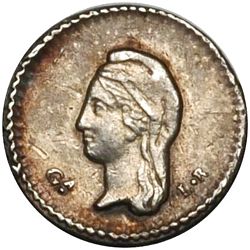
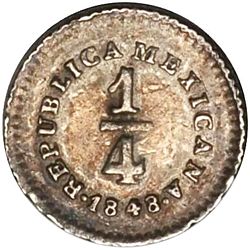
KM-368.3 ¼r Guadalajara 1848 GaLR (Stack’s Bowers Baltimore Auction, 28 March 2011, lot 8087)
Diameter 12 mm. 0.845 g, 0.90277 silver
| Date | Asssayer | Recorded Mintage |
Comment |
| 1842 | JG | ||
| 1843 | JG | ||
| 1843.2 | JG | illustrated below | |
| 1843 | MC | ||
| 1844 | MC | ||
| 1844 | LR | ||
| 1845 | LR | ||
| 1846 | LR | ||
| 1847 | LR | ||
| 1848 | LR | ||
| 1851 | LR | ||
| 1852 | LR | ||
| 1854 | LR | ||
| 1855 | LR | ||
| 1857 | LR | ||
| 1862 | LR |
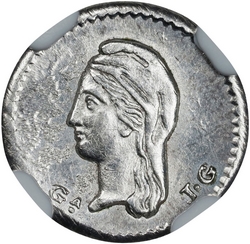
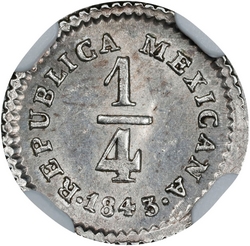
KM-368.3 ¼r 1843/2 Ga JG (Stack’s Bowers Kirk Menczer Collection, 23 June 2026, lot 72007)


KM-370.5 ½r 1825 Ga FS (Stack’s Bowers Kirk Menczer Collection, 23 June 2026, lot 70298)
Diameter 16 mm. 1.690 g, 0.90277 silver
For a consideration of the rarity of Guadalajara ½ real see here.
| Date | Asssayer | Recorded Mintage |
Comment |
| 1825 | FS | ||
| 1826 | FS | ||
| 1828 | FS | reported | |
| 1828/7 | FS | ||
| 1829 | FS | ||
| 1830/29 | FS | illustrated below | |
| 1831 | LP | ||
| 1832 | FS | medal axis | |
| 1834/3 | FS | coin axis | |
| 1835 | FS/LP | 5/4/3 | |
| 1837 | JG | ||
| 1837/6 | JG | illustrated below | |
| 1838/7 | JG | ||
| 1838/7 | JG/FS | 9/8/7 | |
| 1839 | MG | ||
| 1840 | MC | ||
| 1840/39 | MC | illustrated below | |
| 1841 | MC | ||
| 1841 | JG | ||
| 1842 | JG | medal axis | |
| 1843 | JG | coin axis | |
| 1843/2 | JG | coin axis (illustrated below) | |
| 1843 | MC/JG | ||
| 1844 | MC | ||
| 1845 | MC | small cap | |
| 1845 | MC | large cap | |
| 1845 | JG | small cap | |
| 1846 | MC | large cap | |
| 1846 | JG | small cap | |
| 1847 | JG | ||
| 1848 | JG | ||
| 1848/7 | JG | illustrated below | |
| 1849 | JG | ||
| 1850 | JG | ||
| 1850/49 | JG | illustrated below | |
| 1851/0 | JG | illustrated below | |
| 1852 | JG | ||
| 1853 | JG | ||
| 1854 | JG | ||
| 1855/4 | JG | ||
| 1855 | JG | ||
| 1856 | JG | ||
| 1857 | JG | ||
| 1858 | JG | ||
| 1858/7 | JG | illustrated below | |
| 1859/7 | JG | illustrated below | |
| 1860 | JG | ||
| 1860/59 | JG | illustrated below | |
| 1861 | JG | ||
| 1862/1 | JG | small A |
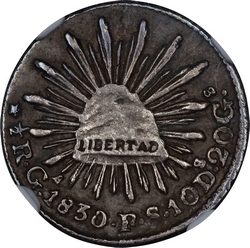
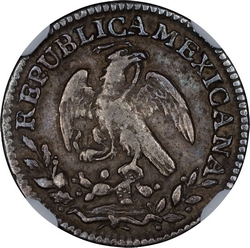
KM-370.5 ½r 1830/29 Ga FS (Stack’s Bowers Kirk Menczer Collection, 23 June 2026, lot 72100)
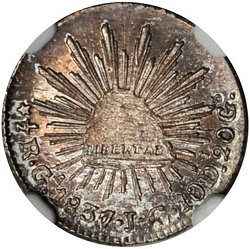
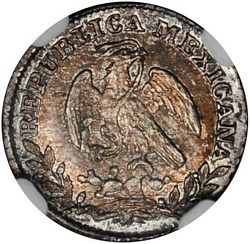
KM-370.5 ½r 1837/6 Ga JG (Ponterio Baltimore auction, 28 March 2011, lot 8137)
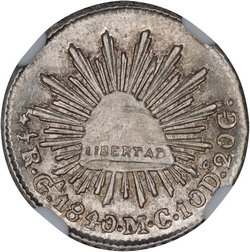
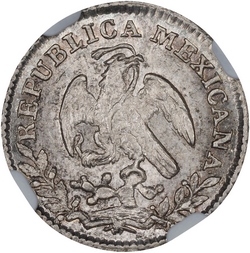
KM-370.5 ½r 1840/39 Ga MC (Stack’s Bowers Kirk Menczer Collection, 23 June 2026, lot 72107)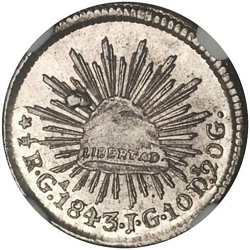
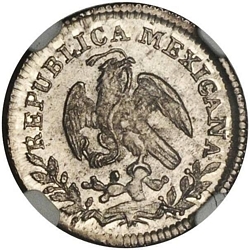
KM-370.5 ½r 1843/2 Ga JG (Ponterio Baltimore auction, 28 March 2011, lot 8140)
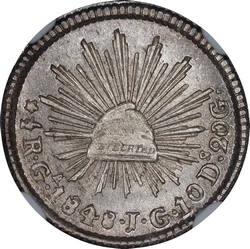
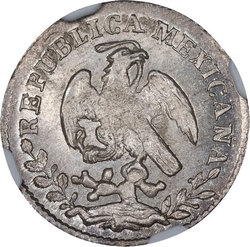
KM-370.5 ½r 1848/7 Ga JG (Stack’s Bowers Kirk Menczer Collection, 23 June 2026, lot 72115)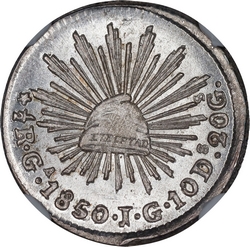
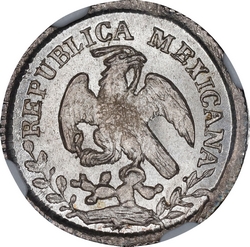
KM-370.5 ½r 1850/49 Ga JG (Stack’s Bowers Kirk Menczer Collection, 23 June 2026, lot 72117)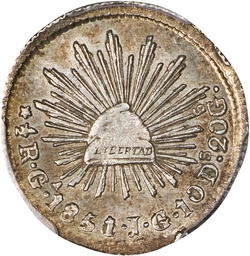
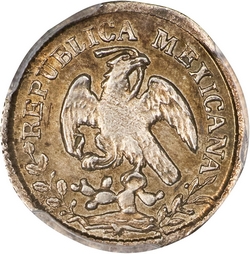
KM-370.5 ½r 1851/0 Ga JG (Stack’s Bowers NYINC auction, 23 January 2025, lot 39283)
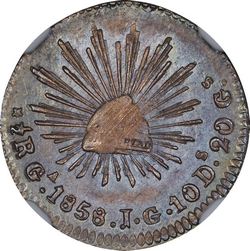
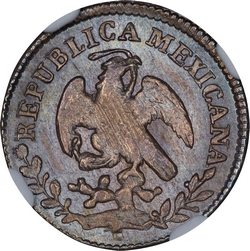
KM-370.5 ½r 1858/7 Ga JG (Stack’s Bowers Kirk Menczer Collection, 23 June 2026, lot 72123)
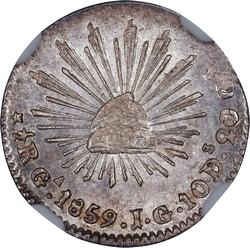
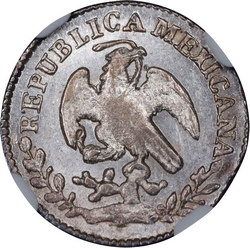
KM-370.5 ½r 1859/7 Ga JG (Stack’s Bowers Kirk Menczer Collection, 23 June 2026, lot 72124)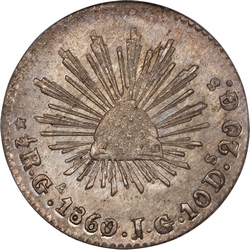
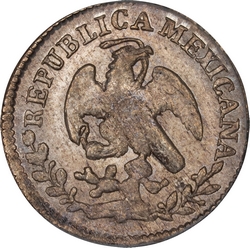
KM-370.5 ½r 1860/59 Ga JG (Stack’s Bowers Kirk Menczer Collection, 23 June 2026, lot 72125)
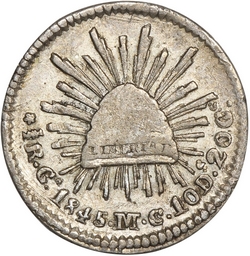
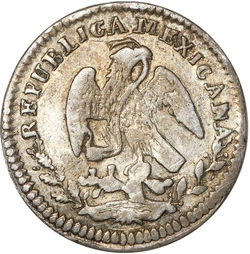
Counterfeit KM-370.5 ½r 1845 Ga MC (Briggs & Bustos Counterfeit issues auction, 10 August 2025, lot 55)
Struck on a slightly debased silver planchet. 1.46 grams, 16.9 millimeters in diameter, coin alignment. Remarkable for its high quality manufacture and close typographic resemblance to the official issue, betrayed only by the oversized Phrygian cap, subtle differences in the eagle’s design, and the absence of the Republican cord on the edge. Metal composition: 87.82% Silver, 10.39% Copper, 0.7393% Lead, 0.5584% Germanium, 0.2803% Zinc, 0.1344% Gold, and 0.0796% Gallium.
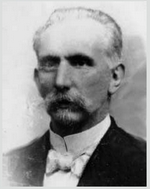 José Salvador Schiaffino Ametller was born in Sayula, Jalisco on 4 January 1848, the son of Mariano Schiaffino y Vallarta and Adela Ametller y Ponce de León.