From the 1780s to the 1840s, the Soho (Birmingham) firm of Boulton, Watt & Company was in the vanguard of coining innovation. One of its founders, Matthew Boulton, secured a patent for the first steam-powered coining press in mid-1790. The company went on to produce the first truly 'modern' coins, created by means of the new device, in 1797. This was the British 'cartwheel' penny, and the form assumed by the new coin was both a reflection of the demands of the new machinery and the convictions of its inventor as to the perfect function and appearance of the coin. Later coinage inventors, their work solidly grounded on Boulton's precedent, retained most of his concepts as to preferable monetary form. So it is that our coinage since his time has generally stressed low relief, and has usually been struck in a close collar.
The activities of Boulton, Watt did not abruptly cease with the securing of the right to strike British copper coins in 1797, even though such a contract had long been a primary goal. Instead, having gained acceptance of a new form and mode of production for coinage in one country, the firm now sought to bring its achievements to others.
It essentially did so in two ways, broadly demarcated by time. In the first phase, it shipped coinage on the new model to a receptive outer world. Even prior to the British issues of 1797, we find it making coins for Madras, Bombay, Sierra Leone, and Sumatra, as well as halfpenny tokens for a dozen concerns in England, Scotland, Ireland, and Wales. These latter were seen by Matthew Boulton as a stopgap measure, providing necessary small change prior to Boulton, Watt's obtaining of the right to strike official British coin. He also saw the tokens as a way of influencing official policy in his direction.{footnote}Matthew Boulton to Jean-Pierre Droz, 7 March 1787, Birmingham Reference Library, Archives Department Matthew Boulton Papers (hereafter BRL), Correspondence, Boulton to Droz, 1787{/footnote} The company intensified its coining activities after 1797: in the following year, it undertook to supply the new United States Mint at Philadelphia with copper planchets for cents and half cents. This lucrative business was only interrupted once (by the War of 1812) until the Americans finally cancelled the arrangement in 1837. Boulton, Watt continued to supply finished coins to the outside world as well, and its role in the Bank of England silver token issues is well known.
The purveyance of coinage to the world is one of the best-known activities of Boulton, Watt & Company. But the firm also supplied entire mints. This formed the second phase of its work, and it is this aspect of the business which forms the concern of this paper. The idea was a logical development in Matthew Boulton's thinking. At first, he determined to give a new type of coin to Britain and the world. But it soon became obvious to him that there was also a market for the machinery which produced that coin. Why not export the machinery, and let the world create its own coinage on the new model?
Boulton, Watt was doing so by the late 1790s. It entered into a contract with the Russian Imperial Government in 1796; despite initial difficulties, a steam-powered mint was in operation in St Petersburg by 1805. Additional contracts were soon secured in Europe: the Danes were striking coins on Boulton's new presses in 1809, and by that time the company was also supplying new machinery to the Royal Mint itself. Its presence there would make possible the extensive recoinage of 1816 and subsequent years.
Matthew Boulton died in 1809, his partner, James Watt, in 1819. By the time of the elder Watt's death, the enterprise which he and Boulton had founded was preparing to export coining machinery far beyond the confines of Europe. In effect, what had begun as a local activity, an offshoot of the British Industrial Revolution, was about to become global.
Logically enough, the company's earliest extra-European enterprises centred in India. There, mechanized mints were set up in Calcutta and Bombay. India had previously received coins on the new model directly from Birmingham; now, it could strike its own, and it began doing so in the early 1820s.
At first glance, the area to which Boulton, Watt now turned its attention was by no means logical. But it did reflect British industrial and political concerns of the period. The company undertook to send mint machinery to Mexico in the mid-1820s, and it would remain active there until the late 1840s.
The form and the very possibility of such an enterprise were conditioned by events taking place in Latin America between 1808 and 1825. The Napoleonic occupation of Spain (coupled with an almost immediate revolt against it in the Americas) meant that the old, closed Spanish economic system no longer obtained. While trade with the Spanish Indies continued to be risky, it was henceforth far easier than it had been in the days of firm Spanish colonial control. Trading patterns established at this point would tend to persist even after the return of peace, especially as British businesses, faced with a contraction in home markets after Waterloo, became increasingly concerned with gaining contacts abroad.
In the Americas, most of the Spanish Empire had turned its rebellion against Napoleon into one against continued colonial status, and it had secured its independence by 1825. The new nations, suddenly deprived of their traditional trading connection with Spain, were also looking for new markets or the extension of old ones. Industrial Britain was a logical destination for their products and object of their attentions.
This was certainly the case in Mexico, which had secured its independence by late 1821. Here, however, two other phenomena deserve mention, for they would both have an effect on the numismatic history of the young nation, and on the economic fortunes of Boulton, Watt & Company.
First, when normal internal trading patterns had been disrupted during Mexico's struggle for independence, the Spanish Crown had authorized the establishment of several emergency royalist mints, whose coinage would supplement that of the main facility at Mexico City. Makeshift mints were soon functioning at Chihuahua, Guadalajara, Guanajuato, Durango, and Zacatecas, all located in the silver country of the centre and north. These mints had been found useful in colonial days, and they were allowed to remain open after Independence. Indeed, they were a vital necessity at the time: communications were no better after 1821 than they had been before, and continuing internal unrest also rendered advisable the existence of subordinate facilities. In point of fact, it encouraged the creation of still others: at one time or another, the Mexican Republic would have a total of fourteen federal mints.
The large number of mints was recognized and to a degree encouraged by Mexico's first basic law, the Constitution of 1824. Written by men who were all too aware of the centralization which had been at the heart of Spanish colonial government, the new document vested preponderant powers in the states, including a right to coin money. In response to the clauses of the Constitution, Mexico would erect and long maintain a dual monetary tier, one state, the other federal, but both accomplished at the same facilities. The decentralization inherent in such an arrangement meant a lack of firm, consistent control over many of its aspects. It was this second phenomenon which created the climate in which Boulton, Watt & Company was able to do business.
The firm's first orders for Mexico were generated in 1825, its last in 1849, at a time when, technically, it was no longer even in existence. It would have business connections with five mints in all, those of Mexico City, Chihuahua, Culiacán, Zacatecas, and Guanajuato. These ties varied greatly in length and in intensity. Dealings with Mexico City never went beyond the preliminary stage. Machinery was shipped to Culiacán, modified to be worked by cattle rather than by steam. Zacatecas received dies and some machinery, Chihuahua dies alone. Mexico City was dealt with in the late 1820s, Culiacán in the early 1830s, Zacatecas and Chihuahua on scattered occasions in the 1840s. These brief encounters need not detain us here; we are concerned with the heart of the matter, which was always Guanajuato.
Machinery, dies, parts, technicians and mechanics went back and forth between Soho and the north-central Mexican mining town from the middle 1820s to the later 1840s. The great majority of the Birmingham archival material on Mexico concerns that mint,{footnote}The heart of the correspondence between Boulton, Watt & Company and the Anglo-Mexican Mint Association will be found in BRL, Mexican Mints Box. Unless otherwise indicated, all succeeding citations come from that source.{/footnote} and, despite lapses due to loss of correspondence, it affords us a remarkably clear picture of the relationship between the British industrial concern and the Latin American mint. I have chosen to report my findings here for two additional reasons. First, the volume of coinage (usually silver) from the Guanajuato facility was enormous, frequently outstripping that of the capital itself.{footnote}See Alberto Francisco Pradeau. Historia numismática de México, 3 vols. (Mexico City: Sociedad Numismatica de Mexico, 1957-61), I, 34 and III, 115 for comparative figures {/footnote} And, secondly, the correspondence has preserved much more than the simple record of the daily operations of a nineteenth-century mint. The isolation in a strange country, with the personality clashes which this inevitably engendered; the reconstruction of machinery intended for a benign European environment to make it functional in a hostile American one; an increased self-reliance on the part of the coiners, as they met and overcame their problems - these matters, too, are found in the correspondence. We have, in fact, a story which goes beyond numismatics, and which incorporates in its telling many of the elements of the Industrial Revolution itself, as it spread from its homeland to new, uncharted regions.
In all of this, Boulton, Watt rarely dealt directly with the mint which it was supplying. Instead, Soho's business was carried on through an intermediary, the Anglo-Mexican Mint Association, a subsidiary of Manning & Marshall. The fact that an English firm should be entrusted with the operation of a Mexican mint underscores the close economic ties between the two countries at this time. It was followed by similar contracts between other British companies and other Mexican mints. On 31 May 1825, the Association's manager in Guanajuato, John William Williamson, concluded an agreement with state authorities in Guanajuato, by which the London concern would have the sole right to coin money there for a ten-year period. Later agreements clarified and extended the original one: that of 7 May 1827 set 24 April 1828 as the date upon which the contract would begin to operate, and a second agreement, concluded on 7 May 1830, gave the Association an additional four years on the life of the contract. The state also provided the site for the mint, which was to be extended and improved.
In return, the Association pledged itself to bring in the machinery which would turn a ramshackle, emergency establishment into an up-to-date mint, of which the people of a new nation might well be proud. The Association would also build a modern assaying facility, and it would pay the salaries of the official assayer and his colleague, the inspector, in addition to a thousand pesos a year to the state by way of rent. At the end of the state at no cost; Guanajuato would then be the proud possessor of a modern mint.{footnote}Mexico, Memoria presentada d la Cámara de Diputados en 20 de Octubre del presente año por el Secretario de Estado y de Despacho de Hacienda, sobre la creación y estado actual de las Casas de Moneda de la República, mandada imprimir por acuerdo de la misma Cámara (Mexico City: Tipografía de M. Murguia, 1849), p. 33.{/footnote}
In reality, the state never got its mint. Despite local opposition in the 1840s and later, Manning & Marshall and its successors continued to obtain renewals of their agreements. There was a brief period in the 1870s when the federal government succeeded in breaking the contract, thus gaining control over public property, but desperate financial affairs compelled it to return it to private hands. Not until 1895, after the iron peace of Porfirio Díaz had improved the financial climate, did the contract system finally come to an end. The central government rescinded the agreements at Guanajuato and Zacatecas, by virtue of buying out the rights of the franchise firms. The Guanajuato mint lingered on for a few years as a purely federal facility. It was finally closed in mid-1900 and never reopened.{footnote}For a detailed account of the friction between the state and federal authorities and the contractors of the Guanajuato mint, see Pradeau. III. 113-63. The official Mexican version of matters down to the late 1840s will be found in the Memoria cited above, pp. 33-4{/footnote}
The connection of Boulton, Watt & Company with the Guanajuato mint dates from the summer of 1825. On 18 August, Robert Mushet, who was entrusted with the project by the Anglo-Mexican Mint Association (and who was still at his post with the Royal Mint as well), requested an estimate for four coining presses, to be worked by hand but which could be converted to steam or horse power, eight planchet or cutting out presses 'to be worked by hand, similar to those formerly used in the old [Royal] Mint,' two milling machines, and a die multiplying press.{footnote}Robert Mushet to Matthew Robinson Boulton. 18 August 1825{/footnote} Matthew Robinson Boulton's reply of the following day is partially illegible, but in its course he apparently advised the use of steam to power the equipment{footnote}Matthew Robinson Boulton to Robert Mushet. 19 August 1825.{/footnote} - in which, of course, the firm of Boulton, Watt & Company was a specialist. By the next day, Mushet was amending his request. His letter to Boulton on the twentieth inquired about additional expenses if the coining presses were modified to be worked by either steam or horse power. He added that he was primarily thinking in terms of the latter, as 'the scarcity of fuel [in Guanajuato] puts the steam Engine out of the question'.{footnote}Robert Mushet to Matthew Robinson Boulton. 20 August 1825{/footnote} Had the Association recalled these words, a great deal of trouble might have been avoided. As it was, it would blithely order steam engines all the same, find that it had no use for them, and be forced to sell them back to Boulton, Watt at a great loss.
Meanwhile, Boulton went ahead with the affair. He sent Mushet an estimate on 24 August, wherein he determined that the cost of providing four coining presses, six planchet presses, two milling machines, a die multiplying press, and the various shafts, pulleys, wheels, tools, etc. needed to render the machinery operative, all delivered at the port of embarkation, would amount to £4,478. The machinery would weigh between twenty-one and twenty-two tons, and it would take a minimum of five months to complete.{footnote}Matthew Robinson Boulton to Robert Mushet. 24 August 1825.{/footnote} By the time the Association received this estimate, it was leaning in favour of the adoption of steam power for its mint. Early the next month, Mushet authorized Boulton to supply the machinery, plus two steam engines, one to be used for a rolling mill, the other for the coining presses and related machinery. Together with spare boilers and parts, the two engines would represent an additional cost of £3,684, bringing the total investment in the mint to a trifle over eight thousand pounds.{footnote}Robert Mushet to Matthew Robinson Boulton. 8 September 1825. Mushet mentions a letter from Boulton of 27 August, in which Boulton presumably made a determined argument on behalf of steam power for the mint machinery.{/footnote}
Work now got under way. A few days after the letter of authorization of 8 September, Boulton, Watt set down on paper a list of articles it was furnishing the 'Mint for Mexico.' This included two steam engines of fourteen and ten horsepower, with extra boilers of seventeen and twelve horsepower. (These engines, typical Birmingham products of the day, strike us as being absurdly small for the purposes for which they were intended. But the early steam engines had very limited power, as well as being very wasteful of fuel. The latter characteristic would occur to someone in the Anglo-Mexican Mint Association well after it was too late to do anything about it.) The remainder of the list is taken up with coining presses, connecting shafts, nuts, bolts, and the other bits of machinery which, unobtainable in Mexico, would have to be made in England.{footnote}'List of Articles of a Coining Apparatus for Robert Mushet to be furnished by Boulton, Watt & Co., Septr. 1825.'{/footnote} By this time, Boulton, Watt had reconsidered charges on the larger of the two steam engines. The total cost of the apparatus would now amount to £8,281, where it would remain.{footnote}Undated memorandum in Matthew Robinson Boulton's hand, entitled 'A Mint for Mexico'; it mentions correspondence of 24 and 27 August and 20 September 1825, and it almost certainly dates from late September 1825.{/footnote}
As the year progressed, details were added to the general picture. Mushet submitted a plan for the arrangement of the mint machinery, which elicited a reply from Boulton on 23 September, counselling modifications. He was concerned that the fourteen-horse engine, intended for rolling ingots into strips for planchets, might not be powerful enough for the purpose. He suggested running the two engines in tandem to accomplish this aspect of the operation.{footnote}'Remarks on Plan of Mint transmitted by R. Mushet Esqr.', 23 September 1825.{/footnote} Meanwhile, with an eye to the difficulty of obtaining coal in the neighbourhood of Guanajuato, the Association had decided that, regardless of how its boilers were set up, they would have to be powered 'exclusively' by wood.{footnote}Robert Mushet to Matthew Robinson Boulton, 21 September 1825.{/footnote}
The winter of 1825-6 appears to have progressed without incident. By the first days of March, however, Mushet was beginning to ask when the machinery would be completed. Could any be sent out now, as 'by recent letters from Guanaxuato [sic] it is very desirable that some parts of the Machinery . . . should be forwarded as soon as possible'. This letter is also important in that it makes the first mention of something which was to be of great significance in future, the provision of dies for the Mexican mint. Mushet inquired as to whether Boulton, Watt had the means of multiplying dies at its Soho concern, providing that the puncheons for doing so were sent from Guanajuato. He estimated that one hundred pairs of eight real dies, fifty pairs of four real dies, and twenty-five pairs each of two and one real dies would be required.{footnote}Robert Mushet to Matthew Robinson Boulton, 4 March 1826.{/footnote}
Here, Mushet and the firm he served were crossing onto debatable ground. If the Guanajuato mint were to strike the huge amount of coinage it was intended to produce (and we must bear in mind that the steam technology proposed for the facility, while accelerating the rate of production, would also use dies in greater numbers than the old technology), where were all those extra dies to come from? In theory, dies at subsidiary Mexican mints such as Guanajuato had to be created from masters or puncheons done in Mexico City, an early attempt at quality control by the central government. In practice, the supply of master dies was frequently interrupted by poor communication and civil disturbance,{footnote}Pradeau, I, 32-3{/footnote} and in any case, official Mexican dies had been often found to be of poor quality, which, as an official of the Mint Association would later observe, positively invited counterfeiting.{footnote}George B. Lonsdale to Boulton, Watt & Company. 13 January 1830{/footnote} Since that was the case, why not have the dies made at Soho, along with the machinery which would use them to strike coins? As will be seen, this would open up involve the firm in a second enterprise - smuggling.
All of this lay in the future. For now, the Association was more concerned with obtaining trustworthy personnel for its mint. In the same letter in which he inquired about the state of the machinery, Mushet asked if a 'Young Man of great respectability' who had been given the post of master of the Guanajuato mint could come to Birmingham to watch the machinery being fitted together. Boulton's partner James Watt, Jr had apparently said that he would be welcome. Mushet also asked Boulton to look for 'an experienced workman to accompany and erect the Machinery at Guanaxuato'.{footnote}Robert Mushet to Matthew Robinson Boulton, 4 March 1826.{/footnote} These requests by Mushet were mentioned by Boulton a few days later in a letter to Watt. He observed that 'the young Mint Master' was most welcome, but that he would do well to wait another two or three weeks before making his visit, by which time the machinery would be nearer completion. Boulton was hopeful about finding a competent mechanic to go out with the machinery, and he was making inquiries in Manchester for such a person. Mushet would be wise to give him some information as to a maximum salary and other considerations of employment.{footnote}Matthew Robinson Boulton to James Watt, Jr. 7 March 1826.{/footnote}
Watt communicated Boulton's thoughts to Robert Mushet, who replied to Boulton in a letter of 10 March. The Association would need two mechanics, whose salaries would range between £200 and £300 per annum. They should be prepared to go to Mexico for a term of five years, their passage paid by the Association. Lodgings would not be provided.{footnote}Robert Mushet to Matthew Robinson Boulton. 10 March 1826.{/footnote} Perhaps in an attempt to secure a liberalization of the terms which the Association (which always drove a hard bargain with its employees) was willing to extend, Watt, who had seen Mushet in London, decided to show the latter one of the contracts recently drawn up for those workers leaving England for the new Calcutta mint.{footnote}James Watt, Jr. to Matthew Robinson Boulton. 10 March 1826.{/footnote}
In the middle of April, the long-deferred visit by the aspiring mint master took place. He was a Scotsman named G. Cumming Scott, whose accomplishments were listed in a letter of the fifteenth from Robert Stevenson to Matthew Robinson Boulton.{footnote}Robert Stevenson to Matthew Robinson Boulton. 15 April 1826{/footnote} The young Scott who was introduced to Watt as well as to Boulton, presumably made a favourable impression on both and profited from his examination of the machinery.
The attentions of the Birmingham firm were soon turned to matters more immediately important to themselves than the education and choice of employees for someone else's mint: on 19 July, Robert Mushet suddenly informed Boulton, Watt that the Association had decided not to ship the mint machinery to Mexico for the time being; additional details would follow. Meanwhile, those workmen who had agreed to go to Mexico would have half their salaries during the period of suspension ('supposing it limited to 12 months'); Mushet wished for Boulton to arrange matters with them on that basis, 'or on one less expensive' if possible.{footnote}Robert Mushet to an unnamed correspondent (probably James Watt, Jr), 19 July 1826. A file in the Public Record Office, London (Mint 13/200, the record book of the Anglo-Mexican Mint Association from May 1825 to October 1827) gives one reason for that firm's decision to refrain from sending steam-powered machinery to Mexico. In a contemporary copy of a letter to Matthew Robinson Boulton dated 9 April 1827. Robert Mushet observed that the enterprise had been abandoned 'in consequence of a deficiency of Water at Guanaxuato [sic]' — an obvious necessity if steam engines are to operate successfully. This letter is missing from the files consulted at Birmingham, and I am most indebted to Mr G. P. Dyer of the Royal Mint, Llantrisant, for bringing it, and Mint 13/200, to my notice.{/footnote}
This information apparently came as a complete surprise to Boulton, Watt. A communication from that company to Mushet observed that the machinery had been scheduled for shipment at the end of August; what should be done now? How long would it remain at Soho before it finally went to Mexico? As for the men who were to accompany it, Boulton, Watt would attempt to keep them happy and gainfully occupied during their enforced waiting period; but it made no promises on that point. {footnote}Boulton, Watt & Company to Robert Mushet, 24 August 1826.{/footnote}
It soon became obvious that the Anglo-Mexican Mint Association had no definite plans for its machinery, except to sell it back to Boulton, Watt. It came to this conclusion by stages. In April 1827, Matthew Robinson Boulton was preparing a preliminary memorandum on expenses needed to convert the Guanajuato machinery from steam power to horse, adding in the amount the Association would be allowed for the engines and related items taken back by the company. Approximately £3,200 would be credited for the return of the machinery.{footnote}'Estimate with the view to the proposition of substituting Horse power for Steam or working by hand', 13 April 1827.{/footnote} This figure would change on several occasions, as the Association failed to make up its mind. But a new stage was reached within two months, when Robert Mushet asked Matthew Robinson Boulton for a new estimate for new machinery for the Guanajuato mint.
It is at once apparent that the scale of the proposed operation had been drastically reduced. Instead of four coining presses, to be worked by steam, Mushet now asked for two, 'to be worked by hand'. The order for six planchet cutters was cut in half, and the machines now requested were to be constructed 'on the plan of those in former use in the old [Royal] Mint, and to be worked by hand'. Mushet went on to inquire about the likely weight of such machinery, and the time when it could be delivered in London for shipment to Mexico; delivery in London on or prior to 1 October would be desirable.
The core of Mushet's letter followed. In the event of 'a Mint of this size and construction' being substituted for 'the more perfect one still with you', could the present one be sold; if so, what sort of loss might the Association expect to sustain?{footnote}Robert Mushet to Matthew Robinson Boulton, 12 July 1827{/footnote}
Boulton's reply of 16 July has not been found, but it is mentioned in Mushet's next letter. The former may have suggested that the machinery already constructed could be converted to hand operation more cheaply than the cost of purchasing new equipment; in any case, Mushet authorized him to so convert two of the coining and three of the cutting out presses. He also asked whether the milling, or edge-marking, machine could be so altered; if so, it should accompany the rebuilt presses, and the die multiplying mechanism should also be readied for shipment. The indication is that, while the mint would henceforth be conceived on a reduced scale, things were moving at last, and machinery and employees would soon be sent out to Guanajuato. {footnote}Robert Mushet to Matthew Robinson Boulton, 20 July 1827{/footnote}
There remained the question of the steam engines and other unwanted machinery. George B. Lonsdale, who had recently been appointed Secretary of the Anglo-Mexican Mint Association (and who would be the usual correspondent between that firm and Soho from that time forward), wrote on 15 October that' a negociation [sic] is now going on for its sale'. Could Soho get drawings made 'as soon as they possibly can', to be forwarded to London? A notation at the bottom of this letter indicates that it was answered four days later.{footnote}George B. Lonsdale to John Robinson. 15 October 1827{/footnote} These deliberations do not appear to have come to anything.
Boulton, Watt agreed to take back the two steam engines, along with the shafts and flywheels necessary for their operation, for the sum of £2,187; a bill of exchange for that amount was drawn up and signed on 11 February 1828.{footnote}Boulton, Watt & Company to Anglo-Mexican Mint Association, 11 February 1828 (contemporary copy).{/footnote} Four days later, matters took an abrupt if temporary change in direction. Lonsdale wrote that the Directors of the Association were in contact with the Austrian Government, with 'hopes of effecting a sale of the Mint Machinery as originally constructed'. That being the case, if the Austrians agreed to purchase the mint, 'the abstracted Machinery must be replaced, as also the Steam Engines'; how long would this take? Lonsdale closed by apologizing for 'the trouble and inconvenience you have experienced'{footnote}George B. Lonsdale to Matthew Robinson Boulton. 15 February 1828; emphasis added {/footnote} — which was probably the least he could have said. The words 'abstracted Machinery' probably refer to the coining presses and other apparatus which had been sent out to Mexico the previous October.
For a time, the Association was optimistic about the prospects of selling its mint on the Continent. On 16 February, Lonsdale mentioned 'a tracing of the plan of the Guano. Mint found in my office'. As it was the 'intention of the Directors to send [it] to Germany by Tuesday's post', could Boulton guarantee its accuracy?{footnote}George B. Lonsdale to Matthew Robinson Boulton. 16 February 1828.{/footnote} There is no other reference to Germany in the entire correspondence; the letter almost certainly pertains to the Austrian venture.
But after a promising beginning, the scheme collapsed. The reasons are not known, but by the following August, Lonsdale was once again inquiring whether Boulton, Watt was disposed 'to purchase the [remaining] Machinery belonging to them [the Association], and now lying at your Foundry also, the terms upon which you will take it off their hands'.{footnote}George B. Lonsdale to Matthew Robinson Boulton, 7 August 1828{/footnote} Boulton would eventually assess the goods remaining at Soho at £3,824,{footnote}'Guanaxuato Mint' (memorandum in Matthew Robinson Boulton's hand), 22 June 1829{/footnote} but years of dispute over the proper value of the machinery would still ensue. By the middle 1830s, a gentleman named Frederic Grellet was making inquiries about the apparatus, at first on behalf of one James Brown;{footnote}'Analysis of the Estimate of the Guanaxuato Mint. . .' (memorandum in Matthew Robinson Boulton's hand), November 1836.{/footnote} by June 1837, we find him introducing a Dutchman named Poelman to Boulton, Watt & Company, with an eye to the sale of the machinery to the Utrecht mint.{footnote}Frederic Grellet to Boulton. Watt & Company, 30 June 1837{/footnote} This is the last reference we have to the problem. Whether the sale was concluded, upon whose behalf Grellet was working, indeed, the very identity of the owners of the equipment at this time - upon these matters we cannot at present be certain.
While all of this was taking place, the Association halfheartedly debated making a final effort to obtain its original dreams for the Guanajuato mint. A note made at Soho on 29 May 1835 refers to a letter from Lonsdale on the nineteenth, asking how much it would cost 'to restore the Anglo Mex. Mint to its original state'. Boulton, Watt & Company put the figure at £4,286;{footnote}BRL, Mint Book [Number 28], Soho Mint. Calculations, Estimate and Charges of Coinage and Coinage Machinery, 1807-1844, p. 203.{/footnote} Lonsdale does not appear to have brought up the matter again. The Association allowed the project to languish, and the Guanajuato mint would not be equipped to work by steam until 1867.{footnote}Pradeau, III, 118.{/footnote}
Even as it had been decided not to send some of the mint apparatus to Mexico, other parts of it had been shipped, and with it, British mechanics to set it up. The list of articles to be dispatched included the two coining presses, a die multiplier, a milling machine, and a turning lathe.{footnote}BRL. Mint Book [Number 28], notation for August 1827. unnumbered endleaf at back.{/footnote} The whole occupied seventy-three large boxes, and it was scheduled to leave England on 3 October.{footnote}George B. Lonsdale to Boulton, Watt & Company. 22 September 1827{/footnote}
The more modest requirements of the mint had resulted in changes in personnel. The much-esteemed Mr Scott had been let go, for an expert on steam coining presses would hardly be needed at Guanajuato if no such presses were being supplied.{footnote}George B. Lonsdale to Matthew Robinson Boulton, 16 February 1828.{/footnote} Instead, two other people had been engaged, each of whom was to prove a liability to the Association.
The more important of the two was Robert McLeish, whom the company, upon Boulton's recommendation, agreed to engage on 4 August 1827. The directors wished to know whether he could erect a steam engine without assistance.{footnote}Robert Mushet to Matthew Robinson Boulton, 4 August 1827.{/footnote} Boulton replied that McLeish was indeed capable of such a task, being 'the person upon whom the erection of the Engines would have devolved had they been sent out'. He went on to inquire whether McLeish should be told to get ready for the voyage, and when he should expect to embark.{footnote}Matthew Robinson Boulton to Robert Mushet, undated rough draft, written on reverse on above, August 1827.{/footnote} Mushet replied that the mechanic would be required to sail for Veracruz (the Mexican east coast port most commonly involved in commerce with Europe at the time) 'in the same ship with your Machinery'. He would be responsible for its safe delivery to Welsh & Company of Veracruz, shipping agents for the Mint Association.
Once in Guanajuato, McLeish would turn dies for coinage, as well as performing any other work connected with the coining and cutting out machines which might arise. His services might also be required by the Anglo-Mexican Mining Association, which owned several steam engines in the Guanajuato district.{footnote}Robert Mushet to Matthew Robinson Boulton, 24 August 1827.{/footnote} They must have been used to pump water from silver mines, and we now have an explanation as to the Association's concern with McLeish's technical expertise with this type of machinery. McLeish in fact accepted the position, and he went to Mexico with the first machinery in the autumn of 1827.
The other person engaged at this time was a blacksmith named Edward Riley. In the early part of September, Mushet observed that a smith would be needed, and he stressed the fact that the Association had in mind someone 'of unexceptionable character with Sober habits'.{footnote}Robert Mushet to John Robinson, 7 September 1827{/footnote} Could Soho supply such a man?
Soho could, or thought it could. The services of Edward Riley were arranged for later that month. Boulton, Watt suggested details of the contract to be drawn up between the artisan and the Association, which the latter rejected as overly generous. As it was finally written, the contract gave Riley a salary of £150 for the first year, £175 for the second, and £200 for the third. His expenses out to Guanajuato would be paid by his employer, but only at the expiration of his contract. And he would have to go out alone: the Association refused to pay passage for his wife and child.{footnote}Robert Mushet to John Robinson, 19 September 1827.{/footnote} Riley agreed to the terms, albeit reluctantly, and he was advanced seventy-five pounds for his passage. He would also travel with the machinery, now set to leave England in the first week of October.{footnote}Robert Mushet to John Robinson, 21 September 1827{/footnote}
Some of the machinery and its keepers sailed on schedule. The shipment included the coining and die multiplying presses, planchet cutters, and a turning lathe. It omitted the milling machine, because we find Lonsdale asking that it be sent, along with a second such mechanism, from Soho to Mexico over four years later, at the request of the Guanajuato coiners.{footnote}George B. Lonsdale to Boulton, Watt & Company, 28 October 1831.{/footnote} Adapted to be worked by hand, the two milling machines were eventually shipped from Birmingham (March 1832).{footnote}BRL. Mint Book [Number 38], Mint and Coinage Day Book 1820-1834, p. 227.{/footnote}
Based on average sailing times current in those days, the vessel, its passengers, and its cargo would have reached Veracruz towards the end of November 1827. There followed the arduous trip over the eastern rim of the mountains. The equipment was carried by muleback, and much correspondence has survived as to the optimum weight and size of each package carried in this fashion. The weight would eventually be fixed at 205 pounds gross, with the dimensions of each crate not to exceed forty-two by twenty by twenty inches.{footnote}George B. Lonsdale to Boulton. Watt & Company, 20 August 1830{/footnote} The first of the apparatus must have reached Guanajuato in February 1828, along with Robert McLeish, the person entrusted with its safe delivery.{footnote}Robert McLeish to Matthew Robinson Boulton. 18 May 1829.{/footnote}
But not all of it arrived at the same instant. In mid-1830, the Anglo-Mexican Mint Association received word from the mint that it was in the process of adapting one of the planchet cutters for use as a press for striking small coins. It was obliged to do so because only one of the Boulton, Watt coining presses had yet arrived at Guanajuato ('which I suppose to be so continually employed in striking dollars, that it cannot be spared for other purposes'). The second press was still on the coast, very likely on the Veracruz docks where it had been deposited late in 1827. Lonsdale blamed administrative incompetence on the part of the company's agents in Veracruz,{footnote}George B. Lonsdale to Boulton. Watt & Company, 1 July 1830{/footnote} but the fact that no one had bothered to travel from Guanajuato to the coast to retrieve it may probably be blamed on the political unrest of the period, soon to be crowned with the first of several dictatorships of the durable Antonio Lopez de Santa Anna. The one British press which had arrived had not appeared at Guanajuato in February 1828; it was still sitting in Jalapa, on the road between Veracruz and Guanajuato, until at least the end of July. Prior to its arrival, the coiners had to make do with a locally manufactured press which gave rather poor results.{footnote}Edward Riley to John Robinson. 31 July 1828.{/footnote} The multiplying press would languish in Jalapa for nearly a year longer.
That it did so was the decision of a Scotsman named Baird. A carpenter by trade, he had been appointed by the mint's Acting Director as foreman of the operation. When Robert McLeish came to Guanajuato early in 1828, he was put under Baird's charge. The two men appear to have taken an instant dislike to each other, and McLeish vented his feelings in a letter written to Matthew Robinson Boulton, dated 18 May 1829.
He said that Baird had not allowed him to get on with his work, that he knew nothing about erecting mint machinery, but that he took all credit for whatever labour McLeish was able to accomplish in that regard. Baird had taken it upon himself to order the multiplying press left at Jalapa, informing McLeish that it would not be required, and that dies would be manufactured in the time-tested, traditional way, with all of their elements punched in by hand. McLeish wryly observed that, considering the poor quality of the local cast steel being used for the purpose, it took some three hours to make a die, and rather less time than that to break it.
Despite disagreements with his supervisor, McLeish had succeeded in setting up a rolling mill (ordered from Rennie & Company, another of the early British machinery manufacturers), two planchet cutters, and the single coining press which had arrived thus far. He also mentioned a milling machine, which was almost certainly a local product.
Happily, Baird left the Association's employ around the beginning of April 1829, and McLeish was now able to get down to serious work. He had recently dispatched two wagons to Jalapa to pick up the multiplying press, and he expected it to arrive in another three weeks. It would be set up as soon as it came to Guanajuato. The mint had also requested British steel for dies, so that, it was hoped, operations would soon improve in that area.
But McLeish's spirits remained low. He was being forced to work overtime by the company, and when he asked for additional wages had been told that he 'ought to be content with my Salary, & work any time call'd upon". In addition, Edward Riley had proved to be an embarrassment. While the Mint Association may have wanted a worker 'with Sober habits', Riley did not correspond to anyone's definition of the term. During the course of this residence at Guanajuato, he had been thrown in jail twice for public drunkenness and, in McLeish's quaint turn of phrase, for 'threating & illtreating Englishmen'. He had finally run away the previous week and had not been seen since.{footnote}Robert McLeish to Matthew Robinson Boulton. 18 May 1829.{/footnote} Considering the separation from his family and the less than generous terms of his employment (about which he had already complained to Boulton{footnote}Edward Riley to John Robinson, 31 July 1828. Riley was especially angry because the Anglo-Mexican Mint Association appeared to be reneging on its promise to pay his passage home after the completion of his contract, unless he agreed to renew it for an additional term.{/footnote}), Riley might have been excused an occasional spree. On the other hand, he does not appear to have returned to his family in England: late in November 1829, his wife was writing to Boulton, Watt as to his whereabouts. She had recently contacted the Association's London office concerning payment of her allowance from her husband's salary, only to be informed that no allowance was admissible, in that Riley had broken his contract with it some six months previously, and in fact owed it nearly £40.{footnote}Mary Riley to John Robinson, 30 November 1829 {/footnote} The surviving correspondence does not indicate the outcome of her letter, nor is anything further known about Riley.
But he would have to be replaced, and so, in short order, would Robert McLeish. The latter's term would end in early September 1830; by 13 August of that year, Lonsdale was writing to Boulton, Watt regarding his successor. A person of 'good temper & docility' was required, doubtless a reference to McLeish's refusal to work additional hours for no pay. As for technical accomplishments, the replacement must know how to harden dies. The Association had someone in mind for the position, but, as the person in question had had no training in that form of work, was it possible that he could learn it at Soho in six or eight weeks' time?{footnote}George B. Lonsdale to Boulton. Watt & Company, 13 August 1830{/footnote}
Apparently, Boulton, Watt & Company did not believe that he could,{footnote}George B. Lonsdale to Boulton, Watt & Company, 20 August 1830.{/footnote} and the firm seems to have recommended one of its own instead. This was James Cottrell, whom the Association agreed to hire, providing he would accept lower wages than those McLeish had enjoyed (the price of labour had declined since 1827 and, in any case, McLeish might have been overpaid for his services), providing also that Cottrell would agree to work nights if requested to do so. He would also have to go to Mexico alone, leaving his wife in England.{footnote}George B. Lonsdale to Boulton. Watt & Company, 1 October 1830.{/footnote} After some hesitation, Cottrell agreed to the terms, and he was scheduled to leave for Mexico about the middle of January 1831.{footnote}A.F. Stonebridge to John Robinson, 21 December 1830{/footnote}
His appointment was not a happy one. Although well-spoken of when he first arrived at Guanajuato,{footnote}George B. Lonsdale to Boulton, Watt & Company, 2 September 1831{/footnote} it developed that Cottrell, like Edward Riley, suffered from a drinking problem. For this reason, he was reluctantly let go in mid-1834, after repeated warnings. Once again, the Mint Association found itself coming to Soho for advice on employee selection.{footnote}George B. Lonsdale to Boulton, Watt & Company. 15 July 1834{/footnote}
Cottrell's salary had been reasonably decent by the standards of the day. It had begun at £17 per month, a figure which would increase by a pound per month for each year's service. But Cottrell had had to sign a contract for five years in order to secure these terms, and there does not seem to have been any provision for his return to England to see his family during the course of the agreement.{footnote}George B. Lonsdale to Boulton, Watt & Company, 5 August 1834{/footnote} An arrangement had been made for Agness Cottrell to receive £10 monthly from her husband's wages, to be paid to her at Soho.{footnote}John Mosley to John Robinson, 15 February 1831.{/footnote} She encountered great difficulty in extracting the money from John Robinson, who acted as the Association's paymaster in this instance. This caused acute economic distress each month, for the Cottrells had a large family. She therefore took the unusual step of a direct appeal to Matthew Robinson Boulton.{footnote} Agness Cottrell to Matthew Robinson Boulton. 19 December 1831.{/footnote} No more is heard of the problem, but concern over the state of his wife and family may have played a part in James Cottrell's personal difficulties in Guanajuato.
The alcoholism of an earlier employee may have been a factor in a momentous decision taken at the Guanajuato mint. It was determined that at least some of the facility's dies would be manufactured at Soho by Boulton, Watt & Company. This idea had been discussed as early as March 1826, when Robert Mushet had asked Boulton whether his firm had the means of multiplying dies, if the Guanajuato mint sent it the puncheons for doing so.{footnote}Robert Mushet to Matthew Robinson Boulton,. 4 March 1826{/footnote} As Boulton observed to his partner, Soho could certainly produce dies for the mint in this way, but at the expense of other work being done for it, i.e., the creation of mint machinery.{footnote}Matthew Robinson Boulton to James Watt, Jr, 7 March 1826{/footnote} And Mushet soon concluded that there was no great urgency in the matter after all, and that coining dies would not be needed 'before the Machinery of the Mint'.{footnote} Robert Mushet to Matthew Robinson Boulton. 10 March 1826.{/footnote}
There the matter rested for the time being. In March 1828, the Association requested a shipment of high-quality steel for making dies, to be sent to the Guanajuato mint.{footnote}George B. Lonsdale to Boulton. Watt & Company, 18 March 1828{/footnote} A formal order for the steel was finally drawn up in October. In the meantime, Edward Riley, who was entrusted with die manufacture at Guanajuato, would have to use inferior local steel for the purpose. But Riley abruptly left the mint's service, as we have seen, owing in part to his drinking problem. This, poor Mexican steel, and the tardy arrival of the English product (Robert McLeish was still awaiting it the following May), put coining operations at Guanajuato in a desperate situation. That being so, 'the Director ask'd me whether your Firm would compleat dies for them, & I gave my opinion yes'. Robert McLeish was ordered to 'get dies ready for Patterns to be sent to Soho', which would shortly leave the Mexican mint. In essence, technological difficulties and personal problems were about to lead to a dramatic new chapter in the dealings between Boulton, Watt and Mexico.{footnote}Robert McLeish to Matthew Robinson Boulton. 18 May 1829{/footnote}
Once the decision had been taken, progress towards implementing it was fairly rapid. A pair of pattern dies was forged in Mexico, and it and 'specimens of a coined dollar [eight real piece] and a blank one' were forwarded to Boulton, Watt at the end of 1829. A request was made for estimates of costs of making dies at Soho, and when such dies could be ready for shipment to Guanajuato. The information would be sent on to the mint in that city. Presumably the pattern dies mentioned here were those prepared by McLeish.{footnote}George B. Lonsdale to Boulton, Watt & Company, 11 December 1829{/footnote} A dated memorandum from Soho added up the charges which would be involved: assuming that 600 dies were needed, they could be furnished for 11s. 6d. per die, in an unfinished or soft state.{footnote}'Estimate of the Charge for Sundry Articles required for use of the Anglo Mexican Mint', 22 December 1829.{/footnote} The Association formally requested Boulton, Watt to prepare dies for its mint on 5 January 1830.{footnote}George B. Lonsdale to Boulton. Watt & Company, 5 January 1830{/footnote}
In the instructions he sent with the pattern dies, Robert McLeish stated exactly what would be needed, and why. The dies to be sent out must strictly follow the patterns he sent; the quality of engraving could be improved upon, 'but nothing must be introduced or omitted and the shape of every thing must be preserved'. This included the odd figure eight (the mark of denomination: eight reales), which was open at the top, which 'must be preserved'. Blank spaces should be left on the reverse dies, for 'the two letters which are the initials of the Assayers of the State & Federation, and the last figure in the date'. Further, the dies should not be hardened when they were sent out. McLeish was thinking in terms of 300 pairs of dies and 150 restraining collars. Half should be shipped as soon as they were finished and the remainder 'by future opportunity'.{footnote}'Proposal for making and engraving the Dies in England — by R. McLeish, Millwright at Guano.', appended to George B. Lonsdale's letter to Boulton, Watt & Company of 11 December 1829{/footnote}
In his letter of 5 January 1830, Lonsdale expressed his own concern about the project. Those working in Mexico would need to be able to punch in the dates and initials required with absolute perfection, 'as any deviation from their [the Guanajuato state government's] rules & regulations would defeat the whole Scheme of manufacturing the Dies &c in England'. He also pleaded with the Soho firm to adhere strictly to the pattern, even to the point of preserving defects such as the open figure 8, 'which although a deformity in our eyes, is not so in those of the Mexicans'.{footnote}George B. Lonsdale to Boulton, Watt & Company, 5 January 1830{/footnote} Lonsdale would next request what was an evident impossibility: his asking that Soho conform 'as nearly as possible' to the pattern coin did not mean that it was to imitate 'the coarseness of the workmanship'; one of the reasons the Association wanted English dies was to produce coins which could not be counterfeited in Mexico. Lonsdale then requested a specimen coin as soon as Boulton, Watt had finished a pair of dies.{footnote}George B. Lonsdale to Boulton, Watt & Company, 13 January 1830{/footnote} Viewing the resulting impressions early in March 1830, he pronounced them 'a perfect facsimile', which could not conceivably cause distress to the jealous authorities at Guanajuato. Could the dies be ready in fourteen days, as a vessel was leaving London for Mexico at that time?{footnote}George B. Lonsdale to Boulton, Watt & Company, 8 March 1830{/footnote}
In so asking, Lonsdale betrayed his ignorance of the workings of Boulton, Watt & Company, which rarely delivered anything on time. The firm disabused him of his hopes the following day, whereupon he attempted to get the dies sent on a later ship, scheduled to depart for Veracruz during the first week of April.{footnote}George B. Lonsdale to Boulton, Watt & Company, 19 March 1830{/footnote} As it happened, Lonsdale was obliged to allow Boulton, Watt to create its own timetable, partly because of delays in sailing times, partly because the Soho firm held all the cards. In a letter of 29 April, Lonsdale admitted defeat, asking simply that Soho forward 'whatever may be ready' for shipment to Mexico on 15 May.{footnote}George B. Lonsdale to Boulton, Watt & Company, 29 April 1830{/footnote}
This was done. The first portion of the order, consisting of three cases containing 103 dies, thirty-seven collars, twelve pairs of layers-on, and a matrix plate for creating number and letter punches, left Birmingham on 3 May. Another thirty-six dies followed a week later in a fourth case.{footnote}BRL. Mint Book [Number 38], p. 202 (entry on 18 December 1830).{/footnote} They sailed on the Dasher.
On 31 March 1831, Lonsdale informed Boulton, Watt that word had been received in London of the arrival in Guanajuato of the shipment, which seems to have been received in late November. Unfortunately, the six months spent in transit had left their mark. The dies had been packed in Russian tallow, which was then in common use as a protection against moisture. When the first case of dies was opened, all were found to be rusty: the tallow apparently contained salt. White wax was suggested as an alternative in future: once it had served its purpose, it could be recycled into candles at the mint.{footnote}George B. Lonsdale to Boulton, Watt & Company, 31 March 1831.{/footnote}
Meanwhile, more dies were leaving Soho, and more would soon arrive in Guanajuato. On 1 July 1830, Lonsdale told Boulton, Watt that the mint now desired some of its dies sent out in a hardened state, with all elements punched in — ten pairs dated 1830, another fifty pairs dated 1831.{footnote}George B. Lonsdale to Boulton, Watt & Company, 1 July 1830.{/footnote} This was a distinctly unusual request, and one might conclude that the facility was now so desperate for dies that it was willing to accept the risk that the assayers might leave office before the dies arrived, and a new combination of initials would render them useless for coining. Someone in the Association had second thoughts: two days later, Lonsdale rescinded the order.{footnote}George B. Lonsdale to Boulton. Watt & Company, 3 July 1830{/footnote} But a smaller one for finished dies was placed later that month,{footnote}George B. Lonsdale to Boulton. Watt & Company, 13 July 1830{/footnote} and it probably arrived in the autumn of 1830, at about the same time as the four cases mentioned above. The coiners found them most satisfactory, and six more pairs, now dated 1831, were ordered on 8 January of that year.{footnote}George B. Lonsdale to Boulton. Watt & Company, 8 January 1831{/footnote}
A notebook entry of 31 March 1831 states that the Guanajuato mint's original order had finally been completed. Another six cases of dies, 329 in all, were now at Soho, awaiting shipping instructions from the Association. Additional collars and layers-on were also in readiness.{footnote}BRL, Mint Book [Number 38], pp. 207-208{/footnote}
Thus far, the dies manufactured had been intended for silver coinage of the eight real denomination. But Soho would now venture into gold coinage as well. In mid-February 1831, Lonsdale requested an estimate of charges for engraving a set of master dies and taking impressions from it for three to six pairs of working dies.{footnote}George B. Lonsdale to Boulton. Watt & Company. 15 February 1831{/footnote} The design wanted was enclosed in the letter and later lost, but we are safe in assuming that dies for the doubloon or eight escudo gold piece were under discussion here. Boulton, Watt's reply was satisfactory, and Lonsdale therefore ordered it to prepare a set of master dies and to take four pairs of impressions for coining doubloons from the masters. As with the puncheons for the silver piece of eight, the originals here would incorporate all elements to appear on the actual coins except for the assayers' initials and the final figure in the date. The working dies would be prepared with these last elements punched in, and hardened so that they could be put in service as soon as they arrived at their destination.{footnote}George B. Lonsdale to Boulton, Watt & Company, 18 February 1831{/footnote} Lonsdale received trial impressions from the new dies on 24 March, pronounced them good, and instructed Soho to complete the working dies in time to send them to Mexico on board the April packet.{footnote}George B. Lonsdale to Boulton. Watt & Company. 25 March 1831{/footnote} The coining dies in fact left Birmingham on their long journey to Mexico on 18 April. The masters remained at Soho, retained there for future use.{footnote}BRL. Mint Book [Number 38], p. 211 (entry of 19 April 1831).{/footnote}
While the Guanajuato mint was finding a solution to its requirements for dies in one area, it was allowing the situation in another to reach a point of desperation. This was the category of 'small money', or subsidiary silver coinage. To a letter of 12 August 1834, Lonsdale appended the observations of Edward Hurry, who had gone out to Guanajuato in a senior capacity some years earlier. Hurry said that the current state of engraving for smaller coins was 'so bad that we must be under the necessity of risking an Importation of Dies'. That being the case, Lonsdale directed Boulton, Watt & Company to prepare six pairs each of four, two, one, and half real dies as quickly as possible. As with the larger dies, the areas for the assayers' initials and the final digit of the date were to be left blank on the smaller; the dies were to be sent out soft, along with the letter and numeral punches which would be necessary to finish the work.{footnote}George B. Lonsdale to Matthew Robinson Boulton. 12 August 1834. Hurry's observations are undated but were likely sent to England early that year, and a copy of them was appended to this letter.{/footnote}
There ensued extensive correspondence as to the accuracy of the dies to be sent. The four real dies came in for the greatest criticism. Writing on 12 September, Lonsdale observed that a specimen coin had been received on the ninth, but that it had many incorrect elements, such as limited space for the assayers' initials, the lack of a dot after the obverse legend, a Liberty cap of incorrect size, etc., all of which would generate suspicions on the part of Mexican authorities, who would forbid the use of the dies 'if they differ in any way from their own'.{footnote}George B. Lonsdale to Matthew Robinson Boulton, 12 September 1834{/footnote} The half real and real likewise came in for criticism, the engraving deemed too large for the modules of the coins. Lonsdale was uncertain as to the justice of this view, however (as Boulton, Watt must have been unclear as to its meaning), and Soho was directed to be the final judge of its own work.{footnote}George B. Lonsdale to Matthew Robinson Boulton, 31 October 1834. {/footnote} Despite these quibblings over designs, the dies were prepared to everyone's satisfaction at last, and they departed Birmingham on 28 February 1835. Significantly, the original dies for each denomination were shipped as well.{footnote}BRL. Mint Book [Number 28], p. 198{/footnote}
The purveyance of coinage dies to the Guanajuato mint would claim the attentions of Boulton, Watt during the final two decades of that firm's existence. What were these dies like? Were they faithful copies of the Mexican originals, whose products could pass unnoticed among the other coins of the Mexican Republic? Or were they different enough to generate comment and cause suspicion?
The answer depends on the denomination. For the eight real coin, which was always the most important denomination struck at the mint (indeed, at all other Mexican federal mints as well), the British dies were fairly faithful copies of the Mexican prototypes. But the peculiar long denticles were abandoned for the borders, and the obverse eagle and reverse Liberty cap were both rendered with somewhat greater skill on the British dies than they had been on the Mexican ones.
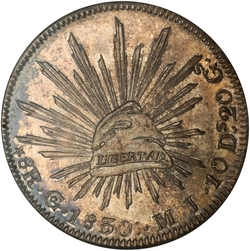
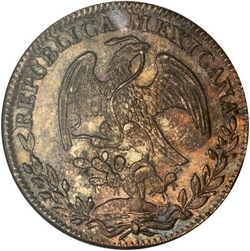
KM-377.8 8r 1830 Go MJ (Ponterio Chicago ANA auction, 13 August 2011, lot 20547)
Full "J", die style of 1830-43.
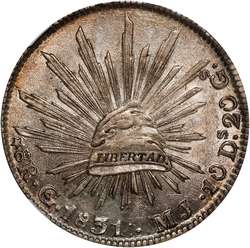
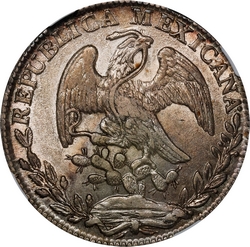
KM-377.8 8r 1831 Go MJ (Stack’s Bowers auction, 31 October 2023, lot 70433)
Three periods after date / Full "J" variety.
These changes took place on 1830-dated coins, the 'improved' version evidently representing the first shipment of Birmingham dies. The new dies displayed one additional point of difference. Original Mexican dies had featured a single dot after the date, separating it from the assayers' initials. Writing at the beginning of 1831, Lonsdale complained that the six pairs of 1831- dated dies sent out the previous July bore three dots in that position
He requested Boulton, Watt to remove the two extra ones on dies prepared in future.{footnote}George B. Lonsdale to Boulton, Watt & Company, 8 January 1831{/footnote} In this instance, his plea for consistency between the new and the old was ignored, and the spare stops remained on pesos struck by the Guanajuato mint through 1843. Lonsdale had greater success with another denomination. Boulton, Watt had initially prepared dies for the four real piece with the same superfluous dots in the same position, but an irate letter persuaded the firm to abandon them.{footnote}George B. Lonsdale to Matthew Robinson Boulton, 12 September 1834{/footnote} They never appeared on smaller silver coins, even in the pattern stage. Nor are they found on gold.
Pradeau speculated that the triangle formed by the three dots might have been intended as a secret reference to Freemasonry.{footnote}Pradeau. Ill, 116-17{/footnote} It is certainly true that the Masonic movement had many adherents among the educated minority of the day — indeed, some of the earliest political battles in the new nation had been fought between conservative escoseses (Scottish Rite Masons) and liberal yorkinos (York Rite Masons), the former supported by the British minister H. G. Ward, the latter by his American counterpart, Joel R. Poinsett. But it is also possible that the triangle formed by the dots was intended as a privy mark to indicate the origin of the dies. It also appeared on pesos from the Chihuahua mint, at a time when Boulton, Watt was making dies for that facility as well as for Guanajuato.{footnote}John Potts to Boulton, Watt & Company, 30 May 1848{/footnote} While Pradeau recorded such extra dots on issues from San Luis Potosí and Guadalajara,{footnote}Pradeau, III, 117{/footnote} he provided no illustrations. For now, the meaning (if any) of the three dots cannot be deciphered; but their employment as a secret mark by Soho cannot be discounted.
For gold, there was little obvious change in dies until the end of the 1830s. An examination of an 1830 doubloon, struck from Mexican dies, with an 1832 coin of the same denomination, manufactured from dies provided by Boulton, Watt & Company, shows only minor differences in the eagle, the position of the pole of the Liberty cap, in the mint mark, and in the figures of the date. The greatest variation between the two coins lies in the use of long denticles in 1830 and shorter ones in 1832, parallelling a phenomenon already seen on pieces of eight of the same period.
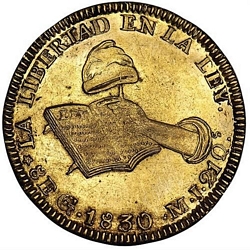
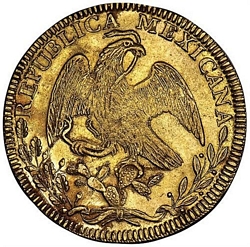
KM-383.7 8E 1830 Go MJ (Stack’s Bowers auction, 11 January 2010, lot 1237)
There is a hint of repunching on the 3 which connects the lower loop to the center, and this may have been confused with a 2 in the past, but no trace of the base of the 2 is seen and repunching seems a more likely candidate than an overdate. Struck medal turn
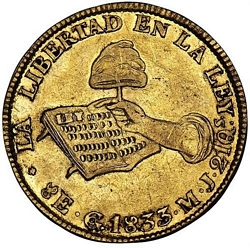
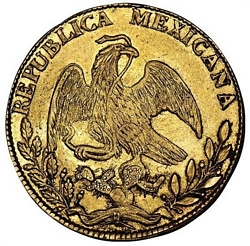
KM-383.7 8E 1833 Go MJ (Stack’s Bowers auction, 11 January 2010, lot 1238)
For minor coinage, the changes were more obvious. The lament of Edward Hurry had some substance: the quality of engraving for subsidiary coins was wretched, as a photograph of two one real pieces attests.
As has been noted, dies for minor coinage were sent to Guanajuato in February 1835; unlike those for the eight real piece, they displayed obvious differences in style from their Mexican predecessors. Obverses featured a more naturalistic eagle of a markedly improved style. Reverses depicted a Liberty cap of an almost perfectly triangular shape, surrounded by thin, carefully executed rays. The differences between old and new, Mexican and British, are well suggested by two medios, half real pieces, one struck in 1833, the other in 1841.
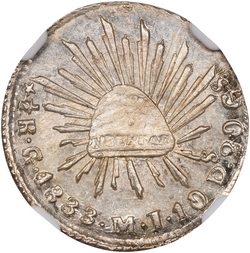
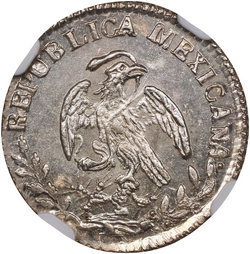
KM-370.7 ½r 1833 Go MJ (Stack’s Bowers Kirk Menczer Collection, 23 June 2026, lot 72139)
Round Top "3" variety.
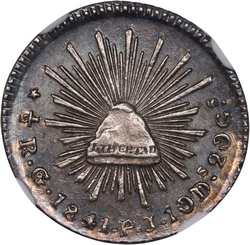
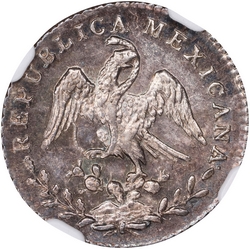
KM-370.7 ½r 1841 Go PJ (Stack’s Bowers Kirk Menczer Collection, 23 June 2026, lot 72142)
Gold would eventually receive a similar treatment. The records at Soho become fragmentary at this point, but John Potts, who served with the Guanajuato mint in the late 1830s, sent a report to the Anglo-Mexican Mint Association on 20 July 1838, which was duly passed on to Matthew Robinson Boulton. Potts observed that 'our gold Dies are very bad'. Could a few doubloon dies be created and sent out to Mexico along with the next shipment of eight real dies? If so, the doubloon dies ought to be sent in a soft state, with blank spaces left for the assayers' initials and for the final two digits of the date.{footnote}'Extract [of] Mr Potts's report 20th July 1838.' From a marginal note on the first page, it appears that Potts's views were sent to Soho with a covering letter on 26 October 1838{/footnote} Soho records indicate that six pairs of dies of this description were prepared in the early part of November.{footnote}BRL, Mint Book. Mint and Coinage Day Book, 1834-1849, p. 56 (entry for 10 November 1838).{/footnote} But a major reform appears to have been envisaged. Soho was soon busy preparing original dies for three other gold denominations. They are not named in the archives, but they must certainly correspond to the four, two, and one escudo size, as the half escudo was not struck at Guanajuato until 1845. An artist named Shinff was engaged to engrave the masters, and he was instructed to copy the smaller engravings 'from his own larger one' rather than from earlier Mexican coins, 'which seem to be but rude productions'.{footnote}Matthew Robinson Boulton to J. Westley, 25 October 1838{/footnote} The Association was eventually charged a total of £31 for preparation of punches and dies for the three denominations which had been redesigned. {footnote}BRL, Mint Book, Mint and Coinage Day Book, 1834-1849, pp. 57, 59 (notations for 24 November and 31 December 1838).{/footnote}
There is a hint here that the eight escudo coin had been reworked, its design changes corresponding with those adopted for the lower denominations. But such dies were not immediately placed into service. The doubloons of 1839 were created from masters of 1831, and it is not until 1840 that the new masters were put into use. The dies they created are distinguished by the realistic eagle already seen on minor silver coinage, as well as by a modest improvement in the reverse design (pi. 1, no. 8, pi. 2, no. 9).
Thus amended, dies continued to travel from Birmingham to Guanajuato through the 1830s and into the 1840s. The turn of the decade necessitated extra work for Soho on at least one occasion: for 30 November 1840, we have a record of a charge of £17. 5s. 'for 30 new dollar dies altered from 183 to 184' (a cost of IIs. 6d. per die).{footnote}BRL, Mint Book, Mint and Coinage Day Book, 1834-1849, p. 80 (emphasis in original).{/footnote} And we have one of the coins, by way of evidence.
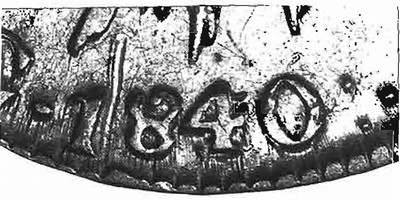
It was one matter to create dies for a mint in the interior of a backward country. It was quite another to get them there safely. Throughout the dealings between the Guanajuato mint and the Anglo-Mexican Mint Association on the one hand, and Boulton, Watt & Company on the other, there was a climate of fear, an element of risk. The viewpoint of the Mexican government concerning dies used for coining was indicated earlier; briefly recapitulated, they were to be created from officially provided matrices, or they would risk confiscation. Assuming that one believed the risk worthwhile, what was the best way of getting dies into the country without penalty?
There were two possibilities, mutually complementary. One could rely upon an absolute conformity with the native product. Soho came fairly close to achieving this goal with the large silver, which constituted the bulk of its die production. The piece of eight enjoyed a wide circulation in Mexico, and it was regularly exported to the Far East as well: dies for this coin had to closely resemble Mexican dies. But no such effort was expended on subsidiary coins, which never entered the export trade and which, due to their lower value, were less likely to draw attention to themselves. Gold adhered faithfully to official models for the first ten years, then, somewhat inexplicably, it was also allowed to differ from the products of other mints, and from the earlier products of the Guanajuato mint. But gold would have formed a very small percentage of the coinage in national circulation; nor did it commonly enter the channels of the oriental trade.
Another possibility for avoiding detection was to smuggle dies past the ever-vigilant customs officials at Veracruz. The Birmingham Archives contain two references to this activity, both from late 1838.
The longer of the two is found in John Potts's 'Report', cited above. Referring to dies for eight real pieces, Potts somewhat breathlessly observed that 'especial care must be taken that they be packed in such a manner, as to avoid detection in the Custom Houses; or they will be seized'. He then went on to suggest a way of doing so. Take iron tubing, of the size of the base of an eight real die, put the dies in the tubing, and, to keep them from rattling (and also to give the tubing the weight of a solid iron cylinder, which is how it was being disguised), put granulated lead pellets and mutton suet in the tubing. The lead and the suet would both be useful at the mint, the lead for assaying and the suet for die preservation. The tubing should be sealed off on either end with flanges ('well adapted by a turning lathe'), sprung into place by heat. What you would obtain would be something which would look like a pillar for machinery, 'which I think will completely avoide suspicion'. {footnote}'Extract [of] Mr Potts's report 20th July 1838.'{/footnote}
Shorter and more oblique, the second reference came from the current Chairman of the Anglo-Mexican Mint Association, John Schneider. In regard to a shipment of eight dies about to leave Birmingham, Schneider advises that 'the Tubes prepared for the Dies' should be called 'Iron rollers for mint purposes'{footnote}John Schneider to Matthew Robinson Bouiton, 2 November 1838{/footnote}, which suggests that Potts's idea would be tried on at least one occasion.
If the British felt they could get the better of the Mexicans, the latter had other ideas. The Memoria of 1849 relates that 'por los anos de 30 o 31' (around 1830 or 1831) dies were prepared in London, using matrices which had been provided to the Guanajuato mint by the central facility in Mexico City. The Anglo-Mexican Mint Association had dies done in England either for reasons of cost or in the belief that better quality would be obtained there than in Mexico. Whatever the reasons, the dies were duly shipped to Veracruz, disguised as machinery. Fortunately, an alert official named Joaquin Lebrija, who was serving as Administrator of Customs at the time, sensed illegality in the making, gathered the suspect crates together, and dispatched them to the proper authorities. Despite this success, the Memoria sadly concluded that, after repeated remonstrances, the Guanajuato mint had never produced dies in conformity with the masters which had been sent to it.{footnote}Mexico. Memoria, p. 35{/footnote}
By the late 1830s, the risks inherent in the importation of dies from Great Britain was leading the Guanajuato coiners in a logical, new direction. While they would continue to get some of their dies from England, they would make others in Mexico. As they did so, they would share in a phenomenon seen in countless other episodes of the Industrial Revolution: attempting to make use of a new technology, they would actually improve upon it.
The new ways centred on dies for pieces of eight, always in heavy use at a Mexican mint. Potts's 'Report' of July 1838 advised that the local stock of lower or cap dies was nearly exhausted, 'but we have taken the precaution to make punches from them, the Eagle [upper or obverse] die also, so as to enable us to make dies from them ourselves when required'. They had made trial dies from the makeshift puncheons; these dies worked 'as well as any that we have from England'. In one respect, the Mexican-made dies were better than those the British sent over in the early 1830s. The latter had been provided with sharp, right-angle edges, because they had originally been intended for use with a collar. (This was due to the fact that, as originally conceived, the Guanajuato mint would receive steam presses from Boulton, Watt. In the firm's technology, steam coining presses were always used in conjunction with restraining collars. The collars made little sense in connection with the hand-powered presses which actually struck Guanajuato's money, although collars, and the layers-on which worked with them, were exported to the mint all the same.) Under Mexican conditions, the sharp-angled dies tended to break at the corners. The new, locally made dies recognized this defect in the British ones, and they were therefore 'left broader, and the corners rounded by which that defect is remedied'. {footnote}Extract [of] Mr Potts' report 20th July 1838{/footnote}
The constant worry over clashes with authorities may have been responsible for another chapter in the story of the Guanajuato mint: after 1842, it made a determined effort to bring its product into full conformity with the rest of the national coinage.
As archival material is essentially lacking, we must depend on the coins themselves to clearly see our way at this point. We are considering two phenomena, a shift from 'English' dies to 'Mexican' ones, and a change in die axis from medallic (faces aligned at twelve o'clock) to monetary (faces aligned at six o'clock). Changes in the one always occur at the same time as changes in the other.
For the half real, these take place in 1842. For the real, coins are lacking in either the American Numismatic Society or the Smithsonian Institution to make a precise determination as to time; but things have definitely taken place by 1846. The two real coin is struck by dies of the English type through 1842; in the following year, dies of the Mexican type succeed them, and the six o'clock die axis replaces the twelve o'clock (pi. 2, nos 12 and 13). Both dies and die axes for the four real coins change in 1843.
For the heart of the Mexican monetary system, the piece of eight, 'English' dies and medallic axes were used through 1843. There were minor die changes in 1844 (most notably, the removal of the extra dots after the date), and the die axis assumed a six o'clock orientation at the same time.
Being rarer than the silver, gold coinage is more difficult to document. But the most important gold denomination, the doubloon, was struck from both 'English' and 'Mexican' dies in 1843, and both die axes are represented on coins from that year. Predictably, the axis on coins from 'English' dies is always set at twelve o'clock, while that on money struck from 'Mexican' dies is consistently at six.
All of this should not lead us to conclude that Guanajuato was preparing all of its own dies (and using matrices from Mexico City to do so) after 1842. Small orders for dies from Birmingham are recorded for 1843,{footnote}BRL, Mint and Coinage Day Book, 1834-1849, p. 95 (notations for 8 and 31 July 1843).{/footnote} much larger ones for 1848. One of the latter involved 205 four real dies,{footnote}BRL, Mint and Coinage Day Book, 1834-1849, p. 113 (notation for 20 April 1848; the orders refers to 'Half Dollar Dies').{/footnote} the other 300 eight real dies; {footnote}BRL, Mint and Coinage Day Book, 1834-1849, (entry of 30 May 1848).{/footnote} but strict conformity was now the rule, and coins struck for the 1848 British dies cannot be distinguished from those of the same date struck from Mexican ones.
We may see the design changes of 1842-3 as a local response to a national call for numismatic consistency. We can, perhaps, account for the change in die axis in the same fashion. In the first few years after Independence, Mexico's coins had retained the twelve o'clock orientation used for issues of the Spanish colony. But the central mint at Mexico City broke away from the past at the beginning of 1827, adopting the six o'clock axis. And other mints followed suit, particularly in the 1840s. Zacatecas abandoned the old way for the new in mid-1842, at almost the same instant as Guanajuato. The process would take many years to complete, but I think we are safe in assuming that, in addition to ordering mints to prepare their dies in a consistent fashion, inspired by a single source, the Mexican federal government was now requesting that they orient them in a consistent position in the coining press. The object would be a decrease in the incidence of counterfeiting.
The changes of 1842-3 may also be connected to local disputes within the state of Guanajuato. The Anglo-Mexican Mint Association had not made itself popular there, and, as its concession was coming up for renewal early in 1842, the Junta Departmental, the governing body of the area, sent a communication to the central government on 28 January, asking that the concession be abrogated.{footnote}Mexico, Memoria, p. 34.{/footnote} In such an atmosphere, the mint's personnel may have felt more inclined to fall in with a general pattern now being encouraged.
The drive for consistency did not affect purely state coinage, and the mints struck cuartillas and octavos (quarter and eighth real pieces) for local consumption on a fairly regular basis. Guanajuato did so between 1828 and 1830, would do so again in 1856 and 1857. The issues of the first series featured a fairly striking design, whose effectiveness was partially lost due to the primitive conditions under which the coins were manufactured. Their metallic composition varied from something approaching pure copper to something resembling brass. In Edward Hurry's opinion, the coins were made of an alloy in an effort to make them impossible to counterfeit. But the benefit was lost because of the inconsistency of the alloy put in use; it would be wiser, he thought, to increase security by improving the engraving and the way in which the coins were manufactured {footnote}Edward Hurry's remarks were included in a letter of 26 December 1831 from George B. Lonsdale to Matthew Robinson Boulton {/footnote} (pi. 2, no. 14).
Inevitably, this would involve Boulton, Watt & Company. Lonsdale sent two of the Guanajuato state coins to Soho on 13 December 1831. The Board of Directors of the Anglo-Mexican Mint Association would be pleased to learn how much it would cost to produce similar but better coins, 'for the purpose of being sent out as a sample'; further, at what rate could Boulton, Watt 'supply such coins in a considerable quantity'? Lonsdale observed that the quality of copper to be used for the projected issue would be the same as that employed for British coinage, but a lower standard was permissible if it would answer the purpose. {footnote}George B. Lonsdale to Boulton, Watt and Company, 13 December 1831.{/footnote}
Matthew Robinson Boulton replied in an affirmative manner, and his firm was authorized to prepare original dies for the cuartilla and strike a dozen specimens from them. It was in this letter that Edward Hurry's observations were included for Soho's guidance. Hurry believed that 'the engraver may indulge his talent as to ornament and difficulty of imitation, [as] it is only necessary to preserve the words and the main figures, for which he may perhaps select a more delicate attitude'. He added that, as the Mexicans seemed to like their coins in various colours, 'it might not . . . be amiss to meet their prejudices': Boulton, Watt should send out specimens in several alloys, so that the authorities in Guanajuato might choose between them and copper for their coinage.{footnote}George B. Lonsdale to Matthew Robinson Boulton, 26 December 1831{/footnote}
Boulton sent three casts of possible designs to Lonsdale on 27 December. The latter's reply, dated the twenty-ninth, is most revealing. Whatever Mr Hurry might think about changing the designs of the coins, the Association was 'apprehensive that any material deviation in the design, would be rejected by the authorities in Mexico'. Lonsdale accordingly requested that Boulton return the two Guanajuato state coins, so that they could be shown to the Mexican minister in London ('or to some other person who may be familiarly acquainted with the coin of the Country & whose opinion may be of value') - an obvious attempt to shift responsibility for the project to someone else.{footnote}George B. Lonsdale to Matthew Robinson Boulton, 29 December 1831{/footnote}
The Mexican minister was duly approached, but he shifted responsibility as well, explaining that, as he represented the entire nation, and as the coin under discussion was exclusively for circulation within a state, he could not give the information required. Lonsdale told the diplomat that the seated figure represented Peace, 'on account of the sprig held in her left hand, which appears more like an olive branch than anything else'. The diplomat replied that the figure might equally be intended to represent Liberty. An impasse ensued, and the Association would therefore have to take the risk, have Boulton, Watt make the dies, strike the patterns, and hope that they were approved once they reached Guanajuato. A 'facsimile' must be engraved, 'as near as possible to the original, due allowance being made for superior workmanship and a perfect figure as far as the imagination can make it out'. The casts and the coins would be returned to Soho-so that the work could proceed.{footnote}George B. Lonsdale to Matthew Robinson Boulton, 4 January 1832.{/footnote}
The work did proceed. On 24 January 1832, Lonsdale acknowledged receipt of two specimen cuartillas from Boulton, Watt. The Association's Board of Directors judged them adequate; could a dozen or so trials be delivered to London by 14 February, for shipment on the next packet?{footnote}George B. Lonsdale to Matthew Robinson Boulton, 24 January 1832.{/footnote}
As it happened, they could not, and Boulton quickly wrote Lonsdale to tell him so. The latter urged him to do his best: the packet was set to leave Falmouth on the eighteenth, and by sending the trial strikes directly from Soho, they might still arrive there in time to intercept the ship.{footnote}George B. Lonsdale to Matthew Robinson Boulton, 27 January 1832{/footnote} The reason for Lonsdale's insistence on speed is not preserved in the archives, but the Association might have reasonably concluded that, considering the speculative nature of the venture, it would be wisest to provide the Guanajuato authorities with an accomplished fact as quickly as possible. Lonsdale was writing in a similar vein a fortnight later.{footnote}George B. Lonsdale to Matthew Robinson Boulton. 10 February 1832{/footnote} He eventually did receive the specimens, but not, it appears, in time for the all-important Mexican packet.{footnote}George B. Lonsdale to John Robinson, 6 March 1832{/footnote} And the project never went beyond the pattern stage. But the prototypes themselves still exist. They are masterpieces of the art of the engraver, and one rather wishes they had seen service in Mexico. They were struck in a collar, and, as Boulton had apparently insisted,{footnote}George B. Lonsdale to Matthew Robinson Boulton, 4 January 1832{/footnote} they were struck in copper. They bore the date 1828, perhaps Boulton's way of making a dramatic comparison between his product and the miserable Guanajuato coin of the same date.
They may have links to a final coin, a pattern cuartilla of 1836. Buttrey and Hubbard tentatively assign this piece to Guanajuato, either struck at that facility or for it, but add that 'the origin of the pattern is unknown'.{footnote}Theodore V. Buttrey, Jr. and Clyde Hubbard, A Guide Book of Mexican Coins, 3rd ed. (Racine, Wisconsin: Western Publishing Company. Inc., 1977), p. 222{/footnote} One might note, however, that the reverse is a close copy of the reverse used for the 1828-dated pattern, while the obverse eagle bears a close resemblance to the eagle employed for subsidiary silver and gold coinage dies made in England for the Guanajuato mint.
But it does not necessarily follow that the new patterns were intended for production at Guanajuato. That they were made at Soho is, I think, more than likely. There appears to be nothing in surviving correspondence concerning them, but there is a notation in one of the Soho Mint Books for a charge of £7. 7s. for the preparation of '1 Original & 3 Moneying dies', intended for 'a Mexn. Copper Coinage'. The entry is dated 31 December 1835.{footnote}BRL, Mint Book. Mint and Coinage Day Book, 1834-1849, p. 25.{/footnote} This notation is not connected with correspondence with the Guanajuato mint at that time concerning a copper coinage. The idea of such a coinage for the state was never mentioned in letters or in Mint Books after 1832. But if the coinage were not intended for Guanajuato, could it be the entering wedge in a campaign by Boulton, Watt to strike copper coinage for Mexico itself? Are we to read the entry literally?
Perhaps we should. There had been a federal copper coinage, struck at the Mexico City mint, since 1829. It had been dramatically lowered in weight during the first year of its emission, after it was found that its copper content equaled or exceeded its face value. But the new coins, whose intrinsic worth was now much below their stated one, were unpopular with the public: they were badly struck on antiquated machinery, and they encouraged counterfeiting. The national government coined them in huge quantities, however, because they represented a real profit to the minting authority. In time, people refused to accept them at face value or, indeed, at all. The government belatedly awoke to the problem, and it finally enacted a law on 17 January 1837, suspending copper coinage at all mints, providing as well for a complicated system of amortization of the millions of coins in private hands.{footnote}Pradeau, I, 354-64.{/footnote}
Here, probably, is where the 1836 cuartilla ought to be introduced into the discussion. While there is no way of telling for certain, my view is that Boulton, Watt & Company is likely to have been advised by those in Guanajuato of the problems with federal coppers, and therefore decided to submit a pattern, carefully made from good copper, artistically designed, and struck in a collar, to the Mexican federal authorities for their consideration. The intention would probably have been to mint any resulting coinage order at Soho, as with the Guanajuato patterns of the early 1830s. Pradeau makes brief mention of a trial for federal copper coinage, whose description agrees precisely with the 1836 pattern illustrated, adding that it was not approved.{footnote}Pradeau, I, 362.{/footnote} Here, I believe, is the answer to the identity and the origins of the copper cuartilla pattern of 1836.
The involvement of Boulton, Watt & Company with the Guanajuato mint had been heavy between 1825 and 1834. There was another burst of activity in 1838, even as the coiners were informing Soho that they now needed less help, that coining skills were passing from the Birmingham firm to themselves. Matthew Robinson Boulton died in 1842, aged seventy-two. His partner would follow him six year later, aged eighty.{footnote}Information kindly supplied by J. D. Warner-Davies, Principal Archivist. City of Birmingham, 6 May 1986{/footnote} The firm entered a decline after Boulton's death, and, upon Watt's demise, it was decided to disband the company and sell its assets. This was done at mid-century. But even at the end, there would still be a connection between the British company and the Mexican mint. An entry in the Soho records for 18 April 1848 makes reference to 500 dies to be sent to Guanajuato (300 for eight real coins, 200 for four real pieces).{footnote}BRL, Matthew Robinson Boulton Notebook (1847-49); no pagination {/footnote} The larger dies are those referred to elsewhere, while the smaller very likely correspond to the order for 205 'Half Dollar Dies' cited above. Preparation of 500 dies would have constituted a large affair even in the heyday of the connection, in the early 1830s. And the firm was filling an order for machine parts as late as 30 April 1849, at a time when the walls were coming down around it.{footnote}BRL, Mint Book. Mint and Coinage Day Book 1834-1849, p. 116{/footnote}
It must have been an unusual time for all concerned, especially for those in Birmingham. So much was drawing to a close, and while machinery could be reemployed (and so could skilled workers), there must have been a sense of loss, a perception of the passing of an era.
But traces of that era remain, and its significance has dimmed but slightly; only we take a meaning from it different from that seen by the men of 1850. Our view shows finely struck coins and profits for the makers of the dies which struck those coins; and so did theirs. But our perception encompasses other things as well, features of a landscape they never saw. We see the workings of an advanced technology, exported to a backward region. We see the myriad concessions and compensations made in tardy recognition of that dichotomy. (A coining machine will not work by steam; redesign it to work by hand. Collars are impractical here; well, then, abandon them and coin as you can.) We also see a change, a shift from a complete reliance on foreign technology to a greater dependence on a local one, and a local technology which is beginning to outdo the imported one. In brief, we are able to perceive that the minor activities of an up-country mint are, in some ways, a paradigm and a symbol of the phases of a much larger entity, the Industrial Revolution. It is this view which was denied to the men of 1850. But we are in their debt, for they were its creators.
In 1969, Ted Buttrey published the first edition of his Guide book of Mexican Coins. In it, he described two copper pattern quarter-reales, or cuartillas, one dated 1828 and the other 1836. He noted many similarities between the two pieces, relating them both to the Guanajuato mint. He was right, but for the wrong reasons.
The two coins formed part of a much larger picture, one occupying the second quarter of the nineteenth century, one whose roots were deeper still, one whose results were seen in Mexico – but whose origins lay in the British Midlands. Both patterns originated in the workshops of the Soho Mint, and how and why they came to be is a fascinating story of idealism and opportunity, misapprehension and greed.
Our story begins in the wake of Mexico’s War for Independence. That conflict had left the country free but bankrupt, exhausted, its infrastructure in shambles. Outside capital was needed if the new nation was to realize the dreams of those who had fought to create it. Mining was of particular importance. New Spain had been known for its wealth in precious metals, especially silver; but the country’s mining industry would require massive amounts of capital and work before production could fully resume, let alone expand.
Just as Mexico and other Latin American countries were seeking outside capital, outside capital, especially British, was seeking new fields for investment. The Spanish El Dorado had been on British radar for centuries; now, at last, Spain had departed, apparently leaving the door to wealth wide open. Britons, and their technical expertise, and especially their money, now clamored to come in.
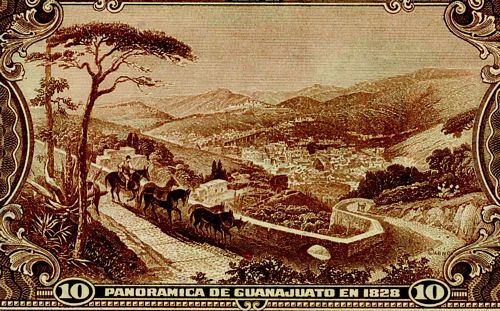
Guanajuato in 1828
As I said, the refurbishing and development of Mexican silver mines attracted great attention, especially those around the north-central town of Guanajuato. The area’s precious metal had long been carried by mule back to Mexico City for coining. The War for Independence made such commerce risky at best and led to the establishment of an emergency branch mint at Guanajuato. This mint remained in business after independence was achieved in 1821, and by the mid-1820s, plans were afoot to refurbish both it and the mines it served. And this is where our story really begins.
All of the main actors in our tale were British. One was the venerable firm called Boulton, Watt & Company, which had been making coining machinery (and a good many other things) for decades. It was located in Soho, a suburb of Birmingham, and was captained by Matthew Robinson Boulton and James Watt, Jr. The other players were two closely-allied London firms, the Anglo Mexican Mining Association and the Anglo Mexican Mint Association. The Mining Association had become deeply involved in the resurrection of Guanajuato’s mines by 1825, and the search for a market for the silver it now hoped to tear from the earth brought the Mint Association into play as well. The silver appeared to be there for the taking, but unless the Guanajuato mint was modernized, provided with cutting-edge machinery on the Boulton, Watt model, it could never hope to process enough silver to make the operation profitable. So the London firms went to work, in two steps. First, they entered into a ten-year contract with the State of Guanajuato, by which they would replace the ramshackle mint with a splendid new one, pay the salaries of all the employees, and, best of all, hand the whole thing over to the local authorities at contract’s end – at no charge.
The Britons were no fools, and they based their generosity on two assumptions. First, the mines were immensely rich. Second, improved, steam-powered machinery would enable them to take so much silver out of the ground (and turn it into so many millions of coins) that it would be impossible not to grow rich from the scheme. If you assumed that there would be a one-time cost of ten thousand pounds to upgrade the mint, the refurbished, more productive facility could make that investment back during its first year, and twenty-six thousand pounds profit besides. And then it would be pure profit for the next nine years. The London group had discovered an enduring law of manufacturing: if you make and distribute enough of anything, it doesn’t particularly matter what you charge for any single unit; volume will take care of you.
Once the contract had been signed, the second step was taken. Boulton, Watt & Company was asked to manufacture the steam engines, rolling mill, coining presses, and the other accoutrements of a thoroughly modern mint. A contract was signed to the tune of nearly nine thousand pounds: work got underway.
And then reality intervened.
To operate a steam-powered mint, you needed three things. You needed water. You needed fuel. And you obviously needed metal to coin. By the summer of 1826, it was becoming apparent that all of these requirements were in somewhat short supply. A senior executive in London had learned that fuel might be scarce, although he neglected to tell anyone about it. Then an employee on the scene in Guanajuato sent back reports that running water was a problem – non-existent during several months of the year. Worst of all, there didn’t seem to be much silver in the region either. Not for the first time, and certainly not for the last, European optimism and greed went eyeball to eyeball with American reality, and blinked first.
There ensued an emotional and financial meltdown. Members of the Mining and Mint Associations turned on each other, then found solutions of sorts. They would ask James Watt, Jr. to take back the two steam engines he had built for them – which he did, and apparently had little trouble selling them to someone else. They would ask Matthew Robinson Boulton to sell the unwanted minting machinery on their behalf – which Boulton attempted to do, with little success, for the next decade and a half. Finally, they’d place an order for a much-reduced, pre-industrial mint for Guanajuato, one more in line with reality. The new, smaller facility was prepared, shipped, and was going into operation by the beginning of the 1830s. And it, at least, proved a success.
I have written several articles and part of a book on the trials and tribulations of the Guanajuato mint; those interested should consult my Soho Mint and the Industrialization of Money (1998) and ’A Mint for Mexico’: Boulton, Watt and the Guanajuato Mint (1986). Here, I wish to focus on one area – the production of dies for coinage. As you’ll see, it has a direct relationship with the two pattern cuartillas with which we began.
By law, all dies for Mexican coinage had to be prepared at the central mint in Mexico City and shipped to the various branches. This involved great risk and inconvenience. What if crooks intercepted a die shipment? What if crucial dies weren’t available at the time and place where they were needed? These considerations led the British coiners at Guanajuato to a crucial decision, and an illegal request: could Boulton, Watt & Company make dies for a Mexican coinage and then send them to Guanajuato? The firm could – and did, for well over a decade. But the dies were officially contraband, and much agonizing ensued on both sides of the Atlantic over how best to send dies from Point A to Point B, especially when they risked scrutiny by eagle-eyed customs inspectors at point C – the port of Veracruz, through which virtually all European imports passed. The situation wasn’t helped by demands that the British dies be identical with Mexican ones in all respects, and yet somehow superior to them as well – remnants of the desire for industrial excellence that had helped tempt the Londoners into the minting business in the first place. Matthew Robinson Boulton and those who worked for him at the Soho Mint racked their brains, did their best – and came up with various attempts to square the circle. Their products were handsome – and there’s just enough variation so that we can discern between them and the objects they were intended to represent, and to replace.
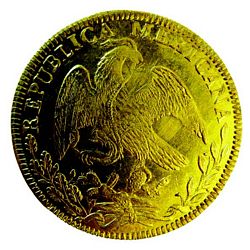
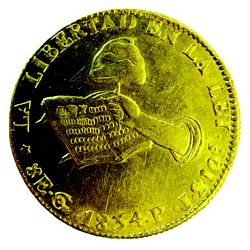
1834 8 Escudos Mexican Dies
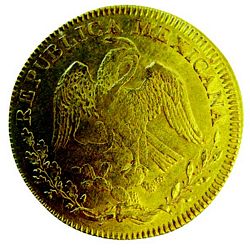
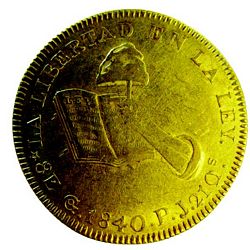
1840 8 Escudos British Dies
The greatest attention was paid to, and the least variation allowed in, dies for the peso, or eight-real silver coin. There was good reason for this concern: this denomination was the workhorse of the Mexican economic system, and any major departures from the norm would be quickly spotted. So an 1832 peso struck from British dies retains most of the characteristics of an 1830 coin, struck from Mexican ones, the only major difference being the more prominent beaded borders on the 1830 coin. Somewhat greater variation was allowed for dies intended for gold coins and for minor silver ones, perhaps in the belief that these denominations would encounter less scrutiny. For minor silver, the gorro frigio (Phrygian cap) on the reverse acquires an almost triangular configuration; but the most obvious difference between these minor silver coins and their earlier counterparts is the obverse eagle. As with the gold, the bird is no longer a caricature but a realistic image, the product of a gifted Soho artist named John Sherriff.
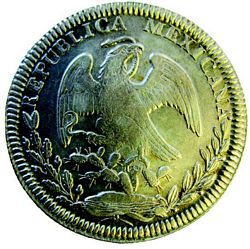
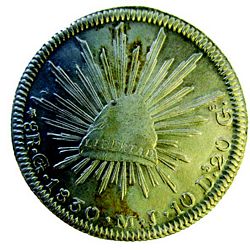
1830 8 Reales Mexican Dies
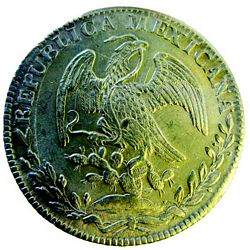
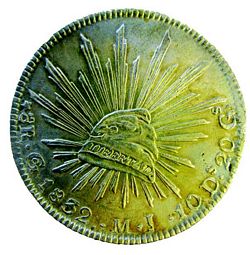
1832 8 Reales British Dies
These coins are hybrids, created by a Mexican mint from British dies. But from this point of departure, attention and speculation rather naturally turned in a new direction. Instead of striking coins from British dies in Mexico, why not strike them from British dies in Britain? Here is where the two pattern cuartillas enter our story, and that of Mexican numismatics.
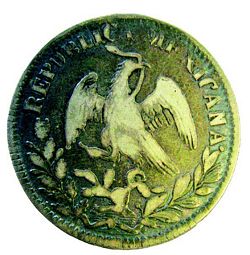
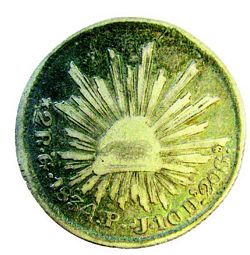
1834 2 Reales Mexican Dies
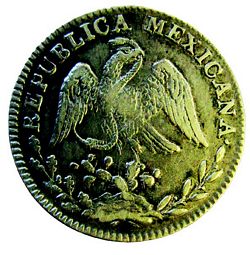
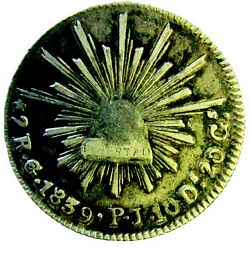
1839 2 Reales British Dies
Mexican coinage followed rules laid down in the country’s basic law, the Constitution of 1824. That document proclaimed a federal republic, with much sovereignty reserved to the constituent states. Since the making of coinage has always been recognized as a mark of identity and power, Mexico would have two types of coinage rather than one. The central government (through the Mexico City mint and its branches) would take care of the country’s needs for a national coinage of silver and gold, whose designs would adhere to tenets laid down in a decree of 1 August 1823 (among other things, this decree stipulated that the eagle and serpent would graces the obverses of Mexican coins, and they still do). But the federal government left most base-metal coinage up to the states. They could choose their own designs, their own metals, and to a degree their own denominations. Between the mid-1820s and the early 1870s, no fewer than eight states struck their own coins, denominated at a quarter, an eighth, and in one case a sixteenth of a real: Chihuahua, Durango, Jalisco, Occidente/Sinaloa, San Luis Potosí, Sonora, Zacatecas – and Guanajuato.
In Guanajuato as elsewhere, the reach of the local coiners exceeded their grasp. Had they been well-struck, the state’s products would have been impressive, with a seated figure emblematic of Guanajuato on the obverse, a Liberty cap in a circle of radiant light on the reverse. But they were not well-struck, and matters were made worse by a cheerful lack of quality control over the metal from which they were made. The composition of Guanajuato’s cuartillas and octavos (eighths) varied from something approaching pure copper to something resembling brass: all in all, this coinage offered a tempting target for local forgers.
A senior executive with the Anglo Mexican Mint Association named George B. Lonsdale believed the designs deserved better treatment. Late in 1831, he asked Boulton, Watt & Company for help. Could the firm replicate the designs on a new state coinage, struck in collar by steam and exported to Mexico? Matthew Robinson Boulton was interested: at the time, his Soho Mint was running at half-speed, its activities limited to creating the latest bunch of planchets for United States copper coinage and striking tokens for Singapore. Neither project was overwhelming, so Boulton instructed his designers to create a perfect version of the imperfect Guanajuato model.
By the turn of the year, Lonsdale and his associates were having second thoughts. They worried that the new coins would invite detection because they would be too perfect. Their fears were justified, as a comparison between a Guanajuato original and a Boulton pattern suggests. The patterns (struck in January 1832 but dated 1828, inviting comparison with the originals) were simply head and shoulders above the Guanajuato strikes, ranking among the most beautiful products that the Soho Mint ever struck. But would they ever see circulation in Mexico? As it happened, they would not.
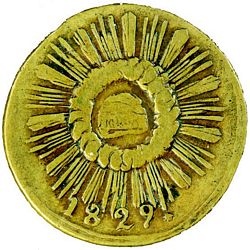
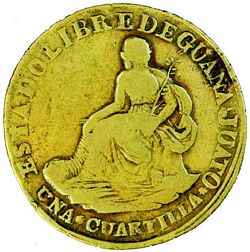
1829 Cuartilla Mexican Dies
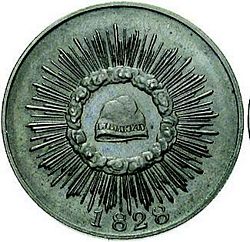
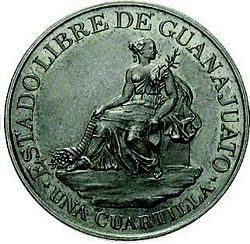
1828 Cuartilla Pattern British Dies
Fretting over the possible risks in carrying the project forward, Lonsdale attempted to shift responsibility for it onto another’s shoulders. The Mexican minister in London was duly approached for his blessings – but he neatly shifted responsibility back to Lonsdale, explaining that, as he represented the entire nation rather than a single state, he lacked the authority to render an opinion. Still dithering but hoping for the best, Lonsdale instructed Boulton, Watt & Company to go on with the project; accordingly, the firm struck a couple of specimens and sent them to the Mint Association’s London office. The specimens were approved, and Lonsdale asked that another dozen or so trials be quickly struck off and sent to London for shipment on the next packet bound for Veracruz. His request for celerity was apparently founded on the realization that the entire venture was deeply speculative, and that it would therefore be wise to present the people in Guanajuato with a fait accompli as quickly as possible. Boulton, Watt & Company were unable to comply (speed was never one of the firm’s strong points). Lonsdale indeed received his patterns, but not in time for the packet. So the opportunity was missed, and these magnificent patterns are all that remain from one of Mexican numismatics’ greatest mights-have-been.
The cuartilla pattern dated 1828 is related to another, dated 1836. This is the other piece that Dr. Buttrey tentatively ascribed to Guanajuato – and it’s easy to see why. Except for the date, the reverses of the two patterns are essentially identical. But the second piece was created for a different, and altogether more ambitious, purpose.
While the individual states enjoyed the right to coin copper money, so did the federal government. The central mint at Mexico City began doing so in 1829 – planning to strike base-metal pieces worth a quarter, an eighth, and a sixteenth of a real. Production of federal cuartillas got under way that spring, but the new coins were so heavy that they tended to break the antiquated presses, and it cost nearly as much to make them as they were worth. Even with a reduction in size that summer, the cuartillas (and their smaller brethren, whose production got under way the following year) proved a major disappointment for the central mint and a major annoyance for the people who were forced to use them. The coins were poorly struck and were almost immediately counterfeited on a massive scale. So great did the problem with false federal – and state – coinages become that the national government finally suspended all base-metal issues, including its own, on 17 January 1837. And it is at this point that the pattern cuartilla dated 1836 enters the picture.
Struck in collar, the pattern is unquestionably a product of the Soho Mint. I’ve noted the similarity between its reverse and that of the Guanajuato trial. Now look at the obverse: we’ve seen that eagle before, on dies prepared for Guanajuato. This piece came about in the following way.
By the mid-1830s, opposition to the crude federal copper coinage had reached serious proportions. Someone at the Guanajuato mint must have written home to Lonsdale mentioning the situation. By a letter of 16 December 1835, Lonsdale passed the information on to Matthew Robinson Boulton, advising him that another opportunity to create a copper coinage for Mexico had just opened up.
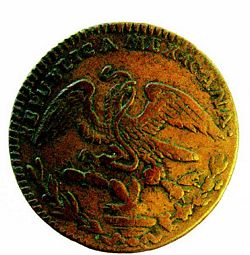
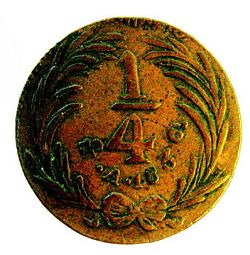
Mexican Republic 1836 Quarter Real
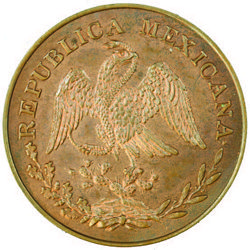
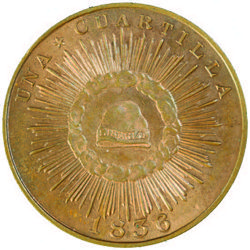
Soho Mint 1836 Pattern Quarter Real
The copper cuartilla pattern of 1836 was the result. Work on it began around Christmas 1835. The designer, almost certainly John Sherriff once again, changed the date on the reverse die to match that of the upcoming year, combined it with one of his eagles – and Lonsdale was sent three dozen of the new patterns on 12 January 1836.
They fared no better than the earlier ones for Guanajuato. But both sets of coins bear witness to a fascinating and distant time, when the world seemed new and anything seemed possible. They are, in fact, witnesses to an alternate reality.
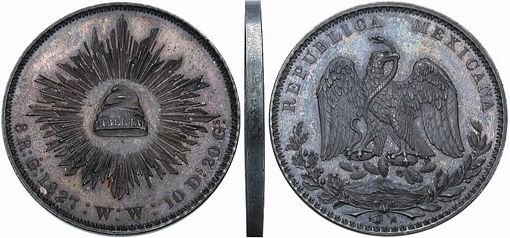 1827 Guanajuato Pattern 8 Reales
(image courtesy of Richard Ponterio)
Among the most classic designs of all Mexican 8 Reales patterns are those designed at the Royal Mint by the famous English engraver William Wyon. The story of these coins is an interesting saga that spans nearly six decades and involves three different mints, Guanajuato, Alamos and Hermosillo. Our story begins with the mint of Guanajuato which began operations during the War of Independence as a provisional mint equipped with less than standard machinery. The production of coinage from this facility was sub standard in comparison to well-equipped mints such as Mexico City.
Shortly after Mexico gained its independence, the mint of Guanajuato was leased to the Anglo Mexican Mint Association. This British firm was closely related to the Anglo Mexican Mining Association, which began serious mining operations in the region in the 1820s. They acquired the mint as a means of refining and minting silver from their mining operations in the region. It became immediately apparent to the Anglo Mexican Mint Association that the facilities in Guanajuato were in dire need of modernization. It is important to note that both the mint and the mining operations in this region were controlled by English firms. For this reason, the natural choice for purchasing minting machinery was through Matthew Boulton and the Soho Mint.
The Anglo Mexican Mint Association took control of the Guanajuato mint in June of 1825. By August of that year negotiations had already begun to acquire new equipment from England. On 18 August a request was made for the estimated costs of a package consisting of four coining presses, eight punch presses for making planchets, a die multiplying press, as well as various other items necessary for the minting of coinage. Although state-of-the-art-steam powered coining presses were available at the time, specific requests were made for presses that could be adapted to either steam or horsepower since the scarcity of fuel (namely coal) in Guanajuato, made the operation of a steam press impractical. It is important to note that the original request for machinery did not include or mention coining des or hubs (this request came later).
Inevitably, the original request for machinery proved too ambitious for the Anglo Mexican Mint Association and a more modest order was placed. The second request was put together consisting of two coining presses, three punch presses for making planchets, one milling machine and a die multiplying press. All of the new equipment was to be operated by hand rather than with steam power. The request was granted and machinery was shipped to Guanajuato in October of 1827. The dies and pattern coinage are another story.
On 4 March 1826, an official from the Anglo Mexican Mint Association made an inquiry with the Soho mint regarding the purchase of master punches for the purpose of producing dies for the Guanajuato mint. In doing so, the Anglo Mexican Mint Association as well as the Soho mint crossed the line of legality. In accordance with Mexican law, all tools used in the creation of coining dies were to be directly acquired from the Mexico City mint. During this period, the Mexico City mint would send out master dies to the branch mints where the dies were then made locally. This proved to be an expensive and time consuming process. The Anglo Mexican Mint Association’s solution to this was to have the Soho mint produce dies and hubs. This would save them a great deal of time as well as a tidy sum of money.
The task of engraving the dies was given to William Wyon, one of the most talented and noted engravers ever to work in England. Although the design elements remained the same as those of other Mexican mints, the artistic style of Wyon’s work was dramatically different. The workmanship is nothing short of spectacular for the time with its neatly detailed design done in the neoclassical style for which Wyon was famous. The dies are remarkably well executed, the lettering used in both the obverse and reverse legends are neatly cut and precise. Struck with a medallic die axis; the piece bears a plain edge and has a very sharp upset rim with ornate denticles struck with the care and precision that is more reminiscent of contemporary English medals. They were undoubtedly struck with the state-of-the-art steam powered coining presses available at the Royal Mint in London. In fact, Buttrey{footnote}T.V. Buttrey & Clyde Hubbard, A Guide Book Of Mexican Coins 1822 to Date{/footnote} states that the patterns were struck in London and the coins and dies were then sent to Mexico in 1827.
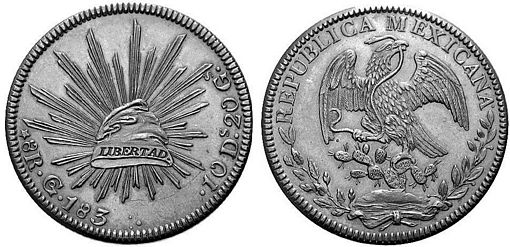 Pattern / trial strike from unfinished Soho mint die’ for the Guanajuato mint.
The second die style ordered by the Anglo Mexican Mint Association
(image courtesy of Richard Ponterio)
This is where the story takes an interesting turn. As previously mentioned, hubs and die making materials were required by law to be acquired directly from the Mexico City mint. As fate would have it, the dies and coins were considered illegal contraband and seized by customs agents at the port of Veracruz while attempting to enter Mexico. Surely the artistic beauty of the dies was one of their condemning factors as they were easily recognizable as not being a product of the Mexico City mint. Although a major setback, this unfortunate set of events did not stop the Anglo Mexican Mint Association from purchasing further dies and hubs from Soho. In 1829 the firm shipped an actual pair of Guanajuato dies to England for the purpose of replication. In the request it was stated that the dies must be virtually identical to the Mexico City product, however of a more refined style and quality. Production of the new dies began 5 January 1830. Coins of this new die style were produced at Guanajuato from 1830 until 1843.
So what became of the original dies and hubs designed by William Wyon that were confiscated in Veracruz? One would speculate that such illegal contraband would have been destroyed after seizure; however this was not the case. In fact, it has long been known that either the dies or hubs later resurfaced in Hermosillo more than half a century later and were used to produce patterns dated 1882. What remained unclear is where were they for the previous 50+ years.
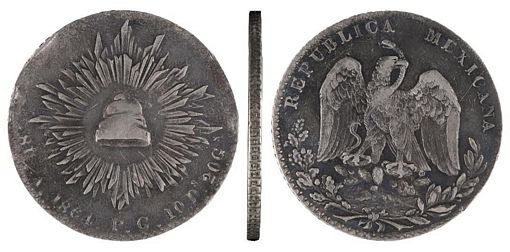 1864 Alamos Pattern 8 Reales of the William Wyon design
The discovery of an Alamos pattern dated 1864 sheds some light on the subject. Totally unpublished in any numismatic reference and believed to be unique, the existence of this pattern only recently came to light. It was brought to us through one of our foreign contacts who acquired it as part of a larger collection in Europe. Clearly it was manufactured using either repurposed dies intended for Guanajuato, or by manufacturing new dies using the original William Wyon hubs. This pattern dated 1864 has a unique claim of being the first 8 Reales pattern of the Alamos mint, as it was produced the very first year of 8 Reales production. Also unique is the fact that it is the only known pattern for this branch mint from any period. The legend has been neatly placed below the cap and ray, having been executed with what appears to be the punches used to produce 2 Reales. The letters PG for Pascual Gaxiola, the assayer at the Alamos mint in 1864, are present after the date. The strike and edge reeding are quite different than the 1827 English made pattern for Guanajuato which as mentioned are plain edge and produced with a stem press. The Alamos piece is more consistent with later Hermosillo pieces showing evidence of screw press manufacturing and the usage of an edge milling machine. Thus, the present coin was unquestionably produced in Mexico rather than England.
The circulated condition of this piece perhaps suggest its use as a pocket piece. It seems unlikely that a coin of such dramatically different style would have remained in circulation long enough to sustain this degree of wear. Being that the coin surfaced in Europe, along with the fact that the mint was contracted to a foreign company leaves one to wonder if this piece belonged to some foreign entrepreneur who held a position at the mint and carried it as a keepsake or memento. This part is best left to the imagination
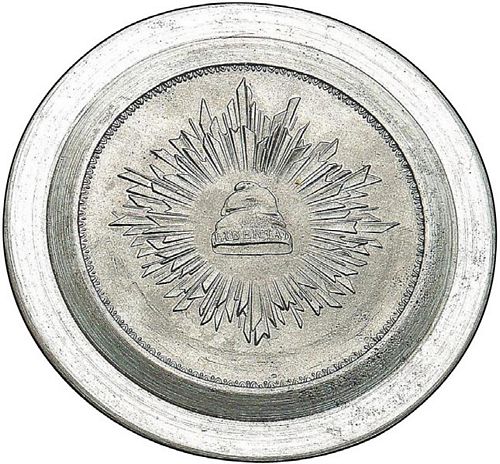 Original William Wyon master hub
Banco de México Collection
 Original William Wyon master hub
Enlargement of defaced legend
Banco de México Collection
Further insight can be gained by examining the original master hub designed by William Wyon (now housed in the Banco de México collection). Clear evidence of intentional defacement is seen from 9 to 3 o’clock to remove the legend intended for Guanajuato. This explains why the piece produced by the Alamos mint and later pieces produced by the Hermosillo mint differ in their legend arrangement and punch size. It is unclear (at least to me) how or when the Banco de México came to be in possession of the Wyon hub. It is plausible that the hub was shipped to Mexico City in the 1890s with other dies and equipment after the Hermosillo mint closed in 1895 and has remained with the Banco de México since that time. What remains unclear is exactly how the hubs which were seized by customs officials in Veracruz made their way some 1,200+ miles to the state of Sonora more than three decades after they were confiscated. Perhaps the most plausible explanation is that somehow during the French intervention the hubs were removed from where they were being stored in Veracruz. The timeline would seem to fit as the French began their bombardment of Veracruz in early 1863, and the hubs were used in Alamos the following year. The pristine condition of the hubs suggests that they may have been still packed in the original white wax used during shipping from England. Certainly they were covered in some substance to prevent oxidation. Regardless, serviceable hubs for coinage manufacture would have been worth a tidy sum of money on the open market.
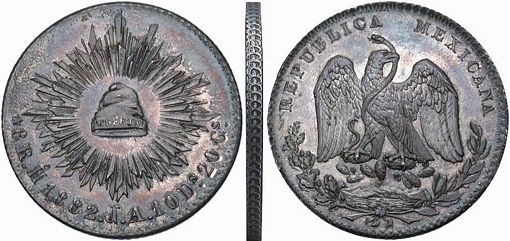 1882 Hermosillo Pattern 8 Reales
(image courtesy of Richard Ponterio)
The 1882 Hermosillo patterns are much like the 1864 Alamos pattern in terms of how they were manufactured. Both were produced with a screw press after the planchets were edged with milling machinery. In fact the edge of the 1882 Hermosillo is identical to regular circulation issue from this year. The legend below the cap and rays was produced with identical punches used on contemporary Hermosillo 8 Reales between 1876 and 1880. The assayer’s initial “J.A.” are consistent with that of Jesus Acosta, the Assayer at the Hermosillo mint from 1877 to 1883.
There are identical defects within the dies, which appear on coins from all three mints. Most noticeable is a small raised dot directly to the left of the liberty cap. This can also be seen on the 1864 Alamos; however, is slightly less noticeable due to the coin being circulated. Exactly how the hubs went from from Alamos to Hermosillo seems a bit easier to comprehend. Both mints are located in Sonora and both were leased either in full or part to Robert R. Symon of the English firm Symon & Cia during the period these coins were produced.
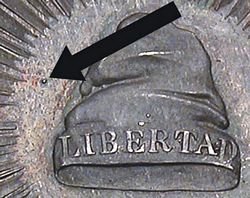
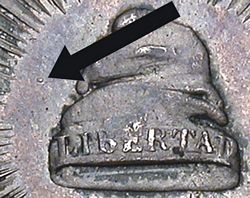
Die defect on 1827 Go Die defect on 1882 Ho
(imagies courtesy of Richard Ponterio)
In the annual report of the Secretary of the Treasury to Congress dated February of 1844, page 28, he says: "The federal government in order to prevent the constant smuggling of gold and silver that was taking place from the States of Sonora and Sinaloa through the seaports of Guaymas and Mazatlán, issued an order whereby the export duty on metals was considerably reduced , but the miners complained of the enormous distance from their mines to the existent mints, the risk involved in transportation and the subsequent delay at the mint, and as no gold or silver was allowed to be exported unless coined, smuggling continued. In order to stop this leakage, the federal government by Presidential Proclamation dated 16 February 1842[text needed], ordered the resumption of the mint at Hermosillo (closed since 1835), and encouraged the state government to promote the establishment of this mint, authorizing the state to levy a forced loan, or to enter into an agreement with private interests or individuals, to bring about the desired results, notifying the federal government about the conclusions reached, for its official endorsement." (Free translation.) This order has reference to the private coining operations of Mr. Santoyo during the years 1832 to 1837, which were carried on in a most primitive manner by means of hand punches (for information, see Pradeau's "Leonardo Santoyo" and Pablo Luna Herrera's "The illegal 8 reales of Hermosillo"). The central government considered this establishment a true mint, but realizing that it might not be an efficient one, authorized the state to negotiate a loan or to enter into an agreement with private parties, whereby an adequately equipped mint could be operated in Hermosillo. However, nothing was done about the re-establishing of the mint in that city until 1851, and the State of Sonora did not coin money in any metal from the year 1837 until the mint was re-opened in Hermosillo in 1851.
The mint in Hermosillo was established in 1851 by Mr. Robert R. Symon and his co-workers, Mr. Sebastian Camacho and Mr. Quintin Douglas. The mint was leased for a period of twenty years beginning in 1851 and ending 1871. All my efforts to obtain a copy of this lease have been futile, but it was my good fortune to discover a piece of information given by Mr. Antonio Peñafiel who found that the mint at Hermosillo began operations in 1852. The existence of such operations was unknown to the treasury department at Mexico City until 1861, as no reports were sent to the federal government previous to that time. This is not strange; at that particular period of Mexican history the states functioned as sovereign and independent units and had the right to legislate and issue their own coinage. It is also not surprising that the records of mintage of both Alamos and Hermosillo are not found in the archives of the State of Sonora , because from 1830 to 1885 the state was in a constant turmoil, having to combat the Apache Indians on the north, the Yaqui Indians on the south, and having besides to put up with constant strife of warring political parties, certain of which burned priceless records in order to escape prosecution. At any rate, the mint of Hermosillo was leased to private individuals until 1871 or 1872 , and neither the state nor the federal government derived any revenue for the first ten years, nor, so far as is known, for the second ten years .
From reports sent to Congress, 28 September 1868, by Mr. Matias Romero, then Secretary of the Treasury, we learn the following:
1. That the State of Sonora entered into a contract with Mr. Robert R. Symon, leasing the mints of Hermosillo and Alamos for a period of twenty years beginning 3 January 1851[text needed].
2. The state guaranteed the lessee that no federal, state, or municipal taxes were to be assessed against the lessee for the first ten years, and only one per cent for the second ten years.
3. The state was to allow the importation free of duty of the machinery, implements, reagents, etc. needed in the erection and to be used in the operation of the proposed mints.
4. The state was to permit the unlimited coinage of gold, silver and copper.
5. The lessee promised to purchase at his own expense the necessary machinery, implements, reagents, etc. for the establishment and the successful operation of a mint at each one of the cities mentioned (Alamos and Hermosillo.)
6. At the termination of the contract the lessee promised to turn over to the state the mint machinery, implements, reagents, etc. which from then on would become state property.
During the French intervention in Mexico (1864-1867) the State of Sonora was in part occupied by the Imperialist forces (chiefly the cities of Hermosillo and Alamos) and as the Imperial Government, with Maximilian at its head, did not approve of the terms formerly agreed upon by the Republican State Government, it became necessary for the lessee to go to Mexico City and make new arrangements with the sub-Secretary of the Imperial Treasury, Don Esteban Villalba. No copy of this document is obtainable. At the expiration of the original lease made by the State of Sonora with Mr. Robert R. Symon, and which I believe ended in 1871, Mr. Symon turned over the mints of Hermosillo and Alamos to the federal government. This act was in compliance with the terms of the original lease, in which it was stipulated that after twenty years the machinery, implements, chemicals, etc. would become the property of the nation. But the federal government, for reasons unknown to me, was unable to operate these mints at a profit, and it showed an operating loss each year . This peculiar circumstance was the chief reason for leasing the mints anew (1876 ) to a company headed by Mr. Symon , as can be seen by the following Presidential Proclamation:
Sebastian Lerdo de Tejada, Constitutional President of the United States of Mexico , to his constituents, be it known:
that by virtue of the prerogative extended by the Law of April 28th, of the present year, the Executive decrees the following:
Article one: The contract of this same date, made by the minister of Finance with the firm Robert R. Symon & Company, leasing to the latter the mints of Hermosillo, Alamos and Culiacan, is hereby approved.
Therefore this order shall be printed, published and circulated to be complied with in due manner.
Given at the National Governmental Palace at the City of Mexico, this twenty -ninth day of August of the year 1876.
Signed -Sebastian Lerdo de Tejada.
Shortly after this contract was made known to the public, the newspapers of Sonora and Sinaloa engaged in a bitter controversy opposing the leasing of the mints to private individuals, claiming that the mining interests of the two states would suffer; also, that the federal treasury would sustain a heavy loss, as the three mints had been leased for a period of three and a half years for only twenty thousand dollars. Foremost among the oppositionists was the newspaper El Occidental edited at Mazatlán, Sinaloa, which in its number of 7 October 1876, had a scorching article criticizing the leasing of the mints to private individuals. This attack was not left unanswered by the men in power, and in the Boletin Oficial of the State of Sonora, published in the city of Ures, then capital of the state, in its edition of 27 October 1876, there appeared the following counter-attack under the heading of "Casas de Moneda" (Mints ):
"The opposition newspaper 'El Occidental' published in Mazatlán, in its number of the 7th instant charges that the federal government has made a grave mistake in leasing the mints of Hermosillo, Alamos, and Culiacan , and that this act will create a hardship to the miners and mining industry.
"We believe that there is no basis to this charge, and we are positive that in leasing the said establishments, the federal government has taken into consideration and consulted the economic side of the problem as well as the public welfare.
"Since the last lease expired the government took over the aforementioned mints and from that time an ever increasing operating expense and loss has been reported in connection with these mints. So the government in leasing them for twenty thousand dollars for a three and a half year period, will not only be saving itself additional expenses and losses, but in reality will be that much money ahead.
"On the other hand, the taxes on the mining industry will continue the same as before; so, where is this terrific blow, that according to the newspaper 'El Occidental' the Mexican miner will receive ?
"Frankly, we are unable to understand the marked opposition of the last few days to every act of the National Executive, creating imaginary wrong doings for which there is no foundation. The object cannot be other than to mislead the unsuspecting public, and to bring about dissension among the gullible, and thus start a war of personalities. In short, this seems to be the motive impelling the press of the opposition which usually is against the legitimate aspirations of the Mexican people ."
The above information was obtained from the archives of the State of Sonora through the courtesy of Mr. Rodolfo Tapia in charge of the "Tesoreria General del Estado " (State Treasury) and of Mr. Ramon E. Corral, clerk in charge of the archives. It was transmitted to the Secretaria de Hacienda y Crédito Público , Departmento de Biblioteca, Archivos y Publicaciones (Treasury Department ) of the Republic, with which the author has been in constant correspondence for a period of over two years. The treasury department in turn transcribed the information given to the Hon. Director of the Mint at Mexico City, and on 2 June 1933, the following response was sent: "In reference to the copy of the contracts asked for, allow us to inform you that they do not exist in this office. It may appear strange that these documents are not to be found in the archives of the government, but from unofficial sources the Director of the Mint has learned that when the government rescinded the contracts in 1893, the lessees were allowed to take the contracts pertaining to each mint" (Free translation). It is hardly credible that the contract entered into for a period of three and a half years and expiring in 1879 or 1880 would have been given back to the lessee in 1893 unless extended in the meantime. However, after two and a half years of effort one must accept this answer as final. Perhaps in a not distant future these documents will come to light, as it is my belief that these documents exist.
Let us at this time engage in an estimate that might give us an idea of the possible profit obtained by the leasing firm. The Hon. Matias Romero, Secretary of the Treasury in 1868 and who published his "Geographical and Statistical Notes on Mexico" while in Washington (1898) has this to say about mints and duties on silver, page 27: "Under the Spanish laws all silver paid a duty; and as most of it was coined, that duty was levied on coinage, and the exportation of bullion was prohibited; but of course a great deal was smuggled, both during the Spanish rule and still more when Mexico was opened to foreign trade after our independence. When I occupied for the first time the Treasury Department of Mexico in 1868, it seemed to me an outrage against the mining industry of the country to require the miners, especially those who were far removed from the mints, to take their bullion to the mints, and from there to the ports to be exported to London, where it was often again turned into bullion; and as the contracts made with the lessees of the mints did not allow the free exportation of bullion, I proposed and succeeded in having enacted a law for the purpose of allowing bullion to be exported, provided that it paid the coinage duty at the respective customs houses for the benefit of the mint's lessees; and this condition of things, extraordinary as it may seem, was a great relief to the silver producers, and continued until the Mexican government could recover all the mints and be free to legislate on the "subject." There were thirteen mints in the country to coin the silver extracted from our mines, which, in the precarious condition of the Mexican treasury , were sometimes rented to private parties who advanced a sum that seemed large enough at that time , although it was a trifle in comparison to their profits, as they collected. a duty of nearly four and a half per cent upon the amount of bullion coined, and they credited to the government only one and a half per cent of the same."
From the above statements (which one must consider authoritative because of their source) and the fact that Mexico is one of the largest producers of silver in the world (having produced up to 1900 about half of the world's supply) one can readily see that three per cent of the silver mined went to the lessees of the mint as net profit, as the law that Mr. Romero caused to be enacted permitted them to collect on the strength of their contracts, without even seeing the metal, without the expenses of minting, collecting, vigilance, and risks . We are entirely in accord with the newspaper 'El Occidental' when it complained of the leasing of the mints for a period of three and a half years for only twenty thousand dollars, when the profit in any one year was nearly double this amount, as follows:
| Total coinage of the mint of Hermosillo for the years 1877, 1878 and 1879 | $ 2,127,810.50 |
| Total coinage in Alamos during the above mentioned period | 2,822,038.20 |
| Total coined in the mint of Culiacan for the same period | 2,782,136.00 |
| Total coined in the three mints during a period of only three and not three and a half | 7,731,984.70 |
| Judging that 4½% was charged for coining or duty as allowed by their contracts the amount collected was | 347,939.31 |
| If from this amount the one and a half per cent had been paid to the government , it would have been | 115,979.77 |
| As the government only received | 20,000.00 |
| There was a loss to the national treasury of | 95,979.77 |
and this was for a period of three years only. No doubt the loss was much greater because the contract was for three and a half years.
Once before, another Secretary of the Treasury, Mr. Bonifacio Gutierrez in 1849 had shown the fallacy in the government's leasing the mints to private individuals. The national treasury lost nearly a million dollars in revenue by leasing three fully equipped mints as is shown by the following:
| The mint of Guadalupe y Calvo, was leased for a period of ten years to the Compañia Mexicana de Guadalupe y Calvo and exempted of all taxation. It would have paid the government for the first four years of operation the sum of | $227,563.96 |
| The mint of Guanajuato was under lease to the Compañia Anglo-Mexicana for a period of fourteen years. During the first five years and eight months, due to the onerous terms of the lease, the government sustained a loss of revenue totaling | $360,071.18 |
| The 19th of September, 1842 the government leased the mint of Zacatecas to the firm Manning and Marshall for a period of fourteen years. During the first five years and two months the operation of this mint resulted in a loss of revenue to the state amounting to the sum of | $332,036.61 |
From 1842 to 1893 practically all the mints of Mexico were leased, and in every instance the terms of the various contracts were extremely advantageous to the lessees and detrimental to the government. Looking back , all one can see is a total disregard of the country's interests.
The statement made by the official Bulletin of the State of Sonora in defending the action of the government, in leasing the mints of Alamos, Hermosillo and Culiacan - because from 1871 to 1876 there had been an ever increasing operating expense and loss - can be explained only by the incompetency or dishonesty of the political appointees in charge of these mints. Either alternative is a reflection upon the favorites in charge of their operation.
From the records of the Secretary of the Treasury, Francisco Mejia , presented to Congress 16 September 1875, covering the fiscal year of 1874-75, page 169, the author has obtained the following: "As I stated a year ago , the government has resumed the operation of ten of the eleven mints, and the only one not taken over by the government is the one at Mexico City, the lease of which will not expire until April 1st, 1877. Since the government took over the operation of the mints there has been a constant increase of revenue derived from this source as can be seen by the following comparative statement:
Revenue obtained by the operation of the mints during
| the fiscal year of 1872-73 | $259,431.58 |
| the fiscal year of 1873-74 | 410,361.03 |
| the fiscal year of 1874-75 | 942,054.19 |
The revenue obtained by the government during the fiscal year of 1874-75 is $682,622.61 more than the government would have received had the mints continued to be leased to private individuals, and when the mint of Mexico City is taken over by the government, the total revenue received from the operation of the mints will by far exceed a million dollars."
In the same report quoted above, page 170, is found a table giving the net profit for the ten mints of the Republic for the fiscal year of 1874-75 as follows:
| For the mint of Alamos | $41,454.70 |
| For the mint of Culiacan | 59,721.06 |
| For the mint of Hermosillo | 7,553.81 |
Where, then, is the "ever increasing operating expense and loss referred to by the 'Boletin Oficial'? According to this information , the Treasury Department received during one single year a net profit of $108,729.57 for the above mentioned mints, and the statement made by the Official Bulletin seems very suspicious. It is unbelievable that with this information on hand, the President of the Republic, Hon . Sebastian Lerdo de Tejada, would have given his official endorsement to a contract by which for the mere trifle of $20,000 the Government leased three profitable mints for a period of three and a half years, and it is far less excusable for the Secretary of the Treasury, Mejia, to submit the contract of 9 August 1876, for Presidential approval, knowing well that its terms were unjust to the Republic, and on the face of his own statements of eleven months before, it becomes criminal.
The lesson so clearly pointed out by the Secretary of the Treasury, Mr. Bonifacio Gutiérrez, and so costly to the country, was never learned by the rulers of Mexico.
Among the numerous compilers of Mexican numismatics, four stand foremost: Don Manuel Orozco y Berra; Don José M. Garmendia; Don Javier Stavoli and Don Antonio Peñafiel. The four have been accepted by the Mexican Government as authorities on the subject, and the only records in the national archives about coinage are those compiled by these men. Orozco y Berra has the most complete numismatic history up to 1868; Garmendia from 1874 to 1883; Stavoli from 1883 to 1895; and Peñafiel until 1900. However, the figures quoted by these men show an enormous variance and as an example we shall take the years of 1877-78 and 79 for the mints of Hermosillo, Alamos and Culiacan, and compare just two of them.
Figures given by Don José M. Garmendia
| Year | Hermosillo | Alamos | Culiacan |
| 1877 | $ 789,980.58 | $ 925,634.00 | $ 824,202.00 |
| 1878 | 877,998.00 | 1,055,818.75 | 886,362.00 |
| 1879 | 557,010.00 | 770,298.15 | 941,181.00 |
| Totals | 2,224,988.58 | 2,751,750.90 | 2,651,745.00 |
| Total amount coined | $7,628,484.48 |
As compared with the figures given by Don Antonio Peñafiel , we have :
| Year | Hermosillo | Alamos | Culiacan |
| 1877 | $ 814,519.50 | $ 1,084,186.50 | $ 933,837.00 |
| 1878 | 737,176.00 | 956,295.40 | 912,015.00 |
| 1879 | 576,125.00 | 781,556.30 | 936,284.00 |
| Totals | $2,127,820.50 | $2,822,038.20 | $2,782,136.00 |
| Total amount coined | .$7,731,994.70 |
showing a difference between the two of $ 103,510.22 for the three years. This being the case , to which shall the student of Mexican numismatics turn in search of reliable information? As each man worked at different periods it is reasonable to suppose that he was correct on the figures obtained during his term of office. I have used in this monograph the figures of all four, and I have accepted the figures given by Messrs . Garmendia and Stavoli as the most dependable for their particular period because they were at the head of the department of coinage at the time.
Let us go a step further and consider the approximate cost of the mint in Hermosillo. The mint building and machinery of Culiacán had cost the government in the neighborhood of $40,000.00 and judging by the total yearly coinage which is so similar in these three houses, the plant at Hermosillo cost the lessees that much. Not having available the amount of coinage for the first nine years we shall take the coinage of 1861-62 as typical of the coinage in the previous years and multiplied by nine we obtain the total approximate coinage for the period 1851-1861 of $1,959,109.83.
| And had the lessee paid the customary 14% duty assignable to the government, it would have been | $29,386.65 |
| And as the coinage of copper for the years of 1861 and 1862, amounted to $73,449.84, and having in my possession coins of this mint of 1859 and 1860 it is justifiable to assume that at least an equal amount was coined in the two previous years | $73,449.84 |
| Deducting from this amount 10% for the metal and cost of coinage | $7,344.98 |
| One can assume that the net profit on this coinage was not less than | $66,104.86 |
| Which gives an approximate net profit to the lessee of | $95,491.51 |
| Deducting the original cost of the machinery , etc | $40,000.00 |
| Leaving a net gain on what the lessee would have paid to the government had the one and a half per cent been imposed upon him as was customary in the other mints | $55,491.51 |
As I said previously this is only an estimate and for this reason I have exaggerated the expense side of the account considerably, and on the other hand, I have taken the minimum production. It is very probable that the machinery did not cost over $20,000.00 and while it was propelled by steam engines, it was quite rudimentary and not at all expensive. In this connection, it is well to bring before readers the fact just related to me by Don Julio Bouchet, an old resident of Hermosillo , that the first time the machinery was placed in operation, they blew the whistle, and as the people of the town had never heard anything like it, it created considerable commotion.
| from | to | |
| 1851{footnote}Different sources disagree on the date of this "opening" and those in charge of its administration, thus: 25 August 1860 by Quentin Douglas and associates. 3 January 1861 by Quintin Douglas and William Miller. 20 August 1860 by William Miller, Quintin Douglas, and Robert Symon.{/footnote} |
||
| 28 April 1876 | 1895 | Robert R. Symon & Compañía |
The assayers{footnote}list updated{/footnote} of the mint were:
| Initials | Name | Begins on | Ends on |
| PP | Pedro Peimbert | 1835 | 1836 |
| CE | 1862 | ||
| MP | Manuel Onofre Parodi | 1866 | |
| PR or R | Pablo Rubio | 1866 | 1875 |
| FM |
Florencio Monteverde Monteverde was director of the mint from 19 October 1871 to 27 November 1876. |
1871 | 1876 |
| AF or F | Alejandro Fourcade | 1876 | 1877 |
| JA or A | Jesús Acosta | 1877 | 1883 |
| R | Guadalupe Rocha | 1877 | |
| FM or M | Fernando Méndez | 1883 | 1886 |
| A | 1884 | ||
| FG or G |
Fausto Gaxiola Rojo was born in Sinaloa in 1861. Fausto was also in local politics. He was the 2° alternative delegate for Ures in the XV and XVI state congress (1895 to 1899) and was elected to the Hermosillo town council in 1901. After the mint closed he was Jefe of the Oficina Federal de Ensaye in Hermosillo in 1902{footnote}La Constitución, Periódico Oficial, Tomo XXV, Núm. 61, 31 December 1902{/footnote}. When Norberto Domínguez left the Culiacan mint to become Director General de Correos, Gaxiola was named to replace him, bur declined{footnote}El Tiempo, Año XX, Núm. 5854, 17 April 1903{/footnote}. He died in Mexico City on 30 June 1926. |
86 | 1895 |
Among the directors of the mint were Don Florencio Monteverde; Don Felizardo Torres; Guillermo Parrodi and Don Gustavo Torres. They were really federal auditors, but I have not been able to find the year or years in which each one served in that capacity.
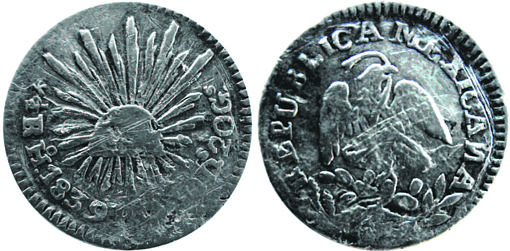
KM-372.7 ½r 1839 Ho PP
Retrograde N in MEXICANA
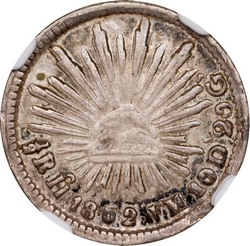
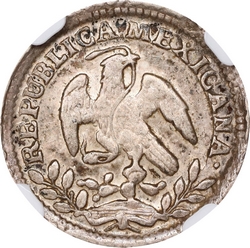
KM-370.8 ½r 1862 Ho FM (Stack’s Bowers Kirk Menczer Collection, 23 June 2026, lot 72169)
Diameter 16 mm. 1.690 g, 0.90277 silver
For a consideration of the rarity of Hermosillo ½ real see here.
| Date | Asssayer | Recorded mintage | Comment |
| 1839 | PP | unique. For more information, see here. | |
| 1862 | FM | ||
| 1867/1 | PR/FM | 6 over inverted 6 (for discussion, see here) | |
| 1867/2 | PR |
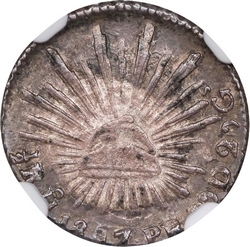
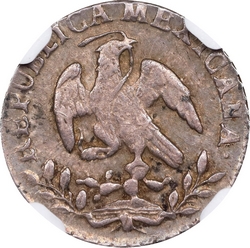
KM-370.8 ½r 1867 Ho PR/FM (Stack’s Bowers Kirk Menczer Collection, 23 June 2026, lot 72170)
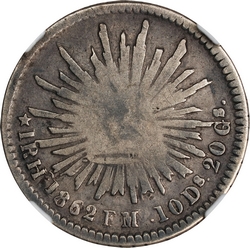
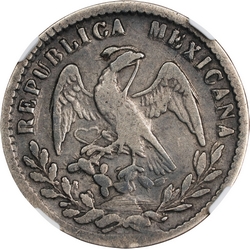
KM-Unlisted (KM-372.7 for other dates) 1r 1862 Ho FM (Stack’s Bowers Kirk Menczer Collection, 23 June 2026, lot 72383)
Diameter 26 mm. 3.380 g, 0.90277 silver
| Date | Asssayer | Recorded mintage | Comment |
| 1862 | FM | ||
| 1867 | PR | small 7 over 1 | |
| 1867 | PR | large 7 over small 7 | |
| 1867 | PR | no crossbar in H of mintmark | |
| 1867/1 | PR | illustrated below | |
| 1868 |
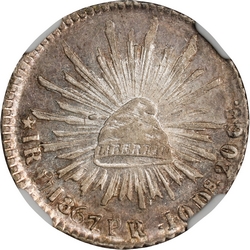
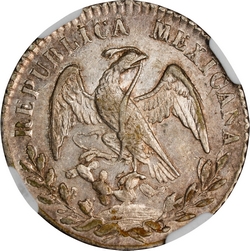
KM-372.7 1r 1867/1 Ho PR (Stack’s Bowers Kirk Menczer Collection, 23 June 2026, lot 72384)
Sonora Cap and Eagle.
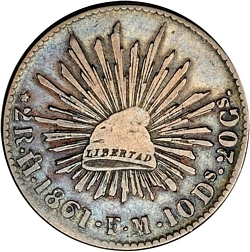
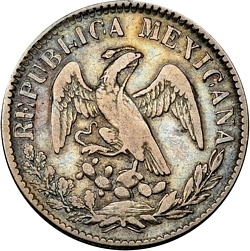
KM-374.9 2r 1861 Ho FM (Ponterio Baltimore auction, 28 March 2011, lot 8277)
Diameter 27 mm. 6.760 g, 0.90277 silver
| Date | Asssayer | Recorded mintage | Comment |
| 1861 | FM | ||
| 1862/52 | FM/CE | Ho mintmark | |
| 1867/1 | PR/FM | illustrated below | |
| 1867 | PR | Escudo edge |
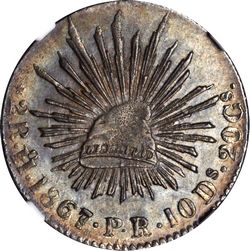
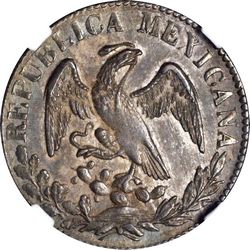
KM-374.9 2r Hermosillo 1867/1 Ho PR/FM (Stack’s Bowers auction, 13 February 2019, lot 71276)
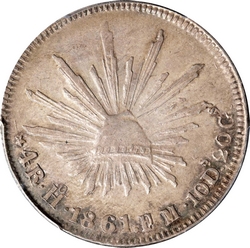
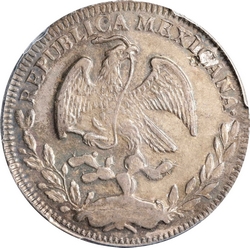
KM-375.5 4r 1861 Ho FM (Stack’s Bowers auction, 26 August 2022, lot 34177)
Diameter 32 mm. 13.540 g, 0.90277 silver
| Date | Asssayer | Recorded mintage | Comment |
| 1861 | FM | ||
| 1862 | FM | two known | |
| 1867/1 | PR/FM | ||
| 1867 | PR |
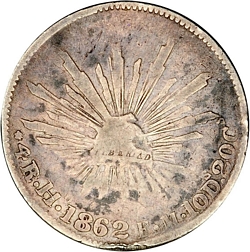
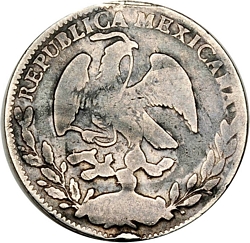
KM-375.5 4r 1862 Ho FM (Ponterio Baltimore auction, 28 March 2011, lot 8376)
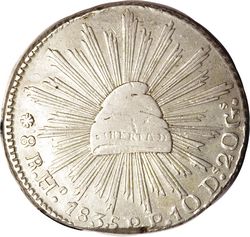
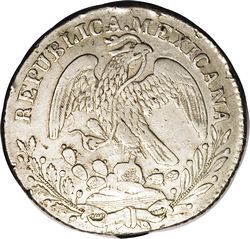
KM 377.9 8 reales 1835 Ho PP (Heritage Long Beach auction, 19 September 2008, lot 21741)
Diameter 39 mm. 27.070 g, 0.90277 silver
| Date | Asssayer | Recorded mintage | Comment |
| 1835 | PP | For a commentary on these three early issues, see here |
|
| 1836 | PP | ||
| 1839 | PR | ||
| 1861 | FM | Ho mintmark (narrow H), reeded edge | |
| 1861 | FM | Ho mintmark (wide H), reeded edge | |
| 1862 | FM | Ho mintmark, reeded edge, snake's tail right | |
| 1862 | FM | Ho mintmark, normal edge, snake's tail left | |
| 1862 | FM | Ho mintmark, normal edge, snake's tail left. long ray over 8R | |
| 1863 | FM | Ho mintmark | |
| 1864 | FM | ||
| 1864 | PR | ||
| 1865 | FM | issued while Maximilian's forces controlled the mint (29 July 1865 - 12 September 1866) | |
| 1866 | MP | ||
| 1867 | PR | ||
| 1868 | PR | ||
| 1869 | PR | ||
| 1870 | PR | ||
| 1871/0 | PR | ||
| 1871 | PR | ||
| 1872/1 | PR | ||
| 1872 | PR | ||
| 1873 | PR | 351,000 | |
| 1874 | PR | ||
| 1875 | PR | ||
| 1876 | AF | ||
| 1877 | AF | 410.000 | |
| 1877 | GR | ||
| 1877 | JA | ||
| 1878 | JA | 451,000 | |
| 1879 | JA | ||
| 1880 | JA | ||
| 1881 | JA | 586,000 | |
| 1882 | JA | 240,000 | |
| 1882 | JA | ||
| 1883/2 | JA | 204,000 | Ho mintmark |
| 1883/2 | FM/JA | Ho mintmark | |
| 1883 | JA | Ho mintmark | |
| 1884/3 | FM | ||
| 1884 | FM | ||
| 1885 | FM | 132,000 | |
| 1886 | FM | 225,000 | Ho mintmark |
| 1886 | FG | Ho mintmark | |
| 1887 | FG | 150,000 | Ho mintmark |
| 1888 | FG | 364,000 | Ho mintmark |
| 1889 | FG | 490,000 | Ho mintmark |
| 1890 | FG | 565,000 | Ho mintmark |
| 1891 | FG | 738,000 | Ho mintmark |
| 1892 | FG | 643,000 | Ho mintmark |
| 1893 | FG | 518,000 | Ho mintmark |
| 1894 | FG | 504,000 | Ho mintmark |
| 1895 | FG | 320,000 | Ho mintmark |
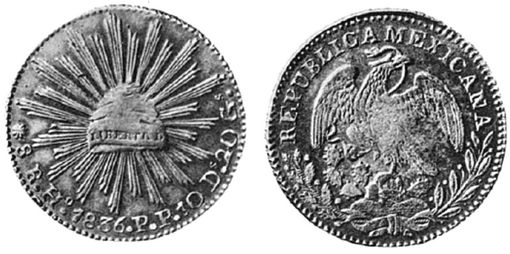 KM 377.9 8 reales 1836 Ho PP
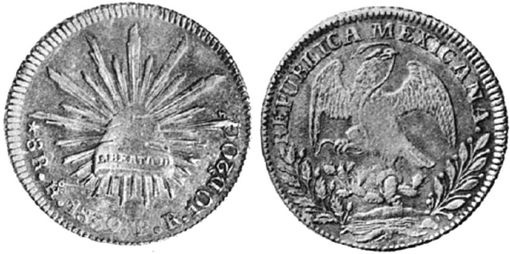 KM 377.9 8 reales 1839 Ho PR
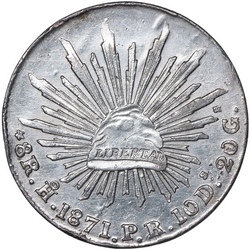
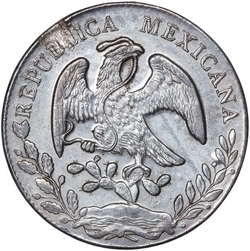
KM-377.9 8r 1871 Ho PR (Briggs & Bustos auction, 31 August 2025, lot 299)
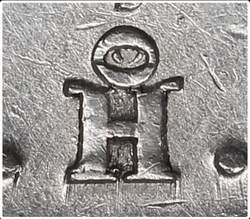 Variety with a large horizontal “O” over a small vertical “o” in the mintmark.
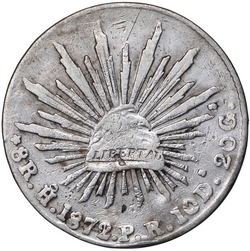
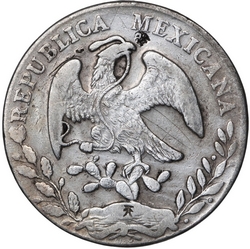
KM-377.9 8r 1872/1 Ho PR (Briggs & Bustos auction, 31 August 2025, lot 300)
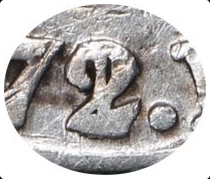 Extremely clear overdate.
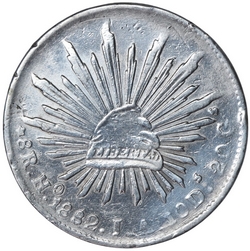
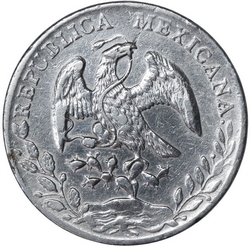
KM-377.9 8r 1882 Ho JA (Briggs & Bustos auction, 31 August 2025, lot 302)
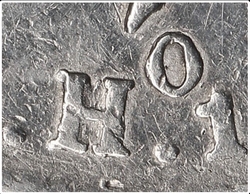 Scarce variety, with the mintmark featuring an “O” after the “H”.