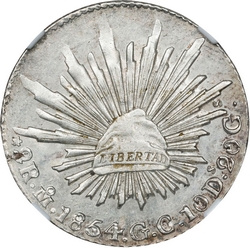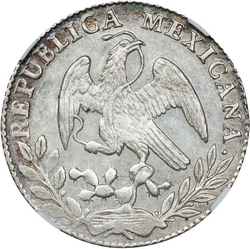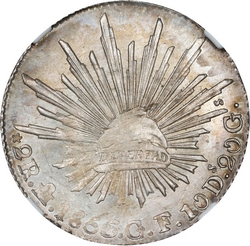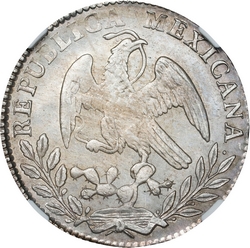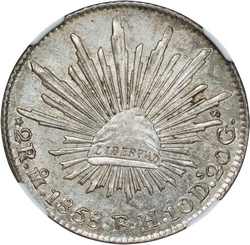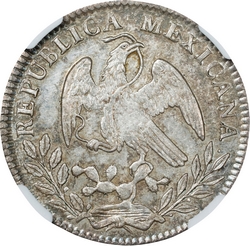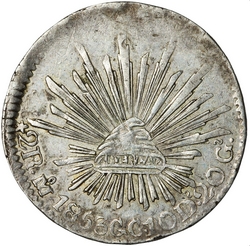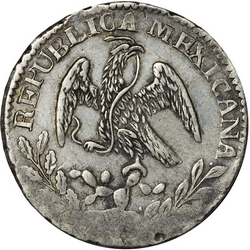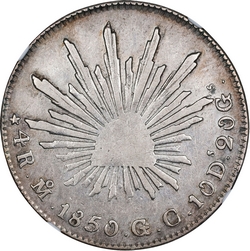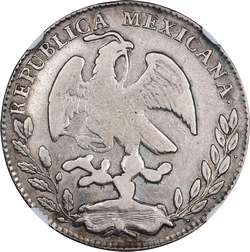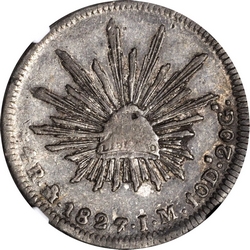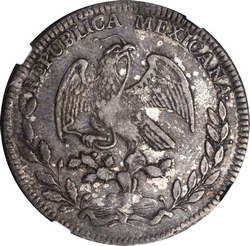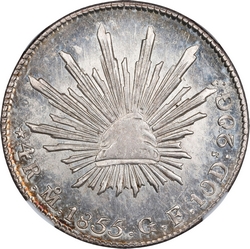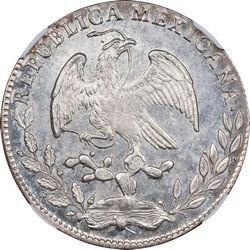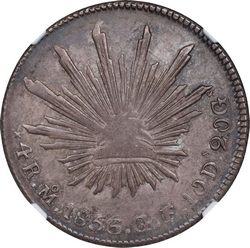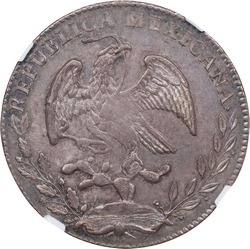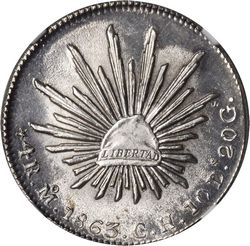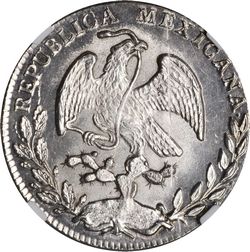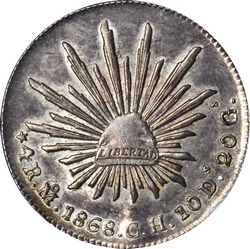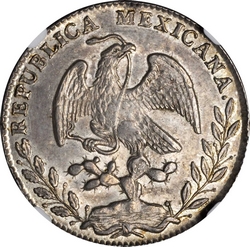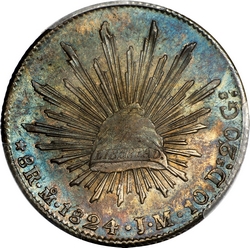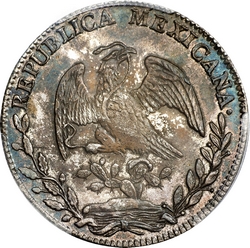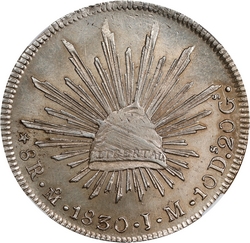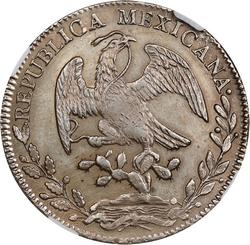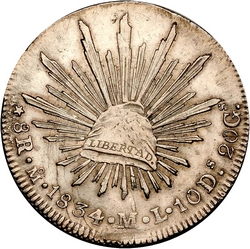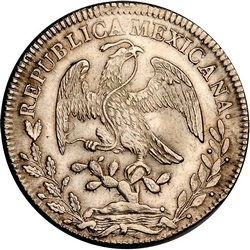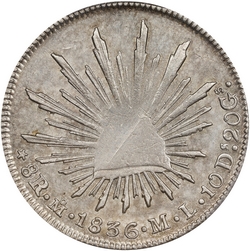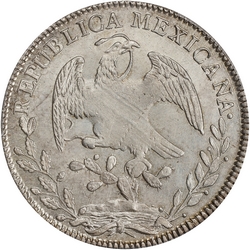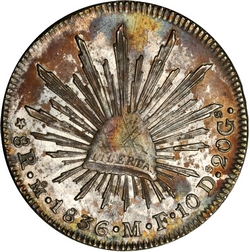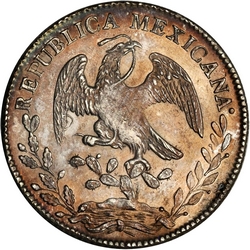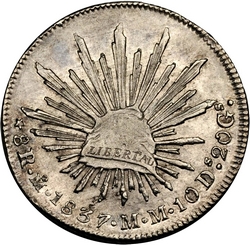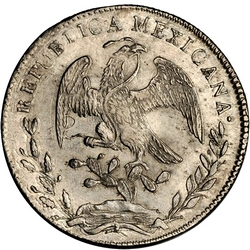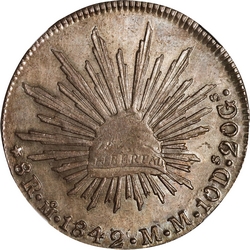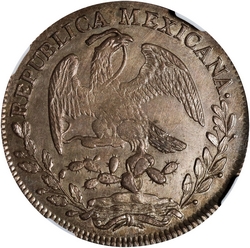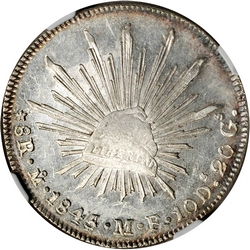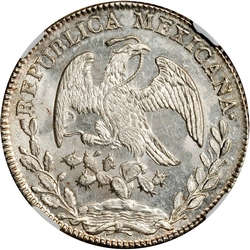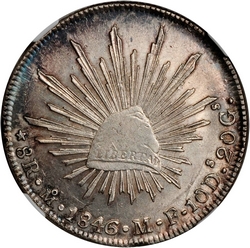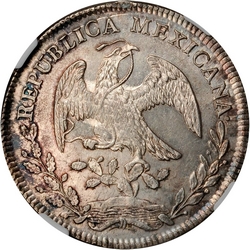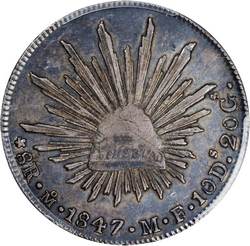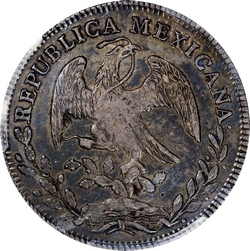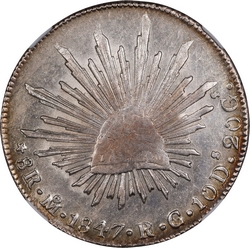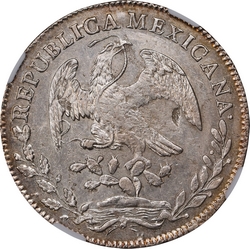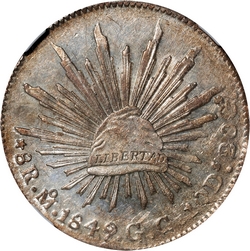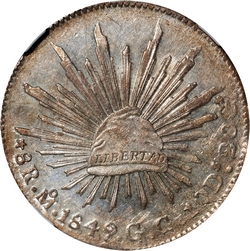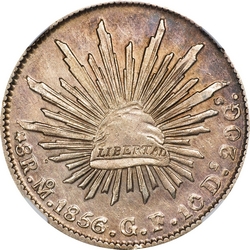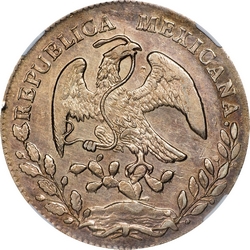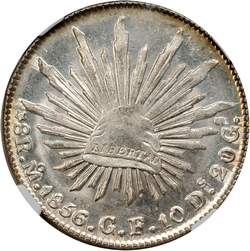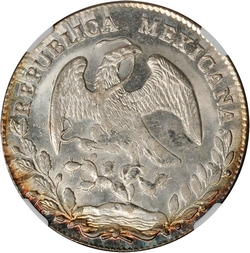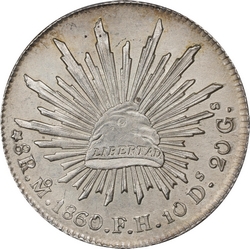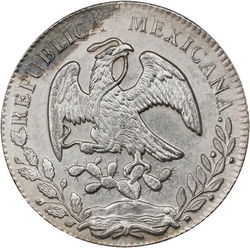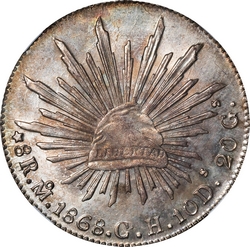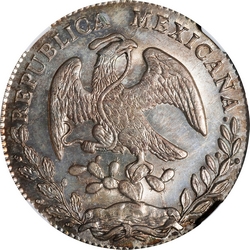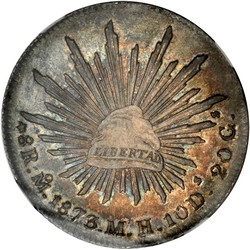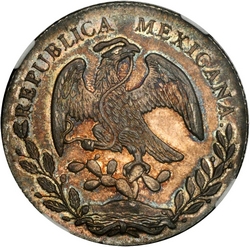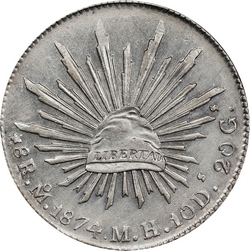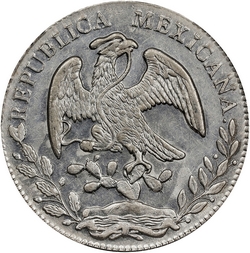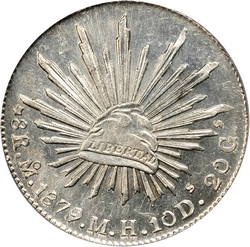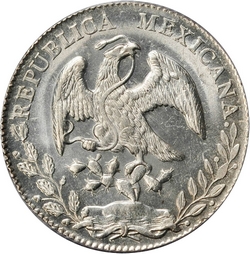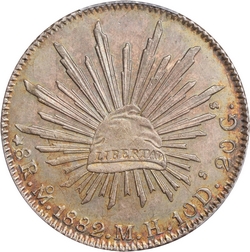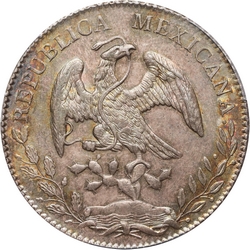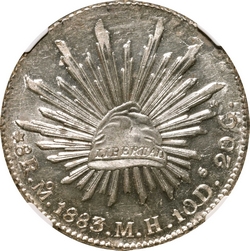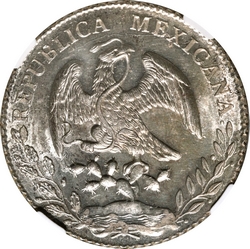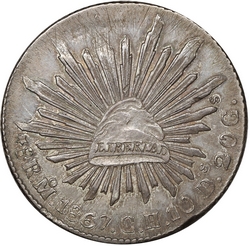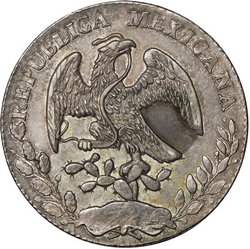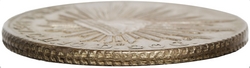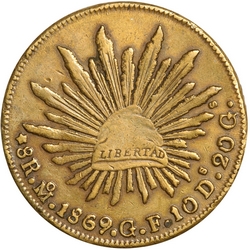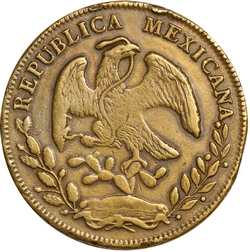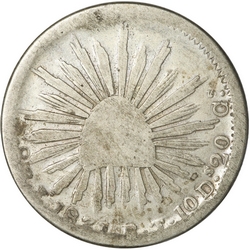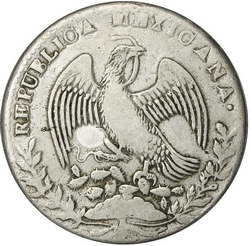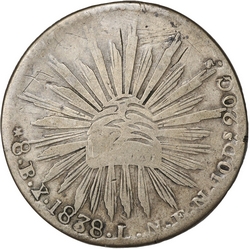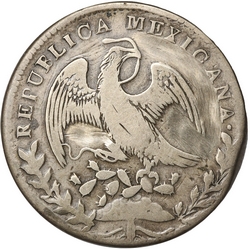
This is the capital of the northern state of Chihuahua. The Spanish Colonial Government operated a mint from 1810-1822. The Republican mint opened in 1831. There is reference to this mint opening in August 1832, but this is obviously an error since coins of 1831 are known. Chihuahua issued coins of the Republic annually, until it closed on 30 June 1895. In 1840 Chihuahua became the third Mexican mint to produce its dies from hubs. This technique greatly improved the quality of the coins produced as well as the efficiency of the mint. The mint was occupied by the Imperial Forces of Maximilian from 15 August 1865 to 17 June 1866. It is not known whether coinage operations continued during this period.
Production of 8 Reales ceased in 1871 and resumed in 1873 during which time Balance Scale Pesos were issued.
| from | to | |
| 1831 | 11 July 1839 | Probably Government of the State of Chihuahua |
| 11 July 1839 | unknown | Kelly y Cia. (Juan Potts and Juan Jennison) |
| unknown | Potts, Garniz y Munoz (unknown) | |
| unknown | 19 August 1863 | Macmanus y Cia. |
| 20 August 1863 | 20 August 1874 | Enrique Mueller y Socios |
| 21 August 1874 | 17 February 1880 | Government of the Republic of Mexico |
| 18 February 1880 | 30 June 1895 | Félix Francisco Maceyra, Luis Terrazas, Luis Faudoa, Ramón Remigio Luján and Miguel Salas (Principal stock holders of the Banco Mexicano of Chihuahua) |
| Initial | Name | Begins on | Ends on |
| MR | Mariano Cristóbal Ramírez | 1831 | 1834 |
| AM | José Antonio Mucharraz | 1834 | 1838 |
| RC | Rodrigo García | 1839 | 1856 |
| JC |
Joaquín Campa was a lawyer who was born and died in Chihuahua. He became politicised at a very young age and joined the liberal ranks. He took up various posts in the judiciary until he reached the rank of Magistrate of the Supreme Tribunal of Justice in Chihuahua. He fought against the French Intervention of Mexico and in August 1862 was president of the junta patriótica established in Chihuahua{footnote}El Siglo Diez y Nueve, Tomo IV, Núm. 594, 31 August 1862{/footnote}. However, in October 1865 as president of the Tribunal Superior he was one of the former enemies who signed the act of adhesion to the Empire{footnote}La Sociedad, Tomo V, Núm. 871, 11 November 1865{/footnote}. He died in 1871. |
1856 | 1866 |
| BA | Bruno Arriada | 1858 | |
| FP |
Edward Francisco Potts was by 1860 “a distinguished English gentlemen of wealth and influence, a twenty years’ resident of Chihuahua and assayer at the mint”{footnote}letter S. Hart, El Paso, to President James Buchanan, 21 January 1860 in report to Congress on the difficulties on Southwestern Frontier(footnote}. On 19 January 1860 he wrote from Chihuahua to Mr. Hart in El Paso, requesting the assistance of U. S. troops against rebels from Durango{footnote}ibid.{/footnote}. On 29 May 1865 Potts was named by the Maximilian regime as a member of the Junta auxiliar de colonización in Chihuahua {footnote}El Diario del Imperio, Tomo I, Núm. 125, 1 June 1865{/footnote}. These local juntas were made up of five hacendados or businessmen, two Mexican and three foreigners, who were tasked with developing the resources of their Departamento{footnote}El Diario del Imperio, Tomo I, Núm. 90, 20 April 1865{/footnote}. |
1865 | 1866 |
| JC |
José María Gómez del Campo Gómez del Campo went on to be listed as ensayador in San Luis Potosí in 1873. |
1866 | 1868 |
| MM | Manuel Merino | 1868 | 1876 |
| EA | Eduardo Avila | 1877 | |
| JM |
Jacobo Mucharraz Losa, the son of José Antonio Mucharraz, was born in Chihuahua around 1837. For three years during the war of Intervention he distinguished himself by the services to the state of Chihuahua. Then he was an assayer in the Guanajuato mint before, in 1870, being nominated assayer of the Mexico City mint (El Ferro-Carril, Tomo III, Núm. 187, 11 August 1870) Mucharraz was appointed assayer of the Chihuahua mint by the governor José Eligio Muñoz, so this was between 19 February and 13 June 1877. On 4 August 1877 he was suspended from his post by the subsequent governor, General Pedro Hinojosa, supposedly for being wayward and hindering the work of the mint (díscolo del empleado y entorpeciiento en las labores ó trabajos de la casa). Mucharraz took the case to court, questioning Hinojosa’s right to fire him: on 13 August the mint director, E. Avila, reported the Mucharraz’s conduct was scandalous and insubordinate (escandalosa é insubordinada) and local businesses, in a report of 9 August, called Mucharraz intolerable in every business in which he was involved (hombre intolerable de todo negocio en que tiene intervencion). However, the Ministerio Público declared that Mucharraz’s rights had been violated and on 8 September the judge, Juan de Dios Búrgos, ruled that, irrespective of the reasons for the firing, it had been unconstitutional{footnote}El Foro, Tomo II, Año V, Núm. 123, 27 December 1877{/footnote}. So Mucharraz’s initials only appear on an 1877 eight reales. Mucharraz appears as a third official in the Chihuahuan state government in November 1890{footnote}El Estado de Chihuahua, Año XIII, Núm. 153, 22 November 1890{/footnote}. He died in Chihuahua on 20 June 1900. Incidentally, his son, Jacobo Mucharraz Calderon, had been a founder of the Partido Antirreeleccionista in Chihuahua in 1909 and was on the town council in 1912 and 1913, but on 13 December 1913, a few days after Francisco Villa captured the town, was executed on Villa’s orders. |
1877 | |
| GR |
Guadalupe Rocha Guadalupe Rocha was listed as the ensayador in 1873. |
1877 | |
| AV |
Antonio Valero In July 1879 a newspaper reported that through either ignorance or malice Valero was causing immense harm to Chihuahua businessmen and miners. Since his appointment the young Antonio Valero had upset all the owners of silver who had to deal with him. The difference between the assays made by M. Merino and A. Barbachano and those made by Valero could be up to forty milésimos{footnote}La Libertad, Año II, Núm. 170, 24 July 1879{/footnote}. |
1877 | 1880 |
| PM | Unknown | 1880 | |
| MM | Unknown (possibly Manuel Merino) | 1880 | |
| MG | Manuel Gameros | 1880 | 1882 |
| MM | Manuel Merino | 1882 | 1895 |
The assayers on its decimal coinage were:
| Initial | Name | Began on | Left office on |
| M | Manuel Merino | 1868 | 1895 |
| P | 1872 | ||
| G | Manuel Gameros | 1880 |
-
-


KM-378.2 ½E 1835 Ga FS (Stack’s Bowers auction, 26 August 2025, lot 41379)
Diameter 15 mm. 1.690 g. 0.8750 gold
| Date | Asssayer | Recorded Mintage |
Comment |
| 1825 | FS | ||
| 1829 | FS | ||
| 1831 | FS | ||
| 1834 | FS | ||
| 1835 | FS | ||
| 1837 | JG | ||
| 1838 | JG | ||
| 1839 | JG | ||
| 1842 | JG | ||
| 1847 | JG | ||
| 1850 | G | ||
| 1852 | JG | ||
| 1859 | JG | ||
| 1861 | JG |


KM-379.2 1E 1825 Ga FS (Stack’s Bowers auction, 3 September 2025, lot 45458)
Diameter 18 mm. 3.380 g. 0.8750 gold
| Date | Asssayer | Recorded Mintage |
Comment |
| 1825 | FS | ||
| 1826 | FS | ||
| 1831 | FS | ||
| 1834 | FS | ||
| 1842 | JG/MC | ||
| 1843 | MC | ||
| 1847 | JG | ||
| 1848/7 | JG | illustrated below | |
| 1849 | JG | ||
| 1850 | JG | ||
| 1852/1 | JG | ||
| 1856 | JG | ||
| 1857 | JG | ||
| 1859/7 | JG | illustrated below | |
| 1860/59 | JG | ||
| 1860 | JG |


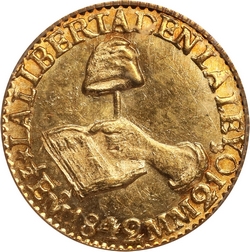
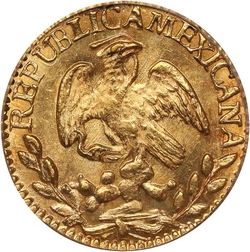
KM-379.2 1E 1848/7 Ga JG (Stack’s Bowers auction, 3 September 2025, lot 45459)


KM-379.2 1E 1850/40 Ga JG (Ponterio Baltimore auction, 6 November 2013, lot 21117)


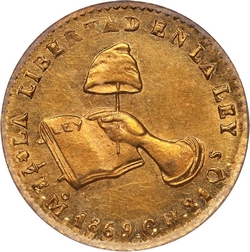
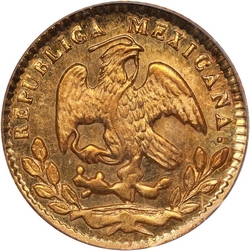
KM-379.2 1E 1859/7 Ga JG (Stack’s Bowers NYINC auction, 21 January 2020, lot 23231)
Diameter 23 mm. 6.770 g. 0.8750 gold
| Date | Asssayer | Recorded Mintage |
Comment |
| 1835 | FS | ||
| 1836/5 | JG | ||
| 1839/5 | JG | ||
| 1840 | MC | two die varieties | |
| 1841 | MC | ||
| 1847/6 | JG | ||
| 1848/7 | JG | ||
| 1850 | JG | two die varieties | |
| 1851 | JG | ||
| 1853 | JG | ||
| 1858 | JG | ||
| 1859/8 | JG | ||
| 1860/50 | JG | ||
| 1861/59 | JG | ||
| 1861/0 | JG | ||
| 1863/1 | JG | ||
| 1870 | JG |


KM-380.3 2E 1836/5 Ga JG (Stack’s Bowers auction, 26 August 2025, lot 41368)

KM-380.3 2E 1853 Ga JG (Stack’s Bowers auction, 15 August 2023, lot 51318)


KM-380.3 2E 1860/50 Ga JG (Stack’s Bowers Chicago ANA auction, August 2025, lot 33515)


KM-380.3 2E 1861/0 Ga JG (Stack’s Bowers NYINC auction, January 2015, lot 1278)


KM-380.3 2E 1863/1 Ga JG (Stack’s Bowers auction, 15 August 2023, lot 51319)


KM-381.2 4E 1844 Ga MC (Ponterio NYINC auction, 6 January 2012, lot 920)
Diameter 30 mm. 13.540 g. 0.8750 gold
| Date | Asssayer | Recorded Mintage |
Comment |
| 1844 | MC | ||
| 1844 | JG |


KM-383.5 8E 1826 Ga FS (Stack’s Bowers auction, 23 October 2025, lot 73004)
Diameter 37 mm. 27.070 g. 0.8750 gold
| Date | Asssayer | Recorded Mintage |
Comment |
| 1825 | FS | ||
| 1826 | FS | ||
| 1830 | FS | ||
| 1836 | FS | ||
| 1837 | JG | ||
| 1840 | MC | ||
| 1843 | MC | ||
| 1845 | MC | ||
| 1849 | JG | ||
| 1850 | JG | ||
| 1851 | JG | ||
| 1852/1 | JG | ||
| 1855 | JG | ||
| 1856 | JG | ||
| 1857 | JG | ||
| 1861/0 | JG | illustrated below | |
| 1863/1 | JG | ||
| 1866 | JG |


KM-385.5 8E 1861/0 Ga JG (Stack’s Bowers NYINC auction, 12 January 2019, lot 41197)

Named in honour of the Virgin of Guadalupe and the governor of the state José Joaquín Calvo, the city of Guadalupe y Calvo is, in the southernmost part of the state of Chihuahua. Located 327 miles south of the capital city, Chihuahua, at an altitude of 7,643 feet, Guadalupe y Calvo was in a remote, but very rich mining area. Its remoteness was one of the principal reasons that local mining interests pressed for the establishment of a mint. The nearest mint was in Chihuahua and transporting bullion there was difficult and dangerous. There were frequent attacks by Apache and Comanche Indians, as well as local bandits.
In 1842 a newspaper reported:
... About eight years ago, … some investigations, made on the two iron-covered slopes, which formed the narrow valley where the stream flows, led to the discovery on the east side of a quartz ridge, which contained grains of gold perfectly perceptible to the naked eye. Shortly after, open-pit tillage began, after the vein had been denounced. In the meantime, the news of this discovery having spread, Messrs. Buchan and Adul, long attached to some English companies, came from Zacatecas; and the result of their voyage was the purchase of a property of 200 varas located to the northwest of the vein and to work this property the company of Guadalupe y Calvo was formed … Gold and silver are concentrated in balls of great wealth. These balls have been found, especially in the work of the English company.{footnote}El Cosmpolita, Vol. V, Núm. 196, 14 December 1842{/footnote}.
On 3 October 1842 Dictator Antonio López de Sama Anna authorized a ten year lease to the British firm Mackintosh & Company, operating as Compañía Minera Mexicana de Guadalupe y Calvo. The mint opened on 1 June 1844. As specified in the lease, the original matrices were provided by the Mexico City mint.
In late 1847 Guadalupe y Calvo became the first mint in the Republic of Mexico to employ steam powered presses for the printing of coins, only eleven years after the introduction of steam press technology at the Philadelphia mint.. This important event is commemorated by a medal bearing the name of the mint director, Tomas Mackintosh.


Grove 93a Silver medal (Stack’s Bowers NYINC auction, January 2015, lot 1298)
The obverse of this medal has a nine line inscription that commemorates the first use of steam machinery for producing coins 'EN / CONMEMORACION / DE LA PRIMERA / APLICACION DEL VAPOR / EN LA REPUBLICA MEXICANA / A LA MAQUINARIA / DE AMONEDACION / TOMAS MACKINTOSH / DIRECTOR (In commemoration of the first application of steam in the Mexican Republic to the coinage machinery. Tomas Mackintosh, Director)'. The reverse has a nine line inscription that commemorates the first steam engine brought into the Sierra Madre 'LA PRIMERA / MAQUINA DE VAPOR / INTRODUCIDA A LA / SIERRA MADRE / COMENZO A ANDAR EN LA / CASA DE MONEDA / DE GUADALUPR Y CALVO / EN DIA 1 DE DICIEMBRE / DE 1847 (The first steam engine introduced to the Sierra Madre began to run at the Casa de Moneda de Guadalupe y Calvo. December 1, 1847}'.
In 1849 the lease passed to Jecker Torre y Cia., who, at the same time, also took over the tease for the mint at Culiacán. There were numerous administrative problems at the mint. Finally, coinage operations ceased in April 1852 and the doors were closed on 22 May 1852. Some of the modern equipment purchased for this mint found its way to Chihuahua where it was installed ca. 1860.
As to the closure of the mint, the newspaper El Siglo Diez y Nueve stated that the mint was seized by order of the District Judge of Chihuahua at the request of the General Commissioner of the State because the director of the mint failed to make a payment of 25,000 pesos that the government negotiated to pay troops on the border{footnote}El Siglo Diez y Nueve, Año Décimo, Cuarta Época, Núm. 639, 1 October 1850{/footnote}.
It is said that, between the opening and closing, the mint at Guadalupe y Calvo minted a total of 5,185,827 pesos, of which 2,690,104 pesos was in silver coins and 2,495,723 pesos in gold coins.
| Year | Silver | Gold |
| 1844 | 338,124.00 | 95,004.00 |
| 1845 | 218,298.00 | 688,513.00 |
| 1846 | 250,322.00 | 752,378.00 |
| 1847 | 230,084.00 | 416,350.00 |
| 1848 | 535,543.50 | 185,222.00 |
| 1849 | 491,586.36 | 173,637.00 |
| Total | 2,063,958,06 | 2,311,104.00 |
| from | to | |
| 30 October 1843 | 1849 | Compañía Minera de Guadalupe y Calvo (Mackintosh and Company) |
| 1849 | 22 May 1852 | Jecker, Torre y Cia. |
The Compañía Minera Guadalupe y Calvo a subsidiary of the parent company Manning & Marshall (other authors refer to it as "Mackintosh & Company"{footnote}The company’s main agent was Ewen Mackintosh, British consul in Mexico {/footnote}), since the rules stipulated that the mint was managed by a Mexican company. This company, taking advantage of the financial difficulties of the government, obtained several lease contracts, such as Zacatecas in 1842, Culiacán in 1843 and Guadalupe and Calvo in 1844, and came to control 80% of the mintage in Mexico. The mints of Culiacán and of Guadalupe y Calvo maintained various links throughout their operation.
| Initial | Name | Began on | Left office on |
| MP | Manuel Onofre Parodi | 1844 | 1852 |
The 8 reales of 1870 has an interesting history. The Mint of Oaxaca minted 8 reales in 1869, but stopped doing so with the decree of 27 November 1867 in which President Benito Juárez implemented the decimal system in Mexico, ordering the minting of pesos and centavos. This mint, along with the one in Mexico City, was the first to mint Balance pesos in 1869. Later, with the decree of President Lerdo de Tejada on 30 May 1873, decimal coins were ordered stopped, so the system of reales was restored, and Oaxaca re-minted 8 reales in 1873.
In 1997, Antonio Deana Salmerón published an article on this coin{footnote}Antonio Deana Salmerón, "The So-called 8 Reales de Oaxaca Coin of 1870" in El Boletín Numismatico, 1997, available on the USMexNA online library{/footnote}. He recorded that Henry Christensen, a prominent dealer in Spanish-American coins in Madison, New Jersey, in compiling an inventory of 8 reales, listed a 8 Reales 1870 A.E. as belonging to the Pradeau collection. Pradeau{footnote}Pradeau{/footnote} himself illustrated the reverse of this coin in the fourth volume of his Numismatic History of Mexico and Utberg{footnote}{/footnote} also noted two examples of this date. On the other hand, Clyde Hubbard and Theodore Buttrey in their A Guide Book of Mexican Coins 1822 to date{footnote}{/footnote}) did not list the 1870 8 reales.
Deana Salmerón decided that the mint was producing Balance Scale pesos in 1870 and that the various examples of this coin were contemporary counterfeits. He notes that “a significant and most important detail is that the 1870 coin illustrated in Dr. Pradeau's book shows the Oa mint mark which was not used until 1873. If this coin had been struck at the Oaxaca Mint, it is logical to believe that the O alone would have been used as it was progressively from 1861 to 1869. This is of vital importance since it gives us the key to determine that this coin is a fake. Additionally, in 1870 it was not known that the mint was to return to the striking of 8 Reales. Consequently, no new logotype as mintmark had been designed. All this tells us that the counterfeiting of these coins must have been done after 1873 when the Oa mintmark was used."
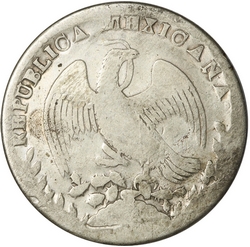
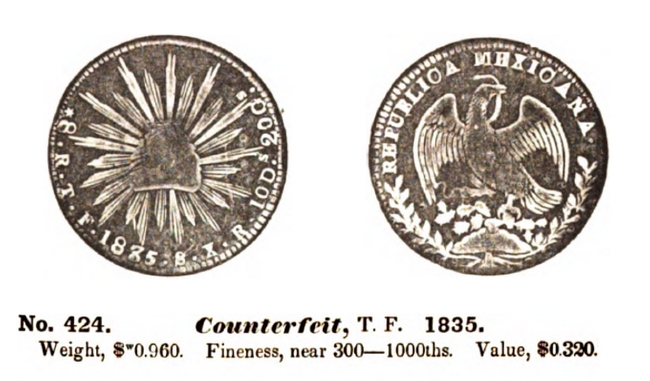
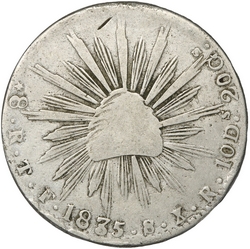
The case of the Oaxaca 8 R 1870 is not the only one as there is the one peso 1870 San Luis Potosi with the initial "H" which never existed but was registered in special catalogs for more than 30 years as well as several 8 Reales from Chihuahua, Guadalajara, Guanajuato, Mexico, San Luis Potosi and many others from other mints whose assayer initials never existed.
The medio real (½R) has long been a popular coin and researched by several different scholars in the field of Mexican numismatics. The outstanding works by Clyde Hubbard and David O’Harrow, Hookneck El Aguila de Perfil and the supplement Hookneck II are essential to any serious collector of that series and important to the ½R collector even though there is only one known issue of the Hookneck ½R, the Mo 1824 JM.
A total of either eleven or twelve different mints produced the ½R between 1824 and 1870. However, one of the intriguing aspects of the Republic ½R series is that despite the fact that small coins were essential Ito everyday commerce in 19th century Mexico only about half of those mints struck them in large numbers and/or with regularity. For those of you not familiar with the ½R even a cursory study of any catalog listing the ½R will show that Alamos and Estado de México produced the coin in only one year and the Chihuahua mint produced them in only two years. The single reported ½R from Alamos is dated 1862 and some controversy surrounds its authenticity (see further details below). Estado de México struck the coin only in 1829 even though it produced 8R in 1828, 1829 and 1830. Chihuahua struck the ½R only in 1844 and 1845 despite producing 8R from 1831 through 1895. This has been partially explained by some researchers who have reasoned that the Chihuahua 8R was struck, in the main, for export; and therefore the minors were not a priority. Another mint, Hermosillo, has only three reported dates – 1839 (not officially open then and there is some question as to its authenticity), 1862 and 1867. As far as we know; neither Catorce nor Oaxaca struck the ½R.
KM-372.7 ½r 1839 Ho PP
The above is the only ½R HO 1839 PP I have seen. Note the broken star and the retrograde N in MEXICANA. The owner was kind enough to send a scan, but I have not been able actually to examine the piece and therefore make no claims as to whether or not it is genuine.
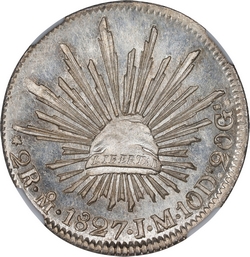
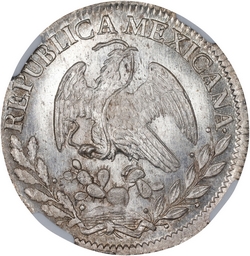
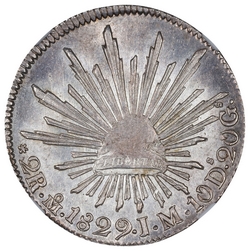
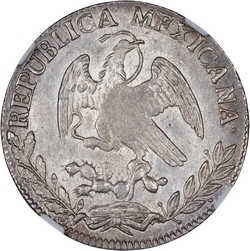
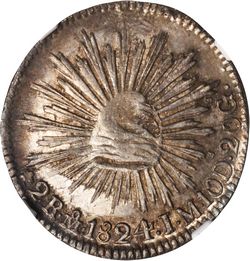
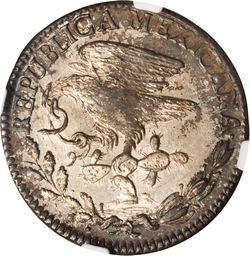
The standard Republic ½R is 16 mm in diameter and has a Fineness of 90.027% silver with a base metal of copper. The edge design is referred to as ornamental. Fineness is expressed as “10 DS 20 GS” (with the DS and GS being abbreviations for Dineros and Granos) and found as part of the legend on the Cap side of the coin. Twelve Dineros is pure silver and each Dinero can be divided into 24 Granos. Thus 10 DS 20 GS is 10 of a possible 12 Dineros plus 20/24 of another Dinero (when added together it comes to nearly 11/12) and calculates (260 ÷ 288) to be 90.27% silver when converted to the decimal system. The obverse features the ancient Aztec symbol of victory; an eagle grasping a water snake in its beak and its left claw (from the observer’s point of view) while using the other leg to stand on a cactus that is rising out of Lake Texcoco. Below and to the right are laurel branches, leaves and berries, to the left are oak branches with leaves and acorns. The legend around the top half of the outer perimeter reads REPUBLICA MEXICANA. Sometimes there is a dot after MEXICANA and sometimes there is not. The reverse features a Phrygian Cap with the word LIBERTAD (Liberty) in block letters across its base. Extending out from behind the Cap are Rays. Thus, the design signifies the dawning of liberty (freedom from Spanish rule) in Mexico. The reverse legend reads “★ ½R • MM • date • assayer initials • fineness • ” for example a Guanajuato ½R minted in 1828 would read: ★½R • GO • 1828 • J • M • 10 DS • 20 GS •. Note that this is the same format used by all denominations in the Cap and Rays series – this one as well as the 1R, 2R, 4R, and 8R. You should also be aware that there were several variances from mint to mint and even year to year within an individual mint such as no star, a six, seven or even eight pointed star instead of the normal five pointed one, irregular spacing in the legends, missing or improperly placed dots, reversed superscript “S” and even missing superscript “S“. In addition, there were over-dates, over-assayers, and re-punched stars, dots, mintmarks, dates, assayer initials, fineness numbers and letters which many collectors of the series find fascinating. Depending on how much detail one chooses to include in his/her collecting criteria, varieties can be almost endless as every separate set of dies, especially prior to 1854, was at least slightly different from those preceding and following. An interesting one is the number of berries and acorns in the wreath below the eagle. I have seen as many as six and as few as two. Some collectors use the term “Incomplete Wreath” to describe such a variety.
Mexico City is the only mint that struck a Hookneck ½R and all known examples bear the date 1824. It has always been a popular coin because of the Profile Eagle design and the fact that the style was used in only one year. The Facing Eagle style ½R specifications – diameter, weight, and fineness – remained the same as those of the Hookneck. Struck at either eleven or twelve different mints between 1825 and 1869 the ½R is one of the most popular coins for collectors specializing in the Republic of Mexico. As with the other denominations the ½R can usually be found in circulated condition rather easily and often for a pittance. However, you probably also know that there are some extremely rare mint date assayer combinations and aside from the more common (Mexico City, Culiacán, Guadalajara, Guanajuato, and Zacatecas mints, all have at least a few years where large numbers were produced) and/or hoard coins, Uncirculated specimens are difficult to locate. I am convinced that the reason for this is that the ½R was essential to everyday commerce among the populace and therefore entered circulation quickly. The list below shows the mints and the years they struck the ½R.
| Mint | Years Struck |
| Alamos | 1862 (note controversy surrounds the one reported specimen, some authorities say it is genuine while others say it is not) |
| Chihuahua | 1844-45 |
| Culiacán | 1846, 1848-49, 1852-54, 1856-58, 1860-63, 1867, 1869 |
| Durango | 1832-34, 1837, 1841-43, 1845-46, 1848-62, 1864, 1869 |
| Estado de México (Tlalpan) | 1829 |
| Guadalajara | 1825-26, 1828-32, 1834-35, 1837-62 |
| Guadalupe y Calvo | 1844-51 |
| Guanajuato | 1826-62, 1867-68, 1870 |
| Hermosillo | 1839, 1862, 1867 |
| Mexico City | 1824 (Hookneck)-36, 1838-63 |
| San Luis Potosí | 1831, 1841-63 |
| Zacatecas | 1826-63, 1869 |
The reason for not being specific as to the number of mints is that more than one notable numismatist believes the Alamos – ½R A 1862 P.G. – was never actually minted and that the one known example is not genuine. Note that Superior Stamp & Coin Company, in the Miguel Muñoz Sale II in June 1979, claimed that the 2R was the only minor minted at Alamos. Regardless of one’s position as to the authenticity of the coin, it is most unlikely that a collector will ever have the chance to own it, as it is thought to be a unique specimen. Thus, if you consider it genuine, you have to go into the medio real series knowing that in all likelihood you will not ever complete either a Type (by mint) or an MDA (Mint-Date-Assayer) set.
At this time, as far as we know, neither Catorce nor Oaxaca struck the ½R.
The die styles within the basic Type are fascinating to those of us bitten by the Mexican coin bug. One of the first issues to be addressed is that most catalogs and references refer to the Hookneck as a specific Type. I would argue that it is a Style rather than a Type. Obviously, whether one chooses to designate it a Type or a Style has no effect on the popularity or value of the Hookneck die style. The argument for calling it a die style is that it has the same basic design elements as any of the Facing Eagle style. For example it has the eagle grasping a snake in one talon and its beak while perched on a cactus that is rising out of Lake Texcoco. The lower half of the perimeter has oak branches, leaves and acorns to the left and laurel branches, leaves and berries to the right. The upper half of the perimeter has the legend REPUBLICA MEXICANA. On the Cap side it has the Liberty Cap with the word LIBERTAD across it with rays extending out from behind it. The Cap side legend reads – ★ ½R • MO 1824 • J • M • – so other than the fact that the eagle is facing on one and profile on the other and that there are some differences in the Cap I believe both the Hookneck and the Facing Eagle should be considered different styles of the same Type.
Hookneck Eagle style


Double struck example
Facing eagle style
Any of the mints that have fairly long production runs show a number of different die styles over time, and occasionally in the same year. Below are two examples:
Eagle of 1827 Eagle of 1828/7
The first is a Mexico City 1827, while the second is Mexico City 1828/7. A simple examination reveals obvious differences including but not limited to:
• 1828 eagle is bigger and more robust
• Upper beak on 1827 has more of a hook to it
• No lower beak on the 1828
• Right wing is smaller and sharper on the 1827
• Snake’s upper body is noticeably closer to the top of the eagle’s head on the 1827
• Oak leaves on the 1828 are less defined (almost rounded like the laurel leaves)
• There are subtle but noticeable differences in the letters of the legend as well as how they were punched.
Obviously, most serious collectors can find additional differences, but my point is that one can see the difficulty that the die sinker had engraving/punching the dies by hand. Obviously, whenever a mint had to change dies because of wear, damage or some other reason, a new set of dies that had to be prepared by hand would be at least slightly different.
Interestingly, we can see that with rarer examples the die style does not always change. Compare the two Chihuahua ½R pieces below. I have studied both extensively “in the flesh” and as far as I can determine, the Eagle side and the Cap side dies are the same for both coins except the date was changed for the 1845 though I found no trace of an overdate. Due to the toning, some details were not picked up on the reproductions of the coins. By the way, those are the only two High Grade Chihuahua ½Rs of which I am aware.
KM-370.1 ½r 1844 Ca RG
KM-370.1 ½r 1845 Ca RG
Note that several of the rays on the 1845 are not quite as sharp as those on the 1844, whether that wasdue to wear on the dies, the strength of the strike or a combination of both has not yet been determined. The same applies to the wings on the Eagle side.
Variety collectors can enjoy the ½R series as long as they choose to continue collecting. Three mints – Mexico City, Guanajuato and Zacatecas – produced many, many varieties and a high percentage of them were undoubtedly unintentional. That is not to say that some of the other mints did not also produce varieties, it is just that those three seem to have an abundance of them. That can probably be explained by the fact that Mexico City, Guanajuato and Zacatecas struck the largest numbers of the ½R. There are some well known and popular varieties including several over dates, over assayers, and errors. One of the first of what I consider to be a major error variety occurred at Guanajuato in 1828. That year there is an over date, 1828/7, plain date 1828, assayer initials MJ and MR. However, what is really interesting is that there is a combination denomination error 2/1 instead of ½ and mintmark error “G” only instead of a small “o” inside the opening of the G. Later we find a regular denomination but the “G” only remains even with the MR assayer. I have studied both the inverted denomination and the assayer MR with the “G” only and found traces of something inside the opening of the G, but cannot state definitively that it is the elusive missing “o” in either one. Unfortunately, I have never seen a High Grade (Extra Fine or better) example of either variety, so my conclusions remain somewhat speculative.
★ 2/1R • G•1828•M•J•
Close up of inverted denomination and G only mintmark
Another interesting variety from the Mexico City mint (it has been overlooked/unreported by standard references including the Clyde Hubbard and Theodore Buttrey, A Guidebook of Mexican Coins 1822 To Date, as well as the latest 2008 North American Coins & Prices A Guide to U. S., Canadian and Mexican Coins, 17th Edition from Krause Publications) is the MO 1841 ML which has two stars (★ ★) in the Cap side legend. By the way I am aware of one such coin in Mint state.

★ ★ ½R • Mo •1841• M • L• Two Stars variety
Yet another unmentioned one from Zacatecas is the ½R Z 1833 OM. First on the Cap side legend we have a six-pointed star - ★ - next we have a 2/1 that has been corrected to a ½, and lastly we have a large assayer initial M when compared to the assayer initial O and the rest of the legend. Keep in mind that the ½R mintmark for Zacatecas is a Z only through 1856. Also, the one pictured below is a Choice Mint state example so it will give the reader some idea of just how crude many of the early issues were.
★ ½R • Z .1833 • O • M • (Note large M assayer initial)

Close up of ½ over 2/1. The loop of 2 is plainly visible as it was not fully removed after the error had been noticed and “corrected.”
The author also thinks there is one from Hermosillo that is worthy of discussing, namely what is usually referred to as the overdate 67, 6/ inverted 6 and 7/1. While I agree that the 6 is over an inverted 6, the properly oriented 6 is more weakly defined than the inverted 6 to the point that some even think it is an inverted 6 over a normal 6. While that is interesting, what is even more so is the claim of 7/1. Even a cursory study shows that it is much more likely that the 7 is over a 2 rather than a 1. Compare the numeral that the 7 is punched over to the 1 that starts the date. The first 1 does not have a base on the “1” while the numeral under the 7 – if it is a 1 – has a wide base causing one logically to conclude that a different punch was used to make it. Thus, one can deduce that the 7 is over a 2 rather than a 1 without a base. A further argument that it is a 7/2 is that Hermosillo did not strike a ½R in 1861 while it did produce one is 1862 but none between 1862 and 1867. All examples of the 1862 that I know of are a plain date 1862. Interestingly, there is no argument that the assayer initials P and R are over the assayer initials FM and the 1862 issue has the assayer initials FM. Therefore, I would argue that the correct attribution should be 1867, 6/ inverted 6, 7/2 and PR/FM.
½R Ho 1867 PR 10 DS 20 GS “6 over inverted 6, 7/2, PR/FM”
Cap side enlarged to show detail better
Note incomplete legend, no star and close study shows no dots (those appearing to flank the date are not actually dots but dings caused by circulation). The legend is crude; the superscript O of the mintmark is not complete nor is it centred above the uprights of the H. The attempt at removing the inverted 6 was so poorly done that it appears to be over the properly oriented 6 which is high compared to the rest of the date; the numeral under the 7 more closely resembles a 2 than a 1: in fact there seems to be a slight roundness at the top of the 7 as well as a ball shaped piece under the left side of the horizontal part of the 7 resembling that on the 2 of 20 GS; thus the assertions that it is actually a 7/2. The PR/FM is weak but discernible. The indentation appearance between the 7 and the rays coming form the bottom of the cap is from clashed dies.
★ 1/1R • C.1861.P.V.
Here is a popular error variety struck at Culiacán (appears in more than one year). Note the denomination of 1/1R instead of a ½R (most catalogs say is it an 1 instead of a ½ but clearly it is a 1/1). Note also the very low Micro Star.
For a consideration of the rarity of Alamos ½ real see here.
For a consideration of the rarity of Chihuahua ½ reales see here.
For a consideration of the rarity of Culiacán ½ reales see here.
For a consideration of the rarity of Durango ½ reales see here.


KM-370.4 Estado de México ½ Real, 1829-EoMo LF (Stack’s Bowers auction, 13 February 2019, lot 71390)
For a consideration of the rarity of Estado de Mêxico ½ reales see here.
For a consideration of the rarity of Guadalajara ½ reales see here.
For a consideration of the rarity of Guadalupe y Calvo ½ reales see here.
For a consideration of the rarity of Guanajuato ½ reales see here.
For a consideration of the rarity of Hermosillo ½ reales see here.
For a consideration of the rarity of Mexico City ½ reales see here.


KM-370.10 ½ Real San Luis Potosí 1856 (Stack’s Bowers Auction, 21 October 2023, lot 71004)
For a consideration of the rarity of San Luis Potosí ½ reales see here.
For a consideration of the rarity of Zacatecas ½ reales see here.