Diameter 32 mm. 13.540 g, 0.90277 silver
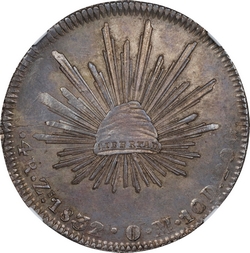
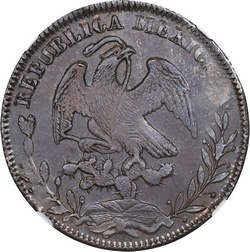
KM-375.9 4r 1832 Zs OM (Stack’s Bowers Kirk Menczer Collection, 24 June 2026, lot 73295)
| Date | Asssayer | Recorded Mintage |
Comment |
| 1830 | OM | reported | |
| 1831 | OM | . after MEXICANA | |
| 1831 | OM | no . after MEXICANA | |
| 1832 | OM | ||
| 1832/1 | OM | ||
| 1833 | OM | ||
| 1833/2 | OM | illustrated below | |
| 1833/27 | OM | ||
| 1834 | OM | ||
| 1834/3 | OM | ||
| 1835 | OM | ||
| 1836 | OM | ||
| 1837 | OM | ||
| 1837/5 | OM | ||
| 1837/6 | OM | reported | |
| 1838/7 | OM | illustrated below | |
| 1839 | OM | ||
| 1840 | OM | ||
| 1841 | OM | ||
| 1842 | OM | small letters (illustrated below) | |
| 1842 | OM | large letters (illustrated below) | |
| 1843 | OM | ||
| 1844 | OM | ||
| 1845 | OM | ||
| 1846 | OM | large OM | |
| 1846 | OM | small OM | |
| 1847 | OM | ||
| 1848 | OM | ||
| 1848/6 | OM | ||
| 1849 | OM | ||
| 1850 | OM | ||
| 1851 | OM | ||
| 1852 | OM | ||
| 1853 | OM | ||
| 1854 | OM | ||
| 1854/3 | OM | illustrated below | |
| 1855/4 | OM | ||
| 1855 | OM | large diameter | |
| 1856 | OM | small diameter | |
| 1856 | MO | ||
| 1857/5 | MO | illustrated below | |
| 1857 | MO | M/O, O/M | |
| 1857 | MO | ||
| 1858 | MO | ||
| 1859 | MO | ||
| 1860 | MO | ||
| 1860/59 | MO | illustrated below | |
| 1860 | VL | ||
| 1861 | VL | ||
| 1861/0 | VL | illustrated below | |
| 1861 6/5 | VL | ||
| 1862 | L | ||
| 1862/1 | VL | ||
| 1863 | VL | ||
| 1863 | MO | thick O | |
| 1864 | VL | issued while Maximilian's forces controlled the mint (6 February 1864 - 29 November 1866) | |
| 1868 | JS | ||
| 1868 | YH | ||
| 1869 | YH | ||
| 1870 | YH |
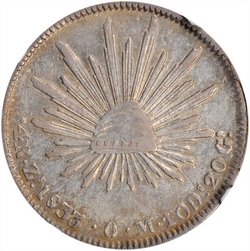
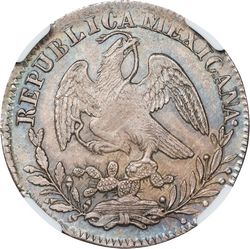
KM-375.9 4r 1833/2 Zs OM (Stack’s Bowers auction, 13 October 2021, lot 71519)
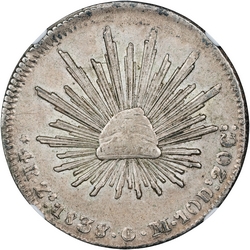
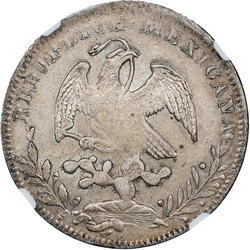
KM-375.9 4r 1838/7 Zs OM (Stack’s Bowers Kirk Menczer Collection, 24 June 2026, lot 73299)
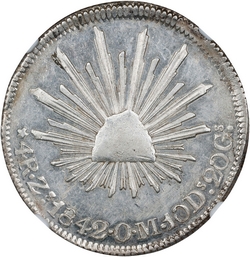
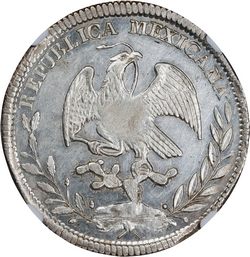
KM-375.9 4r 1842 Zs OM (Stack’s Bowers Kirk Menczer Collection, 24 June 2026, lot 73304)
Variety with large letters.
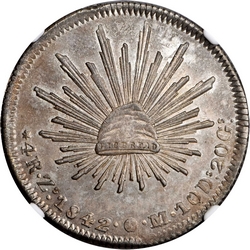
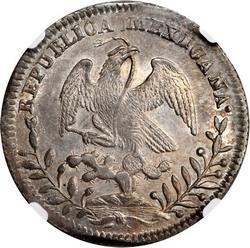
KM-375.9 4r 1842 Zs OM (Stack’s Bowers auction, 13 February 2019, lot 71243)
Variety with small letters.
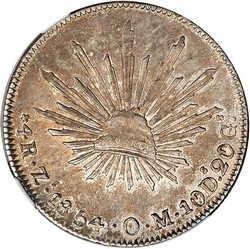
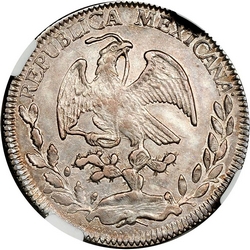
KM-375.9 4r 1854/3 Zs OM (Ponterio Baltimore auction, 28 March 2011, lot 8436)
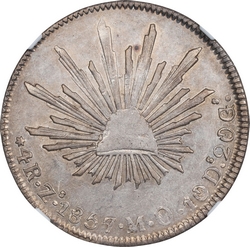
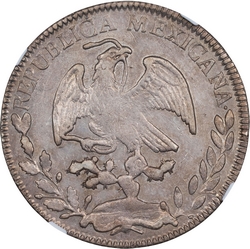
KM-375.9 4r 1857/5 Zs MO (Stack’s Bowers Kirk Menczer Collection, 24 June 2026, lot 73310)
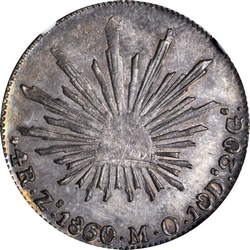
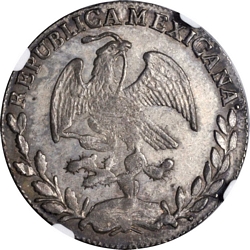
KM-375.9 4r 1860/59 Zs MO (Stack’s Bowers auction, 13 February 2019, lot 71254)
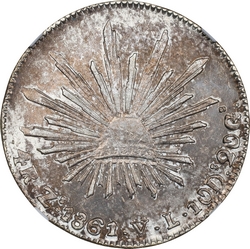
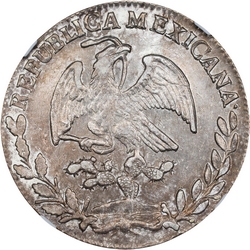
KM-375.9 4r 1861/0 Zs VL (Stack’s Bowers Kirk Menczer Collection, 24 June 2026, lot 73313)
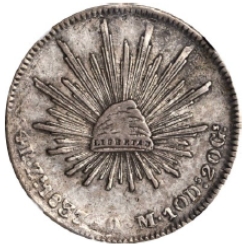
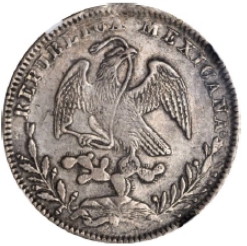
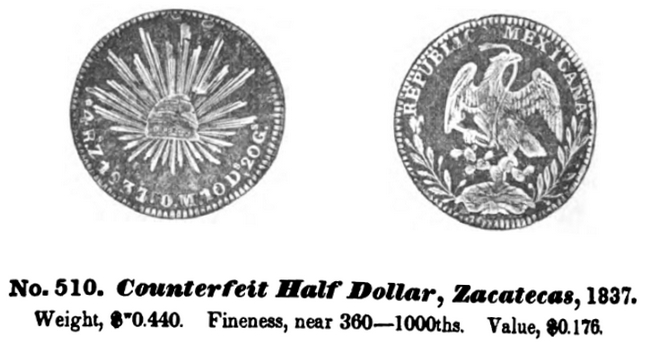
counterfeit KM-375.9 8r 1837 Z OM
This is listed as Riddell No. 510.
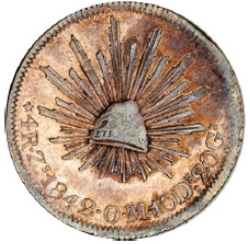
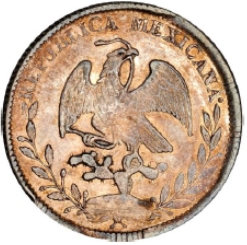
counterfeit KM-375.9 4r 1842 Zs OM
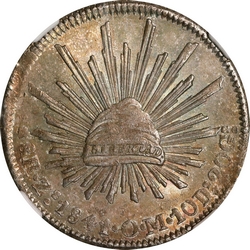
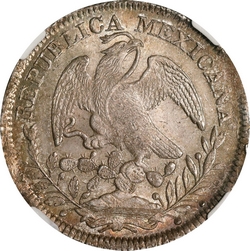
KM-377.13 8r 1841 Zs OM (Stack’s Bowers Hong Kong Auction , 8 October 2022, lot 54473)
Diameter 39 mm. 27.070 g, 0.90277 silver
| Date | Asssayer | Recorded Mintage |
Comment |
| 1825 | AZ | ||
| 1826/5 | AZ | ||
| 1826 | AZ | ||
| 1826 | AV | ||
| 1826/5 | AO/AZ | ||
| 1826 | AO | ||
| 1827 | AO | ||
| 1827 | AO/AZ | ||
| 1828 | AO | wide date | |
| 1828/7 | AO | illustrated below | |
| 1829 | AO | ||
| 1829 | OV | ||
| 1830 | OV | ||
| 1831 | OV | ||
| 1831 | OM | ||
| 1832 | OM | ||
| 1832/1 | OM | ||
| 1833 | OM | ||
| 1833/2 | OM | ||
| 1834 | OM | small 34 in date | |
| 1834 | OM | medium 34 in date | |
| 1834 | OM | large 34 in date | |
| 1835 | OM | ||
| 1836 | OM | ||
| 1836/5 | OM | ||
| 1837 | OM | ||
| 1838 | OM | ||
| 1838/7 | OM | ||
| 1839 | OM | ||
| 1839/7 | OM | ||
| 1840 | OM | ||
| 1841 | OM | ||
| 1842 | OM | eagle style of 1841 | |
| 1842 | OM | eagle style of 1843 | |
| 1843 | OM | ||
| 1843/33 | OM | ||
| 1844 | OM | ||
| 1845 | OM | ||
| 1846 | OM | ||
| 1847 | OM | ||
| 1848 | OM | ||
| 1848/7 | OM | ||
| 1849 | OM | ||
| 1850 | OM | ||
| 1851 | OM | ||
| 1852 | OM | ||
| 1853 | OM | ||
| 1854 | OM | ||
| 1855 | OM | ||
| 1855 | MO | ||
| 1856 | MO | ||
| 1856/5 | MO | ||
| 1857 | MO | ||
| 1857/5 | MO | ||
| 1858 | MO | ||
| 1858/7 | MO | illustrated below | |
| 1859 | MO | ||
| 1859/8 | MO | ||
| 1859 | VL/MO | ||
| 1859 | VL | ||
| 1860 | MO | ||
| 1860/50 | MO | ||
| 1860/59 | MO | ||
| 1860 | VL/MO | ||
| 1860 | VL | ||
| 1861 | VL | ||
| 1861/0 | VL/MO | ||
| 1861/0 | VL | ||
| 1862 | VL | ||
| 1862/1 | VL | ||
| 1863 | VL | ||
| 1863 | MO | ||
| 1864 | VL | ||
| 1864/3 | VL | issued while Maximilian's forces controlled the mint (6 February 1864 - 29 November 1866) | |
| 1864 | MO | ||
| 1865 | MO | ||
| 1865/4 | MO | ||
| 1866 | VL | circulating counterfeit | |
| 1867 | JS | ||
| 1868 | JS | ||
| 1868 | YH | ||
| 1869 | YH | ||
| 1870 | YH | ||
| 1873 | YH | ||
| 1874 | YH | ||
| 1874 | JA/YA | ||
| 1875 | JA | ||
| 1876 | JA | ||
| 1876 | JS | ||
| 1877 | JS | 2,700.000 | |
| 1878 | JS | 2,310,000 | |
| 1879 | JS | ||
| 1879/8 | JS | ||
| 1880 | JS | ||
| 1881 | JS | 5,592,000 | |
| 1882 | JS | 2,485,000 | straight J |
| 1882 | JS | full J (illustrated below) | |
| 1882/1 | JS | straight J | |
| 1882/1 | JS | full J | |
| 1883 | JS | 2,563,000 | |
| 1883/2 | JS | ||
| 1884 | JS | ||
| 1885 | JS | 2.252,000 | |
| 1886 | JS | 5,303,000 | |
| 1886/5 | JS | ||
| 1886 | FZ | ||
| 1887 | FZ | 4,733,000 | |
| 1887 | FZ | Z mintmark | |
| 1888 | FZ | 5.132,000 | |
| 1888/7 | FZ | ||
| 1889 | FZ | 4,344,000 | |
| 1890 | FZ | 3,887,000 | |
| 1891 | FZ | 4,114,000 | |
| 1891/0 | FZ | illustrated below | |
| 1892 | FZ | 4,238,000 | narrow date |
| 1892 | FZ | wide date | |
| 1892/1 | FZ | illustrated below | |
| 1893 | FZ | 3,872,000 | |
| 1894 | FZ | 3.081,000 | |
| 1895 | FZ | 4,718,000 | |
| 1896 | FZ | 4,226,000 | |
| 1897 | FZ | 4,877,000 |
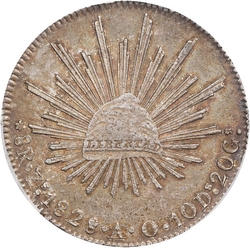
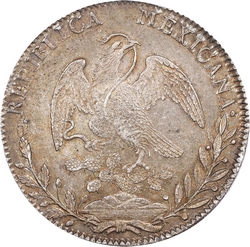
KM-377.13 8r 1828/7 Zs AO (Stack’s Bowers auction, 28 February 2024, lot 73330)
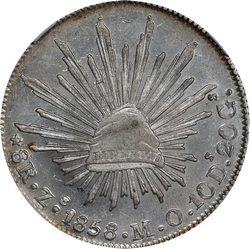
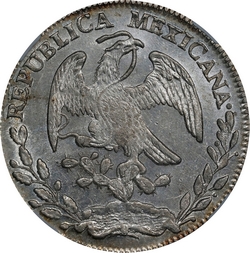
KM-377.13 8r 1858/7 Zs MO (Stack’s Bowers auction, 31 October 2023, lot 70900)
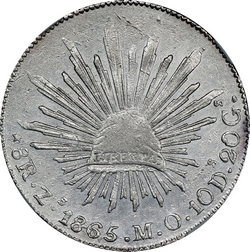
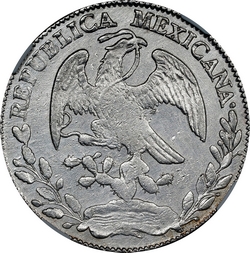
KM-377.13 8r 1865/4 Zs MO (Stack’s Bowers auction, 31 October 2023, lot 70914)
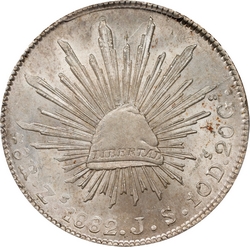
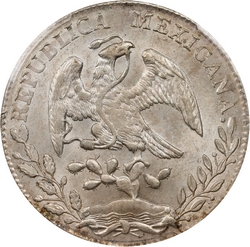
KM-377.13 8r 1882 Zs JS (Stack’s Bowers auction, 19 September 2025, lot 76476)
Variety with full "J" and mule of 1845-82 obverse die with 1882-86 reverse die.
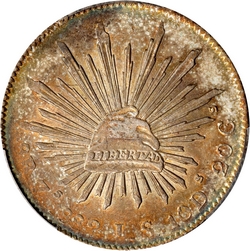
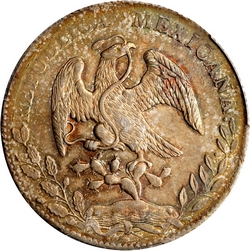
KM-377.13 8r 1882 Zs JS (Stack’s Bowers auction, 16 May 2022, lot 63395)
Variety with straight “J”
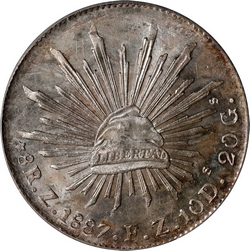
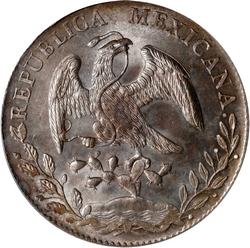
KM-377.13 8r 1887 Z FZ (Stack’s Bowers auction, 26 August 2022, lot 34450)
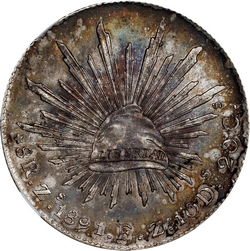
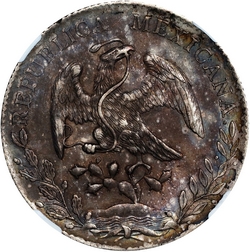
KM-377.13 8r 1891/0 Zs FZ (Stack’s Bowers auction, 31 October 2023, lot 70949)
Displaying an overdate visible under magnification
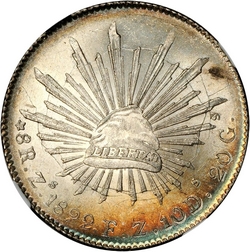
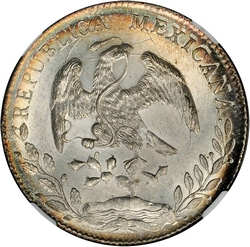
KM-377.13 8r 1892/1 Zs FZ (Ponterio Baltimore auction, June 2011, lot 6619)
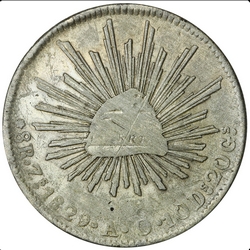
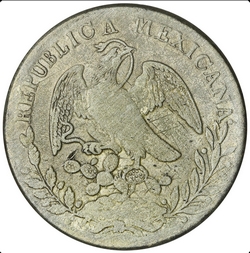
counterfeit KM-377.13 8r 1829 Zs AO (Briggs & Bustos Counterfeit issues, 22 February 2025, lot 37)
Struck in silver.
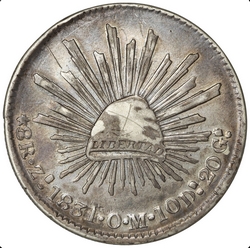
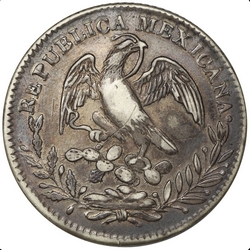
counterfeit KM-377.13 8r 1831 Zs OM (Briggs & Bustos Counterfeit issues, 22 February 2025, lot 38)
Struck in silver. This is absent in Riddell, greater similarity of design on the side of the cap while on the obverse the eagle is thinner.
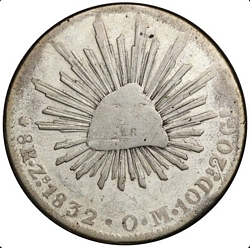
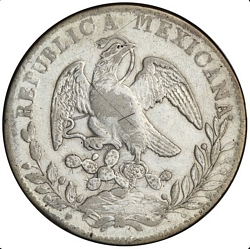
counterfeit KM-377.13 8r 1832 Zs OM (Briggs & Bustos Counterfeit issues II, 10 August 2025, lot 78)
Struck in low-fineness silver, 27.48 grams, 38.8 millimeters in diameter, medal alignment. Interesting contemporary counterfeit, notable for its exceptional similarity to the official issue of the Zacatecas mint, described by Riddell (no 223) as “admirably imitated, or perhaps genuine.”
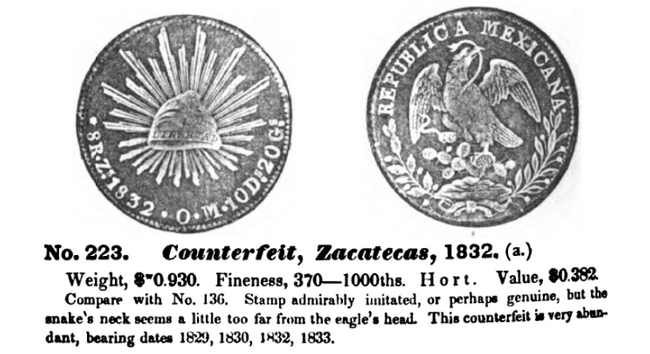 Every design element matches the original, except for the edge, whose engraving is slightly less refined and shows weakness along the rim from 9:00 to 1:00 on the obverse side. Metal composition: 74.37% Silver, 20.62% Copper, 2.58% Zinc, 1.68% Iridium, 0.5572% Lead, 0.1536% Bismuth, and 0.0445% Gold.
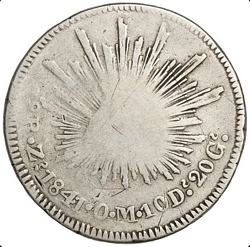
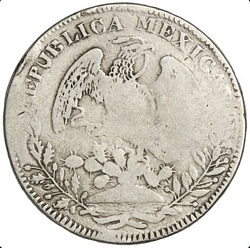
counterfeit KM-377.13 8r 1841 Zs OM (Briggs & Bustos Counterfeit issues II, 10 August 2025, lot 79)
Struck on a flan of alloy commonly known as alpaca, 24.84 grams, 38.9 millimeters in diameter, medal alignment. Counterfeit not documented in Riddell’s work, identifiable by the backward “s” letters in the legend on the cap side, along with a reverse distinguished by the eagle’s curled feathers. Diffuse Republican edge cord at 12:00 and 6:00. Metal composition: 66.45% Copper, 16.85% Zinc, 14.98% Nickel, 0.6669% Iron, 0.66% Lead, and 0.3836% Cobalt.
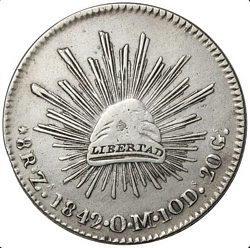
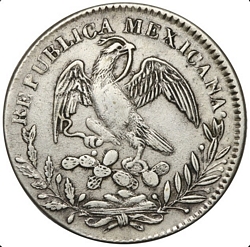
counterfeit KM-377.13 8r 1842 Zs OM (Briggs & Bustos Counterfeit issues II, 10 August 2025, lot 81)
Struck on a low grade planchet. 26.65 grams, 38.2 millimeters in diameter, medal alignment. Easily recognizable by its distinctive Phrygian cap with rounded edges, surrounded by short and narrow rays. Eagle with narrow body and a noticeably smaller left wing. Slight differences in the legend typography. Crude edge design. Metal composition: 54.37% silver, 27.98% copper, 12.06% zinc, 3.48% nickel, 1.1396% lead, 0.76% tin, 0.1202% iron, and 0.0985% Bismuth.
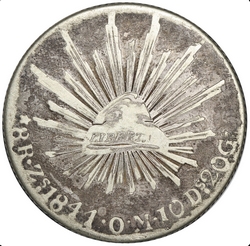
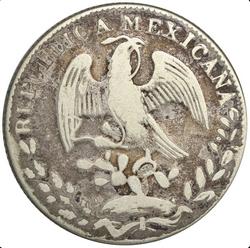
counterfeit KM-377.13 8r 1844 Zs OM (Briggs & Bustos Counterfeit issues II, 10 August 2025, lot 80)
Struck on a flan of alloy commonly known as alpaca with low silver content, 21.16 grams, 38.7 millimeters in diameter, coin alignment. Specimen not reported by Riddell. Features a curious cap design that, when compared to a genuine piece, appears wider and slightly flattened. The reverse shows an eagle characterized by plumage composed of well-defined lines, with an apparent error in the legend: “REPULLICA.” Flan notably thin and the Republican edge cord appears somewhat crude. Metal composition: 56.57% Copper, 20.83% Zinc, 10.78% Nickel, 10.46% Silver, 0.6822% Lead, 0.3868% Cobalt, and 0.2933% Iron.
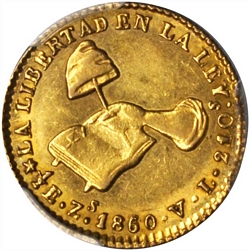
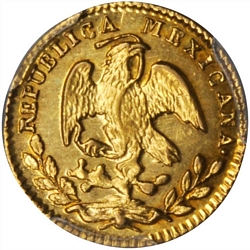
KM-378.6 ½E 1860 Zs VL (Stack’s Bowers ANA auction, 21 August 2018, lot 23380)
Diameter 15 mm. 1.690 g. 0.8750 gold
For a commentary on the Zacatecas half escudo, see here. Zacatecas produced half escudos in only two years.
| Date | Asssayer | Recorded Mintage |
Comment |
| 1860 | VL | ||
| 1862/1 | VL | illustrated below | |
| 1862 | VL |
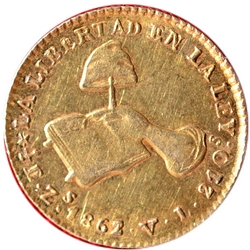
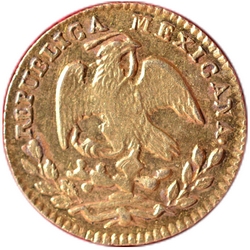
KM-378.6 ½E 1862/1 Zs VL (Stack’s Bowers auction, 3 September 2025, lot 45470)
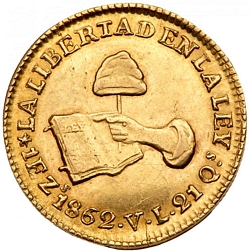
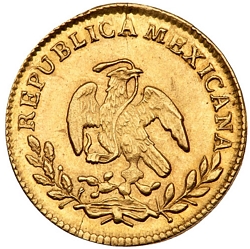
KM-379.6 1E 1862 Zs VL
Diameter 18 mm. 3.380 g. 0.8750 gold
| Date | Asssayer | Recorded Mintage |
Comment |
| 1853 | O-M | ||
| 1860/59 | VL | V is inverted A (illustrated below) | |
| 1860 | VL | ||
| 1862 | VL |
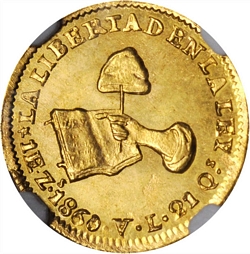
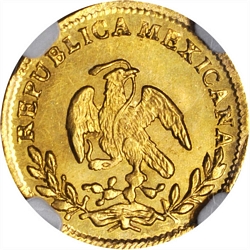
KM-379.6 1E 1860/59 Zs VL (Stack’s Bowers auction, 13 February 2019, lot 71036)
Inverted "A" in place of "V" for the Assayer's initials.
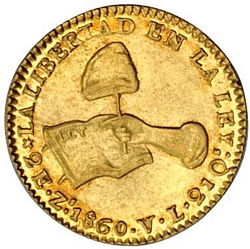
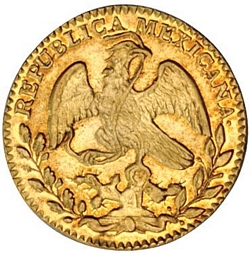
KM-380.8 2E 1860 Zs VL (Ponterio auction, 15 April 2005, lot 3333)
Diameter 23 mm. 6.770 g. 0.8750 gold
| Date | Asssayer | Recorded Mintage |
Comment |
| 1860 | VL | ||
| 1862 | VL | ||
| 1864 | M-O |
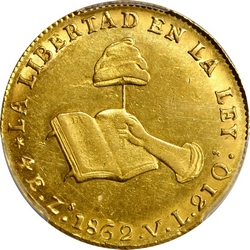
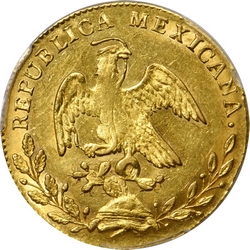
KM-381.8 4E 1862 Zs VL (Stack’s Bowers auction, 22 October 2020, lot 72217)
Diameter 30 mm. 13.540 g. 0.8750 gold
| Date | Asssayer | Recorded Mintage |
Comment |
| 1860 | VL | ||
| 1862 | VL |
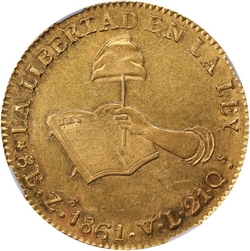
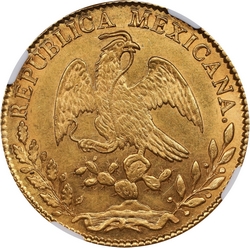
KM-383.11 8E 1861 Zs VL (Stack’s Bowers auction, 26 August 2025, lot 41364)
Diameter 37 mm. 27.070 g. 0.8750 gold
| Date | Asssayer | Recorded Mintage |
Comment |
| 1858 | MO | ||
| 1859 | MO | ||
| 1860/59 | VL/MO | ||
| 1860/9 | MO | ||
| 1860 | MO | ||
| 1861/0 | VL | ||
| 1861 | VLVL | ||
| 1862 | VL | ||
| 1863 | MO | ||
| 1863 | MO | ||
| 1864 | MO | issued while Maximilian's forces controlled the mint (6 February 1864 - 29 November 1866) | |
| 1865 | MO | ||
| 1866 | JS | ||
| 1868 | YH | ||
| 1869 | YH | ||
| 1870 | YH | ||
| 1871 | YH |
Since the 16th century in the viceroyalty period different parts of the Mexican territory requested authorization to open a mint{footnote}Nueva Galicia (Guadalajara) 1573, Zacatecas 1575, Arizpe, Sonora 1768. For more information see: “El comienzo de las Casas de Moneda Provisionales” https://wordpress.com/page/ eldatonumismatico.wordpress.com/176{/footnote}. However, as it is well known, that benefit came with Independence, and thereafter, throughout all of the 19th century, more than a dozen facilities for minting coins entered into operation.
Several authors have documented this period, by explaining the leasing contracts, the relevant laws, and the minting statistics{footnote}The classic texts are: (i) Gutiérrez, Bonifacio (1849) Memoria presentada a la Cámara de Diputados en 20 de octubre del presente año por el Secretario de Estado y Despacho de Hacienda sobre la creación y el estado actual de las Casas de Moneda de la República. [facsimile published in 1989 by the Casa de Moneda de México], (ii) Orozco y Berra, Manuel (1854) Moneda en México, in Tomo V, Diccionario Universal de Historia y Geografía. Imprenta de F. Escalante y C. [facsimile published in 1993 by the Banco de México], (iii) Pradeau, Alberto Francisco (1957) Historia Numismática de México de 1823-1950, Sociedad Numismática de México. México D.F., or more recently: (iv) Matamala, Juan Fernando (2005) Las Casas de Moneda Foráneas 1810-1905 in La acuñación en México, 1535-2005, Casa de Moneda de México. México D.F.{/footnote}. The purpose of this article is to highlight what were the reasons behind the closure of all the existing mints in the 1890s and the first years of the following century, focusing on the effects of the Monetary Reform of 25 March 1905. the cornerstone of the current Mexican currency system.
Since 1849 the then Secretario de Hacienda (Treasury Minister), Bonifacio Gutiérrez had manifested the harm that the leasing of regional mints was doing to the public interests:
...these contracts include privileges to produce coins, that in no way are consistent with the dignity of the Nation, the only one with the right to strike coins [...] these agreements weaken the vigilance of the mints, that in case of any mistake the liability will correspond only to the Nation... Nevertheless, taking advantage of these contracts [...] the lessees have committed several number of abuses{footnote}Gutiérrez, Bonifacio (1849) Memoria presentada a la Cámara de Diputados en 20 de octubre del presente año por el Secretario de Estado y Despacho de Hacienda sobre la creación y el estado actual de las Casas de Moneda de la República. [Facsimile published in 1989 by the Casa de Moneda de México]{/footnote}.
This line of thought was debated by the Constituent representatives who wrote the liberal Constitution of 1857, but nothing was achieved; it would only take effect decades later. It was after the Second Empire, when Benito Juárez finally strengthened his power as the main political leader of the country, that this was achieved. Juárez delegated to his Treasury Ministers, Manuel Dublán and later Matías Romero, the task of arranging the matter with the private contractors.
In 1868 all the regulatory inquiries related to minting coinage were transferred from the Ministry of the Treasury to the Ministry of Development, Industry and Commerce. The reason for this change was important: the government believed that the mints would no longer be considered as a tool for making money, instead it was hoped that they would represent an industry that encouraged mining and national development{footnote}Velasco, Omar, & Romero, Ma. Eugenia. (2020). Exportation of uncoined metals through the Mexican West Coast and the creation of the Culiacan Mint, 1825-1870. América Latina en la historia económica, 27(3), e1030. Epub 22 December 2020. https://doi.org/10.18232/alhe.1035{/footnote}.
On the other hand, an historical and statistical review of some of the leasing contracts shows that the government had made losses of more than one million pesos, in such cases as the Guadalupe y Calvo, Guanajuato and Zacatecas contracts. Moreover, a few lessees came to concentrate the administration of most of the mints: for example, by 1847 Manning & Mackintosh managed 80% of the national silver coin production and 90% of gold{footnote}Herrera Canales, Inés (1999) El rescate de las casas de moneda: un paso a la concentración de las rentas federales a fines del siglo XIX, in El mercado de valores, Revista de Nacional Financiera, México, 11, año LIX. México D.F.{/footnote}.
On 24 December 1871, a law was passed enacting that when the existing leases ended, all the mints would automatically pass to the control of the Federal Government. Also, revenues and tax issues related to mints, such as metal smelting, refinery and coining, would pass to government control{footnote}Herrera, op. cit.{/footnote}.
The same political agenda was shared by Juárez’ successor, Sebastián Lerdo de Tejada (1872-1876). By the 1870s nearly all the Mexican mint had been recovered by the Federal Government, as the following chart shows{footnote}I share some data with Parker J.B, Dunigan, Mike (1997) Resplandores: Cap and Rays 8 Reales of the Republic of Mexico. Superior Stamp & Coin. Beverly Hills, California.: some discrepancies may exist, confronted with sources quoted in the bibliography.{/footnote}:
| Mint | Government takes control |
| Durango, Durango | 1866 |
| Mexico City | 1869 |
| Culiacán, Sinaloa | 1870 |
| Alamos, Sonora | 1871 |
| Hermosillo, Sonora | 1871 |
| San Luis Potosí, San Luis Potosí | 1873 |
| Chihuahua, Chihuahua | 1874 |
| Guanajuato, Guanajuato | 1874 |
| Zacatecas, Zacatecas | 1874 |
| Guadalajara, Jalisco | 1876 |
However, all the progress achieved would temporarily be put into reverse, when Porfirio Díaz arrived in power in 1876, after the Tuxtepec revolts. The public finances of the still fragile Mexican nation faced challenges and the first option to raise money was to lease, once again, all of the mints, despite the criticisms that this was a fast alternative to obtain resources{footnote}Throughout the entire 19th century, money was the principal reason to lease mints, the lack of revenues and a deficit in organization of the national finances by the government, as well as opposition by local businessmen and politicians. (Herrera, 1999).{/footnote}. The following charts the years when all the mints were leased to private contractors:
| Mint | Government cedes control |
| Durango, Durango | 1879 |
| Mexico City | 1872 |
| Culiacán, Sinaloa | 1876 |
| Alamos, Sonora | 1876 |
| Hermosillo, Sonora | 1876 |
| San Luis Potosí, San Luis Potosí | 1876 |
| Chihuahua, Chihuahua | 1880 |
| Guanajuato, Guanajuato | 1876 |
| Zacatecas, Zacatecas | 1876 |
| Guadalajara, Jalisco | 1879 |
On 12 December 1879 a new law (which rescinded the previous law of 1871) approved that the government could lease mints.
Matías Romero, in his memories, explained the main problems with the management of coining facilities in private hands:
The biggest obstacle to improve the mining industry is the harmful system of leasing mints, since this system had turned them into highly productive speculative establishments [...] that benefits only a small group...
Moreover, the historian José Manuel Sobrino has asserted that due to necessity or for the convenience of the mint lessees, the national minting provisions were not enforced. Neil S. Utberg{footnote}Utberg, Neil (1963) The Coins of Mexico 1536-1963. Edinburg, Texas.{/footnote} explained that “…as a result of the lenient terms of the contracts and bookkeeping practices the Mexican Government lost considerable revenue and the contracting companies reaped a good harvest.”

Coining room at the Mexico City Mint in the late 1890s, all the equipment powered by steam.
(Colección CMM, MNN, Anónimo ca. quoted from Garcia Lima, 2017)
How did the Diaz government recover (this time for ever) the national mints? Several factors explain how, in a shorter period, Díaz achieved what Juárez and Lerdo de Tejada could not do.
1. Global depreciation of silver in the last quarter of the 19th century.
2. Less silver coins were exported, as opposed to bullion, and more raw silver or bars, eliminating the coining factor in the chain of production{footnote}By 1878 87% of the exported silver were in coins, by 1900 only 19% (Herrera, 1999){/footnote}.
3. Industrial minerals became more attractive in the international markets.
4. Changes in revenue, tax, and mining laws.
5. New methods for coining production.
6. The consolidation of paper money.
7. The Mexican Peso decreased its use in world trade.
One might think that since the Federal Government had previously run some mints for long periods, for example Mexico City until 1847, Oaxaca from 1872 to 1893, and San Luis Potosi from 1835 to 1857, it would seem that that its intention was to keep all of them. However, the coining industry became less profitable, and coining facilities by this time only functioned to supply the domestic demand for currency (Herrera, 1999).
With a weaker coin industry, a government with better finances and more resources than before, the Díaz administration started to recover the mints{footnote}The Banco Nacional de México helped in the process, giving loans to the government to arrange the multiple contracts (Herrera, 1999).{/footnote}; in 1895{footnote}The decree of 15 June 1895, (that took effect on 30 June) closed all the mints and only assay offices continued to functions in Oaxaca, San Luis Potosí, Monterrey, Guadalajara, Durango, Chihuahua, Alamos and Hermosillo (Méndez Reyes, Jesús (2006) Un debate sobre la regulación económica, la Comisión de Cambios y Moneda antecedente de un banco central, in Temas a Debate. Moneda y Banca en México 1884-1954. UNAM. México D.F). The equipment and machinery of some of them were sent to the Mexico City Mint, such as the case of the San Luis Potosi mint (Sobrino, José Manuel (1989). La Moneda Mexicana, su historia. (Segunda edición). Banco de México. México D.F. ).{/footnote}, calculating the national demand for coins and production, it decided to operate only four branches in the country: Culiacán, Zacatecas, Guanajuato and Mexico City.
I want to start this section with the following quote from Don and Lois Bailey that summarizes in a very clever way the monetary situation in this age:
At the beginning of the 20th century, the coinage of Mexico was in disarray. All the regional mints were in private contracts [...] Leading up to the 1905 reform, the branch mints’ contracts were beginning to come up for renewal [...] This was Mexico´s opportunity to close the branch mints and move all minting operations to Mexico City [...] The monetary reform of 1905 changed the status of the Apartado Mint from the Mexico City Mint to the Mexico Mint.
To realize why, on 31 May 1905, the Culiacán and Zacatecas mints closed (Guanajuato had already closed on 30 June 1900) it is important to understand the Monetary Act of 1905, that for decades has been the subject of debate. This is a complex topic that goes beyond this article{footnote}To know more about this, I recommend the article: “Moneda & crisis económicas, el inicio del siglo XX en México” https:// eldatonumismatico.wordpress.com/la-crisis-de-1907-1908-y-la-estrategia-del-gobierno-con-limantour/{/footnote}, but its main achievement was to introduce the gold standard in Mexico{footnote}The United States introduced the gold standard in 1900, but in practice it was the regular basis since 1879.{/footnote}. I will here focus on the reasons for closing the coining facilities.
This was first mentioned during the London Monetary Conference of 1903, to which Mexico sent a delegation{footnote} The delegation was made up of important individuals such as Manuel Fernández Leal, Director of the Mexico City Mint from 1901 to 1909, Pablo Macedo, adviser of the Banco Nacional de México (who also signed banknotes as a consejero), Joaquín D. Casasus, founder of the Banco Central Mexicano. To review the complete list, see Romero Sotelo, María Eugenia (2006) Bimetalismo vs. Patrón oro, una larga controversia en México, in Temas a Debate. Moneda y Banca en México 1884-1954. UNAM. México D.F.{/footnote} to learn about silver stability and depreciation, in order to plan policies regarding its domestic currency. The general consensus was that in order to achieve the stability of international exchange, it was necessary to prohibit free minting in the hands of private entrepreneurs. (the normal practice in Mexico since the Spanish period) and therefore, to close the provincial mints (Romero Sotelo, 2006).
Furthermore, Ines Herrera{footnote}Herrera Canales, Inés (1999) Casa de Moneda de México en el siglo XIX: de la pérdida a la recuperación del monopolio de acuñación en Casa de Moneda de México, Cinco Siglos de Tradición. Secretaría de Hacienda y Crédito Público. México D.F.{/footnote} add that the advances achieved in metallurgy at that time converted Mexico into an attractive country not only in precious metals, but also in industrial metals. Foreign capital and investors stopped seeing mints as the only lucrative business, migrating to other types of industrial refining factories.
In this same topic, since the Monetary Act of 25 March 1905 focused on gold issues (the international standard) lawmakers believed that Mexico should start to produce more gold pieces than silver ones, whereas the provincial mints were producing mainly silver and copper pieces{footnote}Between 1905 to 1910 gold production went from 89 to 164 tons (Méndez, Reyes 2006).{/footnote}. In the Memoria of 1905{footnote}Memoria de Hacienda y Crédito Público, correspondiente al año económico de 1 de Julio de 1904 a 30 de Junio de 1905, presentada por el Secretario de Hacienda al Congreso de la Unión. Tipografía de la Oficina Impresora de Estampillas. Palacio Nacional, México D.F.{/footnote} that is proved in the following way:

Also, since 1902 new machinery and equipment was purchased for the Mexico City mint to improve the supply of the nation with new coins. In this regard Salvador García Lima (2017) added the following{footnote}To know more about the main changes in the Mexico City Mint in the first years of the 20th century see García Lima, Salvador (2017) El Ingeniero Francisco Valdés y la planta de Apartado. Casa de Moneda de México. Ciudad de México.{/footnote}:
...the adoption of electrical energy as a source of lighting and motor force, with the recovery of the coinage monopoly [...] and the Monetary Reform of 1905, which forced the managers to adopt urgent measures to provide efficient machinery capable of facing the technical challenge implied by the minting of a complete monetary family nationwide...
Years later the Mexico Mint would request foreign mints in the United Kingdom and the United States to complement its own production with foreign minting{footnote}To know more about Mexican coins produced in foreign countries I recommend (i) Long, Richard (1976) The Availability of 20th Century Mexican Coins. Wegferd Publications. Bandon, Oregón and (ii) Bailey, D., & Bailey, L. (2015) Whitman Encyclopedia of Mexican Money, Volume 2, Modern Coins of Mexico, 1905 to Date. Whitman Publishing. Atlanta, Georgia.{/footnote}, but this is a topic for another time.
As discussed, the main debate on recovering all the mints was the idea that the administration of the mints by private lessees was unscrupulous. The necessities of war obliged the government to issue leases again, and only international trade made it easier for the federal administration to achieve control of all the mints. I believe that from the experience acquired throughout the 19th century the solution was to centralize all the operations. From 1895 the Mexico City Mint became the only factory to produce coins and the provincial mints took on other functions. This system was intended to create standardized proceedings and uniform coins. The government institution that managed the monetary procedures was the Exchange and Currency Commission (Comisión de Cambios y Moneda) created on 3 April 1905{footnote}García Lima, Salvador (2017) El Ingeniero Francisco Valdés y la planta de Apartado. Casa de Moneda de México. Ciudad de México.{/footnote}.

Coining room at the Mexico City Mint in the 1930s, all the equipment powered by electricity.
(Colección CMM, MNN, Anónimo ca. quoted from Garcia Lima, 2017)
This was a change that was completed in other areas of the economy such as the railroads, lighting companies, and oil companies. Sooner or later the government decided to control (monopolize) all these industries (although for different reasons) considering not only their profitability but them as industries at the service of society.
I appreciate the help and advice of Alma Parra Campos PhD.
The enormous variety of host coin and countermark combinations that occur in the Spanish colony of the Philippines during 1828-37 created a series that is never ending and impossible to complete. After identifying over 1,600 specimens by inspecting individual examples and acquiring images from various sources including auction catalogs, books, private collections, institutions, pamphlets, periodicals etc. one can explain the whole Philippines countermark series using almost all Mexican host coins as examples. There are three exceptions, one at the very beginning and two towards the end where Mexican host coins for particular varieties were not known to the author. As such, substitutes were used to fill the gaps to give the reader a clearer understanding.
In general, Mexican host coins are some of the most common to be found in the countermark series of the Philippines, but it also includes some of the rarest. There are three major types from this series the Manila overstrikes 1828 & 1830, Ferdinand VII (F.7.0) (1832-34) and Isabella II (Y.II.) (1834-37) as well as categories for minor coinage, gold, additional countermarks, corrected and perforated (holed) examples. The Manila dies were all prepared locally by foundry master Benito de los Reyes at the same foundry where the cast copper brillias were produced. When they switched to the hand held punches of F.7.0 and Y.II. the local government hired Diego de los Reyes to prepare them. The areas of Mexican numismatics covered here include Pillars, Portraits, War of Independence, Empire of Iturbide and early Republic issues up to 1836. Even though Mexican hosts are plentiful if one is patient one can acquire real rarities in their own right.
After the colonies of the Americas gained independence and started issuing their own coinage, the Philippines, one of Spain’s last hold outs, began to see a large influx of coinage with legends that the crown found offensive. Fearing that these offensive insurgent issues might incite an uprising the local government at Manila decided to take action.
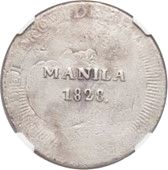
On 13 October 1828, Mariano Ricafort, Captain General of the Philippine Islands, a subdivision of the Vice-Royalty of Mexico, issued an edict introducing a system of marking the “Pesos y Onzas de oro” produced by the “Provincias insurectas y gobiernos revolucionarios” of the South American continent so that such subversive words as “Republica”, “Indepencia”, and“Libre” commonly seen on the newly issued coinage would be obliterated. Thus we have the 1828 and 1830 Manila overstrike issues, each of which had two sets of dies prepared. These were manufactured in a similar fashion to the 960 Reis of Brazil as the authorities completely overstruck the host coins trying to obliterate any and all signs of the original design. Producing these issues ultimately proved to be costly and inefficient with large gaps between production runs.
The traditional thought process for the issues dated 1828 is that there are two different types. The first have full design features such as the serrated border to obscure the offensive legends of both obverse and reverse, full legends “HABIITADO POR EL REY N.S.D.FERN.VII.” (Rehabilitated by the King our Lord Don Fernando VII) around the crowned arms of Spain (obverse) and Manila above date “1828” (reverse). The second type was supposedly caused by effacing the dies by removing the serrated borders and legend leaving only the central design features. Again this was supposedly done due to the frequent break downs, so that the design was easier to impress upon the host.
Though I do not believe this to be the case I do believe them to be related. As the minting equipment kept breaking down the pressure required to fully impress the design features on the hosts became less and less, causing weaker and weaker strikes. The lack of details seemed to coincide with this logic. However, every example that I have examined had remnants of the supposedly effaced details. This leads us to believe that there is in fact only one type.
We know that Benito de los Reyes prepared two sets of dies for the 1828 issues. I have identified them as Die # 1 and Die # 2. These arbitrary designations are for identification purposes as there is no documented evidence which supports this; as such the order is purely conjecture. It is the thought of the author based on the style of these two pairs of dies that Die # 1 was used first and Die # 2 was used second as it is closer in style to that of the 1830 issues. During my research I have been able to identify over 158 individual examples between the two different sets of dies, 30 of which are Mexican host coins all struck with Die # 1. It is possible that muleing of these dies exists. However, no such specimen is known to the author that would indicate this.
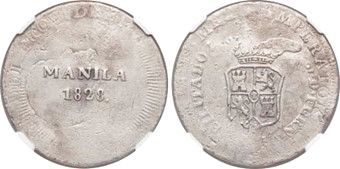 Manila 1828 Die # 1, host Mexico Empire of Iturbide 8 Reales 1822. Only a couple are known to be hosts for the overstrikes.
(Heritage CICF 2014 auction, lot 25625)
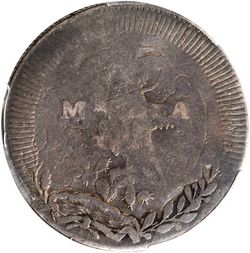
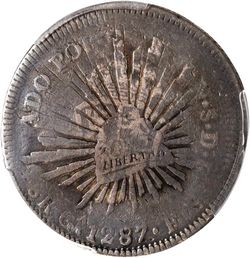
Manila 1828 Die # 1, host Mexico Republic 8 Reales 1287(1827)-GaFS. One of only four examples known and specifically mentioned in Resplandores.
(Stack’s Bowers and Ponterio NYINC auction, 9 Jan. 2015, “The Ray Czahor Collection”, lot 1360)
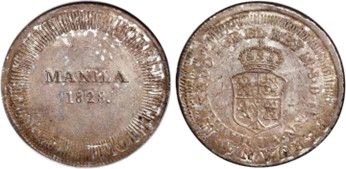 Manila 1828 Die # 2, host Peru 8 Reales 1828-LM JM. Common host coin in unusually high quality. Normally found in Fine to Very Fine condition with weak or uneven strikes, pieces found above Very Fine and with a full strike of both obverse and reverse dies are indeed very rare.
(Heritage ANA 2015 auction Lot # 32328)
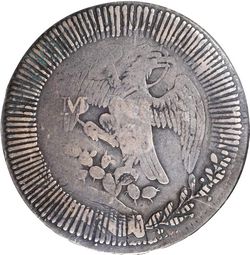
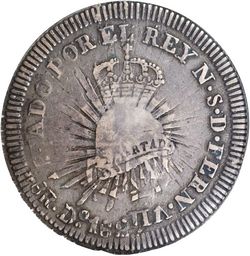
Manila 1830, host Mexico Republic 8 Reales 1827-DoRL. (Stack’s Bowers & Ponterio NYINC 2014 auction, lot 1530, Ex Heritage CICF 2013 auction Lot # 25239, Ex Lyn Knight 10 June 2012 Lot # 5341 “The Dr. Greg Pineda Collection”, Ex Ponterio & Associates Auction # 68 CICF 14-15 April 1994 Lot # 1467, Ex Ponterio & Associates Auction # 58 17 Oct. 1992 Lot # 1492, Ex Aureo Auction 23 Oct. 1990 Lot # 937, Ex Schulman 18-19 March 1966 Lot # 1122 “The Howard D. Gibbs collection”)
The 1830 overstrikes are nearly identical to those of 1828 except for the date, a few minor differences and that different minting equipment was used in their manufacture. The frequent breakdowns of the 1828 issues eventually required the replacement of the equipment. So a new press was ordered from Bengal. When it arrived it was discovered that the old dies could not be retro-fitted and that new dies were required. Two sets of dies were prepared, but commencement of the overstriking did not begin until the issuance of the 16 January 1832 decree. About a week into production the new Bengal press broke down.
It is interesting to note that every example studied was struck with only one set of dies. Though this is not unusual in and of itself it is peculiar as it is known that two sets of dies were produced by Benito de los Reyes who also produced both sets of dies for the 1828 issues, but which used different minting equipment. This could be due to the minting equipment continuously breaking down to the point where it could no longer be repaired and used, thus not placing the second set of dies into production. It is believed that there are approximately 20-30 examples known of which I have been able to locate 13, with only four being Mexican hosts. The 1830 overstrikes are considered one of the keys to the series and as such very rare.
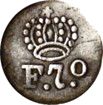 When the authorities eventually abandoned the overstriking process they switched to the hand held punches produced by Diego de los Reyes containing the King’s cipher “F.7.0”. These new punches were more compact and could be applied with a hammer, supposedly to the obverse of the insurgent coins, foreign coins and badly worn or mutilated coins. These countermarks were applied for just overtwo years, authorized on 2 October 1832, commenced on 5 October 1832 and officially ending on 20 December 1834.
With the implementation of these new hand held punches we see a greater variety of host coins, including minor coinage such as 1, 2, and 4 Reales. Smaller denominations from this series are all rare with the 2 Reales being the most “common” and the 1 Real being the rarest. Over 436 examples of various 8 Reales have been cited, with 134 on Mexican host coins. There are three major pearl sequence patterns; 5-4-*(1), 5-4-1 and 5-4-!(2) each with multiple punches.
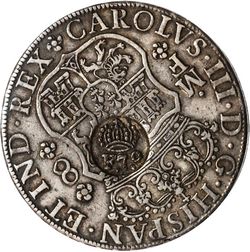
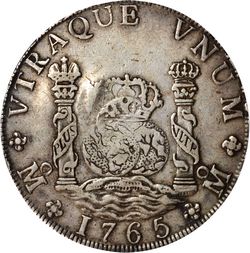
F.7.0 with 5-4-! pearl sequence, host Mexico Pillar 8 Reales 1765-MF; Note: Anvil damage on reverse displaying a mirror image of countermark.
(Stack’s Bowers and Ponterio NYINC auction 9 January 2015 “The Ray Czahor collection”, lot 1373, Ex Philippine Numismatic & Antiquarian Society 19th Annual Convention and Grand Auction 14-15 Nov. 1992 Lot # 350 (Front cover coin))
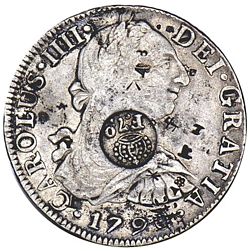
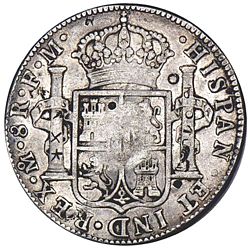
F.7.0 with 5-4-1 pearl sequence, host Mexico Bust 8 Reales 1790-FM, transitional Bust of Charles III, but in the name of Charles IV (ordinal IIII). This one is quite interesting as it displays three generations of Habsburgs.
(Stack’s Coin Galleries 17 Dec. 2008 , lot 1228)
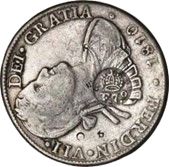
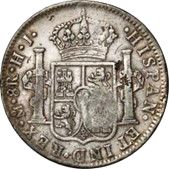
F.7.0 with 5-4-! pearl sequence, host Mexico Bust 8 Reales 1810-HJ. Quite a pleasant example with minimal chopmarks and fairly high grade.(Private collection)
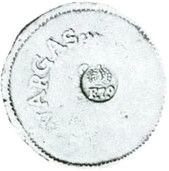
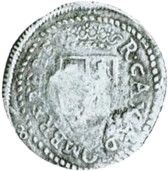
F.7.0 with 5-4-1 pearl sequence, host Mexico War of Independence 8 Reales 1812 Somberete de Vargas. Extremely rare host coin with very few examples known for all types. Plated in Lopez-Chavez-Yriarte, Type III Group B # 1580.
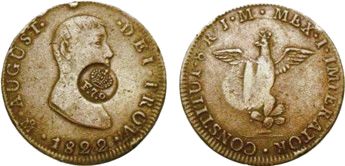 F.7.0 with 5-4-1 pearl sequence, host Mexico Empire of Iturbide 8 Reales 1822-JM, First bust type with skinny eagle; the phallic like anvil damage on the reverse consistently shows up throughout the series in various locations. (Ponterio & Associates Auction # 142 27-28 April 2007 Lot # 2521)
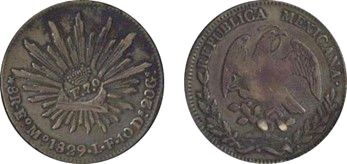 F.7.0 with 5-4-1 pearl sequence. Host Mexico Republic 8 Reales 1829-EoMo. Rare host coin in its own right.
(From the Mariano M. Cacho Jr. collection # VIII- CS-040, Ex Bank Leu Auction 24 Oct. 1990 “A Bostonian Collection”)
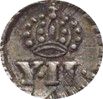 Upon the death of her father, Ferdinand VII, Isabella II became Queen and we see yet another change in the countermarks of the Philippines. No longer do they contain the King’s cipher “F.7.0”, but instead the cipher of the new Queen “Y.II.” (decree of 20 December 1834, suppressed 31 March 1837 (by decree of 1 February 1836)). As with the previous “F.7.0” countermark, all minor coinage bearing the “Y.II” countermark are rare. Over 832 various 8 Reales have been cited with more than 335 being on Mexican host coins. There are seven major pearl sequence patterns; 5-2-2, 5-3-1, 5-3-2, 5-3-3, 5-4-1, 5-4-2 and 5-4-3, many with multiple punches.
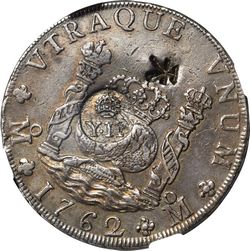
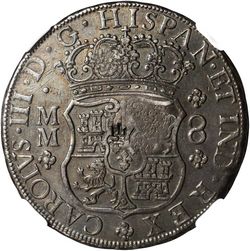
Y.II. with 5-2-2 pearl sequence, host Mexico Pillar 8 Reales 1762/1-MM. A high grade example with minimal chopmarks. (Stack’s Bowers and Ponterio NYINC auction 9 January 2015, “The Ray Czahor collection”, lot 1402, Ex Paul Bosco Auction # 18 4 Aug. 1997 Lot # 229 “The Hal Walls Collection of World Trade Coins”)
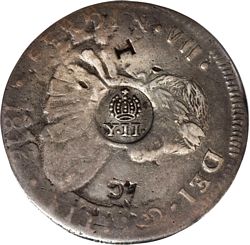
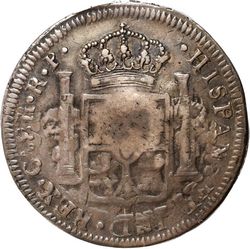
Y.II. with 5-4-3 pearl sequence, host Mexico War of Independence 8 Reales 1816-CaRP. Scarce host with an excellent early provenance.
(Stack’s Bowers and Ponterio NYINC auction 9 January 2015 “The Ray Czahor collection”, lot 1404, Ex Schulman 19-21 March 1968 Lot # 639 , Medina Plate Coin)
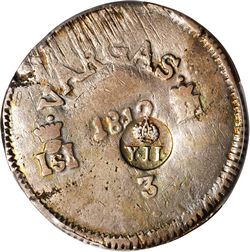
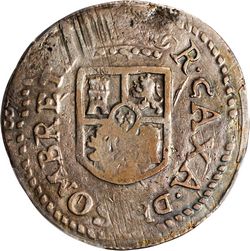
Y.II. with 5-3-2 pearl sequence, host Mexico War of Independence 8 Reales 1812 Somberete de Vargas. Another example of this extremely rare host coin.
(Stack’s Bowers & Ponterio NYINC auction 9 Jan. 2015 Lot # 1407 “The Ray Czahor Collection”, Ex World Wide Coin of California Auction XXX 14 Nov. 1996 Lot # 323)
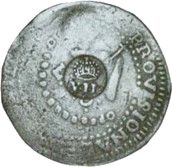 Y.II. with 5-4-1 pearl sequence, host Mexico War of Independence 8 Reales 1811 Moneda Provisional L.V.O., one of only two known to the author with the other housed in the American Numismatic Association’s collection. (Ponterio & Associates auction # 14 25 April 1984 Lot # 330)
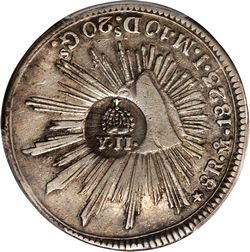
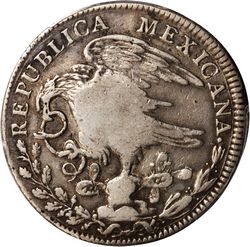
Y.II. with 5-4-3 pearl sequence, host Mexico Republic “Hookneck” 8 Reales 1823-MoJM, Flat top 3 with curled snake. Scarce and popular type.
(Stack’s Bowers and Ponterio NYINC auction 9 Jan. 2015 Lot # 1416 “The Ray Czahor collection”)
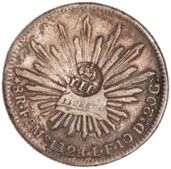
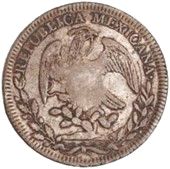
Y.II. with 5-3-2 pearl sequence, host Mexico Republic 8 Reales 1828-EoMoLF. Very rare host with an excellent provenance.
(American Numismatic Society collection # 1926.999.129)
Before the below stated decree minor coinage was to circulate freely without being countermarked. So any “F.7.0” countermarks found on minors is either the result of random pieces mixed in with the submitted coins to be revalidated or someone messing around at the countermarking office because the date of the decree (14 December 1835, suppressed 31 March 1837 (by decree of 1 February 1836)) is after the “Y.II.” countermarks were put into use. For the 1 Real all 11 pieces cited are from Mexico, for the 2 Reales of the 44 pieces cited 35 are Mexican hosts and for the 4 Reales of the 18 pieces cited 12 are on Mexican hosts.


Y.II. with 5-4-3 pearl sequence, host Mexico Republic 1 Real 1830-GoMJ. (private collection)
Y.II. with 5-2-2 pearl sequence, host Mexico Pillar 2 Reales 1756-M. Extremely rare host type for a minor issue.
(Baldwin’s Hong Kong Auction # 50 7 April 2011 Lot # 1155.)
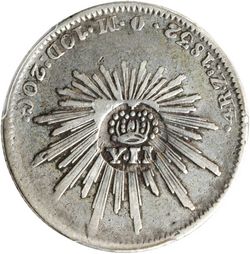
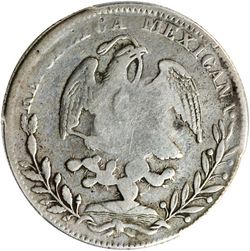
Y.II. with 5-4-1 pearl sequence, host Mexico Republic 4 Reales 1832-ZsOM.
(Stack’s Bowers and Ponterio NYINC auction 9 Jan. 2015 Lot # 1391 “The Ray Czahor collection”.)
Of all of the issues in this series, gold coins are certainly some of the rarest. The most commonly seen is the 8 Escudos; all other denomination are exceedingly rare and virtually uncollectable, with less than a handful known. I have 20 different pieces cited with only four on Mexican host coins, all 8 Escudos. One is an “F.7.0” and the other three are “Y.II.”, including an Iturbide 8 Escudos.
Y.II. with 5-4-3 pearl sequence, host Mexico Empire of Iturbide 8 Escudos 1822-JM.
(Glendinings 16 Oct. 1989 Lot # 312 “The John J. Ford collection”)
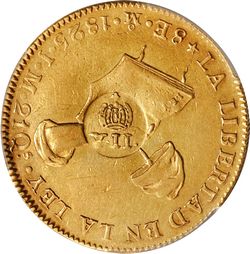
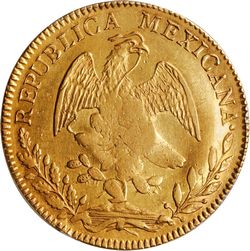
Y.II. with 5-4-3 pearl sequence, host Mexico Republic “Hand on book” 8 Escudos 1825-MoJM.
(Stack’s Bowers and Ponterio NYINC auction 9 Jan. 2015 Lot # 1428 “The Ray Czahor collection”.)
All additional countermarks should be considered very rare. The most common is the Peru 1824 Royalist crown countermark with about 12 pieces cited whilst all others are extremely rare to unique. I have 19 pieces cited with only three on Mexican host coins.
F.7.0. with 5-4-1 pearl sequence over previous Manila overstrike, host Mexico Republic with illegible date or mintmark. From the Mariano M. Cacho Jr. collection # IV- CS-001, Ex Philippine Numismatic Monographs Number 16 August, 1966, Ex The Numismatist Vol. LX Apr 1947(Reprint) Fig. 3, Ex Pablo I. de Jesus collection.
Y.II. with 5-4-1 pearl sequence over previous F.7.0 with 5-4-! pearl sequence, host Mexico Republic 8 Reales 1833-ZsOM. Plated in Philippine Numismatic Monographs Number 21 November 1981 # IX-12.
The original decree stated that the countermarks were to be applied to the obverse of the offending coins. However, with some of the coins the countermarking office found it difficult to determine which side was the obverse and which was the reverse. In some instances the countermarks were applied to the reverse first, then immediately flipped over and struck again thus correcting the mistake made. I have 11 pieces cited with six on Mexican host coins.
Y.II. with 5-4-3 pearl sequence, host Mexico War of Independence 8 Reales 1820-CaRP. Notice the flattening of the reverse countermark caused by the application of the obverse countermark.
(Stack’s Bowers and Ponterio NYINC auction 11 Jan. 2013 Lot # 1625, Ex Almanzar’s Mail Bid Auction 8 March 1982 Lot # 1270)
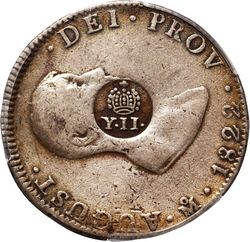
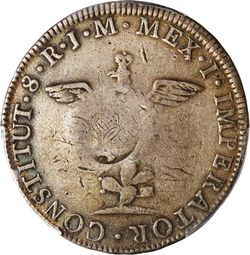
Y.II. with 5-4-3 pearl sequence, host Mexico Empire of Iturbide 8 Reales 1822-Mo JM, Iturbide First Bust Type with Skinny eagle.
(Stack’s Bowers and Ponterio NYINC auction 9 Jan. 2015 Lot # 1411 “The Ray Czahor collection”)
The perforated examples are integral to the series as several of the punches can be linked back to early collections prior to the discovery of forgeries in the 1930s. Several of these examples are housed in the American Numismatic Society’s collection and one plated in José T. Medina’s early work Las Monedas Obsidionales Hispano-Americanas, published in Santiago, Chile in 1919.
On 27 August 1834 a decree was issued stating that pierced coins were no long acceptable legal tender. This of course did not sit well with the local populace and nearly caused an uprising. Due to the fact of disgruntled locals the government at Manila issued the 4 September 1834 decree where holed coins with countermarks over both sides would again become legal tender. Interesting to note about this special issue is that fact that when the countermarks were applied to both sides they were done so at the exact same time. If they were applied in succession one of the opposing sides would show signs of flattening much like the corrected examples above. Also, noted is that the punches though usually rotated to one degree or another are also in alignment with each other. This suggests that one or both punches were affixed somehow either as a hammer and anvil die or like a pair of pliers similar to the Guatemala Type IV countermarks issued in late 1840 to early 1841. The aforementioned decree states that the holed or pierced coins would be accepted as legal tender as long as countermarks were applied over both sides of the hole. Now with that being said not every example has countermarks over both sides of the hole. The pieces with only one countermark are on the obverse in accordance to the original decree of 2 October 1832 where all countermarks were to be applied to the obverse of the hosts. Coins with countermarks over both sides of the perforation are very rare. Coins with countermarks on only one side of the perforation, on minor coinage or with previous countermarks with perforations are extremely rare.
The first and fourth images below are two colonial bust 8 Reales that were used as substitutes as I was unable to locate an example of the type on a Mexican host. Usually when one thinks of coins with holes in them it is considered damage since for the most part the holes are the result of piercing after the coins left the mint. In some instances in the cut and countermarked series plugs were officially removed by a government entity for assaying and/or inflation (lower intrinsic value with nominal face value). There are instances where plugs were unofficially removed by unscrupulous individuals trying to make a little extra on the side. In both instances this was done for a very specific reason. However, with the perforated (holed) coins of the Philippines what makes them special by comparison is the fact the holes were authorized after the fact by the aforementioned decree. I have 70 pieces cited with only 11 on Mexican hosts.
Y.II. with 5-3-2 pearl sequence applied to obverse of perforation, host Peru bust 8 Reales 1819- LIMA JP. Excellent early provenance with clear details of the countermark.
(American Numismatic Society collection # 1933.999.725)
Y.II. applied to both sides of perforation, host Mexico bust 8 Reales1786-FM. (private collection.)
Y.II. applied to both sides of perforation with previous Y.II. on obverse, host Peru bust 8 Reales 1819-LIMA JP.
(Spink Auction # 5014 Lot # 941, Ex The Money Company Auction 25 Jan. 1982 Lot # 578, Ex Superior auction 4-8 June 1979 Lot # 2477).
Y.II. applied to both sides of both perforations, host Mexico War of Independence 8 Reales 18xx-ZsAG; Note: both obverse and both reverse countermarks are the same and have the same alignment and rotation. This piece is one of the keys to understanding the perforated examples as it shows that the punches were in fact affixed in some manner.
(American Numismatic Society collection # 1927.999.238)
The countermark series of the Philippines has many nuances with many myths and wives’ tales. No doubt there are a plethora of forgeries made to fool collectors. However, many examples which surfaced in mid part of the last century have been wrongly condemned today. Not because they are forgeries, but because of the time when they came to market. Prior to their appearance in the marketplace many of the extremely common examples such as Peru standing liberty types and Mexican “Cap & Ray” types were not worth enough to be photographed in early auction catalogs or even to be offered as a single coin in an auction or pricelist. Some of the countermarks on those examples are viewed as spurious, but can be linked back to the early part of the 20th century prior to the discovery of forgeries either through punch linking or plated examples. When looking at this series as a whole it can be quite overwhelming with the various combinations of hosts and countermarks. If one takes a step back to look at the bigger picture it is not all that complicated, but it is very sophisticated.