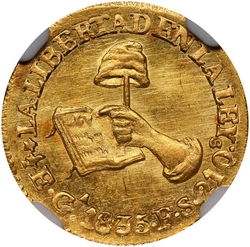
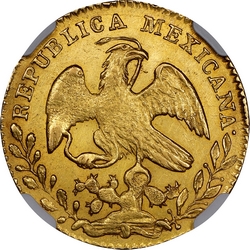
KM-378.2 ½E 1835 Ga FS (Stack’s Bowers auction, 26 August 2025, lot 41379)
Diameter 15 mm. 1.690 g. 0.8750 gold
For a commentary on the Guadalajara half escudo, see here.
| Date | Asssayer | Recorded Mintage |
Comment |
| 1825 | FS | ||
| 1826 | |||
| 1829 | FS | ||
| 1831 | FS | ||
| 1834 | FS | ||
| 1835 | FS | ||
| 1837 | JG | ||
| 1838 | JG | ||
| 1839 | JG | ||
| 1840 | MC | ||
| 1842 | JG | ||
| 1847 | JG | ||
| 1850 | G | ||
| 1852 | JG | ||
| 1859 | JG | ||
| 1861 | JG |
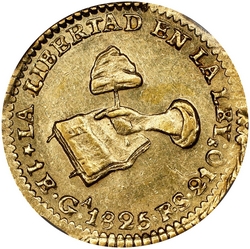
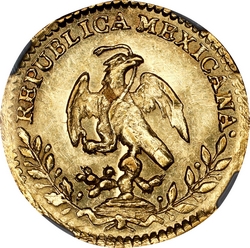
KM-379.2 1E 1825 Ga FS (Stack’s Bowers auction, 3 September 2025, lot 45458)
Diameter 18 mm. 3.380 g. 0.8750 gold
| Date | Asssayer | Recorded Mintage |
Comment |
| 1825 | FS | ||
| 1826 | FS | ||
| 1831 | FS | ||
| 1834 | FS | ||
| 1842 | JG/MC | ||
| 1843 | MC | ||
| 1847 | JG | ||
| 1848/7 | JG | illustrated below | |
| 1849 | JG | ||
| 1850 | JG | ||
| 1852/1 | JG | ||
| 1856 | JG | ||
| 1857 | JG | ||
| 1859/7 | JG | illustrated below | |
| 1860/59 | JG | ||
| 1860 | JG |
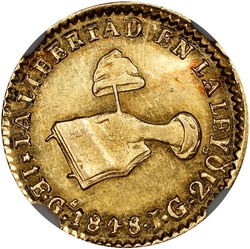
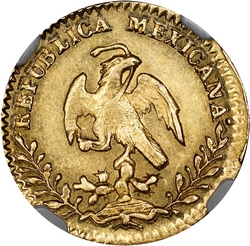
KM-379.2 1E 1848/7 Ga JG (Stack’s Bowers auction, 3 September 2025, lot 45459)
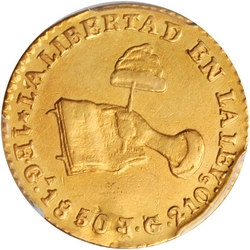
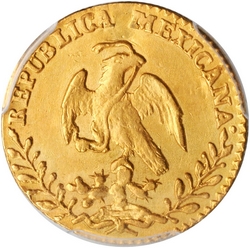
KM-379.2 1E 1850/40 Ga JG (Ponterio Baltimore auction, 6 November 2013, lot 21117)
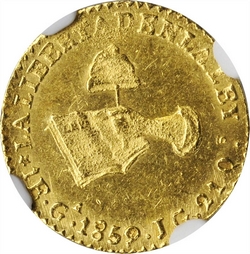
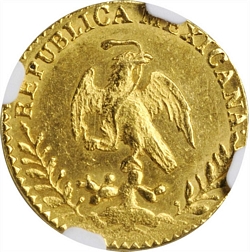
KM-379.2 1E 1859/7 Ga JG (Stack’s Bowers NYINC auction, 21 January 2020, lot 23231)
Diameter 23 mm. 6.770 g. 0.8750 gold
| Date | Asssayer | Recorded Mintage |
Comment |
| 1835 | FS | ||
| 1836/5 | JG | ||
| 1839/5 | JG | ||
| 1840 | MC | two die varieties | |
| 1841 | MC | ||
| 1847/6 | JG | ||
| 1848/7 | JG | ||
| 1850 | JG | two die varieties | |
| 1851 | JG | ||
| 1853 | JG | ||
| 1858 | JG | ||
| 1859/8 | JG | ||
| 1860/50 | JG | ||
| 1861/59 | JG | ||
| 1861/0 | JG | ||
| 1863/1 | JG | ||
| 1870 | JG |
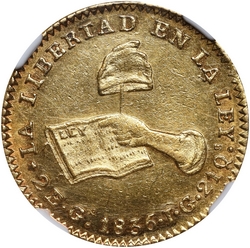
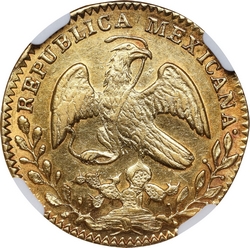
KM-380.3 2E 1836/5 Ga JG (Stack’s Bowers auction, 26 August 2025, lot 41368)
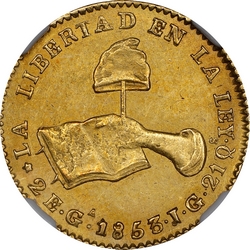
KM-380.3 2E 1853 Ga JG (Stack’s Bowers auction, 15 August 2023, lot 51318)
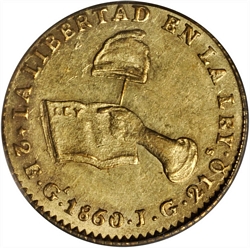
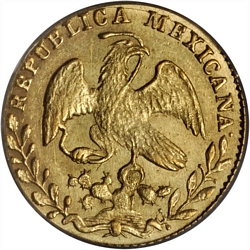
KM-380.3 2E 1860/50 Ga JG (Stack’s Bowers Chicago ANA auction, August 2025, lot 33515)
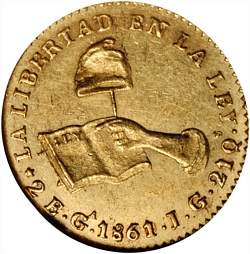
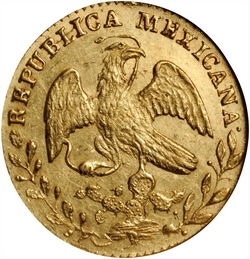
KM-380.3 2E 1861/0 Ga JG (Stack’s Bowers NYINC auction, January 2015, lot 1278)
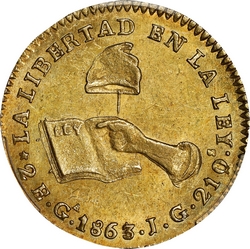
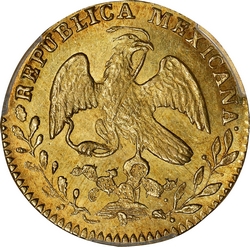
KM-380.3 2E 1863/1 Ga JG (Stack’s Bowers auction, 15 August 2023, lot 51319)
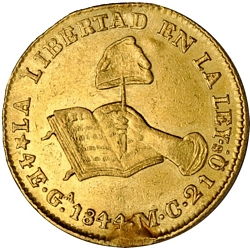
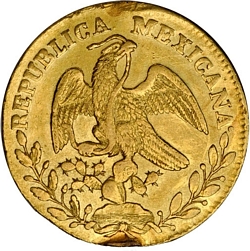
KM-381.2 4E 1844 Ga MC (Ponterio NYINC auction, 6 January 2012, lot 920)
Diameter 30 mm. 13.540 g. 0.8750 gold
| Date | Asssayer | Recorded Mintage |
Comment |
| 1844 | MC | ||
| 1844 | JG |
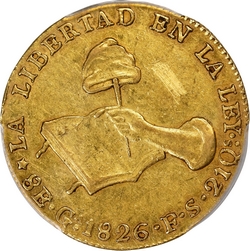
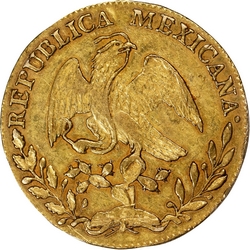
KM-383.5 8E 1826 Ga FS (Stack’s Bowers auction, 23 October 2025, lot 73004)
Diameter 37 mm. 27.070 g. 0.8750 gold
| Date | Asssayer | Recorded Mintage |
Comment |
| 1825 | FS | ||
| 1826 | FS | ||
| 1830 | FS | ||
| 1836 | FS | ||
| 1837 | JG | ||
| 1840 | MC | ||
| 1843 | MC | ||
| 1845 | MC | ||
| 1849 | JG | ||
| 1850 | JG | ||
| 1851 | JG | ||
| 1852/1 | JG | ||
| 1855 | JG | ||
| 1856 | JG | ||
| 1857 | JG | ||
| 1861/0 | JG | illustrated below | |
| 1863/1 | JG | ||
| 1866 | JG |
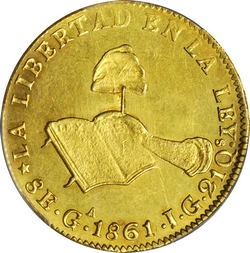
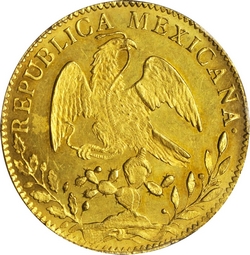
KM-385.5 8E 1861/0 Ga JG (Stack’s Bowers NYINC auction, 12 January 2019, lot 41197)
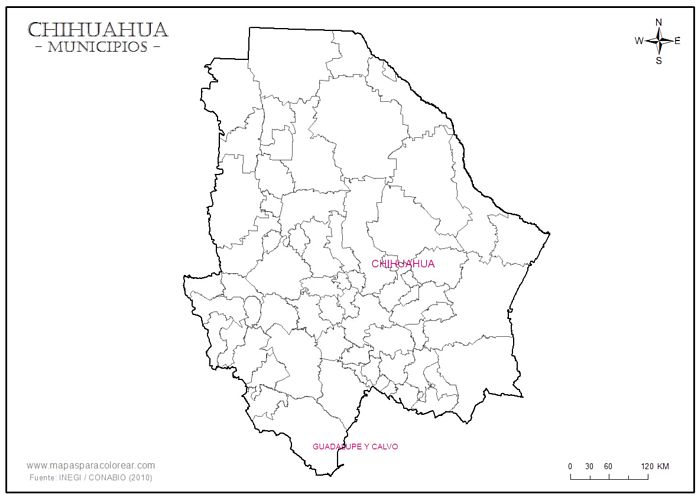
Named in honour of the Virgin of Guadalupe and the governor of the state José Joaquín Calvo, the city of Guadalupe y Calvo is in the southernmost part of the state of Chihuahua. Located 327 miles south of the capital city, Chihuahua, at an altitude of 7,643 feet, Guadalupe y Calvo was in a remote, but very rich mining area. Its remoteness was one of the principal reasons that local mining interests pressed for the establishment of a mint. The nearest mint was in Chihuahua and transporting bullion there was difficult and dangerous. There were frequent attacks by Apache and Comanche Indians, as well as local bandits.
In 1842 a newspaper reported:
... About eight years ago, … some investigations, made on the two iron-covered slopes, which formed the narrow valley where the stream flows, led to the discovery on the east side of a quartz ridge, which contained grains of gold perfectly perceptible to the naked eye. Shortly after, open-pit tillage began, after the vein had been denounced. In the meantime, the news of this discovery having spread, Messrs. Buchan and Adul, long attached to some English companies, came from Zacatecas; and the result of their voyage was the purchase of a property of 200 varas located to the northwest of the vein and to work this property the company of Guadalupe y Calvo was formed … Gold and silver are concentrated in balls of great wealth. These balls have been found, especially in the work of the English company.{footnote}El Cosmpolita, Vol. V, Núm. 196, 14 December 1842{/footnote}.
On 3 October 1842 Dictator Antonio López de Sama Anna authorized a ten year lease to the British firm Mackintosh & Company, operating as Compañía Minera Mexicana de Guadalupe y Calvo. The mint opened on 1 June 1844. As specified in the lease, the original matrices were provided by the Mexico City mint.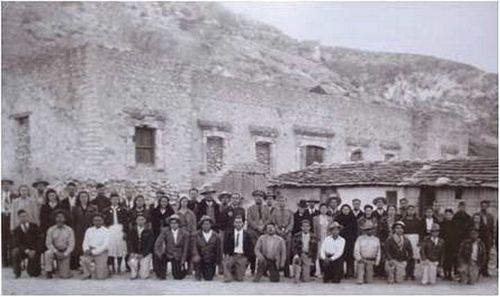
In late 1847 Guadalupe y Calvo became the first mint in the Republic of Mexico to employ steam powered presses for the printing of coins, only eleven years after the introduction of steam press technology at the Philadelphia mint.. This important event is commemorated by a medal bearing the name of the mint director, Tomas Mackintosh.
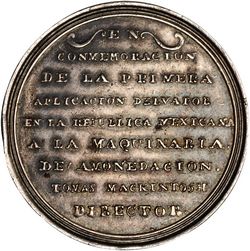
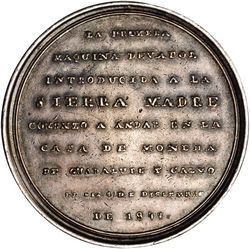
Grove 93a Silver medal (Stack’s Bowers NYINC auction, January 2015, lot 1298)
The obverse of this medal has a nine line inscription that commemorates the first use of steam machinery for producing coins 'EN / CONMEMORACION / DE LA PRIMERA / APLICACION DEL VAPOR / EN LA REPUBLICA MEXICANA / A LA MAQUINARIA / DE AMONEDACION / TOMAS MACKINTOSH / DIRECTOR (In commemoration of the first application of steam in the Mexican Republic to the coinage machinery. Tomas Mackintosh, Director)'. The reverse has a nine line inscription that commemorates the first steam engine brought into the Sierra Madre 'LA PRIMERA / MAQUINA DE VAPOR / INTRODUCIDA A LA / SIERRA MADRE / COMENZO A ANDAR EN LA / CASA DE MONEDA / DE GUADALUPR Y CALVO / EN DIA 1 DE DICIEMBRE / DE 1847 (The first steam engine introduced to the Sierra Madre began to run at the Casa de Moneda de Guadalupe y Calvo. December 1, 1847}'.
In 1849 the lease passed to Jecker Torre y Cia., who, at the same time, also took over the tease for the mint at Culiacán. There were numerous administrative problems at the mint. Finally, coinage operations ceased in April 1852 and the doors were closed on 22 May 1852. Some of the modern equipment purchased for this mint found its way to Chihuahua where it was installed ca. 1860.
As to the closure of the mint, the newspaper El Siglo Diez y Nueve stated that the mint was seized by order of the District Judge of Chihuahua at the request of the General Commissioner of the State because the director of the mint failed to make a payment of 25,000 pesos that the government negotiated to pay troops on the border{footnote}El Siglo Diez y Nueve, Año Décimo, Cuarta Época, Núm. 639, 1 October 1850{/footnote}.
It is said that, between the opening and closing, the mint at Guadalupe y Calvo minted a total of 5,185,827 pesos, of which 2,690,104 pesos was in silver coins and 2,495,723 pesos in gold coins.
| Year | Silver | Gold |
| 1844 | 338,124.00 | 95,004.00 |
| 1845 | 218,298.00 | 688,513.00 |
| 1846 | 250,322.00 | 752,378.00 |
| 1847 | 230,084.00 | 416,350.00 |
| 1848 | 535,543.50 | 185,222.00 |
| 1849 | 491,586.36 | 173,637.00 |
| Total | 2,063,958,06 | 2,311,104.00 |
| from | to | |
| 30 October 1843 | 1849 | Compañía Minera de Guadalupe y Calvo (Mackintosh and Company) |
| 1849 | 22 May 1852 | Jecker, Torre y Cia. |
The Compañía Minera Guadalupe y Calvo was a subsidiary of the parent company Manning & Marshall (other authors refer to it as "Mackintosh & Company"{footnote}The company’s main agent was Ewen Mackintosh, British consul in Mexico {/footnote}), since the rules stipulated that the mint was managed by a Mexican company. This company, taking advantage of the financial difficulties of the government, obtained several lease contracts, such as Zacatecas in 1842, Culiacán in 1843 and Guadalupe and Calvo in 1844, and came to control 80% of the mintage in Mexico. The mints of Culiacán and of Guadalupe y Calvo maintained various links throughout their operation.
| Initial | Name | Began on | Left office on |
| MP | Manuel Onofre Parodi held a succession of positions over four decades. He was an assayer at the Estado de México mint in 1829. He was the sole assayer to appear on the coins of Guadalupe y Calvo from 1844 to 1852, where he was also the local correspondent of El Siglo Diez y Nueve. He was ensayador de cajas in Culuacán in May 1857 when he was one of the officials who refused to swear an oath to the new Constitution{footnote}Diario de Avisos, Año II, Tomo I, 29 May 1857{/footnote}. In May 1861 he was appointed assayer for the Oaxaca mint{footnote}El Monitor Republicano, Año XIV, Núm. 3,916, 1 May 1861{/footnote} but his appointment was revoked before he took up office{footnote}El Siglo Diez y Nueve, Año XXI, Núm. 142, 5 June 1861{/footnote}. He was at Hermosillo in 1866 and was at the Culiacán mint by May 1868 and on its coins from 1873 to 1876. | 1844 | 1852 |
Diameter 12 mm. 0.845 g. 0.90277 silver
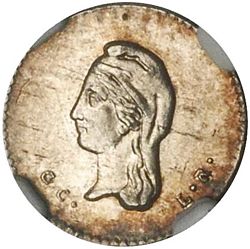
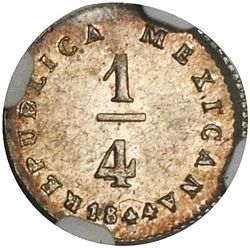
KM-368.4 ¼r Guadalupe y Calvo 1844 GCLR (Stack’s Bowers Baltimore Auction, 28 March 2011, lot 8090)
The ¼ real coin was only produced in 1844. It bore the initials LR, which are those of the former assayer of the Mexico City Mint, Luciano Rovira.
Dunigan and Parker point out that the tools sent from the capital were probably only used in the first year (1844) and thereafter dies were manufactured locally, which explains the varieties of engraving that exist on the coins of 1845 and 1846{footnote}Dunigan and Parker, Resplandores, 1997, p. 202{/footnote}. The uniform style from 1847 onwards can be explained by (i) the remittance of dies from the mint of Culiacán, leased by the same institution and (ii) the implementation of new minting machinery.
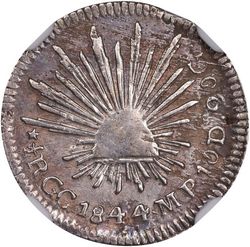
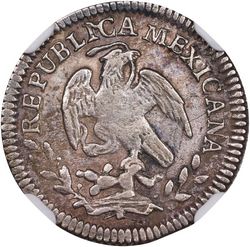
KM-370.6 ½r 1844 (Stack’s-Bowers auction of Kirk Menczer Collection. 23 June 2026, lot 72129)
Diameter 16 mm. 1.690 g. 0.90277 silver
| Date | Assayer | Recorded Mintage |
Comment |
| 1844 | MP | ||
| 1845 | MP | ||
| 1846 | MP | ||
| 1847 | MP | ||
| 1848 | MP | ||
| 1849 | MP | ||
| 1850 | MP | ||
| 1851 | MP |
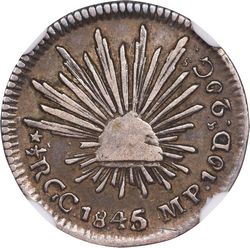
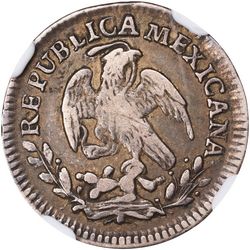
KM-370.6 ½r 1845 (Stack’s-Bowers auction of Kirk Menczer Collection. 23 June 2026, lot 72130)
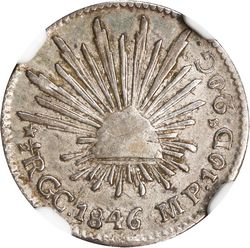
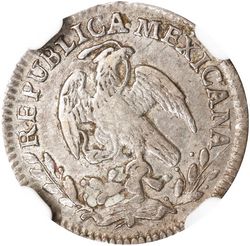
KM 370.6 ½r 1846 GC MP (Stack’s Bowers Baltimore auction, 16 May 2023, lot 70520)
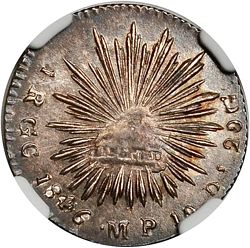
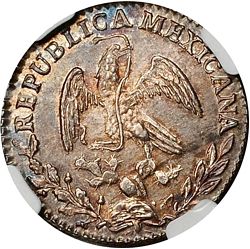
KM 372.5 1r 1846 GC MP (Stack’s Bowers Baltimore auction, 28 March 2011, lot 38186)
Diameter 20 mm. 3.380 g. 0.90277 silver
| Date | Assayer | Recorded Mintage |
Comment |
| 1844 | MP | ||
| 1845 | MP | ||
| 1846 | MP | ||
| 1847 | MP | ||
| 1848 | MP | ||
| 1849/7 | MP | ||
| 1849/8 | MP | ||
| 1849 | MP | ||
| 1850 | MP | ||
| 1851 | MP |
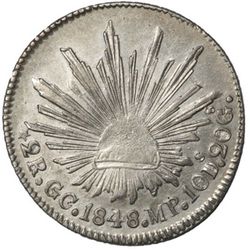
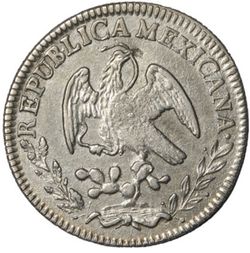
KM-374.7 2r 1848 GC MP (Briggs & Bustos auction XII, April 2025, lot 251)
Diameter 27 mm. 6.760 g. 0.90277 silver
| Date | Assayer | Recorded Mintage |
Comment |
| 1844 | MP | ||
| 1845 | MP | ||
| 1846 | MP | ||
| 1847 | MP | ||
| 1848 | MP | ||
| 1849 | MP | ||
| 1850 | MP | ||
| 1851 | MP | ||
| 1851/0 | MP | illustrated below |
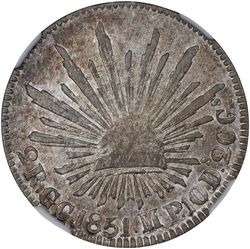
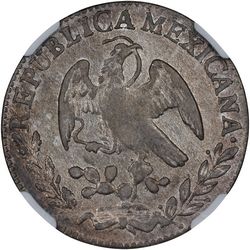
KM-374.7 2r 1851/0 (Stack’s-Bowers auction of Kirk Menczer Collection. 24 June 2026. Lot 73017)
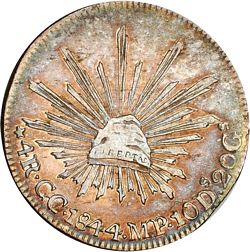
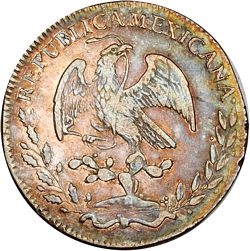
KM 375.3 4r 1844 GC MP (Stack’s Bowers Baltimore auction, 28 March 2011, lot 3843)
Diameter 32 mm. 13.540 g. 0.90277 silver
| Date | Assayer | Recorded Mintage |
Comment |
| 1844 | MP | ||
| 1845 | MP | ||
| 1846 | MP | ||
| 1847 | MP | ||
| 1849 | MP | ||
| 1850 | MP |
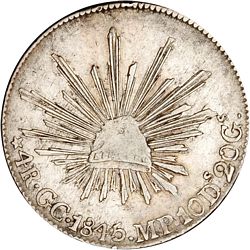
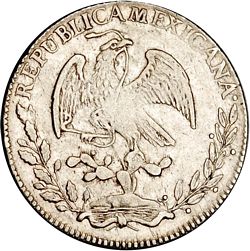
KM 375.3 4r 1845 GC MP (Stack’s Bowers Baltimore auction, 28 March 2011, lot 3844)


KM-375.3 4r 1846 GC MP
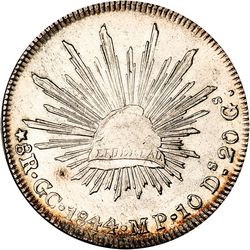
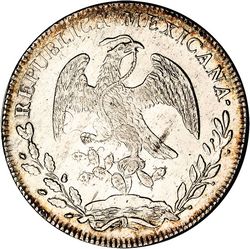
KM-377.7 8r 1844 (Ponterio sale 154, lot 6368)
Diameter 39 mm. 27.070 g. 0.90277 silver
| Date | Assayer | Recorded Mintage |
Comment |
| 1844 | MP | Reversed superscript s in fineness | |
| 1844 | MP | ||
| 1845 | MP | Eagle's tail square (illustrated below) | |
| 1845 | MP | Eagle's tail round | |
| 1846 | MP | Eagle's tail square | |
| 1846 | MP | Eagle's tail round | |
| 1847 | MP | ||
| 1848 | MP | ||
| 1849 | MP | ||
| 1850 | MP | ||
| 1851 | MP | ||
| 1852 | MP |
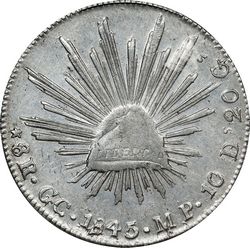
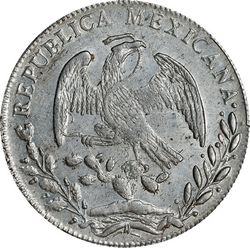
KM-377.7 8r 1845 square tail (Stack’s-Bowers auction, 15 August 2023, lot 51324)
Variety with rounded cap and square-tailed eagle
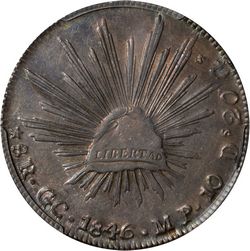
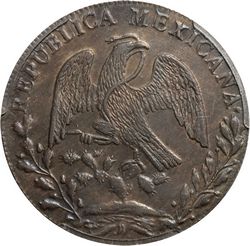
KM-377.7 8r 1846 (Stacks-Bowers auction, 23 February 2022, lot 74640)
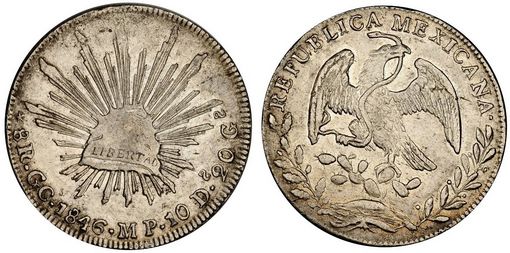
KM-377.7 1846 (Ponterio Baltimore sale 155, November 2010, lot 6323)
Retrograde 's's in '10Ds 20Gs'
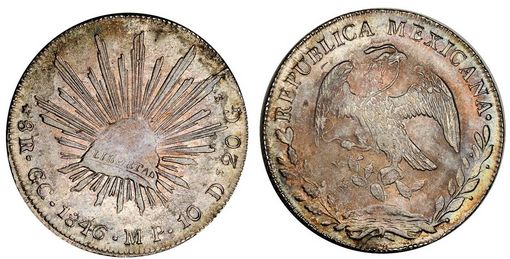 KM-377.7 1846 (Ponterio Baltimore sale 155, November 2010, lot 6324)
Mule: small rounded cap and normal eagle.
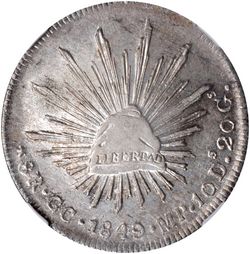
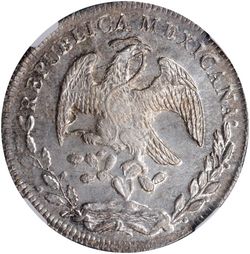
KM 377.7 8r 1849 GC MP (Stack’s Bowers ANA auction, 20 August 2021, lot 41182)
As with silver coins, gold coins from 1845 onwards are also die-cut with locally made dies.
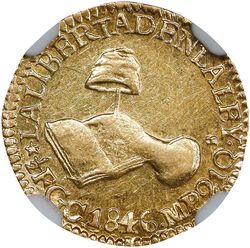
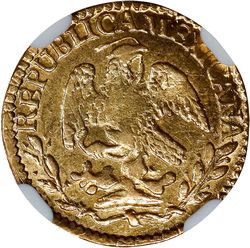
KM 378.3 ½E 1846 GC MP (Stack’s Bowers auction,30 October 2023, lot 70317)
Diameter 15 mm. 1.690 g. 0.8750 gold
For a commentary on the Guadalupe y Calvo half escudo, see here. The mint used two pairs of dies. The first die pair was used from 1846 to 1848. The obverse used a Mexican facing eagle style, and the dies were likely made at the Soho mint in England. The second pair with a larger Sonora eagle were likely made in England and probably at the Soho mint. They were used in 1850 and 1851. This pair of dies were transferred to Culiacán mint and were first used there in 1854.
| Date | Assayer | Recorded Mintage |
Comment |
| 1846 | MP | ||
| 1847 | MP | ||
| 1848/7 | MP | illustrated below | |
| 1850 | MP | ||
| 1851 | MP | illustrated below |
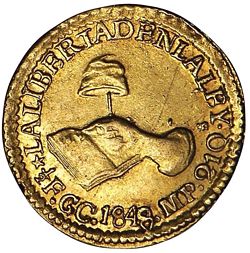
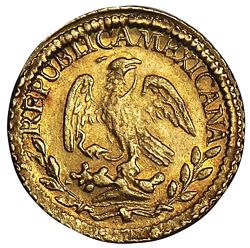
KM 378.3 ½E 1848/7 GC MP (Stack’s Bowers auction,11 January 2010, lot 1357)
"E" missing lower crossbar. The second 8 is punched in low and very deep into the die.
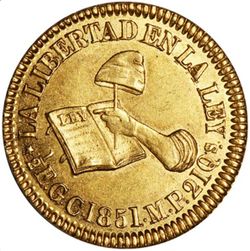
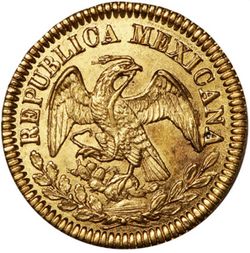
KM-378.3 ½E 1851 GC MP (Briggs & Bustos auction XII, April 2025, lot 304)
Last year of series, stamps of design analogous to the contemporary one of the mint of Culiacán, popularly, known as "Aguila de Sonora".
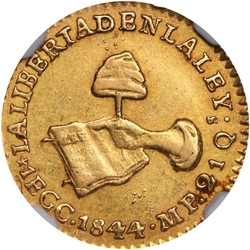
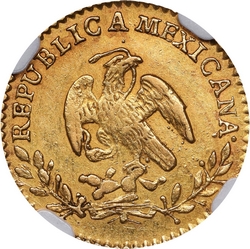
KM-379.3 1E 1844 GC MP (Stack’s Bowers NYINC auction, 23 January 2025, lot 29157)
Diameter 18 mm. 3.380 g. 0.8750 gold
| Date | Assayer | Recorded Mintage |
Comment |
| 1844 | MP | ||
| 1845 | MP | ||
| 1846 | MP | ||
| 1847 | MP | ||
| 1848 | MP | ||
| 1849 | MP | ||
| 1850 | MP | ||
| 1851 | MP |
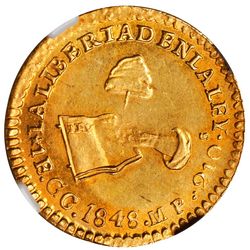
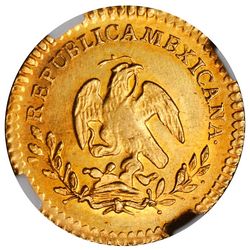
KM 379.3 1E 1848 GC MP (Stack’s Bowers Baltimore auction, 6 November 2013, lot 21118)
Diameter 18 mm. 6.770 g. 0.8750 gold
| Date | Assayer | Recorded Mintage |
Comment |
| 1844 | MP | one known | |
| 1847 | MP | ||
| 1848 | MP | ||
| 1849 | MP | ||
| 1850 | MP |
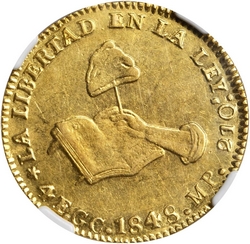
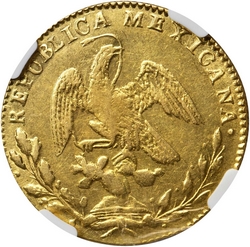
KM-381.3 4E 1848 GC MP (Stack’s Bowers auction, 4 August 2017, lot 21203)
Diameter 30 mm. 13.50 g. 0.8750 gold
| Date | Assayer | Recorded Mintage |
Comment |
| 1844 | MP | ||
| 1845 | MP | ||
| 1846 | MP | ||
| 1848 | MP | ||
| 1850 | MP |
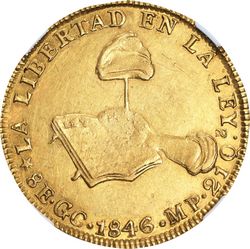
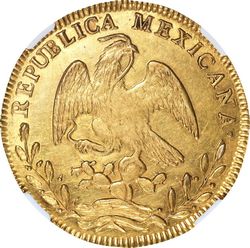
KM-386.6 8E 1846 round tail (Stack’s Bowers auction, 17 August 2024, lot 44438)
Diameter 37 mm.27.070 g. 0.8750 gold
| Date | Assayer | Recorded Mintage |
Comment |
| 1844 | MP | ||
| 1845 | MP | Eagle's tail square | |
| 1845 | MP | Eagle's tail round | |
| 1846 | MP | Eagle's tail square | |
| 1846 | MP | Eagle's tail round | |
| 1847 | MP | ||
| 1848 | MP | ||
| 1849 | MP | ||
| 1850 | MP | ||
| 1851 | MP | ||
| 1852 | MP |
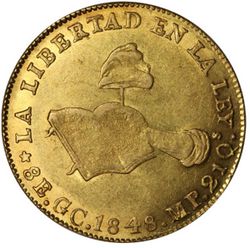
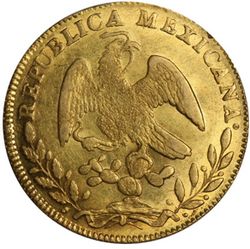
KM-383.6 8E 1848 GC MP (Briggs & Bustos auction XII, April 2025, lot 333)
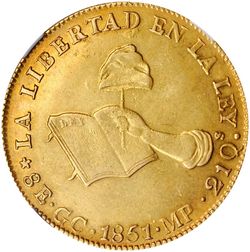
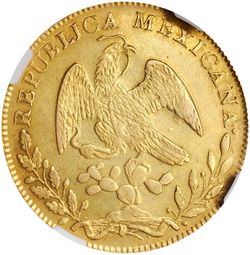
KM 383.6 8E 1851 GC MP (Stack’s Bowers ANA auction, 20 August 2021, lot 41176)
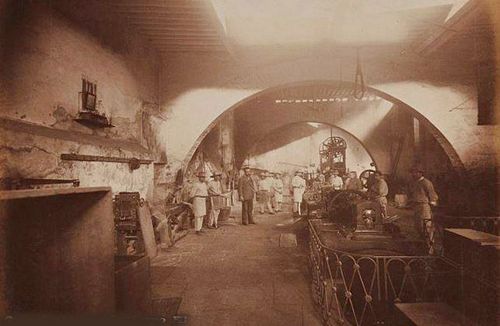
The city of Guanajuato is the capital of the state of Guanajuato. Located 220 miles northwest of Mexico City in a rich mining area, this mint is reported to have been established as a rebel mint by Hidalgo in 1810. The first known coinage of this mint, however, is under Spanish Colonial rule in 1812. The first Republican 8 Reales were minted in 1824 and bore the Profile or Hookneck Eagle design. In 1830 Guanajuato became the first mint in Mexico to produce its 8 Reales from hubs. This resulted in a great improvement in the quality of the coinage.
Eight Reales coinage was interrupt ed three times during this mint’s long run. The first interruption was 1863-1867 during the Maximilian era. The government of Maximilian occupied the mint from 8 December 1863 to 26 January, 1867 and struck Maximilian Pesos dated 1866 with the Go mintmark. The second interruption was in 1869, a year for which no Guanajuato coinage is known. The third interruption was for the issue of the Balance Scale Peso series in 1871-1873. Guanajuato was one of only four mints to coin 8 Reale until the series ended in 1897.
Shortly after Mexico gained its independence, the mint of Guanajuato was leased to the Anglo Mexican Mint Association. This British firm was closely related to the Anglo Mexican Mining Association, which began serious mining operations in the region in the 1820s. They acquired the mint as a means of refining and minting silver from their mining operations in the region. It became immediately apparent to the Anglo Mexican Mint Association that the facilities in Guanajuato were in dire need of modernization. It is important to note that both the mint and the mining operations in this region were controlled by English firms. For this reason, the natural choice for purchasing minting machinery was through Matthew Boulton and the Soho Mint. The task of engraving the dies was given to William Wyon.
| from | to | |
| October 1824 | ||
| l June 1825 | 24 April 1842 | Cia. Anglo-Mexicana (Manning & Marshall), by a contract dated 31 May 1825 |
| 24 April 1842 | 31 March 1874 | Cia. Mexicana de Casa de Moneda (Manning & Marshall), by a contract dated 13 December 1841 |
| 1 April 1874 | 30 June 1876 | Government of the Republic of Mexico |
| 27 May 1876 | 30 June 1895 | Cia. Guanajuatense Zacatecana (formerly Cia. Anglo-Mexicana) |
| 1 July 1895 | 1 July l 900 | Government of the Republic of Mexico |
In March 1853 the provisional government of Manuel M. Lombardini leased the mints of Guanajuato and Zacatecas to Jecker, Torre y Compañía. However, in May 1853 the new government of Santa Anna rescinded this contract without it being executed.
Pradeau in his monumental work Historia Numismatica de Mexico 1823-1950 gives an impressive list of assayers for Guanajuato and their tenures. The problem is that in only a few cases do the initials and tenures match up with the coins. Pradeau points out that the initials represent two assayers, but this is clearly at odds with one of the early initials that match exactly the assayer and bis tenure. We believe that Pradeau was partially right and that on the later issues (1878-1897) the initial do correspond to two assayers. Probably the volume at Guanajuato became so great that two primary assayers were needed. Based on Pradeau's list we have attempted to identify, where possible, the assayer's initials that appear on the coins.
| Initial | Name | Begins on | Ends on |
| JM | José Antonio Mucharraz | 1824{footnote}(since 1821 under Spanish Colonial Rule{/footnote} | |
| IJ | José Mariano Jimenez | 1825 | 1826 |
| MJ | unknown | 1826 | 1833 |
| MR | unknown | 1827 | 1828 |
| JM | unknown | 1833 | |
| PJ | unknown | 1834 | 1842 |
| PM | Patrick Murphy | 1842 | 1848 |
| PF | unknown | 1848 | 1861 |
| YE | lnocencio Espinoza | 1862 | 1863 |
| YF | Yldefonso Flores | 1862 | 1868 |
| FR | Faustino Ramírez | 1870 | 1878 |
| SM | unknown (possibly Francisco Sardaneta and Roman Mendoza) | 1878 | 1879 |
| SB | unknown (possibly Francisco Sardaneta and Aguslin Barbachano or Jacobo Blanco) | 1880 | 1883 |
| BR |
unknown (possibly Jacobo Blanco and Carlos Romero)
In 1884 he was named the 2o Ensayador of the Guanajuato mint, being promoted to 1o Ensayador in 1894. When the mint closed in 1900 he was appointed Jefe of the Oficina Federal de Ensaye, a position he held until the office closed in 1912. He was elected a deputy to the XXV state Legislature on 1 September 1912. A devout Catholic he was Presidente of the Archicofradía del Inmaculado Corazón de María in the Belén church, from its foundation on 25 March 1895 until his death. He died on 8 May 1913{footnote}La Esperanza, Año X, Núm. 19, 17 May 1913{/footnote}. |
1883 | 1884 |
| RR | unknown (possibly Carlos Romero and Carlos Rodriguez Rey or José Guadalupe Reynoso) | 1884 | 1890 |
| RS | Rosendo Sandoval (possibly with Carlos Romero) | 1891 | 1900 |
The assayers on its decimal coinage were:
| Initial | Name | Begins on | Ends on |
| S | 1869 | 1884 | |
| M | 1876 | 1878 | |
| R | 1877 | ||
| B | 1883 | 1884 | |
| R | 1884 | 1890 | |
| RS | 1898 | 1900 | |
| R | 1900 |
 Carlos Romero was born in León on 4 November 1840, From 1851 he studied in Mexico City and in 1862 obtained the title of Ingeniero, becoming the Sub-Prefecto of the Colegio de Minería until the collapse of Maximilian’s empire, whereupon, as he disagreed with the new regime, he retired back to Léon. There he founded an Instituto Científico-literario, of which he was Director until 1870, when he moved to Guanajuato as a Professor in the Colegio del Estado where he established the class of Geology and Palaeontology and continued teaching until his death.