Mexican coins used in Canada
Newfoundland
Long before it became a Canadian province in 1949, Newfoundland operated with its own sovereign currency system, initially utilizing the Newfoundland Pound before switching to its own independent, gold-standard decimal Newfoundland Dollar in 1865. Early military and merchant trade heavily relied on token economies, using items such as the Ordnance Dollars.
Heralded in 1905 as an important numismatic discovery and later demonized as an utter fraud, these Spanish American dollars countermarked GR 5 ORD have known a chequered past. Paul Berry's "The Ordnance Dollars of Newfoundland" by Christopher Faulkner, David Bergeron, Paul Berry, and Markus Molenda, Newfoundland Numismatics: A Collection of Essays identifies the parties responsible for their production, proposes where and when they were distributed, and reveals the dollars' surprising connection to Britain's oldest colony in Canada. It catalogues known examples in their many varieties and using numismatic and non-numismatic references, collection databases, and digital sales records traces their appearance over the last hundred plus years among some of the hobby's most prominent dealers and collectors.
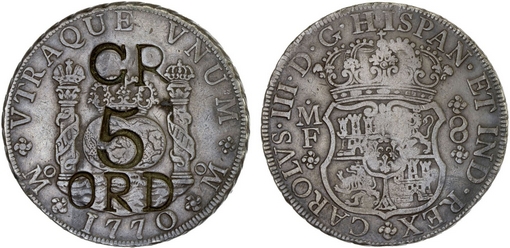
(Stephen Album Rare Coins, Auction 53, 18 September 2025. lot 992)
"GR / 5 / ORD" countermark on an 8r 1770 Mo MF (KM-105). The GR stands for Georgius Rex (King George III of Great Britain); 5 represents the value it was assigned, viz. 5 Shillings, and ORD refers to Ordnance.
Prince Edward Island
Around the end of the 18th century, the Spanish dollar was in constant circulation in Eastern Canada and the United States. The value of the coin varied in different centres but was highest in Halifax. Therefore, whenever the merchants of Prince Edward Island secured them, they sent them to Halifax to take advantage of the higher rate. The resulting shortage of money in Prince Edward Island prompted lieutenant governor Charles Douglass Smith, on 24 September 1813{/Weekly Recorder, 25 November 1813footnote} to gather in all the Spanish dollars he could and have their centres punched out, whereupon the central plug and rims were stamped with a sunburst. The punched centres passed as shillings and the outer rims as five-shilling pieces. The combined value of the mutilated coins was thereafter 20 per cent greater in Prince Edward Island than outside the island (and the individual components less valuable), so as a consequence, the coins became the official currency in Prince Edward Island.
Christopher Faulkner in his outstanding surveyChristoher Faulkner, The Holey Dollars and Dumps of Prince Edward Island, Spink, distinguished thirteen different groups of Holey Dollars and Dumps, the first six based on differences in the countermark.
Group A (Twelve Rays)
This countermark is quite crude and is comprised of twelve points or rays of uneven size. All coins were pierced using the hard punch method. They were all pierced from the obverse and the hole produced is somewhat irregular in shape.
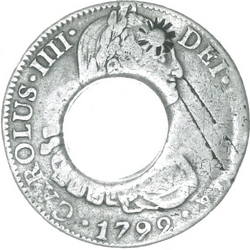
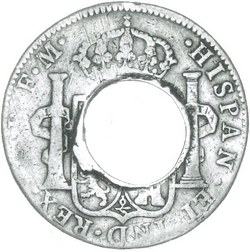
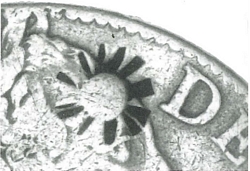
“Capital City Dollar”, an 8r 1792 Mo FM of Charles IV
Group B (Ten Rays)
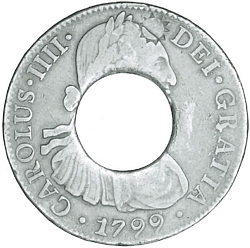
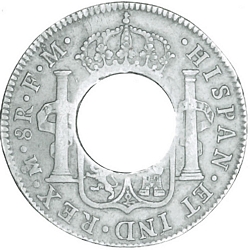
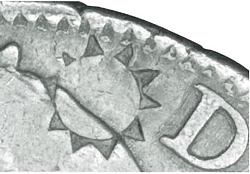
“Bahamas Dollar”, an 8r 1799 Mo FM of Charles IV
Group C (Ten Rays)
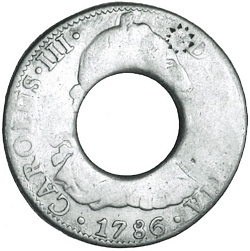
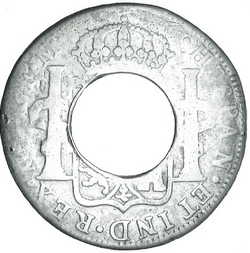
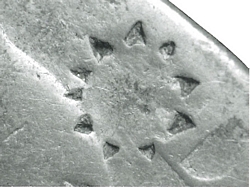
“Commerce Dollar”, an 8r 1776 Mo FM of Charles III
These were made by the same apparatus – a hard punch in a drop hammer press – as Group B.
Group D (Ten Rays)
These are distinguished by a broken ray among the ten that makes up the radiant sun in the countermark.
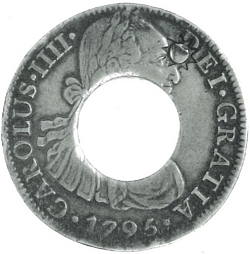
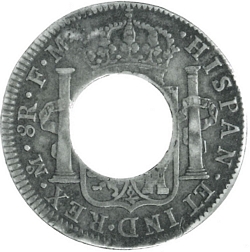
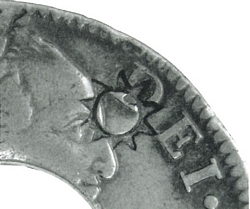
“Abbott Dollar”, an 8r 1795 Mo FM of Charles IV
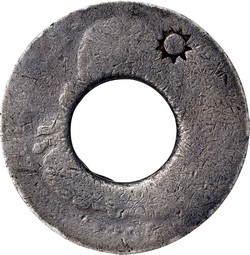
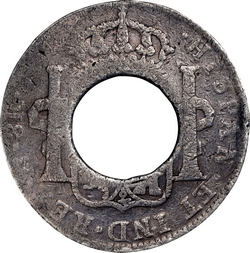
KM-2.1 Holey Dollar (5 Shillings), ND (1813), on an 8r 1805 Mo TH of Charles IV (Stack’s Bowers NYINC auction, 13 January 2023, lot 21354)
Group E (Ten Rays)
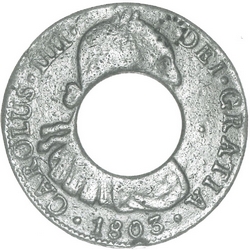
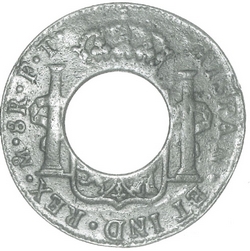
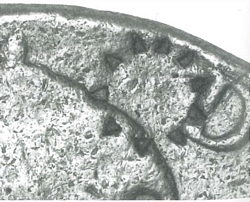
“Wickham Dollar”, an 8r 1803 Mo FT of Charles IV
Described as a countermark cog-wheel the “Wickham Dollar” appears to be a cast 8 reales. Possibly all this group are contemporary merchant counterfeits.
Group F (Nine Rays)
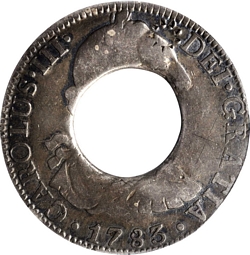
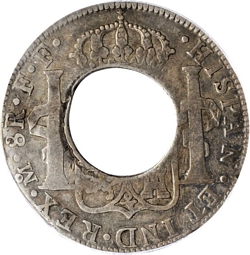
KM-2 Holey Dollar (5 Shillings), ND (1813), on an *r 1783 Mo FF of Charles III (Stack’s Bowers NYINC auction, 18 January 2020, lot 21014)
The other groups are:
Group G (Irregular Countermarks)
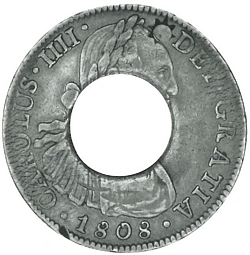
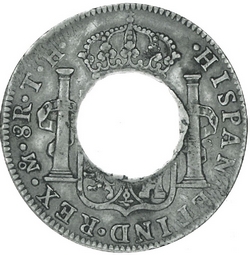
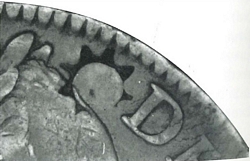
“Hill Dollar”, an 8r 1808 Mo TH of Charles IV
Only seven rays of the countermark have struck up, and two of those weakly so.
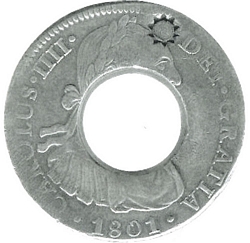
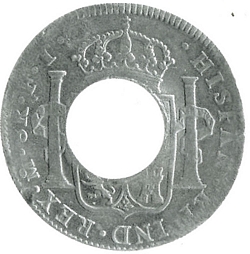
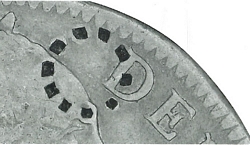
“Barrett 1 Dollar”, an 8r 1803 Mo FT of Charles IV
This dollar is unusual for its circle of ten lines in the form of small squares and/or rectangles. “All in all, the characteristics of this coin might lead one to speculate about its legitimacy”.
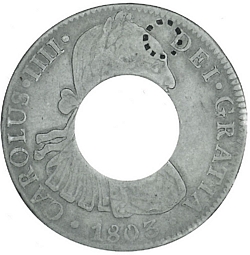
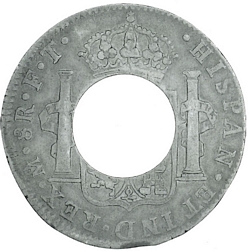
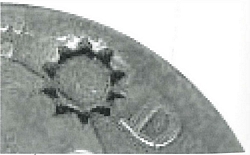
“Haiti Dollar”, an 8r 1801 Mo FT of Charles IV
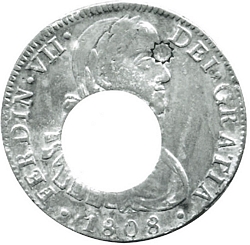
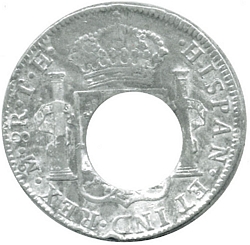
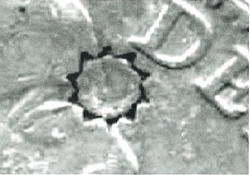
“Mexico 2 Dollar”, an 8r 1808 Mo TH of Ferdinand VII
Group H (Unclassified Holey Dollars and Dumps)
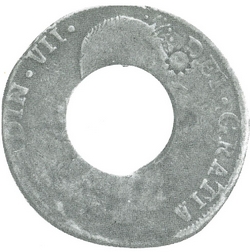
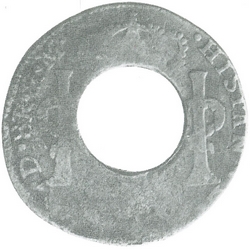
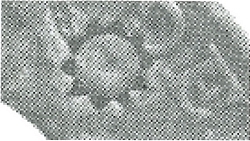
“New York Dollar”, an 8r 1813 Do RM of Ferdinand VII
Group J (Unidentified Holey Dollars and Dumps)
Group K (Holey Dollars and Dumps without countermarks)
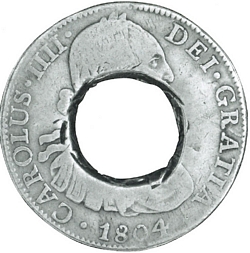
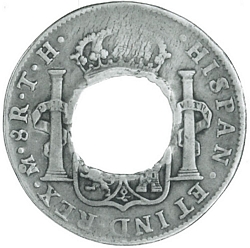
“Unholy Dollar”, an 8r 1804 Mo TH of Charles IV
This piece has been holed with a tool something like a cold chisel. Faulkner regarded it as a contemporary counterfeit rather than a recent forgery.
Group L (Replica Holey Dollars and Dumps)
Group N
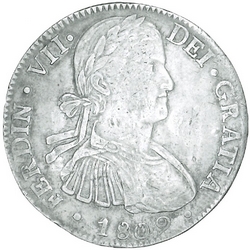
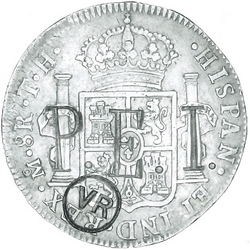
“Leroux Dollar”, an 8r
Group M (Forgeries)