The 1914 Zapata Presentation Coin
by David Hughes
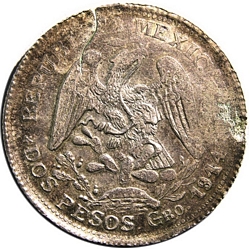
KM-644 $2 1914
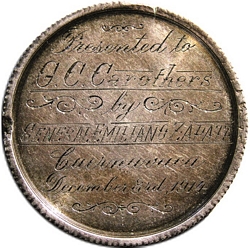
This is a Guerrero 1914 2-peso, a GB-213 early strike, an early strike as the eagle side (GB die 3) does not have a radial die break through the E of PESOS, as all the later GB-213 strikes have. The sun side, though, has been faced off in a jeweler’s lathe and nicely engraved:
PRESENTED TO / G. C. CAROTHERS / BY / GENERAL EMILIANO ZAPATA / CUERNAVACA / DECEMBER 3RD, 1914.
One of many appearing in the Mexican Revolution was the American George C. Carothers, raised in Mexico and a grocer in Tampico, Tamaulipas, on the Gulf Coast. He was appointed, by the State Department prior to the Revolution, to represent the American community in Torreón, Coahuila, a city without a formal State office. The Consular Agents were not professional diplomats but businessmen acting as honorary consuls, and were by no means disinterested observers. After General Francisco “Pancho” Villa conquered Torreón on 1 October 1913, in the second phase of the Mexican Revolution (the revolt against the dictator Victoriano Huerta), Carothers was attached to Villa as a Special Representative. The State Department believed Villa was a potential victor in the Revolution, and felt they should have a representative-informant in the Villa camp. Villa, in his pre-1916 romance with the Americans, accepted Carothers, maybe even felt it a diplomatic coup having an American attaché around. Carothers encouraged Villa in this, perhaps overstating his connections to the American government.
Originally under the banner of the Constitutionalist Army, Villa eventually split with the First Chief of the Constitutionalists, Venustiano Carranza, in 1914, when Carranza stopped Villa from advancing on Mexico City after Villa’s important victory over the Federal Army at Zacatecas on 23 June 1914, by denying him coal for the railroad engines that transported his army. After Huerta fled the country on 15 July 1914, Carrancista general Álvaro Obregón marched into Mexico City unopposed on 14 August.
Carranza was uneasy, his political control shaky, feeling the breath of both Pancho Villa and Emiliano Zapata down his neck, and was subsequently displaced from Mexico City by the forces of Zapata on 24 November 1914. Villa commanded a national army (Army of the North) with a local agenda, Zapata commanded a local army (Liberating Army of the South) with a national agenda (the Plan de Ayala)). Villa felt he could make common ground with Zapata, and sent Carothers to Zapata’s headquarters in Cuernavaca, Morelos, to arrange a meeting.
Carothers, ever the opportunist, appears in photographs taken at this time, with Zapata and his generals. And, on 3 December 1914, Emiliano Zapata gave George Carothers a Zapatista Dos Pesos coin. Carothers obviously had a sense of history, and kept this coin, subsequently having it engraved.
Zapata agreed to meet Villa in Xochimilco, a small town just outside of Mexico City on 4 December 1914, where they agreed on their common hatred of Carranza. They both entered Mexico City on horseback in triumph on 6 December, Villa paid his respects to the nominal (Conventionalist) President of Mexico in the National Palace, sat in the President’s Chair with Zapata beside him, sending a powerful image of the real power behind the throne. Villa was at the height of his power, commanding the largest army in Mexico, in the national capital. But Villa was a local from Chihuahua, having the chance of claiming the Presidency of Mexico he declined, claiming he was uneducated and unfit for the position, he frittered it all away when he quit listening to his advisors, started making command decisions on his own, ignored advise and allowed Carranza and his general Álvaro Obregón to regroup. Zapata returned to Morelos and applied the Plan de Ayala, Villa attacked an entrenched Obregón and lost, and attacked again and lost, and attacked and lost again, and limped back to Chihuahua, the Army of the North dissipated. Villa never was completely vanquished but also never did win again on a national scale, remaining a local terror in Chihuahua, denying Carranza actual state control.
Zapata was assassinated in 1919 on the order of Carranza, Carranza was shot in 1920 attempting to remain in power behind a puppet president, Villa was assassinated in 1923, the action likely abetted by President Álvaro Obregón, who was also shot in 1928 while attempting to return to the Presidency.