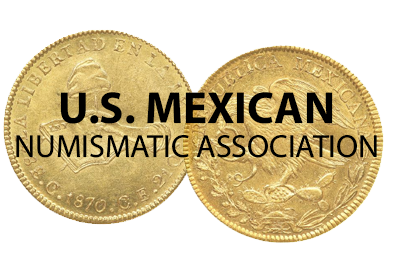
Origin, Development and Current Existence of the Fifty Pesos Centenario Coin
by Pablo Luna Herrera


KM-481 $50 1931 (Stack’s-Bowers auction 26 August 2025, lot 41451)
The origin of the Centenario and the end of its use as currency in the early 1930s (1921-1931)
In 1905 the Monetary Reform introduced the first five- and ten-pesos gold coins known as “Hidalgos”, adjusting to the economical necessities of that time. From that moment the Mexican peso would be backed with gold (known as the “gold exchange standard”). However, the Revolutionary movement of the next few years halted the enforcement of that legal system; it was not until 1918 when Venustiano Carranza reinstituted the application of the gold standard and in the succeeding years introduced a couple of new denominations (two and a half and twenty pesos) coins, to go with the preexisting 1905 coins.
The death of Carranza was followed by the governments of Adolfo de la Huerta and Alvaro Obregón. Both disturbed the cornerstones of the gold standard, due to the abundance of silver issues, and the practice of convertibility between gold and silver did not work again. World War I produced fluctuations in the precious metals market and a flourishing demand for gold. For those reasons President Obregón issued a decree on 14 September 1921 that approved this fifty pesos gold coin, though there were other motivations, such as:
1. A commemorative date. The War of Mexican Independence ended in 1821, so 1921 celebrated the centenary of its conclusion.
2. The need for currency with bigger denominations for bigger transactions (paper money did not yet exist).
3. The opportunity to provide the means of disposing of government gold and to give the people a means of storing wealthLong, R. A. (1976). The Availability of 20th Century Mexican Coins. Wegferd Publications. Bandon, Oregón .(Long, 1976).
4. The aim of maintaining the peso on a solid footing by keeping it backed with goldLaurence Hanks, William, (1976), The Comprehensive Catalog And Encyclopedia Of Modern Mexican Coins, Aztlan Numismatic Society, El Paso, TX..
The silver problems through the 1920s did not affect the yearly striking of the fifty pesos coin as legal tender, but they kept the government unable to control economic issues such as the deficit, depression, inflation and others. In 1927 all silver striking was stopped but the problem was still there. The 1929 crisis was another factor that made the Treasury understand that if silver (the main currency) continued in circulation the legal obligation of conversion with gold could not possibly continue, the unlinking of both metals was required, no more different prices of goods depending in which metal you paid.
In addition, when President Plutarco Elias Calles took the presidential oath in 1924, he tried to change the economic policies of his predecessor (Alvaro Obregón) striking more gold and less silver. As an example, in 1924 there were $21.9 million gold pesos in circulation, and in 1925 the number increased to $35.8 million pesos.
On the other hand, by the end of the 1920s, gold really did not circulate at all. In most cases it was exported (illegally) or treasured by the people, furthermore the Banco de México was never able to collect the mandatory gold fund for silver convertibility.
For all those reasons on 25 July 1931, President Pascual Ortiz Rubio in his State of the Union proclaimed: “the national gold coin starting now will be only an international good and will cease to have a monetary function”. The monetary reforms of that year allowed more stability for the Mexican peso, now silver could circulate without restrictions and the newborn paper money could take a more important role. The early success of the reform can be proved with the GDP data: between 1929 and 1932 the regression was 16%, but in 1933 the growth was 11.3%.
Two days before that same source reported that gold could be bought only as a precious metal. Indeed, if you wanted to buy gold there were a few options, (I) foreign coins, (II) the old coin that used to be legal tender, (III) gold plates or little ingots produced and refined directly by the mint in different weights.
The return of the gold in the context of an international war (1943 - 1947)
World War II had a relevant impact on Mexican economics. The following factors are related to the return of the Mexican fifty pesos “Centenario”:
A.- A huge increase of foreign money, one portion from Europe, with investors looking for a neutral country to save (not invest) their money and the other part from the United States, fearful that the government could at any moment become involved in the war and freeze their assets.
B.- This inflow of currencies induced an excess of money in circulation, a factor than can produce inflation. The Mexican Government reacted by implementing a series of actions, one of them being to strike gold again, with the purpose of hoarding and reducing the money in circulation; and lastly
C.- The halt to the production of pesos and half pesos.
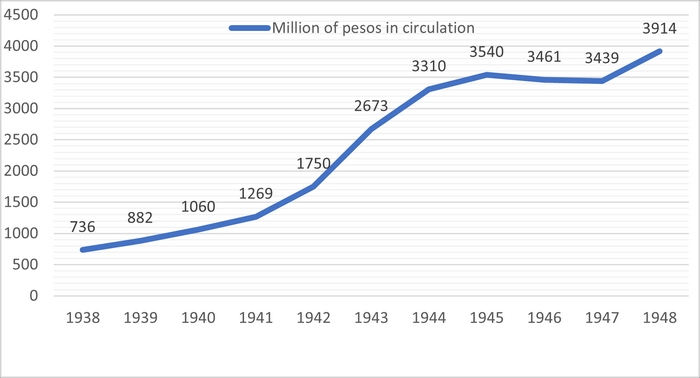
Eduardo TurrentTurrent, Díaz Eduardo (2008), Banco de México, su historia en cápsulas, Banco de México, México D.F explained that by the climax of WWII “there was a lot of gold, but there was nothing to spend it on. For each dollar that entered to the country the Mexican Treasury printed 4.85 pesos, causing monetary expansion and accumulated inflation”. As we can see in the following graphic the gold issues were part of a package of solutions to reduce the money in circulation, in the context of the World War II. This was the primary function of the 1943-1947 Centenarios.
The return in 1943 of the fifty pesos “Centenario” after eleven years was an important numismatic event. In the May 1943 edition of The Numismatist the editors informed that Mexico would introduce minted gold with the objective of stabilizing inflation. Additionally, they added that part of the metal would be from the gold that Mexico had stored in New York.
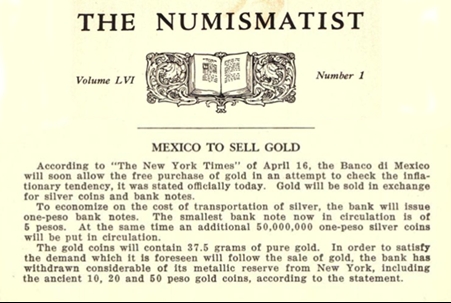
The Numismatist, vol. LVI, no. 1, May 1943
In the numismatic context the first date of 1943 is commonly known as “Tejo”, by their unique particularity that no denomination (of 50 pesos) is shown on the coin. Two authors give different explanations for this situation.
First, Richard A. Long relates that by 1943 there was not a relationship between the intrinsic value of the coin and its face value so the face value was withdrawn. However, the new appearance of the coin did not meet the holders’ approval and requests were made for a return to the old design. Moreover, the new “Centenarios” were sold for a lower price than the old with the denomination present, despite the gold content being the same. By 1944 these claims were heard, and the old design returned.
Neil S. UtbergUtberg, Neil, The Coins of Mexico. Edimburg, Texas, 1963 described that the public thought that the 1943 “Centenario” without a face value had a lower value compared to the “Centenarios” from previous years. For that reason, the new coin was commonly rejected in daily trade. The coins were produced consecutively with a different year date until 1947. The end of World War II and the prelude to the 1949 depreciation (that was beginning to manifest itself from 1947) were economic reasons that explain why the coins were not produced in 1948; the main issue is that all the wealth that arrived to Mexico (in the majority of the cases) was not invested in the country´s economy; the foreigners only waited for the end of the conflict to return to their homeland. For that reason by the late 1940s Mexico suffered a new crisis. It went from having a lot of unused resources to having nothing.
The end of new-different dated coins and the start of restriking era (1947 - now)
Moreover, from a numismatic point of view another reason that explains why gold coins were not minted in 1948, and very few in 1947, is the decree of 11 September 1947 that authorized a massive production of one peso (KM-456) and five pesos (KM-465) coins, but as was a common practice in decrees in the 20th century, the preparation of the coins started before Congressional approval of the decree. The national press reported the coin production from February 1947, all the efforts of the Mexico Mint would be entirely focused on the new silver coinage, the gold specimens would be forgotten (for that moment).
Finally, when did the restriking began and why were the coins still dated 1947? The bibliography suggest that the restriking began as early as 1949, and that is related to the 1947 date that the coins bear. Different authors explain why that situation happens; the following chart synthetizes the opinions:
Utberg A surplus of coin dies was common since the first years of production in 1921, and the use of those tools for the following years were common (this also explain overdates). The leftover of dies in the 1940s was a considerable saving for the mint, so they decided to work with old dies without a change in 1949. No problem was envisaged, as the coins were not legal tender, and the bullion content was the same as in previous years.
Long Long appeals to the tradition, the acceptation, and easy recognition, that the coin per se was a symbol of integrity and government strength, For those reasons a change was not necessary at all.
Hanks Hanks agrees with the previous authors and adds that restriking was also produced (without change of date) with dies of 1943, 1944, 1945 and 1946.
Banco de México In the 2001 book Mexican CoinageBanco de México. Mexican Coinage. Horz & Chapa Editores. México D.F., 2001 the authors suggest that the same date was used for reasons of investment, international bullion, and stability for financial markets and numismatic collections.
In addition, I believe that no time (or even money) was available for new dies in the late 1940s, the economic crisis and the mint occupation at the top of its capacity were enough reasons to employ dies with little or no use from previous years.
Regarding modern times, and why in better economical situations the date does not change, I believe the feeling of past times, traditions and history were used in the popular thoughts, the people who purchase “Centenario’s” feel that the 1947 coin was really produced more than 70 years ago, and that feeling of old and high-quality gold gives them security and confidence in the legitimacy of their piece.
Conclusions
We can conclude that the fifty pesos “Centenario” started as a commemorative coin but were minted in the following years because of demand and popularity and that only issues related to the functioning of the gold standard stopped their production in the early 1930s. In their second stage they returned only as a bullion coin, destined to address inflationary troubles at the time. Again. its demand caused the continuity of production, halted this time only by an urgent demand for silver coins, but that did not last long, as their production has continued until now with the same date for reasons that primarily appeal to cost savings and traditions.