Mexican coins used in the Caribbean
Cuba
For Mexican coins ciunterstamped with a key, see here.
Jamaica
When Spanish rule came to an end in Jamaica in 1655, the conquering British added the island to their growing portfolio of claims under colonial rule. However, it took nearly a century to establish a controlled currency, part of British efforts to remould the island’s economy to meet its needs.
Jamaica was the bullion centre for the British Colonies in the West Indies for much of the 17th and 18th centuries. Commercial and illicit activities insured a constant supply of Spanish-American gold and silver coinage flowed into the island economy. As no supply of coinage was provided by the home government Jamaica, along with other colonies had to rely on coinage of Spanish-American or Spanish origin. By the 1750s the supply of coinage on the island began to diminish due to increased trade with other colonies and the old ‘cob coinage’ was increasingly compromised due to clippingR. Chalmers, History of Currency in the British Colonies, 1972{/footnote].
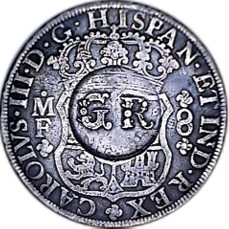
On 18 November 1758, during the reign of George II, the Jamaica Assembly passed “An Act for Ascertaining the Value of Spanish Milled Money, and for Rendering the Payment of Debts More Certain”PRO. ref. CO 139/19. Major F. Pridmore,: Coins of The British Commonwealth of Nations, Part 3 (West Indies etc.), 1965. Under the provisions of this act four denominations of gold and six denominations of silver coinage would be stamped on both sides with a countermark consisting of the ‘floriate design letters GR’, in relief within a circular indent. Both sides of the coins were struck simultaneously with an upper and lower die. It has long been known that a number of die pairs were used to stamp the Dollar coins (this is probably the case with the other denominations as well, but to date no specific study of these other denominations has been conducted). There seems to be no pattern of consistency relative to obverse or reverse as to how the coins were positioned when being struck. Unfortunately, the precise mechanism for the stamping process is not known and to date no serious study of die linkage has been undertaken. However, an examination of 33 specimens (actual coins and photo images) suggests perhaps four different genuine die pairs and no indication of die linkage between these pairs is apparent. This examination does reveal die deterioration and it could be that the dies were fixed such that when one broke down the pair had to be discarded.
No specimens of the two smaller gold coins and the smallest of the silver coins with stamps are known and it is presumed that these denominations were not stamped A total of£100,000 was authorised over all ten denominations. These stamped coins would circulate at a new and higher value. The measure was futile as by common consent all milled coins, whether stamped or not, also circulated at the new 6s 8d per dollar rate. As a result, only £12,000 of all the coins were actually stamped and the project was abandoned in 1759. Furthermore, the Act was repealed by the home authorities and the Governor of Jamaica was instructed to adhere more strictly to his instructions relative to the passing of Laws. The Privy Council (Colonial)'s comments to the Act were: "We apprehend further that putting a Stamp upon money to ascertain its value; to make it legal Tender, and to impose penaltys of High Treason on those who shall counterfeit the said Stamp, is to all Intent and Purposes setting up a mint, which we conceive to be no less an Usurpation of your Majesty’s Prerogative.".
A total of 60,000 Dollar (8 Reales) coins were authorised and it can be presumed that only part of this quantity was actually stamped.
[image needed]
KM-1.2 5 Pence
on ½r Mo (KM-67)
[image needed]
KM-4.2 1 Shilling 8 Pence
on 2r Mo (KM-84)
[image needed]
KM-4.3 1 Shilling 8 Pence
on 2r Mo (KM-85)
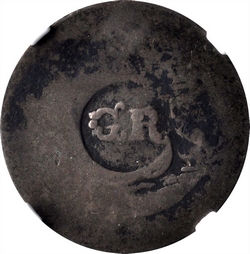
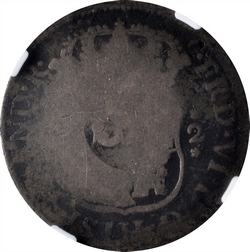
KM-4.4 1 Shilling 8 Pence (2 Reales - Quarter Dollar) (Stack’s Bowers NYINC auction, 20 January 2022, lot 8652)
Applied to both sides of a 2r 17x8 M of Ferdinand VI (KM-86).
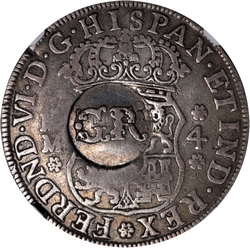
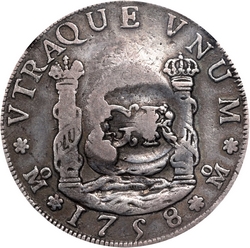
KM-7 3 Shillings 4 Pence (4 Reales - Half Dollar), ND (1758) (Stack’s Bowers NYINC auction, 15 January 2022, lot 2042)
on a 4r 1758 Mo MM of Ferdinand VI (KM-95).
[image needed]
KM-8.3 6 Shillings 8 Pence
on 8r Mo (KM-104.2)
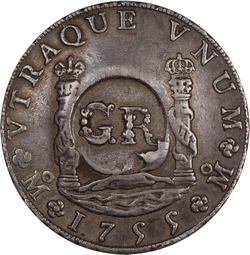
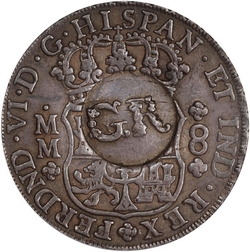
KM-8.2 6 Shillings 8 Pence (8 Reales - Dollar), ND (1758) (Stack’s Bowers auction, 26 August 2025, lot 41262)
countermark applied to both sides of an 8r 1755 Mo MM of Ferdinand VI (KM-104.2).
[image needed]
KM-8.2 6 Shillings 8 Pence
on 8r Mo (KM-104.1)
[image needed]
KM-11.2 5 Pounds
on 8E Mo (KM-148)
Counterfeits
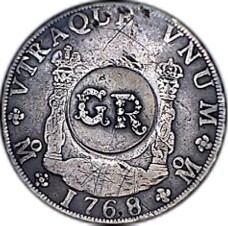
At least two die pairs of modern fakes have been recorded. In the 1980s one of these die pairs was privately given the designation of ‘Type X’ by a colleague in Jamaica. Nearly all the examples noted are on host coins with dates ranging from 1761 to 1770 … all past the date when stamping was discontinued in Jamaica.
Other than the host coin date being the most obvious feature of the vast majority of this fake the other identifying feature is on one of the GR dies where the ‘R’ is offset a bit lower than the ‘G’ and the R has a long-extended tailK. V. Eckardt, Jamaica ‘’Type X’ Countermark – A Modern Fake . BNS Research Blog. 13 January 2021.
Puerto Rico
The Spanish-ruled island of Puerto Rico did not establish an official currency until the end of the nineteenth century, and before this time a variety of coins, including Mexican, circulated concurrently, each with a unique origin, distinct intrinsic value, questionable legal standing, and local value distinct from its international value. This reliance on foreign currency, combined with protracted currency shortages and constant modifications to the monetary system, created conditions that were more than sufficient to impede the local circulation of goods and the formation of capital.
On 27 November 1884 the General Treasury Department approved the countermarking of pierced coins in circulation on the island with an incuse fleur-de-lis[text needed]. Pierced coins were to be presented to one of seven appointed local customs houses for countermarking. The countermarking took place between 14 March and 1 April 1885. After the latter date pierced coins without a countermark were no longer considered legal tender.
On 17 March 1894 a government directive[text needed] was issued recalling all pierced coins in circulation, with or without a countermark, provided that the coin itself was dated 1885 or earlier (as it was prohibited to import pierced coins into the island after the initial action of March 1885). The population were given until 26 March 1894 to redeem their coins at their local customs house, after which no pierced coins, countermarked or otherwise, would be legal tender.
On 17 August 1895 Queen Regent María Cristina granted the Puerto Rican people the right to use their own currency. The new coin was known as the Puerto Rican provincial peso, and was manufactured under the direction of Tomás Castellano y Villarroya, the Minister of Overseas. So, on 17 August and 6 December the Mexican silver currency used in Puerto Rico was demonetised and ordered to be replaced with the new Puerto Rican provincial peso.
KM-16.1 1/8 Dollar
countermark on 1r Mo (KM-78.2)
KM-16.2 1/8 Dollar
countermark on 1r Mo (KM-78.2a)
Leewards Islands
St. Croix
For Mexican coins used in St. Croix see here.
Danish West Indies
For Mexican coins used in the Danish West Indies see here.
Tortola
For Mexican coins used in Tortola see here.
St. Maarten
For Mexican coins used in St. Maarten see here.
St. Bartholomew (St. Barts)
For Mexican coins used in St. Bartholomew see here.
Montserrat
For Mexican coins used in Montserrat see here.
Guadeloupe
For Mexican coins used in Guadeloupe see here.
Dominica
For Mexican coins used in Dominica see here.
Martinique
For Mexican coins used in Martinique see here.
Windward Islands
St. Lucia
For Mexican coins used in St. Lucia see here.
Barbados
For Mexican coins used in Barbados see here.
St. Vincent
For Mexican coins used in Barbados see here.
Grenada
For Mexican coins used in Grenada see here.
Tobago
The Tobago silver coinage was introduced towards the end of the year 1798Neither the proclamation nor the Council Minutes which authorized the introduction of the Tobago cut dollar and plug have been traced . In form, denomination and value it is identical with the similar measures taken by Dominica in September and was copied from the Dominica issue.
The dollar was pierced with a central circular hole with crenated edges, the points of which are rather angular. It was not otherwise stamped and the only distinction between the Tobago and Dominica pierced dollars is the angular style of the crenations and their number, the Tobago dollar having 14 crenations while the Dominica issue has 15. Another key identifying factor between these two West Indian issues is that the Tobago pieces were pierced from the obverse while those of Dominica were done so from the reverse.
It is now speculated that there are two distinct types from Tobago; Type I, crude elongated and slanted crenations and Type II, with neat nearly vertical crenations.
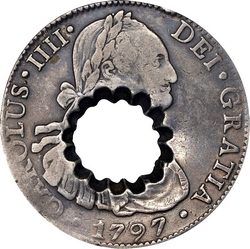
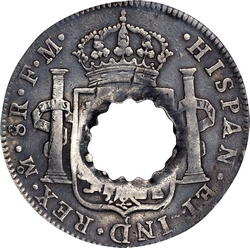
KM-12 11 Bitts (8 Shilling 3 Pence - Dollar), ND (ca. 1798) (Stack’s Bowers NYINC auction, 13 January 2023, lot 21468)
Countermark applied to a 8r 1797 Mo FM of Charles IV (KM-109).
The central segment also copies the similar segment of Dominica and was stamped with a special die with the letter J in script form.
After the issue of Imperial sterling coins in 1825, a proposition was made before the Legislature to withdraw the islands cut money, which at that date was estimated to amount to between 30,000 to 50,000 dollars. However, since the term "cut money" also related to clipped gold coin in Tobago, this estimate is no guide to the actual amount of mutilated silver in circulation. The action to withdraw the cut money in 1825 was seemingly abandoned for the cut dollar was still in circulation in 1860 and passed current at 3s. 9d. or approximately its intrinsic value in sterling.
Trinidad
On 15 October 1803, a Committee of Council was appointed "to consider the inconveniencies arising from the want of change, and to regulate the value of the coins in the island." The committee recommended that the dollar should be cut into 2, 4, 8 and 12 parts, under the direction of a Committee, but nothing came of this proposal. In the Coinage Proclamation of 9 February 1804, two mutilated coins were accorded a legal status-a cut silver half Bitt at 6d. currency and the cut silver quarter of a Bitt at 3d. currency. Both cut segments were unstamped and had been so mutilated by private persons according to requirement.
On 16 February 1804, a meeting of the Council resolved that a Committee should be formed to call in the small change denominated bitts (the Spanish provincial 1 Real of the new plate standard) in order to have them cut into halves and quarters. This action was taken and the whole coins were cut accordingly, but at this date no special markings were applied to the segments. Cut half and quarter segments of the 1 Real with plain cut edges and not otherwise marked can be attributed to Trinidad as representative of a local legal tender under the Act of 1804.
In 1811 the increased price of the dollar in England drained the island of its silver specie. To prevent the export of the dollar, the measure was adopted of piercing it with a central hole and authorizing the circulation of the ring and the piece cut out as separate coins. The initial proposal for this action is contained in a Council
Minute of 17 June 1811. Further details, including the shape of the piercing (an octagon) are noted in another minute of 19 June. The proclamation giving the dollar and plug legal status is also dated 19 June 1811PRO, CO 298/5. The completion of the task and payment for cutting the dollar was dealt with at a Council Meeting of 26 August 1811.
Except for the shape of the central hole, the dollar was not otherwise marked, but the octagonal centre pieces were stamped incuse with a letter T-the initial letter of the colony. Their declared values were-for the dollar ring, 9s. or 9 Bitts currency, and for the plug, ls. or 1 Bitt.
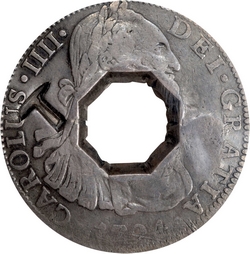
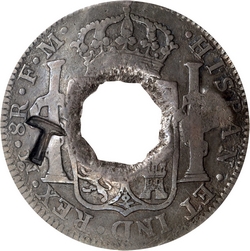
KM-A13 9 Bitts (9 Shillings), ND (1811 (Stack’s Bowers NYINC auction, 15 January 2022, lot 2431)
Issued by local authority of 11 June 1811. Octagonal shaped cut from the obverse on 8r 1794 Mo FM Mexico of Charles IV (KM-109).
Additional "T" punches have been applied to the obverse and reverse, struck multiple times. There are no known official documents that pertain to these additional markings on dollars. These punches seem to be in imitation of the "T" punch found on the central plugs, but do not match in style of application.
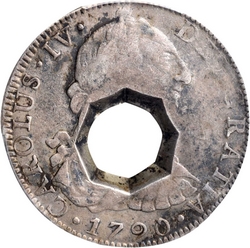
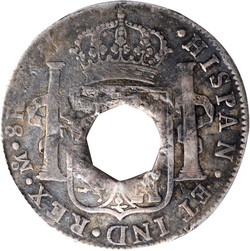
KM-A14.1 9 Shillings, ND (1811) (Stack’s Bowers ANA auction, 20 August 2021, lot 41627)
Struck upon a host 8r 1790 Mo FM (KM-108).
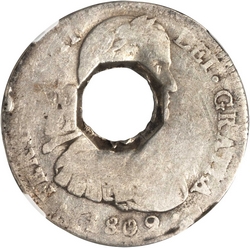
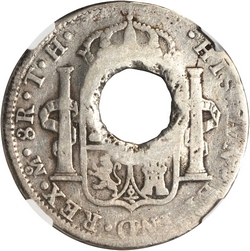
KM-A14.2 9 Bitts (9 Shillings) (Stack’s Bowers ANA auction, August 2015, lot 31355)
An 8r 1809 Mo TH of Ferdinand VII (KM-110) with a central octagonal cutout with plain edges pierced from obverse.
On 4 September 1811, it was ordered that the circulation of the T Bitts by tale should cease but at a further meeting of the Council on 14 September their circulation was restored. By a government order dated 29 August 1816, the T Bitts were ordered to pass by weight only at 17 dwts. 8 grs., the accepted weight of the dollar. They were finally demonetised on 1 December 1823. The cut dollar continued to circulate by tale at 9s. currency until it too was ordered to pass by weight. The proclamation to this effect was issued by Sir Ralph Woodford on the 14 September 1814. Neither the cut dollar nor the small cut halves and quarters of the l Real sanctioned in 1804 were decried. These continued in circulation until exhausted by normal wastage, and some few cut dollars were still in circulation as late as 1860, rated at 3s. 9d. sterling or 90 cents.
After the T Bitts were ordered to be withdrawn on 1 December 1823, all those redeemed by the Treasury were shipped to England with the request that the silver might be recoined into local coins. This request was refused, because plans were being considered to introduce sterling coins in the colonies generally.
Curaçao
Until the year 1827 the currency unit of Curaçao was the Spanish dollar. Its value was originally 8 reaals or 48 stivers, with 6 slivers to the reaal or Dutch shilling. By the end of the 18th century the local currency value had increased to 10 reaals, but a dollar, when tendered in cut quarter segments, was worth 12 reaals. This anomaly was removed when, on 17 November 1801, the whole or entire coin was advanced to 12 reaals or 72 stivers.
Also during the governorship of J. K. Lauffer, small silver coins were obtained by cutting the Spanish dollar into quarter parts. A goldsmith, H. J. Hoyer, cut 7,000 dollars into four equal parts and a quarter segment was declared current at 3 reaals or 18 stivers. These pieces are the cut quarters of the dollar with the cut edges crenated, and bear a countermark of a rosace of five petals. In the English regulations this mark is referred to as a "star".
The local name given to this issue of cut money was guillotinos and they are so named in public notices.
British Administration 1807-1814
Following the general increase in the value of the dollar in the British Windward Islands, a similar increase was made in Curaçao in 1814, and at the same time, provision was made for the supply of small change by a new issue of cut money. At a meeting of the Courts of Policy on 19 and 29 July 1814, under the British Governor, John Hodgson, a proposal was submitted for the central piercing of 5,000 dollars, and making the resulting ring shaped portion current for 12 reaals or 72 slivers. A further 3,000 dollars were to be cut into five equal parts and each part brought into circulation for 3 reaals. As the first proposal for piercing the dollar was not deemed very practicable the final decision was to cut the entire 8,000 dollars into five parts.
Previous to the issue of this new cut money, an attempt was made to recall from circulation all the earlier 3 reaal pieces or guillotines of the four to the dollar standard. This action was taken by a Notice dated the 24 August 1814, which called upon all persons possessing such coins to hand them in before 1 September.
By the end of August, the new form of cut money was ready for issue. On 30 August a Notice was issued by the Governor which announced that Spanish dollars cut into five parts were to be made current, each part at 3 reaals or 18 stivers, "each of the portions of the said cut money bearing a star in the centre on the mint-or pillar side, shall circulate as current coin". By a Notice of 21 September, the old quarter parts withdrawn during the previous month were brought back into general circulation and increased in value from 3 reaals to 3½ reaals or 21 stivers. To effect easy recognition between the two denominations of cut money, these old quarters of the dollar were restamped by the Administration with their new value. The official Notice provides the following description "the old cut money, called guillotines, bearing the mark of a star, and marked with the value thus 21 on the mint-or pillar side".
Dutch adninistration
Curaçao was restored to the Dutch on 4 March 1816. At a meeting of the Courts of Policy on 13 July 1818, the Governor, A. Kikkert, tabled a proposal to cut a quantity of dollars in an effort to relieve the shortage of small change. The decision was taken that a quantity of dollars not exceeding 18,000, should be cut into three and five parts, either all at once, or from time to time as the Governor thought fit, and to make the segments current for the following values: the third dollar segments for 5 reaals or 30 stuivers, and the quarter dollar segments for 3 reaals or 18 stivers. The segments were to be countermarked with the numerals 5 and 3 respectively. The coins of this issue have the usual crenated cut edges, and the numeral 5 or 3 is enclosed within a plain circle.
On 18 May 1819, the Governor presented a report which gave the following details. Altogether 16,512 dollars were cut, 1,000 into three parts of 5 reaals each, and 15,512 into five parts of 3 reaals each. The cutting, and presumably the stamping of the coins, was done by an A. W. Neuman, who received payment at the rate of 5 slivers per piece for 10,000 dollars, and at 4 slivers per piece for the remaining 6,512.
According to a report dated 20 December 1825, after the government ceased to buy up dollars for the purpose of cutting into small change, it was open to anyone to cut the dollar into 3 or 5 parts. Since the value of a whole dollar was about 14 reaals, although when tendered in cut segments it was 15, the private cutting of the dollar into fifths and stamping the segments with a figure 3 became a general practice.