Mexican coins used in Latin America
Guatemala
Countermark Type I of 1838 was of a sun at left behind a volcano under a long cloud.
image needed
KM-76.5 4 reales
Countermark Type I on 4r Mo cob (KM-40a).
image needed
KM-76.2 4 reales
Countermark Type I applied on an 4r 1812 Sombrerete (KM-175).
KM-77.8r ND (1838) (Stack’s Bowers auction, 17 May 2023, lot 71389)
Type I countermark: Radiant personification of the sun to left of volcano. Applied to the reverse of a 8r 1734 Mo MF Klippe of Philip V KM-48).
image needed
KM-77.6 8 reales
Countermark Type I on 8r Mo cob (KM-46).
image needed
KM-77.6 8 reales
Countermark Type I on 8r Mo cob (KM-47a).
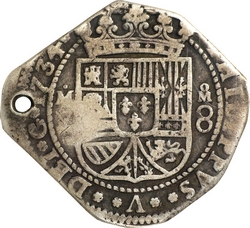
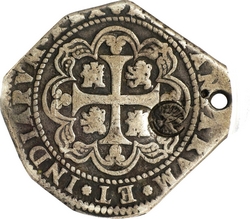
KM-77.8 8 reales
countermark Type I on 8r Mo klippe (KM-48).
Issued by decree of 26 April 1839 through 20 November 1840.
Countermark Type II of 1839 was a sun above a row of volcanos in a 6.5mm circle.
image needed
KM-89.1 4 reales
Countermark Type II on 4r Mo of Carlos and Joanna (KM-18).
image needed
KM-89.2 4 reales
Countermark Type II on 4r Mo of Philip II (KM- ).
image needed
KM-89.5 4 reales
Countermark Type II on 4r Mo klippe (KM-41).
image needed
KM-104 8 reales
Countermark Type II on 8r Mo cob (KM-45).
image needed
KM-105.2 8 reales
Countermark Type II on 8r Mo cob (KM-47a).
image needed
KM-105.1 8 reales
Countermark Type II on 8r Mo Royal (KM-R47).
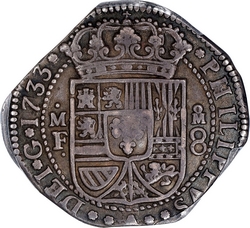
KM-107 8 reales
Countermark Type II on 8r 1733 Mo MF (KM-48).
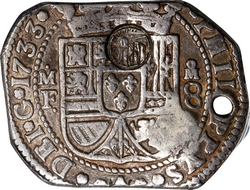
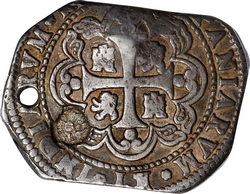
KM-107 8r ND (ca, 1839-40) (Stack’s Bowers NYINC auction, 13 January 2023, lot 21397)
Countermark: Type II, radiant personification of the sun above mountains. Applied to the reverse of a 8r 1733 Mo MF of Philip V (KM-48).
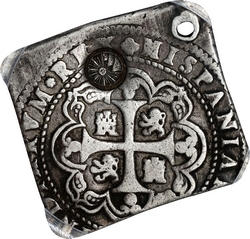
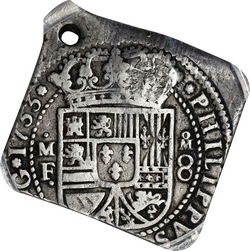
KM-107 8r ND (ca, 1839-40) (Stack’s Bowers auction, 15 August 2023, lot 51268)
Countermark: Type II; radiant personification of the sun above mountains. Countermark applied to the reverse of a 8r 1733 Mo MF Klippe of Philip V (KM-48).
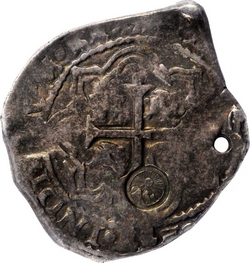
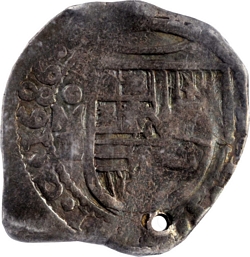
KM-unlisted 8r ND (ca, 1839-40) (Stack’s Bowers NYINC auction, 18 January 2020, lot 20136)
Type III countermark (host not listed). Type II Countermark; sun over mountains within circular boarder. On a 8r 1686 oML cob of Charles II.
Stack’s Bowers writes “The host coin itself is very rare in its own right being a fully dated Mexican cob of Charles II. With the exception of Mexican cobs dated 1679-82, most of which are sea salvaged recovered from the shipwreck of the Johanna, fully dated cobs of Charles II are extremely rare. It appears that once the hinged dies were introduced cobs were no longer being authorized as no known examples bear the bi-facial countermark (Type IV), though there does exist three examples of cobs that bear only the reverse countermark of the Type III, sun superimposed on bow, arrow and quiver.”
Counterfeits
The economic situation in Central America after gaining independence was so dire that numerous counterfeits circulated freely. In several instances they were even officially authorized by the government, such as the case with the provisional government of Honduras. When studying and comparing the countermarks of Guatemala it is noted that several official punches were employed throughout the countermarking action. It is also noted that several different counterfeit punches have been recorded, though the style is close to legitimate issues they are a bit crude and lack in the fine details found on the government issued punches.
KM-107 8r ND (ca, 1839-40) (Stack’s Bowers NYINC auction, 13 January 2023, lot 21398)
Countermark: Type II; radiant personification of the sun above mountains applied to the reverse of a 8r 1733 Mo MF of Philip V.
A Very Rare and seldom encountered combination of a genuine countermark on the reverse coupled with a contemporary counterfeit countermark on the obverse. Both countermarks are boldly applied, though the legitimate stamp is near the end of its usefulness showing much degradation. The contemporary counterfeit is a bit cockeyed and slightly muddled from the host design features.
British Honduras
Following the lead of Fred Pridmore(footnote}Major F. Pridmore, The Coins of the British Commonwealth of Nations, Part 3, Spink, 1965, the 8 reales countermarked with various crowned GR stamps are listed in this catalogue under British Honduras. Regrettably, there is no contemporary documentation or foundation for this attribution. That these countermarks are contemporary to c. 1810-20 is not in question, as examples exist that have been overstruck with Brazilian 960 réis dies c. 1820. Perhaps British Guiana might be suggested as a possible attribution for this series of coins. However, other than the proximity of British Guiana to Brazil, there is no foundation for this attribution. The fact that there are several varieties of countermark suggests this could well be an issue initiated by merchants, and the use of a crowned GR might imply a degree of official authority.
Due to the lack of official contemporary documentation, the attribution to British Honduras is uncertain. Famous collector and author Major Fred Pridmore speculates that the merchants of the settlement applied the various crowned "GR" countermarks to dollars for trade with indigenous tribes between 1810-1818. Prior to 1810 the primary barter item with the Indians were cutlass blades stamped with "GR". In an attempt to continue trade, it is believed that a similar mark was applied to dollars, continuing the accustomed unit of value. Stamping coins in this manner would not require official authority since it would not have affected their currency value in the settlement.
[image needed]
KM. 1.1 6 Shillings 1 Penny
Crowned script "GR" in rectangular indent on 8r Mo (KM-109)
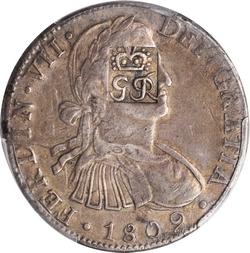
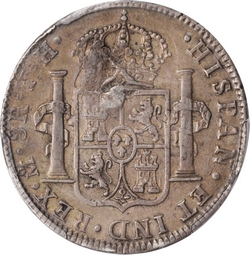
KM-1.2 Dollar (6 Shillings 1 Penny), ND (ca. 1810-20) (Stack’s Bowers NYINC auction, 18 January 2020, lot 21010)
Crude raised crowned "GR" countermark within pointed rectangle indent on an 8r 1809 Mo TH (KM-110).
This stamp was previously attributed as a counterfeit of some nature, but this has been debunked considering that this stamp appears on host coins that have been overstruck by Brazilian 960 Reis.
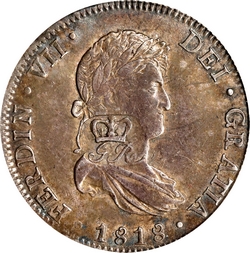
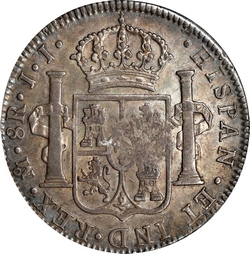
KM-2 Dollar (6 Shillings 1 Penny), ND (1810-20) (Stack’s Bowers NYINC auction, 13 January 2023, lot 21349)
Countermark of raised crowned script "GR" within ovaloid indent, applied to a 8r 1818Mo JJ of Ferdinand VII (KM-111). The countermark shows signs of degradation slightly unevenly applied with several die characteristics, a die chip at the base of the left leg of the "R" and another die chip between the "G" and "R" with a faint vertical crack leading to the back base of the upper portion of the "G".
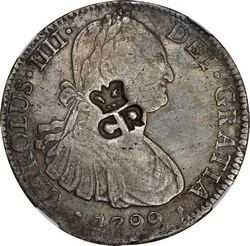
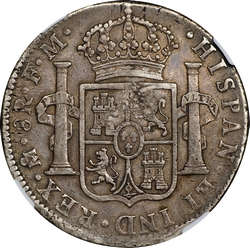
KM-Unlisted Dollar (6 Shillings 1 Penny), ND (ca. 1810-20) (Stack’s Bowers auction, 21 April 2023, lot 43196)
Incuse crowned block letter "GR" countermark on an 8r 1799 Mo FM of Charles IV (KM-109).
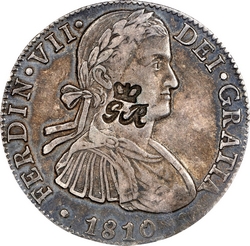
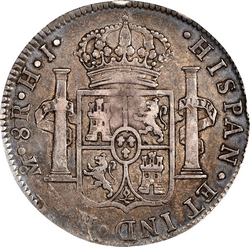
KM-4.1 Dollar (6 Shillings 1 Penny), ND (ca. 1810-20) (Stack’s Bowers NYINC auction, 13 January 2023, lot 21352)
Countermark of incuse crowned script GR, applied to an 8r 1810 Mo HJ of Ferdinand VII (KM-110).
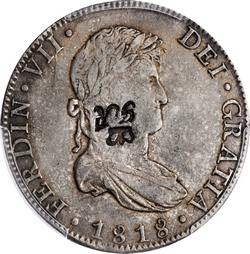
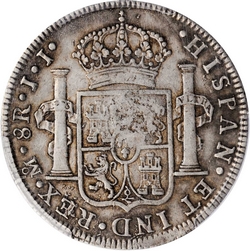
KM-4.2 Dollar (6 Shillings 1 Penny), ND (ca. 1810-20) (Stack’s Bowers auction, 6 August 2020, lot 21065)
Countermark of incuse crowned script GR, applied to an 8r 1818 Mo JJ of Ferdinand VII (KM-110).
This countermark variety has long since been the topic of discussion on whether it is genuine or not, this is an open and closed case as far this cataloger is concerned. This particular variety along with several others from this series have been discovered as host coins for Brazilian 960 Reis conclusively proving its contemporary nature.
Honduras
El Salvador
A decree of 27 October 1830[text needed] authorised countermarking 4 reales and 1 peso coins of legal silver weight and fineness. The countermark was a volcano, with S on either side and 1830 below, in a rectangle.
image needed
KM-27 4 reales
Countermark Type I on 4r Mo (KM-97).
A decree of 28 September 1868[text needed] in El Salvador ordered that all worn, milled 1 and 2 Reales Spanish-American coins to be counter-stamped with the official Salvadoran arms.The primary goal of this decree was to validate legitimate silver circulating in the economy and distinguish authentic wealth from the heavily debased coins flooding the region.
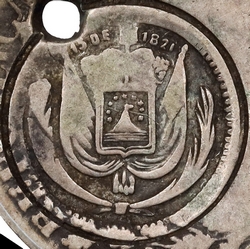
The "Type V" countermark displays the El Salvador coat of arms (a Liberty cap above a shield) enclosed within a dentilated circular border.
image needed
KM-50 1 real
Countermark Type V on 1r Carlos y Joanna (KM-9).
image needed
KM-51 1 real
Countermark Type V on 1r of Philip II (KM-27).
image needed
KM-A53 1 real
Countermark Type V on 1r Mo (KM-81).
image needed
KM-B53 1 real
Countermark Type V on 1r Mo (KM-82).
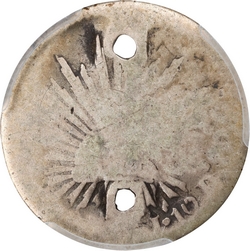
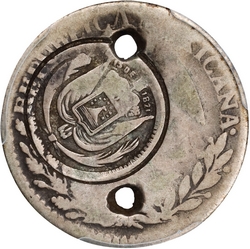
KM-Unlisted 1r (Stack’s Bowers auction, 8 September 2026, lot 43294)
Applied to an undated 1r Cap & Ray (KM-372).
image needed
KM-57 2 reales
Countermark Type V on 2r Mo (KM-86).
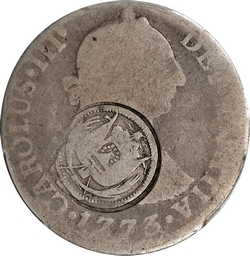
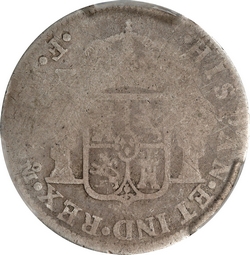
KM-Unlisted 2r (Stack’s Bowers auction, 17 May 2023, lot 71358)
Countermark Type V applied to a 2r 1773 Mo FM of Charles III (KM-88.1).
image needed
KM-58 2 reales
Countermark Type V on 2r Mo (KM-89).
image needed
KM-59 2 reales
Countermark Type V on 2r Mo (KM-90).
image needed
KM-60 2 reales
Countermark Type V on 2r Mo (KM-91).
image needed
KM-61 2 reales
Countermark Type V on 2r Mo (KM-93).
image needed
KM-65 2 reales
Countermark Type V on 2r Mo of Iturbide (KM-303).
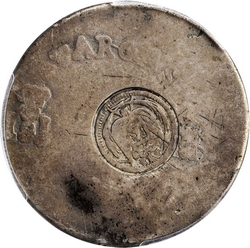
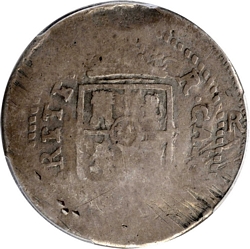
KM-68 4r ND (1868) (Stack’s Bowers NYINC auction, 18 January 2020, lot 21028)
Type V Countermark applied on an 4r 1812 Sombrerete (KM-175 ).
Nicaragua
Costa Rica
For Mexican coins counterstamped in Costa Rica, see here.
Essequibo & Demerara
The British seized the plantation colonies of Essequibo and Demerara from the Dutch in 1803. In 1808, the colonies introduced an emergency cut-and-countermark coinage system due to a severe shortage of small change.
The measure was approved on 9 December 1808 by the Court of Policy (under British occupation during the Napoleonic Wars)Minutes of the Court of Policy of Essequibo and Demerary of the Meeting, 9 December 1808, P.R.O. C.O. 111 series. Spanish-American silver coins, specifically Mexico City 8 Reales, were to be cut. The main coin was countermarked with E & D (Essequibo & Demerara) and valued at 3 Guilders (equivalent to 12 Bits) while the punched out central silver plug was countermarked E & D / 3 BTS and valued at 3 Bits (equivalent to 15 stivers / fifteen pence).
This emergency system immediately preceded the first standardized, regular milled colonial coinages minted in London starting in 1809 and later the copper issues of 1813.
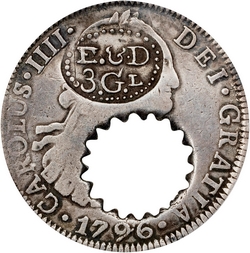
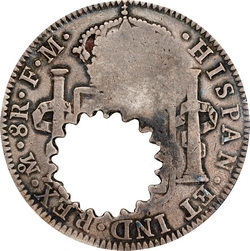
KM-2 3 Guilders (12 Bits, 5 Shillings), ND (1808) (Stack’s Bowers NYINC auction. 16 January 2026, lot 41057)
Countermark "E&D/3.G.L" within beaded border, hole with 19-crenelations pierced through obverse, applied to an 8r 1796 Mo FM of Charles IV (KM-100).
Brazil
Minas Gerais is a state in eastern Brazil. In September 1808 an edict was issued for the authorisation of various counterstamps to be used on the many circulating Spanish 8 reales in the country. The Minas Gerais counterstamp was issued both with and without the M on the reverse. The silver value was 750 to 800 Réis per coin but they were stamped and passed at 900 Réis giving the government a nice profit.
from I September 1808 until 1810 the counterstamp was on the obverse a crowned shield in branches / 960 and on the reverse a banded globe with a cross.
[image needed]
KM-245 960 Réis
On 8r Mo (KM-105)
[image needed]
KM-246 960 Réis
On 8r Mo (KM-106)
[image needed]
KM-247 960 Réis
On 8r Mo (KM-107)
[image needed]
KM-A248 960 Réis
On 8r Mo (KM-108)
[image needed]
KM-248 960 Réis