The Volcanos Edition of the Legends of Mexico Medal
by Scott Doll
In 1987, the Mexican Mint issued a number of commemorative 5-ounce silver medals celebrating events such as the Bicentennial of the US constitution, ANA 96th Anniversary Convention, as well as one for the fifth anniversary of the birthday of a Giant Panda named Tohui LINK history/bullion/platinum#TOHUI. Along with these, the mint also issued a 5-ounce silver medal with an Aztec theme which the mint referred to as “The Volcanos” edition of the Legends of Mexico, which was without a doubt the most artistic and beautiful of the medals produced that year.
The medal was designed by Alfonso Rodríguez Facio who was the Chief Engraver at the Casa de Moneda de México at that time. The artistic design and inspiration for the medal came from a famous painting titled “La Leyenda de los Volcanes” by Jesús de la Helguera Espinoza who was born in Chihuahua, Mexico and lived from 1910 to 1971. This was arguably the most famous amongst all his paintings.
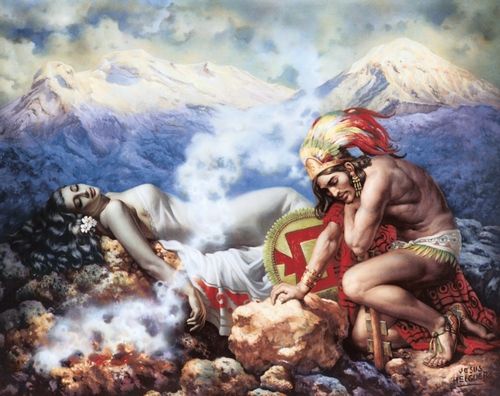
“La Leyenda de los Volcanes” by Jesús de la Helguera Espinoza,1940
(image from Museo del Ca;endario)
Silver 5-Ounce Medal with Serial Numbers (Reeded and Plain Edges)
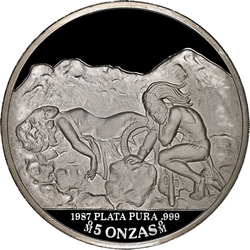
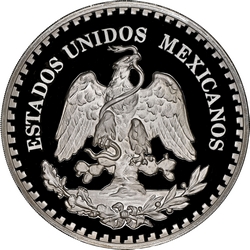
The design on this medal includes two figures from Aztec mythology which are also the names of the two volcanos located just outside of Mexico City. One is called Iztaccíhuatl or “the lady in white,” while the other is Popocatépetl or “smoking mountain.” According to the Certificate of Authenticity (COA) insert included with the medal, “the two lovers depicted, according to Aztec legend, transformed into great volcanic mountains forever watchful over each other and the people of the valley of Mexico. Symbolic of enduring love.”
The mint struck a total of 1,000 numbered 5-ounce silver (.999) medals where the serial number was imprinted (incuse) into the edge of each. Five hundred with a plain edge reportedly went to the United States market while the remaining five hundred with a reeded edge were distributed in Japan. It was reported that the mint also struck five gold (.999) medals as special presentation pieces.
The story of Popocatépetl and Iztaccíhuatl is the Aztec equivalent of Shakespeare’s Romeo and Juliet. Their love was denied while living but they were destined to spend eternity together in death. Popocatépetl was a warrior within his tribe, while Princess Iztaccíhuatl was the daughter of the tribe chieftain. Popocatépetl wanted to marry Iztaccíhuatl, but the chieftain promised to let Popocatépetl wed his daughter only if he returned victorious from war with a neighboring tribe. Sometime after he left, a jealous suitor of Iztaccíhuatl told her that Popocatépetl had died in battle. This left her extremely depressed and grief-stricken, whereupon she cried until she eventually died from sadness. When Popocatépetl returned victorious from the war, he was devastated to hear of Iztaccíhuatl’s death and he proceeded to mourn her passing by building a massive tomb and laid her body atop it as a tribute to her. He then knelt beside her with a smoking torch to watch over her. The gods then covered them with earthand snow until they became the mighty volcanoes they are today.
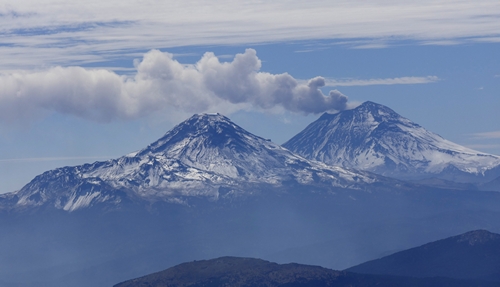
The volcanos Popocatépetl (background) and Iztaccíhuatl (foreground) located outside Mexico City
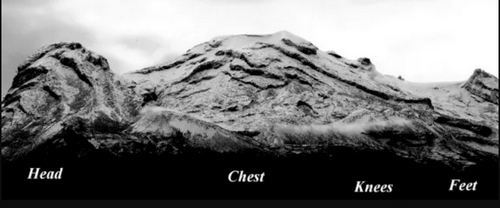
Representation of the Iztaccíhuatl volcano in relationship to Princess Iztaccíhuatl’s body as she lies on her tomb built by Popocatépetl
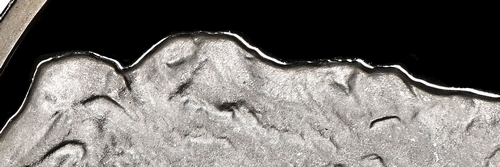
Enlargement of Iztaccíhuatl volcano as engraved on the medal
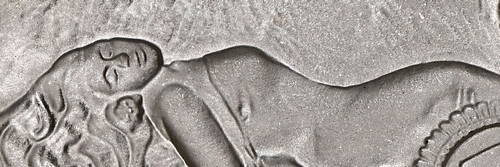
Enlargement of Princess Iztaccíhuatl as engraved on the medal
The imagery of these volcanos is not something that is new with this 1987 medal since they have been an integral design element on other Mexico medals, coins and even on some banknotes. For example, they can be seen in the background on the Centennial 2 pesos struck in 1921. The same basic design continued with the famed Libertad starting in 1982, as well as the updated design starting in 1996. They can be seen with plumes on the 1914 crudely struck Revolutionary two pesos from the State of Guerrero. The volcanos are also visible on the Pyramid of the Sun themed twenty centavos which was struck from 1943-1974. Lastly, the volcanos are easily visible on numerous banknotes including the Gobierno Provisional de México issues from the Mexican Revolution.
Silver and Copper Piedfort Pattern Medals with and without Serial Numbers (Reeded and Plain Edges)
While most of this information on this medal with the volcanos theme is public knowledge and known by most serious collectors of modern Mexican medals, some may not be aware that a limited number of Piedfort patterns in proof quality were struck in silver (.999), as well as copper with both reeded and plain edges. In this case, the Piedfort medals were struck on a 65 mm diameter planchet twice the normal thickness with a weight of approximately ten ounces and not the usual five ounces as noted on the medal reverse legend. As you might expect, these Piedfort pattern strikes are extremely rare due to their low mintages.
According to Art Garnett, the Piedfort pattern strikes of ‘The Volcanos” medal is extremely rare, and he recalls that the mint struck a limited number in silver, as well as copper and all were proof quality. Based on his feedback, as well as an analysis of the medaIs on hand, most had an incuse serial number on the edge while one was struck with no serial number. Also, the silver medaIs have an incuse phrase “PIEDFORTE PRUEBA” (PIEDFORT PATTERN), while the copper medals have either “PRUEBA EN COBRE” (PATTERN IN COPPER) or “PRUEBA COBRE” (PATTERN COPPER) on the edge.
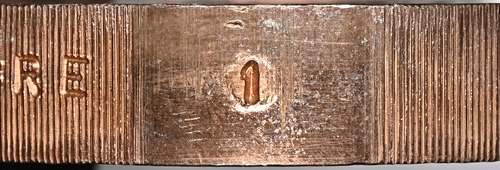
Copper Piedfort Pattern Medal #1(Reeded Edge)
The following are images of the copper Piedfort pattern strike with a reeded edge and serial #1. This medal was graded by Numismatic Guaranty Company (NGC) as PF 67 RD ULTRA CAMEO with a pedigree (PRUEBA COBRE) #1.
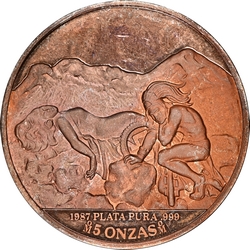
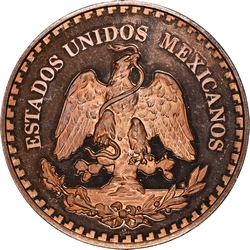
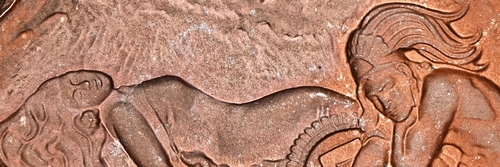
Enlargement of Ixtaccihuatl or “the lady in white” and Popocatepetl or "smoking mountain.”
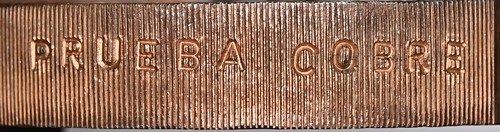
As seen in the following images, the serial number is incuse in a small plain area on the edge of the medal while the rest of the edge is completely reeded. Within the reeded area, right before the serial number, the incuse phrase PRUEBA COBRE (PATTERN COPPER) is visible.
Copper Piedfort Pattern Medal (Plain Edge)
The following are images of the copper Piedfort pattern strike with a plain edge which has no serial number imprinted on the edge. This medal was graded by NGC as PF 66 RD ULTRA CAMEO with no serial number pedigree.
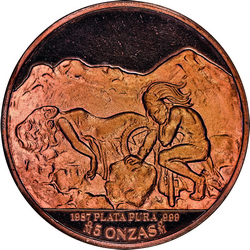
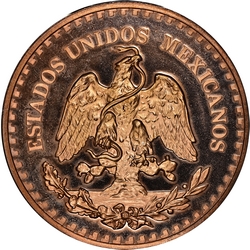
The edge of this medal is entirely plain and has no serial number and only has the incuse lettering, PRUEBA EN COBRE (PATTERN IN COPPER) visible.
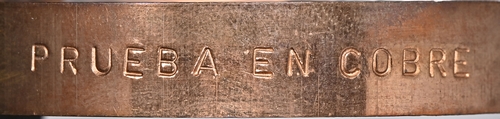
Pablo Luna HerreraPablo Luna Herrera, Las Pruebas De La Moneda Mexicana Del Siglo XX, 2016 mentions the existence of a “The Volcanos” Piedfort copper medal with a plain edge with “PRUEBA COBRE” and serial number “9” stamped into the edge, which is catalogued as PL-118. This medal is quite different than the copper Piedfort with plain edge mentioned here since it has no serial number and the phrase “PRUEBA EN COBRE.” Note the addition of the word “EN”. Otherwise, all obverse and reverse characteristics on the Piedfort pattern “PRUEBA COBRE 9” are the same as the copper Piedfort pattern discussed within this article with no serial number.
Silver Piedfort Pattern Medal #1 (Reeded Edge)
The following are images of the silver Piedfort pattern strike with a reeded edge and serial #1. This medal was graded by NGC as PF 66 ULTRA CAMEO with a pedigree (PIEDFORTE PRUEBA) #1.
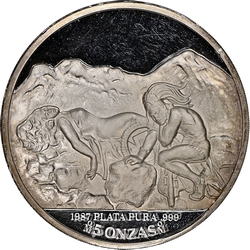
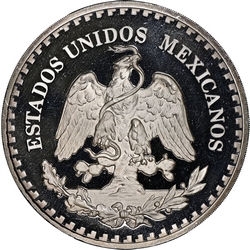
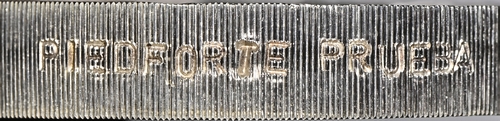
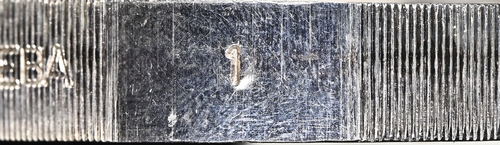
Serial #1 medal has an interesting characteristic where the reverse shows signs of doubling. Since most proof coins and medals have multiple strikes to bring out a clear and sharp impression of the details, it is believed this doubling occurred as part of that striking process.
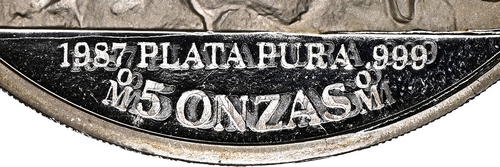
Silver Piedfort Pattern Medal #5 (Reeded Edge)
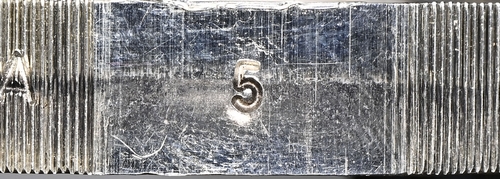
The following are images of the silver pattern Piedfort strike with a reeded edge and serial #5. This medal was graded by NGC as PF 66 ULTRA CAMEO with a pedigree (PIEDFORTE PRUEBA) #5. AII details are the same as previously discussed serial #1 medal except for the lack of doubling on the reverse.
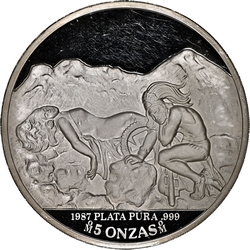
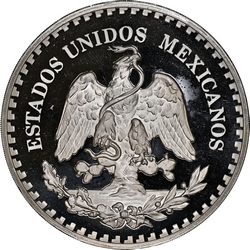
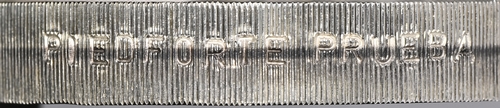
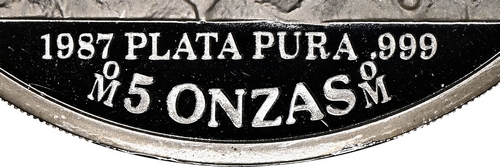
Close up of serial #5 medal reverse legend which shows no signs of the doubling, therefore the mint fixed the issue sometime after striking serial #1 medal assuming they were struck in numerical order.
The following two charts, one for Piedfort patterns and the other for the non-Piedfort medals, is a short reference and checklist of sorts of what I discovered through my investigation or what I believe to be fact to help the collector regarding these medals
1987 The Volcanos Edition of the Legends of Mexico Piedmont Patterns
| Metal | Edge | Edge Lettering (Incuse) | Size / Diameter | Mintage | Comments |
|---|---|---|---|---|---|
| Copper | Plain | PRUEBA EN COBRE |
Piedfort (65 mm) |
Unknown Most likely 10 or less. |
No serial number on the edge. NOTE: Pattern strike known without a serial number (specimen in this article). |
| Copper | Plain | PRUEBA COBRE |
Piedfort (65 mm) |
Unknown Most likely 10 or less. |
Incuse serial numbers on the edge. NOTE: Pattern strike known with Serial #9 (plate example as pictured and described in Las Pruebas De La Moneda Mexicana Del Siglo XX). |
| Copper | Reeded | PRUEBA COBRE |
Piedfort (65 mm) |
Unknown Most likely 10 or less. |
Incuse serial numbers on the edge. NOTE: Pattern strikes known with Serial #1 (specimen in this article), #5 (Galleon Collection) , #7 (Galleon Collection) and #unknown (specimen listed in PCGS Census most likely this variety since images appear to show a reeded edge). |
| Silver (.999) |
Plain | PIEDFORTE PRUEBA |
Piedfort (10 oz.) (65 mm) |
Unknown | No examples are known; however, there is a strong likelihood they do exist |
| Silver (.999) |
Reeded | PIEDFORTE PRUEBA |
Piedfort (10 oz.) (65 mm) |
Unknown Most likely 10 or less. |
Incuse serial numbers on the edge. NOTE: Pattern strike known with serial #1 (example in this article) with signs of reverse doubling. NOTE: Pattern strikes known with serial #5 (example in this article) and serial #7 (Galleon Collection) which do not show any signs of reverse doubling. |
1987 The Volcanos Edition of the Legends of Mexico Non-Piedforts (5-Ounce)
| Metal | Edge | Edge Lettering (Incuse) | Size / Diameter | Mintage | Comments |
|---|---|---|---|---|---|
| Copper | Plain | N/A | Unknown | Unknown | No examples are known to exist. |
| Copper | Reeded | N/A | Unknown | Unknown | No examples are known to exist. |
| Gold (.999) |
Unknown | N/A | 5 oz. (65 mm) |
5 (est) | #Unknown (specimen listed in NGC Census). |
| Silver (.999) |
Plain | N/A | 5 oz. (65 mm) |
500 Mint published maximum (not to exceed) mintage. |
Incuse serial numbers on the edge. Plain edge variety distributed in the U.S.A. NOTE: Based on analysis of available specimens, serial numbers range from 1-500. NOTE: Pattern strike known with serial #0000 (example in this article). |
| Silver (.999) |
Reeded | N/A | 5 oz. (65 mm) |
500 Mint published maximum (not to exceed) mintage. |
Incuse serial numbers on the edge. Reeded edge variety distributed in the Japan. NOTE: Based on analysis of available specimens, serial numbers range from 501-1000. NOTE: No pattern strike are known to exist |