Mexican coins used in the Leeward Islands
St. Croix
Danish West Indies
Tortola
While under the administration of the Leeward Island group, the British Virgin Islands were somewhat remote from government headquarters in Basseterre, St Kitts and later St John, Antigua. It would appear this remoteness allowed the Tortola Assembly to exercise rather more independence in their local actions. As a result, one element was the circulation of cut and countermarked coins for nearly 100 years; the silver one bitt coins and the black doggs were withdrawn in 1889 and the cut half-, quarter- and eighth-dollar segments were withdrawn in 1892, well past the obsolesce of cut and countermarked coins in the rest of the West Indies. Another interesting feature of the cut countermarked coins of Tortola are the number of multiple island examples. Coins countermarked on other islands ending up in Tortola inevitably were stamped with a Tortola stamp of one type or another.
On 3 February 1801 British authorities in Tortola ordered a total of 2,500 Pounds sterling to be cut and stamped for local circulation[text needed].
This action was reversed in 1805, and it was decreed that the cut coinage was no longer to be considered legal tender. Local private issuers then began producing their own stamped coinage, distinguishable by its crude metalwork and misspelling of the island's name as "TIRTILA". This misspelling was most likely a deliberate effort to avoid allegations of counterfeiting. The specie continued to circulate widely in a quasi-official capacity until finally withdrawn in 1892.
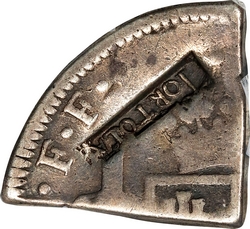
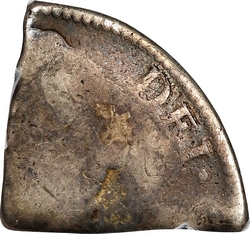
KM-6 2 Shillings (¼ Dollar), ND (1801) (Stack’s Bowers NYINC auction, 17 January 2023, lot 40281)
Countermark: Type I, TORTOLA within shaped indent. Applied to a cut ¼ 8r Mo FF of Charles III (KM-88).
KM-7 4 Shillings 1½ Pence (Half Dollar), ND (1801 (Stack’s Bowers auction, 27 February 2023, lot 71460)
Countermark Type I, "TORTOLA" within shaped indent applied to the obverse of a ½ cut 8r Mo of Charles III.
KM-7 4 Shillings 1½ Pence (Half Dollar), ND (1801) (Stack’s Bowers NYINC auction, 18 January 2024, lot 58716)
Countermark Type I, "TORTOLA" within shaped indent. Applied to the obverse of a cut ½ 8r 1794 Mo FM of Charles IV (KM-109).
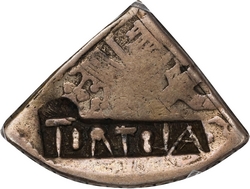
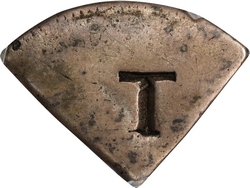
KM-9 2 Shillings (1/4 Dollar), ND (ca. 1805-24) (Stack’s Bowers auction, 25 February 2026, lot 77079)
Countermark Type II, crude raised "TIRTILA" within shaped indent applied to a cut ¼r Mo FM (KM- ). On the reverse appears an incuse "T" stamp, suggestive of an undocumented earlier authorization for Tortola.
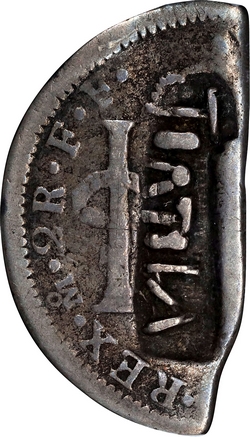
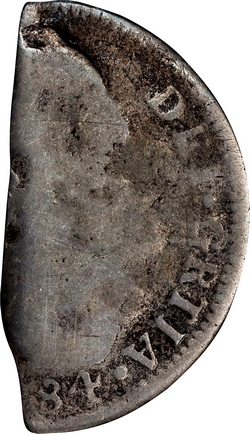
KM-14 9 Pence (⅛ Dollar), ND (ca. 1805-24) (Stack’s Bowers NYINC auction, 13 January 2024, lot 53254)
Countermark Type III, crude raised "TIRTILA" within shaped indent. Applied to the reverse of a 2r 1784 Mo FF Mexico of Charles III, spelling error variety "DEI GRTIA" (KM-88.2).
It is interesting to point out that very few examples of this denomination are known on a cut ½ 2 Reales, rather than the more common cut ⅛ of an 8 Reales.
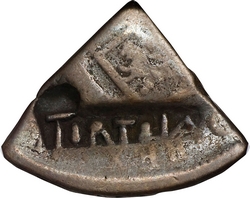
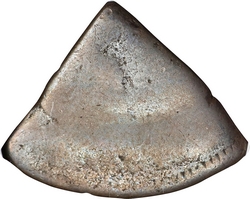
KM-17 . 2 Shillings (¼ Dollar), ND (1805-24) (Stack’s Bowers auction, 22 August 2023, lot 53880)
Countermark: Type II, TIΛTI⅃Λ within rectangular incuse, with semicircle above first T. Applied to a ¼ cut 8r Mo of uncertain date or ruler (but likely Charles III).
KM-18 (for "TIRTILA" basic type), KM-4 (for "S" basic type) ¼ Dollar (2 Shillings), ND (ca. 1805-24) (Stack’s Bowers NYINC, 8 January 2016, lot 41509)
countermark Type III, TIRTILA and incuse "S".
Initial cut quarter segment for early Tortola with incuse "T" prior to 1801, probably by a local act ca. 1798 where is would have been valued at 2 Shillings. Then to St. Kitts where an incuse "S" was applied to each corner by the local act of 3 February 1801 and the value was raised to 2 Shillings 3 Pence (2s. 3d.) or 3 bitts. Then back to Tortola where the misspelt Type III countermark was applied between 1805-24 and the value lowered back to 2 Shillings. All on a cut quarter segment of an 8r Mo FF of Charles III ca. 1776-84.
Though unable to locate any specific documents pertaining to the early Tortola "T" countermark sources indicate that it was after 1798, but before 1801 of which only a few examples are recorded and none with this specific countermark combination.
Stack’s Bowers write “While searching through the famous collections of cut and countermarked issues of the West Indies we were able to locate only a few examples of the early Tortola "T" countermark as a type let alone being combined with other islands. Of the examples we could locate with the early Tortola "T", one was in the Edward Roehrs collection part I, lot # 161 as a double island countermark combined with the Montserrat couped cross design as well as the raised "M" in square three times. The second example was in the Ralph C. Gordon collection Lot # 38 as a double island countermark where it was also combined with both the Montserrat coupled cross and raised "M" in square three times. The third example was in the Fred Pridmore collection Lot # 252 as a double island countermark where the early Tortola "T" was cataloged as Trinidad combined with Tortola type I on a 1/8 cut segment of a dollar. The fourth example was in the John J. Ford collection Lot # 131 as a single island countermark where the early Tortola "T" was cataloged as Trinidad on a 1/8 cut segment of a dollar. Both the Pridmore and the Ford example share the same "T" punch and came from the same hoard.”
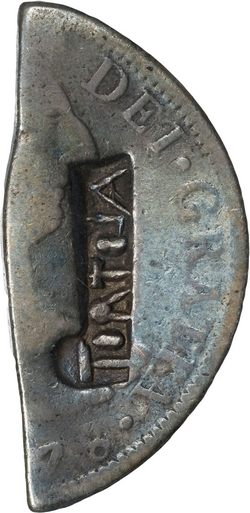
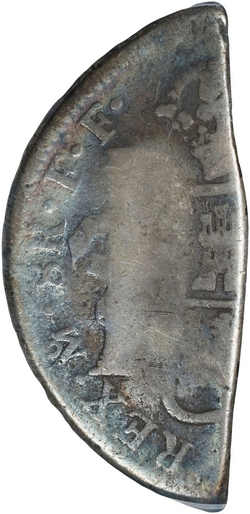
KM-19 4 Shillings 1½ Pence (½ Dollar), ND (1805-24) (Stack’s Bowers auction, 5 November 2026, lot 73163)
Type III countermark on a ½ cut 8r 1778 Mo FF of Charles III (KM- ).
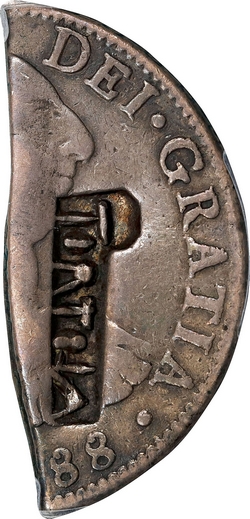
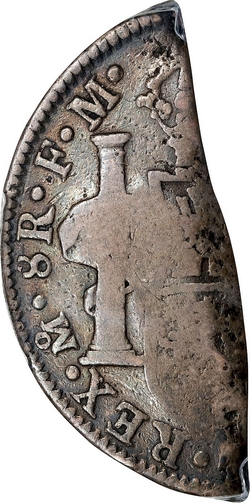
KM-19 4 Shillings 1½ Pence (½ Dollar), ND (1805-24) (Stack’s Bowers auction, 14 November 2022, lot 71404)
Type III countermark on a ½ cut 8r 1778 Mo FF of Charles III (KM- ).
St. Maarten
This island was divided between the Dutch and French. Some one stuiver coins show countermarks from both administrations.
Issues of c. 1797
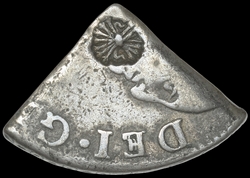
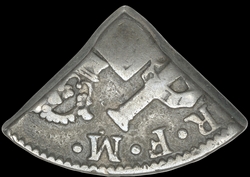
KM- 18 Stuivers (Noonan’s Lyall Collection of Cut and Countermarked Coins, 27 September 2018, lot 5071)
A cut quarter-segment of an 8r Mo FM of Charles IV, countermarked with design of seven bonded arrows raised within a shaped indent.
St. Bartholomew (St. Barts)
These countermarks were authorised by a local Act of 30 December 1808[text needed]. Nicholas Morin was appointed to produce the stamps and countermark coins that had been so worn as to make identification of the value difficult to determine. As evidence shows he also countermarked coins that would have generally been unfamiliar to the local population in order to avoid any confusion regarding valuation.
In August 1802 the Spanish Provincial 2 reales, ‘head pistareens’ and the smaller denominations were rated on a par with the Spanish-American coins. This value rating remained in effect until 1821. The list of values vs coins in effect when Morin was authorised to commence his countermarking activities is as follows:
Spanish-American 2 reales and ‘Head’ pistareens 18 Stuivers
Spanish Cross pistareens 14 Stuivers
Spanish-American 1 real and Spanish 1 real (post 1771) 9 Stuivers
Spanish Provincial 1 real (cross type) 7 Stuivers
Spanish-American half-real and Spanish half-real (post 1771) 4 Stuivers
Spanish Provincial quarter-pistareen (half-real) 3 Stuivers
After Morin's death in 1819 countermarking was continued by a number of other people. The general dates of operation of silversmiths who stamped coins are known and they are identified as James Charlotte, whose countermarking activity was from January 1821 until his death in 1823; David Cohen, whose first recorded countermarking activity was 1825 until his death in 1827; and Craves (Christian name unknown) who appears to have been countermarking coins by 1834, but his father may have been active prior to this date and they may have used the same stamps. Another silversmith, having the initial ‘O’, produced punches very much in the style of Morin, but it has not been possible to trace his name and he remains unidentified. This person may have been associated with Morin, perhaps as an apprentice, and worked alongside him, taking over the countermarking activity upon Morin’s death in 1819 until the appointment of Charlotte in 1821.
The various countermarks post-Morin are somewhat complicated in that a decree was established in January 1821 that increased the value of the Spanish-American dollar (8 reales) from 72 stuivers to the dollar to 84 stuivers to the dollar. This explains the Spanish-American 1 real coin stamped ‘10’ and the Spanish-American half-real coin stamped ‘5’. What confuses the matter is that it appears that the coins previously stamped by Morin continued to circulate but if recognised as a Spanish-American coin it was valued and passed at the new higher rating (i.e. a Mexico 2 reales stamped 18 would now be valued at 21 stuivers). If the coin was so worn that it could not be determined if it was Spanish-American or Spanish, then it would circulate at the old rating (i.e. a 2 reales size coin worn smooth and stamped 18 would continue to be valued at 18 stuivers). It is not certain when one or more of the above-mentioned silversmiths stamped coins to the new 1821 rating, and currently stamps for some of the new rating values are unknown.
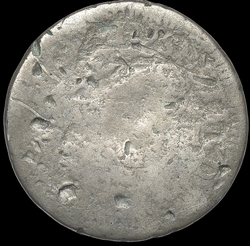
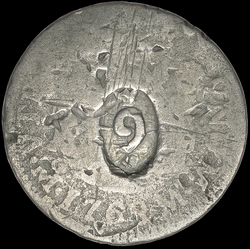
KM-8-9 9 Stuivers (Noonan’s Lyall Collection of Cut and Countermarked Coins, 27 September 2018, lot 5084)
A 1r 1768 Mo of Ferdinand VI (KM- ), countermarked with a crown/9/M raised within an oval indent.
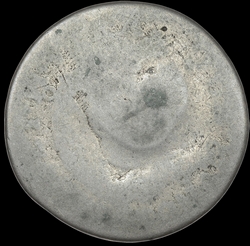
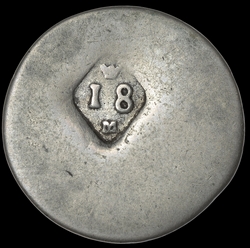
KM-13 18 Stuivers (Noonan’s Lyall Collection of Cut and Countermarked Coins, 27 September 2018, lot 5082)
A 2r Mo countermarked with a crown/18/M raised within an elliptical indent.
Montserrat
Montserrat is one of six islands that constitute the Leeward Islands, with nearly twice that number forming the Windward Islands group to their south. The islands were valuable stopping points in the sea journey between South America and Europe, and the nations in conflict in Europe brought their conflicts to the islands.
Each of the island groups at one time or another during the 17th, 18th and into the early 19th centuries, used necessity money, often in the form of cut and countermarked versions of the silver, gold and other metallic coins of whichever major nation controlled a particular island at a particular time.
KM-4 3 Dogs (4½ Pence - ½ Bit)
countermark M on ½r Mo (KM-71)
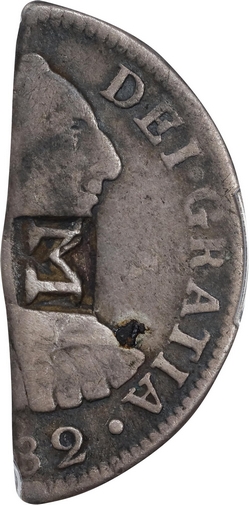
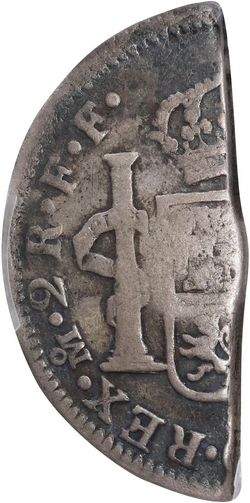
KM-6.2 6 Dogs (9 Pence - Bit - 1/8 Dollar) ND (ca. 1785-1801) (Stack’s Bowers auction, 26 August 2025, lot 41459)
A countermark "M" with square indent applied to half of a 2r 1782Mo FF Mexico of Charles III (KM-88.2).
KM-11.1 12 Dogs (2 Bits - 1/4 Dollar)
on 2r Mo (KM-85)
KM-11.2 12 Dogs (2 Bits - 1/4 Dollar)
on 2r Mo (KM-86)
KM-11.3 12 Dogs (2 Bits - 1/4 Dollar)
on 2r Mo (KM-87)
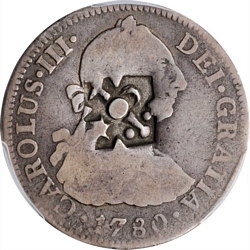
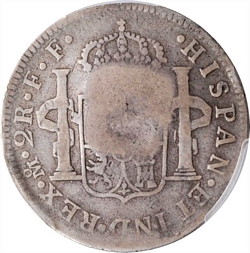
KM-12 12 Dogs (2 Bits - 1/4 Dollar, ND (ca. 1785-1801) (Stack’s Bowers auction, 25 February 2021, lot 74206)
This countermark of a couped cross within shaped indent is applied a 2r 1780 Mo FF of Charles III.
KM-14 48 Dogs (8 Bits - 1 Dollar)
countermark of three crosses on 8r Mo (KM-106)
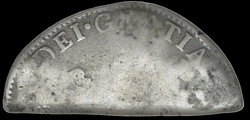
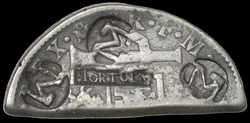
KM- Half Dollar (Noonan’s Lyall Collection of Cut and Countermarked Coins, 27 September 2018, lot 5066)
A double island issues (Montserrat-Tortola), a cut half-segment of an 8r Mo FM of Charles III (KM- ), countermarked M raised within a circular indent, in three places, and later countermarked TORTOLA raised within a shaped indent.
Guadeloupe
By a proclamation published on 1 December 1802 2,000 Spanish dollars were ordered to be cut into nine parts. The cutting form is unusual. A piece in the shape of an octagon and having a value of one third of the entire coin was cut from the centre of the dollar, and passed current for four escalins. The ring of the dollar after the removal of the octagonal centre was then cut into eight segments, each segment passing current for one escalin. The octagonal pieces were stamped 4E over RF and the one escalin segments RF.
Shortly after the British assumed control the currency question was again a matter of concern. By a proclamation dated 9 May 1811, a new rating was introduced for the Portuguese Johannes. Provision was also made for the cutting and stamping of the Spanish dollar and the countermarking of small value English, French and Spanish silver coins.
Spanish dollars, to the number of 10,000, were ordered to be cut and stamped. The form adopted was that already established in other British islands. A segment was cut from the centre of the dollar and the two pieces circulated as separate coins. For Guadeloupe the shape of the centre segment was a small square with crenated edges. These centre pieces like those of Dominica and Tobago, were restamped with a specially made die with the letter G radiate. Their value in local currency was 20 sous or 1s. currency.
The dollar ring was stamped once on each side with a small G crowned, and passed current for 9 livres or 9s. currency. The countermark or stamp of the crowned G indicated English authority (George III).
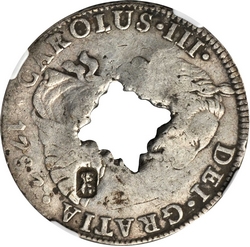
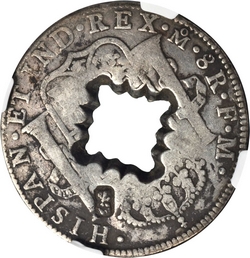
KM-24 9 Livres (9 Shillings) (Stack’s Bowers ANA auction, August 2015, lot 31329)
countermark of crowned "G" on obverse and reverse of a holed 8r1787 Mo FM of Charles III (KM-106.2a).
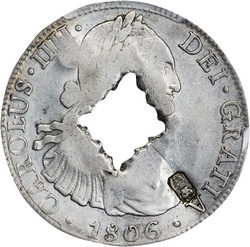
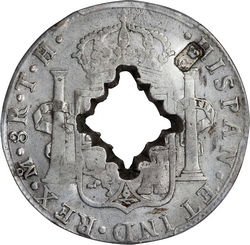
KM-25 9 Livres (9 Shillings, ND (1811) (Stack’s Bowers NYINC auction, 13 January 2024, lot 53274)
Countermark: Raised crowned "G" within shaped indent applied to obverse at 5 o'clock and reverse at 1 o'clock, the central plug removed from the reverse by four individual cuts with crenellated edges. Applied to an 8r 1805 Mo TH of Charles IV (KM-109).
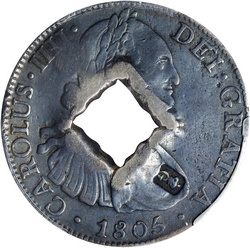
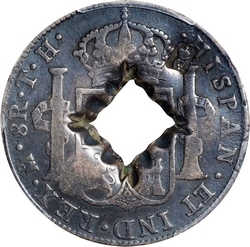
KM-25 9 Livres (9 Shillings, ND (1811) (Stack’s Bowers NYINC auction, 17 January 2025, lot 30217)
Similar countermarks applied to an 8r 1806 Mo of Charles IV (KM-109).
KM-26 9 Livres (9 Shillings) (Stack’s Bowers ANA auction, August 2015, lot 31326)
An 8r 1809 Mo TH of Ferdinand VII (KM-110) with a central square cutout of 12 crenations. Raised crowned "G" countermarked within shaped indent applied to obverse at 5 o'clock and reverse at 1 o'clock.
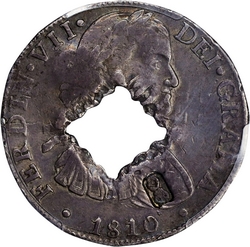
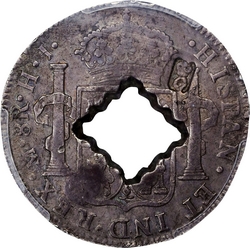
KM-25 9 Livres (9 Shillings, ND (1811) (Stack’s Bowers auction, 17 August 2024, lot 44390)
Applied to an 8r 1810 Mo TH of Charles IV (KM-109).
KM-26 9 Livres
countermark of crowned "G" on obverse and reverse of a holed 8r Mo (KM-110)
A further provision of the proclamation was the countermarking of whole coins with a crowned letter G. These were the smaller silver issues of England, France and Spain. Worn Spanish Reales and Half Reales, were required to be taken to Mr. Gobert, the official stamper at Basse-Terre, to be stamped with the G crowned punch. The Spanish real was normally current for 22 sous 6 denier, but worn out pieces showing little or nothing of the original design, when stamped were valued at 20 sous. In a like manner, worn out half reales, when stamped, were valued at 10 sous.
When the colony returned to French rule in 1816, steps were taken to remove the cut monies of the previous administration. An order dated 23 May 1817, demonetized the cut segments, hut in the case of the 1811 pierced dollar, some still continued in use until 1858 before they too were finally suppressed.
Counterfeits
The following are contemporary counterfeits or local imitations, a privately manufactured piece by an opportunist attempting to profit from cutting and countermarking a Mexico 8 Reales and passing it off in circulation as a 9 Livres.
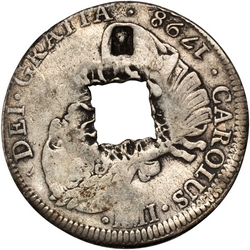
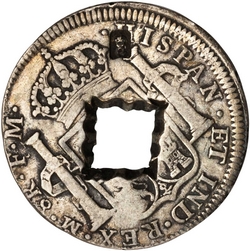
counterfeit KM-25 9 Livres (9 Shillings) (Stack’s Bowers ANA auction, August 2015, lot 31339)
An 8r 1798 Mo FM of Charles IV (KM-109) with a central square cutout of 12 crenations. Raised crowned "G" countermarked within shaped indent applied to obverse at 5 o'clock and reverse at 1 o'clock. Produced with a slightly heavy weight.
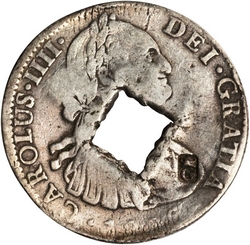
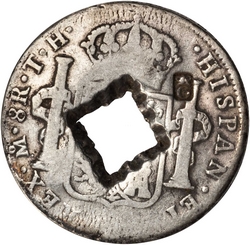
counterfeit KM-25 9 Livres (9 Shillings) (Stack’s Bowers ANA auction, August 2015, lot 31338)
An 8r 1806 Mo TH of Charles IV (KM-109)with a central square cutout of 16 crenations. Raised crowned "G" countermarked within shaped indent applied to obverse at 5 o'clock and reverse at 2 o'clock. Produced within the correct weight standard
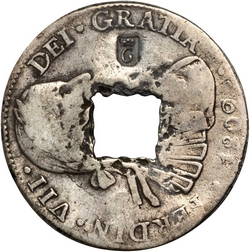
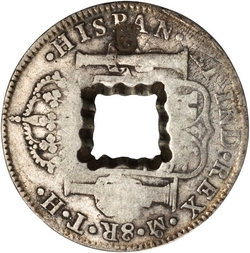
counterfeit KM-26 9 Livres (9 Shillings) (Stack’s Bowers ANA auction, August 2015, lot 31341)
An 8r 1809 Mo TH of Ferdinand VII (KM-110) with a central square cutout of 12 crenations. Raised crowned "G" countermarked within shaped indent applied to obverse at 3 o'clock and reverse at 3 o'clock.
Dominica
Dominica was the first British colony officially to pierce silver coins with a large hole thus reducing their weight and preventing them from being paid away in external trade. A later development of this principle was to stamp the segment removed from dollars and circulate both the "ring" and the "plug" at declared values. It is to this Dominica action that all the British colonial holey dollar coins owe their inception.
The earliest of the distinctive local coinages was obtained by piercing silver coins with a large heart shaped hole. The official documents relating to this measure have not been traced, but a mention of the heart pierced coins occurs in the minutes of a Dominica Council meeting on 12 September 1798 and establishes the correctness of the attribution of some coins to this island. However, other issues with heart-shaped holes have been assigned to Gibraltar.
At the Council meeting a further issue of mutilated money was authorized. Spanish dollars were centrally pierced with a large, circular, crenated hole, and the crenated segment removed was die stamped with a letter D. The holed coin was declared legal tender as 11 Bitts or 8s. 3d. currency whilst the centre segment stamped with a script "D" with rays and a small star in the loop of the letter (KM-1) passed for 1½ Bitts or 1 Shilling 1½ Pence currency.
The amount to be cut was 4,000 dollars. However, a report dated 1 March 1816 states that 5,000 were cut in 1798.
[image needed]
KM-3.1 11 Bits
crenated centre hole from 8r Mo (KM-106).
[image needed]
KM-3.2 11 Bits
crenated centre hole from 8r Mo (KM-107).
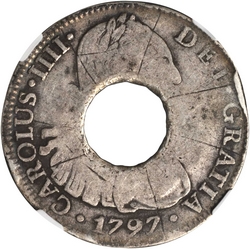
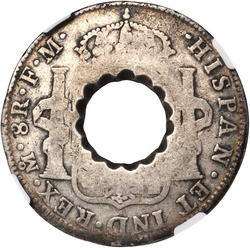
KM-3.3 11 bits (8 Shillings 3 Pence) (Stack’s Bowers ANA auction, August 2015, lot 31325)
An 8r 1797 Mo FM with central circular cut out of 15 crenations.
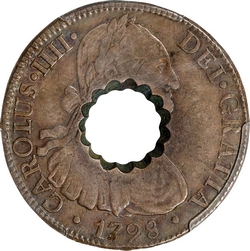
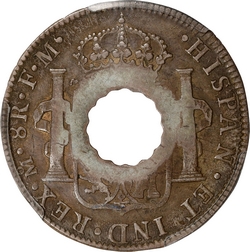
KM-3.3 11 Bits (8 Shilling 3 Pence – Dollar) ND (1798) (Stack’s Bowers NYINC auction, 13 January 2023, lot 21377)
This countermark, centrally pierced from the obverse with 15 crenations, was applied to a 8r 1798 Mo FM of Charles IIII (KM-109).
A third issue of local coinage was introduced in 1813. The same principle of piercing the coins and the removal of a large centre segment was followed, this time with even more ingenuity. The plan is contained in the minutes of the Privy Council of Dominica for 7 and 21 August 1813. The measures approved were:
(i) Whole dollars to be stamped and to pass for 16 Bitts or 12s. currency.
(ii) The 1798 cut dollar to be similarly stamped and to pass for 16 Bitts or 12s. currency.
(iii) Dollars to have a piece cut out of about one-third of their weight and the dollar ring to be stamped for 12 Bitts or 9s. currency.
(iv) The centre circular segment from the dollar (iii) to be stamped for 6 Bitts or 4s. 6d. currency.
(v) The centre circular segment from the dollar (iii) to be further cut in half, each half to be stamped for 3 Bills or 2s. 3d. currency.
On 20 September 1813, another denomination was introduced:
(vi) The old 1798 cut dollars to be cut again in the same manner as the whole dollar (iii), and the centre segment, already having the 1798 circular crenated hole, to be stamped for 4 Bitts or 3s. currency. The dollar rings of these coins were stamped for 12 Bitts as those of (iii).
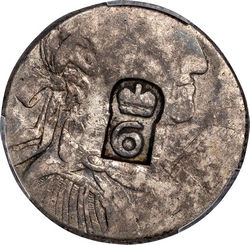
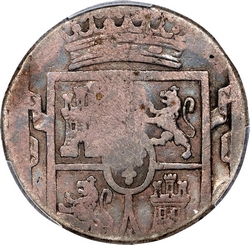
KM-6 6 bits, ND (1813) (Stack’s Bowers NYINC auction, 13 January 2023, lot 21378)
Countermark: Raised crowned 6 within shaped indent, roughly grained edge. Applied to the obverse of a central plug of a 8r 1808-11-Mo s of Ferdinand VII (KM-110).
There are two interesting facets concerning this coin. First, being able to attribute the host to a four-year bust type that is unique to Mexico. When encountered the host is usually well-worn with many examples exhibiting damage of some kind. Second, the presence of the grained edge. Due to the crude nature of the grained edge coupled with heavy circulation, the edge is seldom even noticed.
[image needed]
KM-8.1 16 Bits
countermark of crowned "16" on obverse of a holed 8r Mo (KM-107)
[image needed]
KM-8.2 16 Bits
countermark of crowned "16" on obverse and reverse of a holed 8r Mo (KM-108)
[image needed]
KM-8.3 16 Bits
countermark of crowned "16" on obverse and reverse of a holed 8r Mo (KM-109)
In 1818 the local currency was so bad that efforts were made to reform it. A request was made to England for a properly struck local money, but nothing came of the request. It was not until 1862 that Dominica finally demonetized its remaining mutilated monies, and sterling became the standard.
The Holey Dollar issues of Dominica and Tobago appear to be quite similar, but in fact are distinctly different. The most significant difference is the side each coin was pierced from; Dominica from the reverse while those of Tobago were pierced from the obverse.
Martinique
Martinique is located in the Lesser Antilles between Dominica to the north and Saint Lucia to the south. France took possession on 25 June 1635, and has maintained possession since that time except for three short periods of British occupation during the Napoleonic Wars (13 Feb 1762 – 1763, 22 May 1794 - Sep 1802, and 21 Feb 1809 - 8 Oct 1814).
During the 18th and early 19th centuries, Mexican silver coins, specifically 8 Reales, circulated extensively in Martinique. Because of coin shortages, these foreign and colonial coins were frequently adapted for local use. Mexican and Spanish colonial silver coins were cut into segments (such as bits or escalins) or stamped with local countermarks (such as the ST MARTIN or regional French island countermarks) to revalue and legalize them for circulation in Martinique and neighbouring islands.
During the first few years following the British occupation of 1793, the circulation of small money was chiefly composed of lightweight cut segments of larger silver coins. The practice had begun with fraudulently minded persons cutting whole coins into segments which although purporting to be cut quarters, in reality were only the equivalent of a fifth part. Eventually, the circulation of these deficient pieces caused such dissension and disputes between the merchants and the people that the government was compelled to take preventative action.
In an effort to overcome the frauds, the English Governor issued an Ordinance dated 1 September 1797 which authorized the circulation of certain cut segments at declared values. At the same time it was ordered that the cut edges of the segments would be marked in such a manner that it would be impossible for them to be further cut or clipped without immediate detection.
The coins approved were:
(i) Cut quarters of dollars, each to pass current for 3 escalins or 45 sols (2s. 3d.).
(ii) Cut quarters of half dollars, each to pass current for 22 sols 6 deniers, or 1½ escalin (1s. 1½d.).
(iii) Cut thirds of quarter dollars, each to pass current for 1 escalin or 15 sols (9d.).
Except for their crenated edges, this particular series of cut money was not otherwise marked.
KM-25 Escalin
cut third of 2 reales
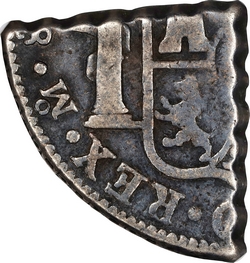
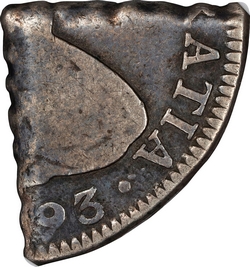
KM-26 3 Escalins (Moco) ND (1797) (Stack’s Bowers auction, 15 August 2023, lot 51275)
Cut quarter of a 8r 1793 Mo FM of Charles IV (KM-109) with crenated edges.
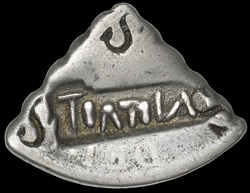
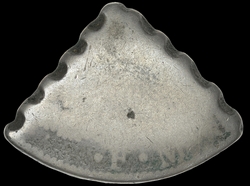
KM- Quarter Dollar (Noonan’s Lyall Collection of Cut and Countermarked Coins, 27 September 2018, lot 5060)
A treble island issues (Martinique-St Kitts-Tortola), , a Martinique ‘Moco’, c. 1797, cut from a 8r Mo FM (initials reversed), with crenated edges, countermarked with incuse S three times for St Kitts, c. 1801, and TIRTILA raised within a shaped indent.
An interesting document is a notice issued by the Martinique Magistrates Court on 28 July 1812, drawing public attention to the recent import of silvered copper forgeries which purported to be cut quarter segments of the dollar.