Mexican coins used in the Windward Islands
The Windward Islands comprise Grenada, Grenadines, St. Lucia and St. Vincent. It was only after the middle of the eighteenth century that the Windward Islands (as far as they were then British possessions) came to have a currency system other than that of the dominant island of Barbados. From then until the closing years of the century, this system was derived from and identical with that of the Leewards. The unit of account was the Spanish dollar containing 11 Bitts or 8s. 3d. currency.
St. Lucia
Around 1798 the island used segments from the Spanish 8 reales counterstamped with the monogram SL consisting of:
(1) Cut half = 6 escalins stamped twice;
(2) Cut third = 4 escalins stamped three times;
(3) Cut quarter = 3 escalms stamped three times;
(4) Cut sixth = 2 escalins stamped twice.
The cut edges of the segments are plain.
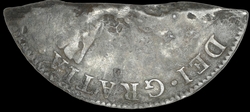
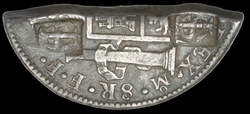
KM-4 6 Escalins (Noonan’s Lyall Collection of Cut and Countermarked Coins, 27 September 2018, lot 5186)
a cut half-segment of am 8r Mo of Charles III (KM-), countermarked with SL monogram twice, raised within a rectangular indent with lightly serrated edges.
Around 1811. Annulet stamped segments from the 4 reales consisting of
(5) Cut third = 2 escalins stamped three times;
(6) Cut quarter = 1½ escalins stamped twice;
and segments from the 2 reales consisting of-
(7) Cut third = 1 escalin stamped once;
(8) Cut quarter = 11 sols 6 denier and NOT stamped.
The cut edges of this series are crenated.
However, in St. Lucia, an endeavour was made to bring this form of cut money under regulation. A new local issue was obtained by causing all cut quarters of dollars then circulating in the island to be brought to a selected person for examination. All cut quarter segments found to be of the correct weight were then punched with the SL interlaced mark in their three angles. No other cut quarters of dollars, except those bearing the official stamps were permitted circulation.
Two types of the 1812 cut quarter dollar exist, one with the cut edges plain and the other with the the cut edges crenated..
The measure taken in August 1812 was of a corrective nature only and did not result in any increase in the local coinage. The position remained acute and in January, 1813, a new coinage was introduced. Like the previous issues, the new coins were obtained by cutting and stamping the Spanish dollar and its parts, but a new form was devised, and increased values were placed upon the pieces.
By an Ordinance dated 20 January 1813 Spanish dollars, halves and quarters were authorized to be cut, this time in parallel, making three divisions. The cutting line was determined by the reverse design of the original coin, and each segment was stamped with the island name in full--S. LUCIE. The values assigned to this new coinage gave to the whole dollar a value of 15 escalins or bitts ( = 11s. 3d. currency). However, it is probable that for some reason or another only full dollars were cut.
As might be expected, forgery soon became rampant and their circulation was checked. Eventually, on 26 April 1817, all import of cut money was forbidden and the values of the cut segments was reduced by one ninth. This reduction gave a rating to the whole dollar of 10s. currency-the eventual prevailing rating throughout the Windward Islands. This was the final issue of local coins for St. Lucia.
Barbados
St. Vincent
The introduction of a distinctive local coinage was established in 1797, when the currency was chiefly composed of light-weight cut half and quarter segments of dollars and counterfeit copper coins. To prevent the further import of counterfeit copper and to bring the deficient silver money under regulation, a local Act was published on 9 December 1797 . This laid down a minimum weight standard for the cut half and quarter dollars and provided for the stamping of the segments after examination by an appointed committee. Cut quarter-segments were to be no less than 85 grains and cut half-segments were to be no less than 168 grains. Most cut quarter-segments seem to meet the standard but similar cut half-segments seem to be very rare and many surviving examples fall short of this standard although seemingly officially stamped.
The stamp used in 1797 was the island's initials SY. This occurs on the coins with the letters interlaced within an octagonal indent.
[image needed]
KM. 9.1 4½ bits
Cruciform punch with S / IV 1/2 / B on 2r Mo (KM-86)
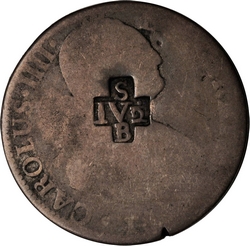
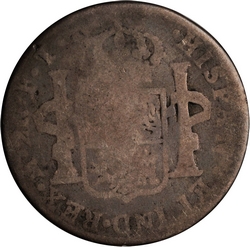
KM. 9.1 for denomination, but different host 4½ bits, ND (1797-1818) (Stack’s Bowers Philadelphia Americana auction, 14 September 2011, lot 867)
Cruciform punch with S / IV 1/2 / B on 2r 18xx Mo.
[image needed]
KM. 9.2 4½ bits
Cruciform punch with S / IV 1/2 / B on 2r Mo (KM-88.2)
[image needed]
KM. 12.2 12 bits
Countermark S / XII on holed 8r Mo (KM-109)
[image needed]
KM. 12.3 12 bits
Countermark S / XII on holed 8r Mo (KM-110)
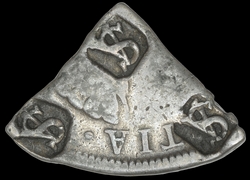
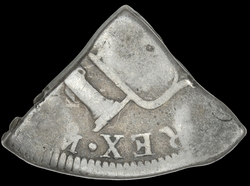
KM- (Noonan’s Lyall Collection of Cut and Countermarked Coins, 27 September 2018, lot 5224)
Quarter-Dollar (valued at Two Shillings Three-Farthings, or Two-and-Three-Quarter Bitts), a cut quarter-segment of an 8r Mo of Charles III (KM- ) countermarked three times with SV monogram raised within a shaped indent.
The scarcity of small silver coin continued, and in April, 1811, a committee was appointed to examine the question. The proposals of the committee are recorded in the minutes of a meeting of the Legislative Council on 3 September 1811. A new form of cut money was to be introduced. Dollars and half dollars were to have a circular piece a half of their weight removed from the centre, and the rings and plugs to circulate as separate values
The coins required for this new issue were apparently purchased in October but when they were received a slight change in plan was made. The dollar was; pierced after the manner proposed and the ring and the centre plug stamped for XII bitts or 9s. currency and VI bitts or 4s. 6d. currency respectively. In the case of the half dollar, it would seem that due to the possibility of confusion arising from distinguishing the half dollar rmg and plug from the dollar ring and plug, the coin was not cut. It was, however, countermarked with the value IX bitts or 6s. 9d. currency, its value being proportionate to the whole dollar of 18 bitts as composed of the dollar ring and plug.
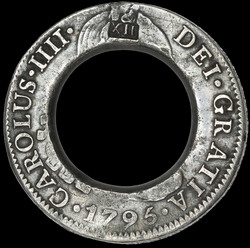
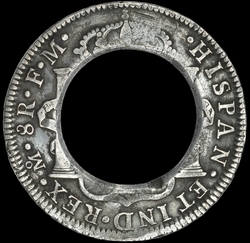
KM-12 (Noonan’s Lyall Collection of Cut and Countermarked Coins, 27 September 2018, lot 5225)
Twelve Bitts (valued at Nine Shillings), 8r 1795 Mo FM of Charles IV (KM- ) with a large central hole, countermarked &/XII raised within a shaped indent.
A further issue of local coins was made in 1814, and consisted of both silver and copper. The details are contained in a message to the Council from the Assembly and although the Proclamation or Act cannot now be traced, specimens of the coins show that the measures were carried into effect.
New supplies of whole coins consisting of dollars, half dollars and quarter dollars, were to be obtained and then cut or stamped in the same manner as those then circulating. The dollar was cut and stamped and the half dollar was stamped in the same manner after the earlier batch m 1811. For the quarter dollar coins, these were stamped for IV bitts or 3s. 9d. currency. Specimens of this last coin are the 2 Real pieces of the Spanish American mints and are correctly a quarter part of the dollar.
Grenada
The continued scarcity of small coin led to an attempt to secure from England a specially minted coinage. When this failed, the local authorities in October 1814, resolved to cut up 6,500 dollars into parts and to stamp them with their denomination. The proposed method of cutting; stamping, and their values, is given in the minutes of the Legislative Assembly of 26 October and their circulation was authorized by a Proclamation dated 2 November 1814.
The minutes state that the dollar was to be cut into ½, ¼ and ⅛ parts and stamped with the values of 6, 4 and 2 bitts respectively. However, to have followed this plan would have upset the value of the dollar, for in the case of four quarters or eight eighths, the value of a whole dollar would have been 16 bitts. This error was discovered before the coins were cut and the dollars were correctly cut into ½, ⅓ and ⅙ parts for the required values.
The form of the stamps was the island's initial - the familiar incuse letter G. The numerals 6, 4, 2 or 1 for the number of bitts contained in each stamped segment and the initials of the person responsible for the cutting and stamping of the coins. Two people were so employed - a TR and GS.
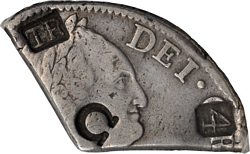
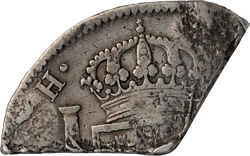
KM-7 4 Bitts (3 Shillings), ND (1814) (Stack’s Bowers NYINC auction, 18 January 2020, lot 21032)
Silversmith hallmark "TR", incuse "G" and raised "4" within rectangular boarder all on a cut 1/3 8r 1803-08 Mo TH of Charles IV(KM- ).
The date of the withdrawal of the mutilated coinages is not certain but on 24 August 1840, Grenada dispensed with its currency ratings and adopted sterling denominations of account. The local coins perhaps ceased to circulate about that date.